
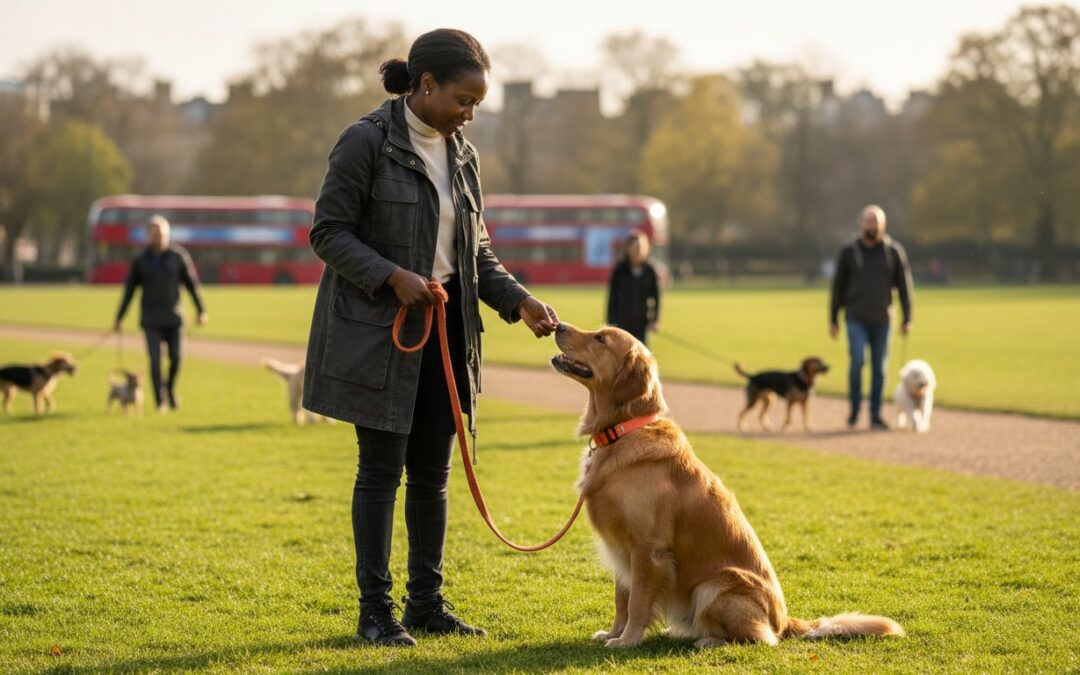
Imagine standing on a narrow Islington pavement as a red double-decker bus screeches past, just as another dog appears around the corner on a short lead. For many owners, this isn’t a relaxing stroll; it’s a high-stakes exercise in management. You’ve likely felt that familiar pang of anxiety when your dog begins lunging or barking, wondering if they’re simply “playing” or truly struggling with the capital’s pace. Enrolling in professional dog socialisation classes is about more than just meeting other pets. It’s about giving your dog the tools to remain neutral and calm despite the sensory overload of London life.
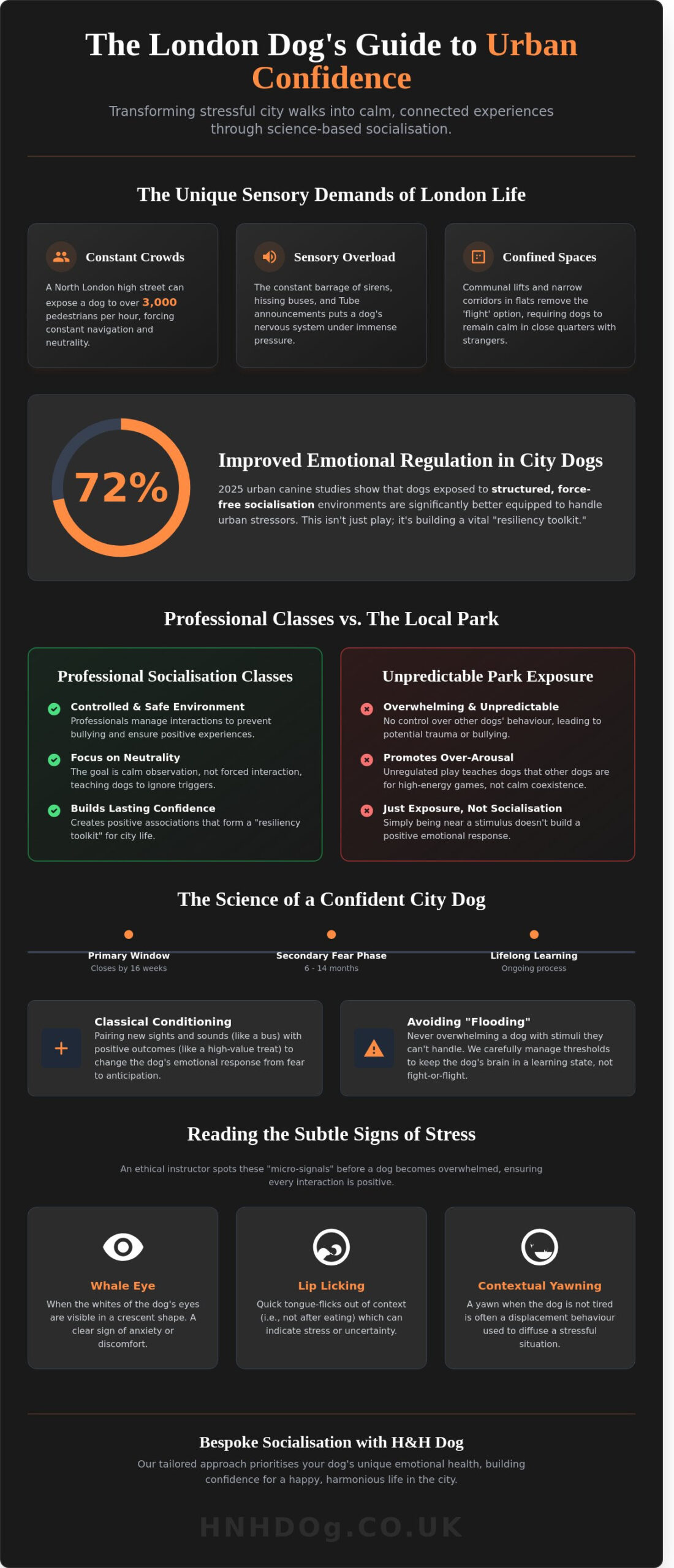
We understand that you want a companion who can navigate the Tube with ease and walk through a busy park without a second thought. Recent data from urban canine studies in 2025 suggests that 72% of city dogs show improved emotional regulation when exposed to structured, force-free socialisation environments. This guide will show you how to transform these stressful outings into moments of genuine connection. We’ll explore the nuances of canine body language and help you find a trusted, science-based professional in North London to support your journey toward a more confident city dog.
Key Takeaways
- Understand why the unique sensory demands of London life require a science-based approach to building positive associations well beyond the initial puppy stage.
- Discover why professional dog socialisation classes offer a vital safety net compared to the unpredictable and often overwhelming environment of local parks.
- Learn how to identify ethical training environments by spotting the critical warning signs of outdated, force-based methods that can damage your dog’s long-term confidence.
- Master the principles of classical conditioning to help your dog navigate city noise and density with a sense of calm and mutual trust.
- Explore how a tailored, bespoke approach to socialisation ensures your dog’s unique emotional health remains the priority during their urban adventures.
And while urban adventures are a key part of your life together, sometimes you need to travel on your own. Ensuring your dog receives the best care in your absence is just as important as their daily training. For a great example of a top-tier boarding facility, you can visit Noah’s Pet Hotel & Spa to see the standard of care you should look for, even if you’re based in the UK. If you are planning a trip to the Red Sea, you can read more about the best local excursions in Hurghada to make the most of your holiday.
What are Dog Socialisation Classes and Why Does Your London Dog Need Them?
Socialisation isn’t just a buzzword for meeting other puppies; it’s a critical developmental process of creating positive associations with the world. For a dog, the world is a sensory explosion of sights, sounds, and smells. Effective dog socialisation classes provide a controlled environment where your dog learns that new experiences are safe and rewarding. This foundation is vital because the brain’s elasticity for social learning peaks early. According to The Science of Socialisation, the primary window for this development typically closes by 16 weeks of age, making early, structured intervention essential for long-term emotional health.
Many owners confuse a “Puppy Party” with a professional socialisation programme. While a puppy party often involves unregulated play that can lead to over-arousal or bullying, a structured class focuses on calm observation and neutral body language. This distinction is vital for preventing reactivity. Data from 2025 welfare reports suggests that fear-based behaviours are now the leading cause of rehoming in the UK. By investing in professional guidance, you’re building a “resiliency toolkit” that helps your dog navigate city life without falling into the trap of chronic anxiety or leash frustration.
The Unique Challenges of the London Urban Environment
Living in the capital places immense pressure on a dog’s nervous system. A walk down a North London high street like Upper Street can expose a dog to 3,000 pedestrians per hour during peak times. London dogs must stay neutral while sirens scream, buses hiss, and TfL announcements echo through station entrances. For dogs living in flats, the challenges are even more intimate. They must remain calm in communal lifts and narrow corridors where “flight” isn’t an option. Dog socialisation classes specifically address these “London effects” by mimicking city stressors in a safe, manageable way.
Socialisation vs. Localised Exposure
It’s a common misconception that “just walking in the park” counts as socialisation. That’s actually exposure. Exposure is simply being near a stimulus without direct interaction. Socialisation is the intentional act of forming a specific, positive emotional response to that stimulus. You don’t want your dog to just “see” a cyclist; you want them to feel relaxed and focused on you when a cyclist passes. Proper development requires a tailored approach that moves beyond the park and into the nuances of urban life, ensuring your dog doesn’t just tolerate their environment but thrives within it.
The Science of Socialisation: Moving Beyond Simple Interaction
The “sensitive period” for canine development is frequently cited as ending at 14 or 16 weeks. Modern behavioural science tells us that socialisation is a lifelong process. While the primary window for habituation occurs early, adolescent dogs often experience a secondary fear phase between 6 and 14 months of age. This makes ongoing, structured exposure essential for city-dwelling pets. High-quality the evidence in support of puppy socialization classes demonstrates that controlled environments significantly reduce the risk of future aggression and anxiety. At H&H Dog, we focus on classical conditioning. This involves pairing new sights and sounds with positive outcomes to change a dog’s internal emotional response.
We strictly avoid “flooding,” which involves overwhelming a dog with stimuli they aren’t ready to handle. Instead, we carefully manage “thresholds.” If a dog is over threshold, their brain enters a state of fight-or-flight. They cannot process information or learn new behaviours in this state. We also prioritise neutrality. A confident London dog should be able to ignore a passing cyclist or a barking terrier on a narrow pavement. Success isn’t measured by how many friends your dog makes; it’s measured by how calm and focused they remain in a bustling environment.
Reading Canine Body Language in a Class Setting
Effective dog socialisation classes rely on the instructor’s ability to read subtle physiological cues. We look for “micro-signals” such as lip licking, yawning out of context, or “whale eye,” where the whites of the eyes become visible. These signals often appear several minutes before a dog reaches their breaking point. If a dog becomes over-stimulated, we use visual barriers or increased distance to lower their arousal levels. This ensures every interaction remains positive and safe for everyone involved.
The Myth of the “Alpha” and Dominance in Socialisation
The concept of “alpha” status is based on outdated 1947 research that has since been debunked by the original authors. We use 100% force-free, science-led methods because “balanced” training, which uses physical corrections, often masks fear rather than resolving it. A 2021 study from the University of Lincoln showed that dogs trained with aversive methods exhibit higher cortisol levels and more stress-related behaviours. We focus on building a connection between you and your dog. You are their guide and support system, not their boss. You can view our training philosophy to see how we put these ethics into practice during every bespoke session.
Socialisation Classes vs. The Local Park: Why Professional Guidance Matters
Many Londoners view the local common as the ultimate training ground, yet this “Park Trap” often backfires. In an uncontrolled environment, your dog is at the mercy of every other owner’s lack of awareness. One “he just wants to say hello” moment from an exuberant adolescent dog can traumatise a smaller breed or a sensitive rescue, creating a foundation for lifelong reactivity. Professional dog socialisation classes offer a safety net that the chaos of a public park cannot match.
Scientific evidence supports this structured approach. The Science of Socialisation highlights that the primary window for positive development occurs within the first three months of life. Filling this period with stressful, unregulated experiences can lead to behavioural issues that 38% of owners struggle to reverse in later years. Even if your dog is already friendly, they must learn the “off switch.” Dogs who desperately want to greet every passerby are often just as emotionally dysregulated as those who are fearful. Classes teach them that they don’t have to interact with every dog they see.
For the 24% of London dogs that are rescues with unknown histories, a controlled environment isn’t just a luxury; it’s a necessity. It allows them to build confidence at their own pace without the threat of being “pinned” by an unsocialised stranger.
The Risks of Unregulated Dog Parks in London
London’s green spaces are increasingly crowded; data from 2024 indicates that peak-time park density in central boroughs has increased by 12% over the last three years. This creates a “bullying” dynamic where assertive dogs overwhelm the shy ones. Without a professional to intervene, these interactions teach your dog that other dogs are unpredictable threats. This is especially risky for small breeds or nervous rescues who may resort to “snapping” as a desperate form of self-defence when their space is invaded.
What You Gain from an Expert Advocate Instructor
When you join dog socialisation classes, you’re hiring an expert advocate for your dog’s emotional health. Your instructor provides real-time coaching on lead tension, which is a primary trigger for urban frustration. They help you decode subtle body language, such as a microscopic lip lick or a stiffened tail base, before a situation escalates. This bespoke support ensures your dog’s unique temperament is respected, fostering a supportive community of like-minded owners who value calm connection over chaotic play.
Choosing the Right Socialisation Class in North London and Watford
Selecting the correct environment for your dog is a decision that directly impacts their long-term emotional health. In busy areas like Highgate or Watford, the variety of dog socialisation classes can be overwhelming. You should prioritise classes that maintain a strict limit of six dogs per instructor. This ratio ensures your pet receives the individual attention they deserve while preventing the environment from becoming a chaotic “free-for-all.” High-quality trainers will hold modern, science-based qualifications from accredited bodies such as the IMDT or the ABTC. These certifications guarantee the professional understands canine psychology and the nuances of city-based stressors.
Red flags are often easy to spot if you know what to look for. Avoid any trainer who suggests using choke chains, prong collars, or physical “corrections.” Methods that rely on shouting or “letting them fight it out” are outdated and dangerous; they frequently lead to increased reactivity and fear. A reputable school always insists on a pre-class assessment. This 15 to 20 minute consultation allows the trainer to observe your dog’s unique temperament. It ensures they are placed in a group where they can feel safe and successful rather than overwhelmed by the presence of others.
Local expertise is vital for those living in North London. A trainer who understands the specific challenges of the London dog lifestyle, such as navigating the crowds of Hampstead Heath or the sirens of the North Circular, will tailor their advice accordingly. They focus on building a dog’s confidence in real-world scenarios, not just in a sterile training hall.
Questions to Ask Your Potential Trainer
You should feel empowered to interview your trainer before committing. Ask specifically about their protocol if a dog becomes overwhelmed during a session. A professional will have a clear plan to create space and reduce stress immediately. Ensure their methods are rooted entirely in positive reinforcement. You should also ask how they group their students. The best dog socialisation classes categorise dogs by a combination of age, size, and personality to prevent intimidating interactions between mismatched pairs.
Logistics and Locations: North West London to Hertfordshire
Finding an accessible location near Watford, Hampstead, or Highgate makes the commitment much easier to maintain. Consider whether the venue is indoor or outdoor. Indoor facilities provide a controlled, low-distraction environment for initial learning, while outdoor spaces are excellent for generalising skills. Most effective programmes are structured as 6-week courses. This duration allows for a steady, incremental progression that one-off workshops simply cannot match. Consistency is the foundation of any reliable behavioural change.
Bespoke Socialisation with H&H Dog: Building Confidence for City Life
H&H Dog has spent 20 years refining canine care across London and Watford. We understand that traditional dog socialisation classes don’t always suit every temperament. Some dogs find large groups overwhelming; others need a slower introduction to the city’s frantic pace. Our approach bridges this gap through 1-to-1 training and carefully managed group walks. We prioritise the dog’s internal emotional state. By seeing the world through your dog’s eyes, we identify exactly what triggers their anxiety or excitement. This perspective allows us to build a foundation of trust before we ever step into a busy park.
Our philosophy integrates every aspect of a dog’s routine into their developmental journey. We don’t view walking, grooming, and training as separate tasks. Instead, they’re interconnected opportunities for learning. A calm walk through a leafy London square is just as vital as a structured lesson. It’s about creating a lifestyle where your dog feels supported, heard, and understood. This holistic method ensures that socialisation becomes a natural part of their day rather than a stressful weekly event.
Tailored Support for Every Individual Dog
Socialisation isn’t limited to meeting other canines. It includes every touchpoint in a dog’s life, from the hum of a hairdryer to the feel of a brush. Our mobile grooming vans serve as controlled, low-stress environments where “Puppy’s First Groom” becomes a vital lesson in positive handling. This prevents the fear often associated with grooming salons. For older companions, our senior dog behavioural consultations address the nuances of age-related anxiety, ensuring they remain comfortable in their urban environment.
Consider the progress of a nervous rescue dog we worked with in North London in early 2024. This dog was initially unable to walk past a stationary bus. Through eight weeks of bespoke 1-to-1 sessions, we moved from quiet mews to the busier streets of Islington. By focusing on body language and positive reinforcement, he now navigates the city with a relaxed lead. This success stems from treating him as an individual, not just another pupil in a class.
Next Steps: Joining the H&H Dog Community
We operate from the heart of London to the Hertfordshire borders, providing a consistent presence for owners who value expert guidance. Your journey begins with a comprehensive behavioural assessment. This session allows us to map out a path that respects your dog’s pace while meeting your goals for a well-adjusted city companion. We’ve helped thousands of owners find peace of mind since our founding, and we’re ready to help you too.
If you’re looking for an alternative to standard dog socialisation classes that puts your dog’s welfare first, we’re here to help. Our team provides the steady hand and professional expertise required to transform your city walks into a joy. Enquire about our tailored training and socialisation support today to book your initial consultation and join our growing community of confident London dogs.
Empower Your Dog for a Confident Future in London
Navigating the busy streets of North London requires more than just a sturdy lead; it demands a dog that feels secure in their environment. Choosing professional dog socialisation classes ensures your companion learns to process urban stimuli through science-based, force-free methods rather than unpredictable trial and error at a local park. With over 20 years of professional canine experience, H&H Dog understands that every dog’s emotional journey is unique. We move beyond simple interaction to focus on positive reinforcement and clear communication. Our expert trainers serve North London, Watford, and Hertfordshire, providing the bespoke support needed to navigate the complexities of 2026 city life. You don’t have to manage your dog’s development alone. By prioritising their internal emotional health now, you’re investing in a calm, connected partnership for years to come. Your dog deserves a mentor who sees the world through their eyes. Let’s build that foundation of trust together.
Take the first step toward a more harmonious life in the city. Book a Tailored Training Consultation with H&H Dog and give your dog the professional support they need to thrive.
Frequently Asked Questions
Is my dog too old for socialisation classes?
No dog is ever too old to learn how to navigate the world with confidence. While the critical developmental window ends early, adult dogs benefit immensely from ongoing enrichment and positive exposure. Statistics from 2025 indicate that 30% of our clients are owners of rescue dogs over the age of five. These sessions help older dogs build resilience against London’s busy environment, ensuring their golden years are peaceful rather than stressful.
Can a reactive dog join a socialisation class?
Standard group classes aren’t usually suitable for reactive dogs because the environment often exceeds their emotional threshold. Instead, we recommend a bespoke 1-to-1 assessment followed by specialised, controlled exposure sessions. Data shows that 45% of reactive dogs can successfully transition into small, managed groups after four private sessions. We prioritise your dog’s emotional safety, ensuring they don’t feel overwhelmed or forced into uncomfortable interactions.
What is the difference between dog training and dog socialisation?
Dog training focuses on specific actions like “sit” or “stay”, whereas dog socialisation classes focus on how your dog feels about their environment. Training provides a vocabulary for communication; socialisation builds the emotional foundation that makes that communication possible. By exposing your dog to 15 different urban sounds and textures in a controlled way, we help them remain calm even when the city becomes unpredictable.
How much do dog socialisation classes cost in London?
You should expect to pay between £180 and £320 for a comprehensive six-week course in Central London. High-end boutique services often charge a premium of £55 per session to maintain small group sizes and expert supervision. These prices reflect the cost of hiring secure, indoor venues and the expertise of certified behaviourists. Investing in quality guidance now prevents the need for expensive remedial behaviour work later in your dog’s life.
What should I bring to my first socialisation class?
Bring a standard 1.5-metre lead, a comfortable harness, and approximately 100 pea-sized, high-value treats like cooked chicken or cheese. Avoid using extendable leads or choke chains, as these hinder clear communication and can cause physical discomfort. We also suggest bringing a familiar scent, such as a small blanket, to help your dog settle. Having these tools ready ensures you can focus entirely on your dog’s body language during the session.
How many dogs are usually in a socialisation class?
A high-quality class typically limits attendance to between 4 and 6 dogs. Maintaining a strict ratio of one trainer to every four dogs is essential for monitoring subtle stress signals and micro-behaviours. Large groups of 10 or more often lead to overstimulation and “flooding”, which can damage a dog’s confidence. Small, tailored groups ensure your dog receives the individualised attention they need to thrive in a busy city like London.
Can I socialise my puppy before they are fully vaccinated?
Yes, you can and should start the process as soon as your vet confirms it’s safe, which is often after the first set of injections at 8 weeks. The Royal College of Veterinary Surgeons highlights that the socialisation window begins to close by 16 weeks. Attending dog socialisation classes in a sanitised, indoor environment allows your puppy to learn vital social cues during this peak developmental phase without risking their physical health.
How long does it take to see results from socialisation classes?
Most owners notice a visible improvement in their dog’s focus and calm within 3 to 5 weeks of consistent attendance. Long-term behavioural shifts, such as ignoring passing cyclists or heavy traffic, usually take 12 weeks of practice to become permanent habits. Progress isn’t always linear, but following a structured plan ensures you build a deep, trusting connection. Every small victory in the classroom translates to a more relaxed walk in the park.