
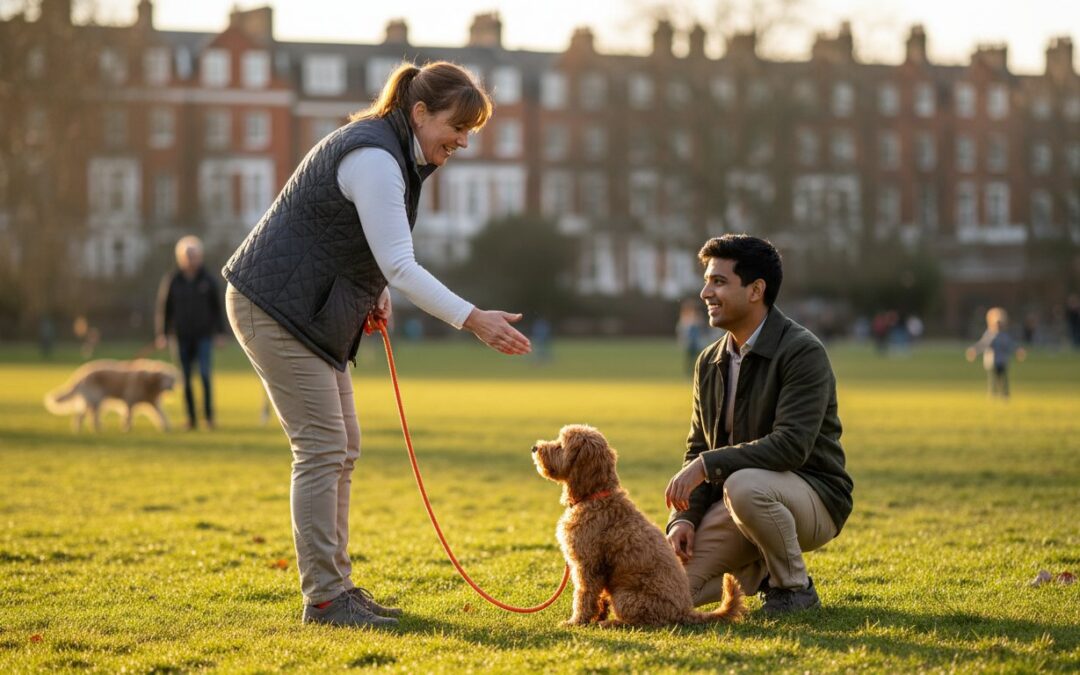
Imagine walking through a bustling Camden street on a Saturday afternoon, your six month old puppy lunging at every passing cyclist while you juggle a coffee and a tangled lead. It’s a common struggle, as recent data shows that 68% of city dog owners find lead pulling in high traffic areas their primary source of stress. You likely want a peaceful stroll through Hampstead Heath rather than a frantic battle of wills. When you begin searching for puppy obedience classes near me, you deserve more than just a list of names; you need a mentor who understands the unique sensory overload of London life.
We believe that every behavioural challenge has a manageable, ethical solution rooted in mutual respect. This guide provides the tools to find and evaluate the best training in London and Hertfordshire, helping you move past conflicting online advice. You’ll learn to see the world through your dog’s eyes, building the confidence to handle busy streets and park socialisation with ease. We will explore how to vet trainer credentials and identify the specific, tailored skills your puppy needs to thrive in a metropolitan environment.
Key Takeaways
- Understand why training in your local London or Watford environment is essential for helping your puppy generalise positive behaviours to the unique sights and sounds of city life.
- Discover how to evaluate modern curricula, ensuring they use force-free, science-based techniques that advocate for your dog’s emotional welfare and long-term connection.
- Determine whether your pet would benefit most from the controlled socialisation of a group environment or the bespoke, individual focus of 1-to-1 training.
- Learn how to find the most effective puppy obedience classes near me by prioritising small group sizes that offer a calm, safe, and supportive learning space.
- Gain practical guidance on preparing your puppy for their first session, from health requirements to assembling a high-value kit that encourages focus and engagement.
Understanding Puppy Obedience Classes Near You in London
Puppy classes are structured learning environments where your young dog learns basic manners and critical socialisation skills. When you search for “puppy obedience classes near me” in a bustling city like London or nearby Watford, you’re looking for more than just a place to learn a “sit” cue. Local training is essential because puppies don’t naturally generalise behaviours. A puppy who listens perfectly in a quiet rural kitchen may struggle to focus near the constant hum of the North Circular or the distractions of a local park. Training in your specific urban environment helps your dog apply their learning to the real-world sights and sounds they encounter every day.
The first 16 weeks of your puppy’s life represent the most critical window for their emotional development. Data from the Royal Veterinary College suggests that positive, varied experiences during this early stage significantly reduce the likelihood of fear-based reactivity in adult dogs. This period is a fleeting opportunity to build a foundation of confidence. We distinguish between traditional obedience and modern life skills. While obedience involves responding to specific cues, life skills focus on emotional regulation. It’s the difference between a dog that stays because it’s told to and a dog that remains calm because it feels safe in its surroundings.
The Role of Socialisation in the City
London puppies require a bespoke approach to socialisation. They must navigate a landscape filled with high-decibel sirens, heavy buses, and diverse crowds of people. A professional class manages these exposures without overwhelming the puppy’s nervous system. If a puppy is forced into a scary situation, they can become sensitised rather than socialised. We act as your dog’s expert advocate, helping you see the world through their eyes. When a bus releases its air brakes, your puppy experiences a sudden, high-pitched hiss that can be startling. We teach you how to support them through these moments, ensuring their internal emotional state remains balanced and positive.
What ‘Obedience’ Really Means in 2026
By 2026, the dog training industry has moved decisively away from outdated dominance-based methods. We focus on partnership and mutual respect rather than “alpha” hierarchies. Modern puppy obedience is a form of clear, two-way communication between species that prioritises mutual understanding over simple compliance. For a London dog, this means mastering practical skills that make city life harmonious for both of you. Key priorities include:
- Loose lead walking: Navigating narrow pavements without tension or frustration.
- Settle on a mat: Allowing you to enjoy a coffee in a local cafe while your dog rests calmly at your feet.
- Emergency recall: Developing a reliable return to you, even when distracted by squirrels in a busy park.
Choosing “puppy obedience classes near me” ensures you receive tailored support that reflects the realities of your lifestyle. You aren’t just teaching your dog to follow instructions; you’re building a resilient, trusting bond that will last a lifetime.
What to Look for in a Modern Puppy Training Curriculum
Selecting the right school involves more than a quick search for puppy obedience classes near me; it requires a deep dive into the methodology that will shape your dog’s future. Modern canine science has moved away from the outdated “obedience” model toward a collaborative educational approach. You’ll find that the most effective puppy obedience classes near me are those that prioritise emotional regulation over robotic commands. You should look for centres in North London or Watford that limit their intake to 6 puppies per session. This small ratio ensures each dog remains below their threshold of stress, allowing for genuine learning rather than mere survival in a crowded room.
Professional credentials serve as your first line of defence against unregulated amateurs. Look for trainers registered with the Animal Behaviour and Training Council (ABTC) or the Association of Pet Dog Trainers (APDT). These organisations require members to adhere to strict ethical codes and demonstrate a working knowledge of learning theory. A qualified mentor won’t just teach your puppy to sit; they’ll teach you how to read subtle changes in your dog’s ear position or tail carriage, providing a window into their internal emotional state.
Identifying Force-Free and Ethical Practices
Ethical training relies on positive reinforcement, using food, play, and praise to build a reliable bond. You should be wary of any trainer who mentions “alpha” status, “dominance,” or uses “corrections” to stop unwanted behaviours. These concepts were debunked by research decades ago. Check chains and slip leads have no place in a modern classroom. Using treats isn’t bribery; it’s a fair wage for a puppy’s hard work. Aversive methods often lead to a 40% increase in cortisol levels and anxiety-related behaviours, potentially damaging your puppy’s confidence for years to come.
The Importance of a Tailored Approach
Every puppy arrives with a unique genetic blueprint and varying early-life experiences. A bold Terrier requires a different motivational strategy than a sensitive Sighthound. Professional trainers adjust their mentorship to suit these individual temperaments, ensuring the environment remains supportive for everyone. To understand how these principles apply specifically to the challenges of city living, you can read our Puppy Training in London: The Complete Guide to Raising an Urban Dog. If you’re ready to start your journey with expert support, explore our bespoke training options to find the perfect fit for your family’s needs.

Group Classes vs. 1-to-1 Training: Which is Right for You?
Deciding between a collective environment and individual mentorship is a pivotal step in your dog’s development. Both pathways offer distinct advantages depending on your puppy’s current temperament and your specific lifestyle goals. While searching for puppy obedience classes near me, you’ll find that the choice often dictates the speed and depth of your progress. Group settings are designed for socialisation, while 1-to-1 sessions focus on the intricate nuances of your home life.
The Group Class Experience in London
A typical session in a North West London community hall or a park in Queen’s Park provides a vibrant, controlled environment for your puppy to learn. These classes aren’t just about commands; they teach your dog to focus on you despite the presence of other people and pets. You’ll benefit from seeing other owners face similar hurdles, which builds a supportive community. If your puppy is overly excited or particularly shy, a skilled trainer manages these emotions by using visual barriers or adjusting distance. This ensures the experience remains positive rather than overwhelming. A 2023 survey of UK dog owners indicated that 74% felt more confident in their handling skills after completing a structured group programme.
The Power of Bespoke 1-to-1 Mentorship
Individual training is often the most efficient route for busy owners or puppies with specific anxieties. Training within your own home is vital for addressing flat-living challenges that a group class cannot replicate. We focus on practical London hurdles such as:
- Lift Etiquette: Teaching your puppy to remain calm in confined moving spaces.
- Balcony Safety: Establishing boundaries to ensure your dog views the balcony as a place of rest, not a high-alert zone.
- Threshold Manners: Managing excitement when the doorbell rings or when preparing for a walk in a busy street.
These tailored sessions allow for a deep dive into your puppy’s internal emotional state. We move at your dog’s pace, ensuring they never feel pressured. This bespoke approach can reduce the time spent on basic foundations by up to 40% because every minute is dedicated to your specific needs.
When evaluating the cost, consider the long-term value of professional guidance. A six-week group course in London typically ranges from £150 to £250, while 1-to-1 sessions often start from £95 per hour. Many owners find a hybrid model most effective. They start with 1-to-1 sessions to build a solid communication foundation at home, then transition to puppy obedience classes near me to proof those skills around distractions. This dual approach ensures your puppy is both well-mannered at home and confident in the bustling London environment.
How to Prepare Your Puppy for Their First Training Session
Success in a group environment begins long before you step inside the training hall. Your puppy’s safety is the primary concern; therefore, ensure they have completed their full primary vaccination course. Most London veterinary practices advise waiting 10 to 14 days after the final injection before attending indoor classes. This window ensures their immune system is robust enough to handle socialisation safely. Beyond health, your puppy’s emotional state dictates how much they will learn. A puppy that is overwhelmed or physically exhausted cannot process new information effectively.
Physical preparation requires a delicate balance. Avoid a vigorous park session immediately before your class. Instead, opt for a gentle 10 minute sniff walk to allow them to empty their bladder and bowels. Research into canine developmental stages suggests the “five-minute rule” (five minutes of formal exercise per month of age) remains a reliable benchmark to prevent over-tiredness. When searching for puppy obedience classes near me, you’ll find that the best instructors prioritise a calm, focused learner over a dog that is physically drained.
Building the Right Kit for Success
Your equipment serves as your primary communication tool. We recommend a well-fitted, Y-shaped harness that allows for free shoulder movement and avoids pressure on the sensitive neck area. Pair this with a standard 1.5 metre flat lead; avoid extendable leads, as these create constant tension and teach your puppy to pull. To help your puppy settle, bring a specific “settle mat” such as a familiar fleece or towel. This acts as a portable “safe zone” where they can learn to relax amidst distractions.
- High-Value Treats: Standard kibble often fails to motivate a puppy in a room full of new friends. Bring small, pea-sized pieces of boiled chicken, lean turkey, or low-fat cheddar.
- A Favourite Toy: A non-squeaky toy can be a wonderful reward for puppies who are more play-motivated than food-motivated.
- Poo Bags and Water: Always be prepared for accidents, which are a natural part of the learning process.
The First Class: A Step-by-Step Guide
Arrive at the venue at least 10 minutes early. This gives your puppy time to decompress and take in the sights and smells of the new environment at their own pace. During the session, focus on your puppy’s body language rather than just their performance. If you notice “whale eye,” where the whites of the eyes are visible, or frequent lip licking, they may be feeling pressured. Stay calm and supportive; your puppy looks to you for reassurance. If they “forget” a command they knew perfectly at home, don’t feel embarrassed. The “distraction tax” in a new environment is high, and it takes time for them to generalise behaviours.
Training is a lifelong journey of mutual understanding, not a quick fix to be completed in an hour. By preparing thoroughly for the puppy obedience classes near me, you are setting the foundation for a confident, happy adult dog. Focus on the connection you are building rather than a perfect “sit.”
Ready to start your journey with expert, force-free guidance? View our tailored puppy training packages and find the perfect fit for your new arrival.
Why H&H Dog is the Choice for London & Watford Owners
Since 2004, H&H Dog has provided a steady hand to thousands of owners across North London and Hertfordshire. We don’t believe in the one-size-fits-all approach often found in commercial franchises. Instead, our team offers over two decades of experience rooted in the belief that every dog is an individual with a unique emotional profile. When you search for puppy obedience classes near me, you aren’t just looking for a trainer to teach a “sit” command; you’re looking for a mentor who understands the nuances of canine communication.
Our philosophy centres on being an expert advocate for your dog. This means we prioritise their emotional well-being and psychological safety above simple outward compliance. We help you decode your puppy’s body language so you can understand the “why” behind their behaviour. This compassionate mentorship empowers you to lead with confidence rather than force. We avoid outdated, confrontational methods, opting instead for science-based positive reinforcement that builds a foundation of trust. Our goal is to ensure your puppy feels safe, heard, and motivated to learn.
We provide a bespoke suite of services that grow with your dog. From the first week your puppy arrives home to their senior years, we offer a continuous support system. This includes everything from behavioural consultations to professional mobile grooming services that prioritise your dog’s emotional welfare and professional walking. Because our team handles every aspect of your dog’s care, we ensure that the training principles established in our sessions are reinforced during a groom or a walk in the park. This consistency is the key to long-term success.
Our Presence in North London and Watford
Our trainers are deeply familiar with the specific challenges of raising a dog in an urban or suburban environment. We understand the distractions of a busy N6 high street and the high-energy atmosphere of Watford’s local parks. Our training sessions aren’t conducted in a vacuum; they address real-world scenarios like lead tension during street walks or socialisation near coffee shops. For a deeper dive into managing these environments, you can read The Ultimate Guide to Dog Training in North London. Our holistic approach ensures that your dog’s grooming and walking schedule supports their training journey, creating a balanced lifestyle that reduces stress for both of you.
Next Steps for You and Your Puppy
The journey toward a well-adjusted adult dog begins with a single assessment. You can book an initial 1-to-1 consultation or join one of our small, curated group classes by contacting our team directly. Consistency is the most vital component of your puppy’s education. We recommend dedicating just 15 minutes each day to the exercises we cover in our weekly sessions. This daily engagement reinforces your bond and ensures that the skills your puppy learns become permanent habits. Investing your time and energy into your puppy’s education today will pay dividends in the form of a calm, confident, and joyful companion for the next fifteen years.
Start Your Journey Toward a Confident Canine Companion
Building a lifelong bond with your dog starts with understanding how they see the world. By choosing a training path that focuses on communication rather than control, you’re setting the foundation for a confident, well-adjusted companion. Whether you opt for the socialisation of a group setting or the focused attention of individual sessions, the right support makes all the difference. When searching for puppy obedience classes near me, it’s vital to choose a mentor who prioritises your dog’s emotional well-being over simple compliance.
At H&H Dog, we bring over 20 years of professional experience to every session. Our force-free, science-based methods serve owners across North London, Watford, and Hertfordshire, ensuring every behavioural challenge has an ethical solution. We don’t believe in one-size-fits-all fixes. Instead, we offer bespoke guidance tailored to your puppy’s unique personality and your specific lifestyle needs. Taking this first step ensures you aren’t just managing a pet; you’re developing a deep, mutual understanding that will thrive for years to come.
Book your bespoke puppy training assessment with H&H Dog today and give your puppy the expert start they deserve.
Frequently Asked Questions
When should my puppy start obedience classes in London?
Your puppy should ideally start obedience classes between 8 and 12 weeks of age. This period is a critical developmental window for socialisation, which typically begins to close by 16 weeks. Starting early allows your dog to build positive associations with new environments and people before fear responses become more established. Many London trainers offer specialised sessions for this vulnerable age group to ensure they develop confidence in a controlled, safe setting.
Does my puppy need all their vaccinations before joining a class?
Most puppies can join an indoor class one week after their first set of vaccinations, usually around 10 weeks of age. While full protection occurs after the second booster, the risk of missing the socialisation window often outweighs the controlled risk of a clean training environment. According to guidelines from the World Small Animal Veterinary Association, the benefits of early exposure in a sanitised space are vital for long-term behavioural health. Always check your specific trainer’s policy and consult your vet first.
What should I do if my puppy is too reactive or barky for a group class?
If your puppy is showing signs of intense reactivity or distress, you should opt for a 1-to-1 bespoke training session instead of a group class. Approximately 20% of puppies find the high-arousal environment of a group setting overwhelming, which can lead to increased anxiety rather than learning. Tailored home visits allow us to focus on your dog’s emotional state in a low-stress environment. We can build their confidence gradually before considering a transition to puppy obedience classes near me in a group format.
How much do puppy obedience classes typically cost in the London area?
You can expect to pay between £150 and £250 for a standard six-week puppy obedience course in London. Prices vary based on the trainer’s qualifications and the size of the group, with smaller classes of 4 to 6 dogs often commanding a premium. Some high-end London boroughs may see prices reach £300 for specialised coaching. This investment covers the trainer’s expertise and facility hire; it often includes supplementary digital resources to support your progress at home.
Are treats always necessary for puppy training?
Food treats are a primary reinforcer and are essential during the initial stages of learning to build strong, positive associations. Using high-value rewards allows your puppy to understand exactly which behaviours are being reinforced, making the learning process 50% faster than methods without clear incentives. As your dog becomes more proficient, we transition to intermittent rewards and incorporate life rewards like play or praise. Keeping treats as a tool ensures your dog remains motivated and engaged in busy urban environments.
How long does it take to see results from puppy obedience training?
You will likely see initial progress, such as improved eye contact or a basic sit, within the first 45-minute session. However, establishing reliable habits usually requires 4 to 6 weeks of consistent daily practice. Training isn’t a quick fix but a lifelong journey of communication with your dog. Most owners report a 70% improvement in lead walking and recall after completing an initial foundation course and maintaining a 10-minute daily training routine at home.
Can I attend classes if I live in a flat with no garden?
You can absolutely attend classes if you live in a flat, and it’s actually highly recommended for urban dogs. Puppies living in London apartments need to learn how to settle in smaller spaces and navigate busy communal areas or lifts. Training provides the mental enrichment that compensates for a lack of private outdoor space. We focus on teaching calm settles and polite greeting manners, which are essential skills for any dog navigating the 4,000 hectares of public parkland across Greater London.
What is the difference between a dog trainer and a dog behaviourist?
A dog trainer focuses on teaching specific skills and cues like recall or loose-lead walking, while a behaviourist addresses complex emotional issues such as separation anxiety or aggression. Accredited behaviourists often hold post-graduate degrees in animal behaviour and work on a veterinary referral basis. If your dog is struggling with deep-seated fears, a behaviourist will look at the underlying cause behind the action. For most owners searching for puppy obedience classes near me, a qualified positive-reinforcement trainer is the ideal starting point for foundation skills.