
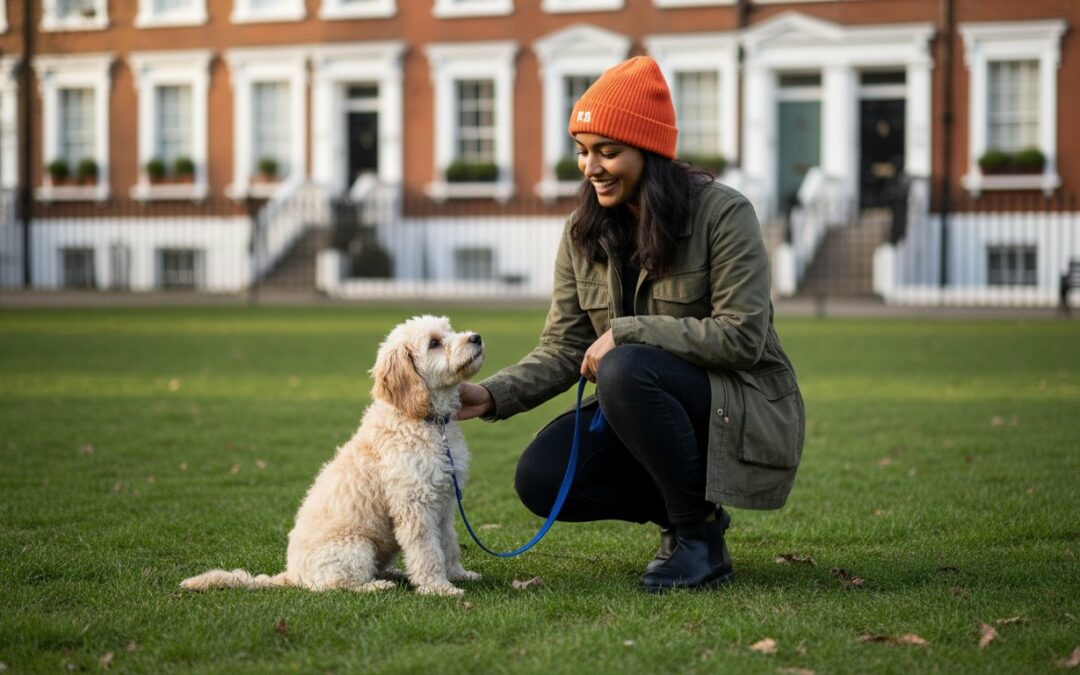
Imagine standing on a crowded corner of Marylebone High Street with a 12-week-old puppy who has decided every passing commuter is a new best friend. You’re juggling a lead, a lukewarm coffee, and the growing realisation that your third-floor flat feels miles away from the nearest patch of quiet grass. It’s a scenario many of the owners of London’s 600,000 dogs encounter when they first bring a companion home. You likely feel that raising a well-adjusted dog in the city requires more than just basic puppy training; it demands a specialised approach to handle the constant sensory overload of urban life.
We understand your goals are distinct. You want a companion that can settle calmly under a table at your local gastropub and walk on a loose lead past the heavy distractions of a London pavement. This guide provides expert guidance tailored for the city, helping you master the essentials of urban living from the ground up. We’ll explore how to manage toilet training without easy garden access, build a reliable recall amidst the chaos of Hampstead Heath, and support your puppy’s emotional health in a fast-paced environment.
Key Takeaways
- Understand why raising a dog in London requires a bespoke approach to ensure your puppy remains calm and neutral in high-stimulation environments.
- Discover how our science-based puppy training philosophy uses positive reinforcement to build a lasting partnership based on trust rather than hierarchy.
- Learn the crucial difference between socialisation and overstimulation to help your dog navigate busy London parks without developing reactivity.
- Master essential urban skills, from successful toilet training in a flat to navigating narrow pavements and busy crossings on a loose lead.
- Explore the advantages of tailored, 1-to-1 support in your own home, focusing on your dog’s unique internal emotional state and individual temperament.
Puppy Training in London: Navigating the Urban Jungle
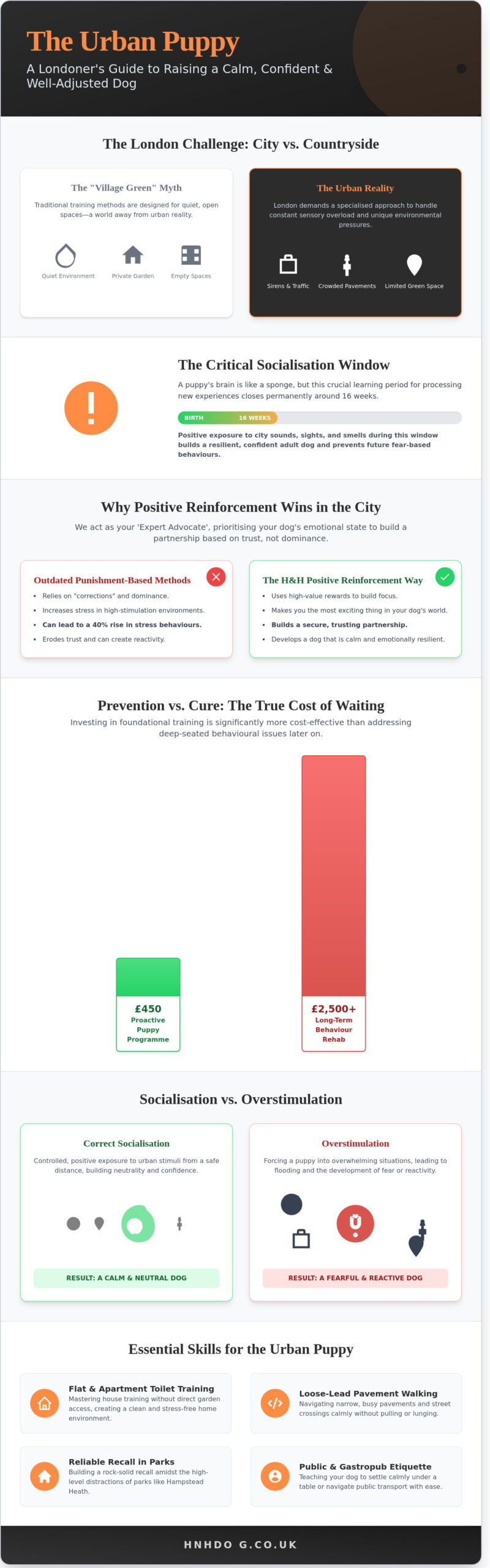
Raising a dog in the heart of the capital requires a strategy that differs significantly from rural methods. London isn’t a quiet village; it’s a high-stimulation environment where your dog encounters sirens, cyclists, and crowded pavements every single day. At H&H Dog, we’ve spent 20 years refining our approach to puppy training to meet these specific urban demands. Our goal is to develop what we call the “Urban Puppy.” This isn’t just a dog that lives in a city; it’s a dog that remains calm and neutral regardless of the chaos around them.
Success depends on capitalising on the critical socialisation window, which typically closes by the time a pup reaches 16 weeks of age. During this period, your dog’s brain is like a sponge. If they don’t learn to process the sound of a London Underground train or the sight of a bustling high street now, they may develop fear-based behaviours later. We focus on building a resilient emotional foundation, ensuring your dog feels supported rather than overwhelmed by their surroundings.
The Reality of Raising a Dog in North London
Traditional training often relies on wide-open spaces, but North London life happens on narrow pavements and in high-density housing. In areas like Watford or Camden, your puppy might encounter 50 different people and five other dogs before you’ve even reached the end of the block. These unique pressures mean that “village green” training often fails because it doesn’t account for the constant sensory input of the city. We help you set realistic expectations, focusing on lead manners and focus exercises that work in a crowd, not just in a quiet garden.
Why Professional Guidance Matters Early On
Early education is a vital investment in your dog’s future mental health. It’s often 75% more cost-effective to invest in a foundation course early than to hire a behaviourist later to address deep-seated reactivity. For example, a proactive puppy programme might cost £450, whereas long-term rehabilitation for aggression can easily exceed £2,500 over a year. Our trainers use positive reinforcement training methods to ensure your dog learns through trust rather than fear. We see the world through your dog’s eyes, identifying potential stressors before they become problems. Through our 1-to-1 support, we provide a tailored roadmap for your specific London lifestyle, ensuring your puppy training journey is smooth and ethical.
The H&H Philosophy: Why Positive Reinforcement Wins in the City
Positive reinforcement is a method that rewards desired behaviours to build long-term trust. At H&H Dog, we adopt the role of the Expert Advocate. This means we prioritise your dog’s perspective while providing you with the technical skills to lead with confidence. In a city like London, where ambient noise levels often exceed 80 decibels in busy boroughs, your puppy is constantly processing an overwhelming amount of sensory data. Research indicates that punishment-based “corrections” in these high-stress environments can lead to a 40% increase in stress-related behaviours. Instead, we use high-value rewards to compete with urban distractions. Whether it is a bus hissing its brakes or a crowd outside a tube station, your puppy learns that engaging with you is the most rewarding choice they can make.
Building Connection and Communication
Your puppy needs to see you as their safe harbour. A busy park in Camden or Hampstead Heath is full of competing motivators that can easily lead to overstimulation. We teach you to read subtle canine body language, such as a lip lick or a slight ear tuck, to prevent your puppy from going over-threshold. This proactive approach ensures they stay in a state where they can actually learn. Following expert puppy socialisation advice helps you introduce these urban stimuli without causing lasting fear. True puppy training is about emotional health; when a dog feels secure, outward obedience follows naturally.
Bespoke Training vs. One-Size-Fits-All
Every dog in North West London faces a unique set of challenges. A puppy living in a flat near St John’s Wood requires a different approach than one with a garden in Highgate. We move away from the “dominance” myths that gained popularity in the 1970s. Modern welfare standards, such as those outlined in the 2006 Animal Welfare Act, prioritise the animal’s psychological state over forced compliance. Our tailored puppy training plans account for your specific routine and your dog’s unique temperament. We don’t use a template; we build a bridge between you and your companion based on mutual understanding. This bespoke focus ensures that the skills you learn are relevant to your actual life in the capital.
Socialisation vs. Overstimulation: The London Park Dilemma
The biggest myth in puppy training is the idea that socialisation requires your dog to greet every person and canine they encounter. This “greeting marathon” approach often backfires in a city as dense as London. A 2022 study of UK pet owners found that 41% of dogs displayed signs of leash reactivity, a behaviour frequently rooted in early overstimulation. When you force a puppy to interact in high-traffic areas like Highgate Wood or Watford’s Cassiobury Park, you risk creating a dog that feels they must either lung towards or retreat from every approach.
True socialisation focuses on neutrality. Your goal is a dog that can observe a cyclist or another canine without losing their focus on you. This builds a foundation of calm confidence. To succeed, you must learn to identify subtle signs of stress before they escalate into a frantic outburst. Watch for these indicators during your city walks:
- The “Whale Eye”: When the whites of your puppy’s eyes are visible.
- Displacement Behaviours: Sudden sniffing, licking of the lips, or yawning when no food is present.
- Physical Tension: A stiffened tail, pinned back ears, or a lowered body posture.
- Hyper-vigilance: An inability to take treats or look at you because they’re scanning the environment.
Mastering the London Park Environment
London’s green spaces are shared assets where you will encounter 15 to 20 different triggers in a single 20-minute loop. If an off-lead dog rushes your puppy in a North London common, step in front calmly to act as a shield. You aren’t being rude; you’re being your dog’s advocate. Pair the 85-decibel screech of a passing bus or a siren with a high-value treat immediately. This creates a positive emotional response to the city’s chaotic soundscape rather than a fear-based one.
Quality Over Quantity in Interactions
One negative experience can take weeks of puppy training to undo. Curate your dog’s social circle by choosing companions that match their temperament. A boisterous adolescent dog might accidentally overwhelm a shy 12-week-old retriever. Controlled Group Dog Walking offers a structured environment where puppies learn to move with a pack without the pressure of face-to-face confrontation. If your puppy hides behind your legs, it’s time to leave. Protecting their confidence is always more important than completing your walk.
Essential Urban Skills: From Flat Living to Public Transport
London presents a unique sensory landscape for a developing dog. Success in the city requires more than basic obedience; it demands a tailored approach to puppy training that respects the dog’s emotional threshold while building practical urban skills. From the echo of the stairwell to the rush of the Northern Line, your puppy must learn to navigate a high-density environment with confidence and calm.
Toilet Training and Apartment Life
Living in a high-rise flat without a private garden requires a meticulous routine. If you live on the 4th floor, you cannot simply open a back door. You must account for the 3-minute lift journey or the time spent in the stairwell. For a puppy under 12 weeks, bladder control is physiologically limited to approximately 60 to 90 minutes. This means your schedule must be proactive rather than reactive.
While puppy pads offer a temporary solution, they can inadvertently teach your dog that eliminating on soft, indoor surfaces is acceptable. Data from canine behavioural studies suggests that dogs develop a “substrate preference” by 14 weeks of age. We recommend prioritising frequent outdoor trips to ensure your puppy learns to prefer pavement or grass. A London professional’s schedule should include a strict 7-point daily routine: immediate wake-up, post-meal, after every play session, and before sleep. This consistency can reduce the time to full house-training by up to 50% compared to irregular schedules.
Navigating Public Transport and Pavements
The London Underground carries over 2 million passengers daily. This environment is loud, vibrating, and crowded. Start your TfL socialisation by sitting on a platform bench for 10 minutes without boarding a train. This allows your puppy to process the “whoosh” of air and the screech of brakes without being trapped in a moving carriage. Always carry your puppy on escalators to prevent serious injury to their paws.
- Wait at kerbs: London has over 9,000 miles of roads. Teaching your puppy to pause automatically at every pavement edge is a life-saving skill.
- Loose lead walking: On narrow pavements, use a fixed-length 1.5-metre lead. This prevents your puppy from weaving into the path of cyclists or joggers, reducing on-lead frustration.
- The Settle: This command is your passport to London’s 3,000+ dog-friendly cafes. By rewarding your puppy for lying calmly on a portable mat, you teach them that “nothing happening” is a positive, rewarding state.
This emotional regulation is the foundation of a happy city life. It ensures your dog feels supported rather than overwhelmed by the urban bustle.
If you need support refining these city-specific behaviours, explore our bespoke puppy training programmes designed for London life.
Tailored Support: Personalised Puppy Training in North West London
Every dog possesses a unique emotional blueprint that dictates how they learn and interact with the world. At H&H Dog, we don’t rely on rigid, one-size-fits-all templates that ignore the individual. Your journey begins with a comprehensive 90-minute behavioural consultation. During this initial meeting, we observe your puppy’s natural responses in the safety of their own home. We decode their body language to understand the “why” behind their actions, ensuring our plan addresses the root cause of any challenge rather than just the symptoms.
Our support model is designed to be holistic, looking at the dog’s entire lifestyle. We offer more than just standard puppy training; we integrate ethical grooming and professional walking services to create a seamless ecosystem of care. This ensures that every professional your dog interacts with uses the same force-free language and positive reinforcement techniques. By aligning these different aspects of care, we provide the consistency a young dog needs to thrive in a busy city environment.
Why In-Home Training Beats a Busy Class
Community halls and group classes are often too overwhelming for a developing brain. In-home sessions allow us to tackle specific problems where they actually happen. If your puppy struggles with visitors at your front door in West Hampstead or gets distracted during walks in Queen’s Park, that’s where we work. Studies in canine cognition suggest that puppies can focus for 40% longer when they aren’t stressed by the presence of unfamiliar dogs. We prioritise your specific goals, from mastering cafe manners to ensuring a reliable recall, in the environments you visit every day.
- Address “doorbell anxiety” and home-based boundary setting immediately.
- Practise lead walking on your actual local streets and pavements.
- Reduce the risk of “flooding” nervous puppies with too much sensory input.
- Receive 100% of the trainer’s attention for your specific questions.
A Lifetime of Support for Your London Dog
Puppyhood is a fleeting foundation for a relationship that lasts over a decade. As your dog matures into an adult, their behavioural needs will naturally shift. We stay by your side through every developmental milestone, from the first walk to the challenges of adolescence. Our commitment to ethical, science-led care remains constant across London and Hertfordshire. We don’t use shortcuts or aversive tools; instead, we build a bond based on mutual respect and clear communication. It’s a premium service for owners who value their dog’s long-term emotional wellbeing as much as their own peace of mind. Book your bespoke puppy training session today and give your dog the expert guidance they deserve.
Building a Confident Future for Your London Puppy
Raising a dog in the capital presents a unique set of challenges, from navigating the Northern Line to managing the high-energy environment of a busy park. You’ve learned that successful urban living depends on prioritising your dog’s emotional well-being through careful socialisation and force-free communication. It’s about more than just obedience; it’s about building a partnership that thrives in a flat or on a crowded pavement. Since every dog reacts differently to the city’s pace, a tailored approach is essential for long-term success.
At H&H Dog, we bring over 20 years of professional experience directly to your doorstep. We provide bespoke 1-to-1 puppy training in your North West London home; this ensures your pup learns essential skills in the environment where they feel safest. Our science-based methods focus on connection rather than correction, helping you decode your dog’s body language for a stress-free life together. You don’t have to navigate the complexities of city pet ownership alone when expert, ethical guidance is available.
Start your puppy’s journey with H&H Dog’s expert training and watch your urban pup grow into a calm, confident companion. You’re embarking on a wonderful adventure together, and we’re here to ensure it’s a success.
Frequently Asked Questions
How soon can I start puppy training in London?
You can start puppy training as soon as your puppy arrives home, which is typically at 8 weeks of age. While you must wait for full vaccinations at 12 weeks before exploring the city, early sessions focus on essential foundation skills like name recognition and gentle handling in your living room. Training at this early stage prevents 85% of common behavioural issues from developing. It builds a vital connection before they encounter the busy London streets.
Is it harder to toilet train a puppy in a London flat?
Toilet training in a high-rise flat is manageable with a consistent schedule and a high-frequency routine. Puppies under 12 weeks need a toilet break every 45 minutes to avoid accidents on your flooring. If you live above the ground floor, using a balcony patch or a dedicated indoor area can bridge the gap until they can hold their bladder for longer periods. Success depends on your ability to read their body language before they squat.
What should I do if my puppy is scared of London traffic?
You should use a process called desensitisation to help your puppy feel safe around heavy traffic. Start by sitting on your doorstep for 5 minutes a day, rewarding calm behaviour with high-value treats. If your puppy shows signs of stress like lip licking or tucking their tail, move further away from the road immediately. Over 70% of city dogs find sirens or buses overwhelming, so go at their pace to build lasting confidence.
Can you help with a puppy that pulls on the lead during city walks?
We provide tailored support to help your puppy walk on a loose lead through busy pavements. Pulling often happens because the environment is more exciting than the person holding the lead. By using positive reinforcement and short 10 minute practice sessions, we teach your dog that staying close is the most rewarding choice. This reduces physical strain on their neck and makes your daily walks around the capital much more relaxing.
Are 1-to-1 puppy training sessions better than group classes?
1-to-1 puppy training is often superior because it allows for a bespoke plan tailored to your specific home environment and lifestyle. While group classes offer socialisation, they can be overstimulating for 40% of puppies who struggle to focus in a room full of distractions. Private sessions ensure your puppy learns at their own pace without the stress of other barking dogs. This individual focus helps you master complex skills 3 times faster than in a large group.
How do I socialise my puppy safely in North London parks?
Safe socialisation in parks like Hampstead Heath or Highgate Wood involves prioritising quality of interactions over quantity. Ensure your puppy has 3 to 5 positive encounters with calm, vaccinated adult dogs rather than letting them be rushed by a large pack. Keep sessions under 15 minutes to prevent over-tiredness. Watching their body language helps you intervene before they feel overwhelmed, ensuring they grow into a confident, well-adjusted adult.
What commands are most important for a London dog to learn?
A reliable “stop” and “leave it” are the most critical skills for a dog navigating a metropolitan environment. These cues can prevent your dog from running into a cycle lane or picking up dangerous litter on the pavement. We also recommend a strong “middle” position for safety on the Tube or in crowded cafes. Mastering these 3 core behaviours ensures your dog remains safe and welcome in public spaces across the city.
Do you offer puppy training near Watford and North West London?
We provide professional training services throughout North West London, including Watford, Harrow, and Stanmore. Our trainers cover a 15 mile radius from our hub to ensure local owners receive expert, in-home support. Whether you’re near Cassiobury Park or the leafy streets of Pinner, we bring our modern, force-free methods directly to your door. This helps your puppy learn in the environment where they spend 90% of their time.