
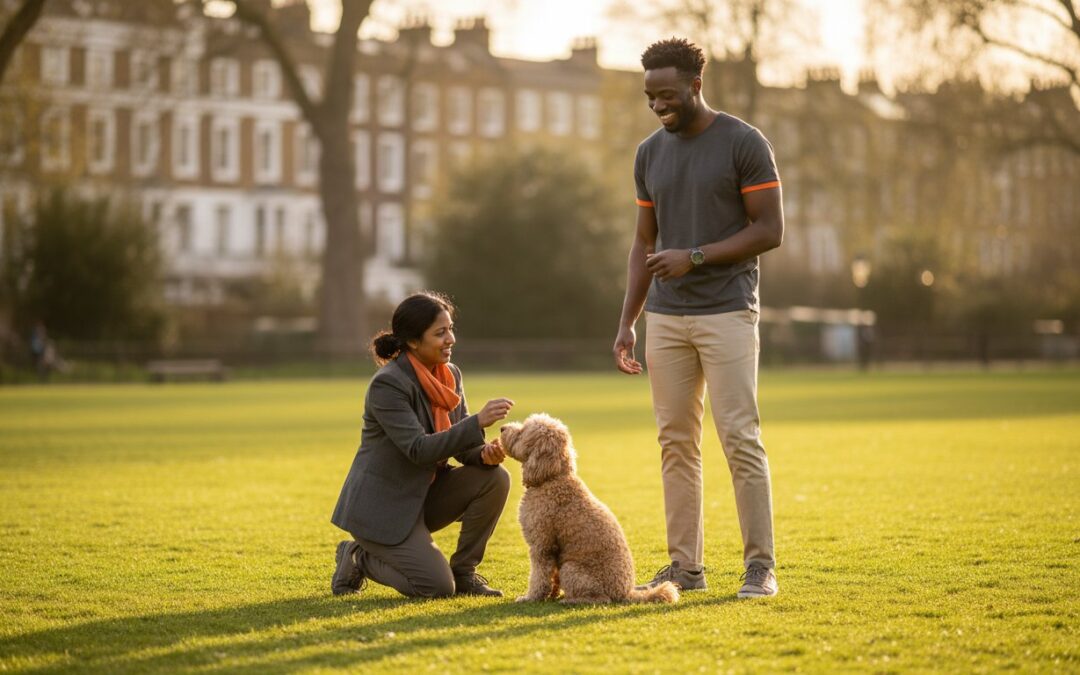
Imagine walking through Regent’s Park on a sun-drenched Saturday afternoon. Instead of a relaxing stroll, you’re gripped by anxiety as your dog lunges at a passing cyclist; you feel the heavy weight of judgmental stares from nearby picnickers. It’s a common struggle in our busy capital. According to the 2023 PDSA Animal Wellbeing Report, 60% of veterinary professionals noted an increase in canine behavioural issues over the last two years. When city life becomes overwhelming for your pet, seeking the guidance of a qualified dog behaviourist is the most compassionate step you can take.
You likely understand that your dog isn’t trying to be difficult, yet the confusion between simple lead training and complex behaviour modification often leaves owners feeling stuck. You deserve to walk down a crowded London pavement without your heart racing. This guide promises to show you how a professional dog behaviourist can transform your London dog’s life by addressing the root causes of challenging urban behaviours. We will explore the science of canine emotions and outline a clear, force-free plan to help your dog feel safe and settled in the city.
Key Takeaways
- Learn how a qualified dog behaviourist differs from a trainer by focusing on your pup’s emotional health and the underlying “why” behind their actions.
- Discover how high-density London living impacts your dog’s stress levels and why common issues like lead reactivity require a specialised, empathetic approach.
- Identify the critical accreditations to look for, such as the ABTC or APBC, to ensure your chosen expert uses modern, science-based, and force-free methods.
- Understand the importance of moving away from outdated “alpha” or “dominance” concepts toward a relationship built on advocacy, kindness, and mutual communication.
- Explore how a bespoke, tailored consultation can provide a clear, actionable path toward a calmer and more confident life for your urban pup.
Understanding the Role of a Dog Behaviourist in London
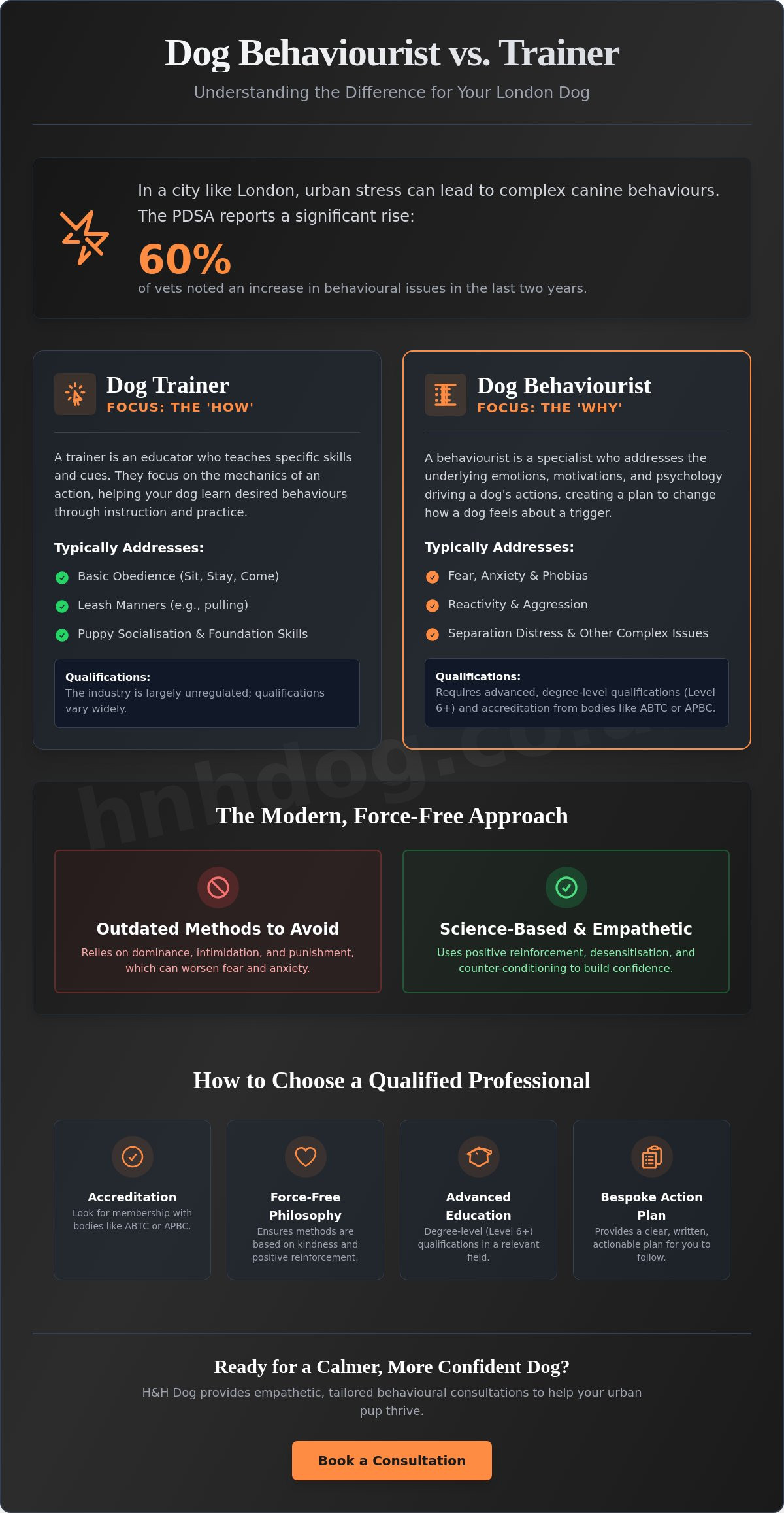
Living in a bustling capital like London presents a unique set of challenges for our canine companions, from the constant hum of traffic to the high density of people and other pets. A dog behaviourist is a professional who modifies complex behaviours by addressing underlying emotional states. While many people confuse them with trainers, the two roles serve very different purposes. A trainer typically focuses on teaching specific skills like “sit” or “heel,” whereas a dog behaviourist acts as a specialist in psychology and emotional health. They look beyond the surface level of an action to understand the “why” behind it, ensuring that the root cause of a struggle is addressed with compassion and expertise.
The urban environment requires a sophisticated approach to animal welfare. In a city where triggers are around every corner, relying on outdated methods can cause more harm than good. Modern professionals use force-free, science-based techniques to help dogs feel safe and confident. This shift in focus from mere obedience to emotional stability is what sets a behaviourist apart. By prioritising the dog’s internal experience, we create a foundation for a harmonious life together in the heart of the city.
When to Seek a Behavioural Consultation
Recognising the signs of deep-seated anxiety or fear is the first step toward helping your pet. You might notice your dog retreating under furniture, trembling at the sound of a siren, or showing intense reactivity toward other dogs on a lead. It is vital to distinguish between a simple lack of manners, such as jumping up to greet guests, and a genuine behavioural disorder like separation distress or noise phobia. Early intervention is particularly crucial for dogs living in busy North West London postcodes like NW1, NW3, and NW6. The high-frequency environment of these areas can cause stress to escalate quickly, making professional support essential for maintaining your dog’s quality of life.
The Science of Force-Free Behaviour Modification
The industry has seen a welcome move away from “dominance” theory, which relied on the mistaken belief that dogs try to control their owners. Modern research into canine behavior shows that dogs respond best to positive reinforcement and clear communication. At H&H Dog, we advocate for the dog’s perspective in every session, ensuring their voice is heard. We utilise evidence-based methods such as desensitisation and counter-conditioning to change a dog’s emotional response to urban stressors. This process involves gradually exposing the dog to a trigger at a level they can handle, then pairing it with something they love. This tailored approach builds genuine confidence, allowing your dog to thrive amidst the vibrant energy of London life.
Dog Behaviourist vs. Dog Trainer: Which Do You Need?
Understanding the distinction between a trainer and a dog behaviourist is the first step toward resolving your pup’s challenges. While the roles often overlap, they require different levels of expertise. Trainers generally focus on teaching specific skills and mechanics. In contrast, a behaviourist holds advanced qualifications, typically at a degree level (Level 6) or higher (Level 7), focusing on the “why” behind a dog’s actions. They look at the internal emotional state rather than just the external response.
Consider two common urban scenarios. If your dog pulls on their lead while walking through Marylebone, they likely need a trainer to teach them the mechanical skill of walking at your side. However, if your dog lunges at a bus in Watford or freezes in terror at the sound of a motorbike, you’re looking at an emotional reaction. This requires a professional who can deconstruct the fear or over-arousal driving that choice. For owners who have welcomed a rescue dog into their home, a dog behaviourist near me serves as the essential bridge between a traumatic past and a confident future.
The best outcomes often stem from a collaborative approach. A behaviourist identifies the root cause and creates a bespoke rehabilitation plan, while a trainer helps refine the practical cues once the dog is emotionally ready to learn. This partnership ensures that we aren’t just masking symptoms with obedience, but actually changing how the dog feels about their environment.
The Trainer’s Focus: Skills and Cues
Trainers are the educators of the canine world. They help you teach basic obedience such as sit, stay, and reliable recall in busy London parks. Their work is vital for puppy socialisation, helping young dogs learn how to interact politely with people and other animals. If you’ve just brought a new addition home, booking puppy training early provides a structured foundation. It prevents bad habits from forming before they become ingrained behaviours.
The Behaviourist’s Focus: Emotional Rehabilitation
A dog behaviourist steps in when a dog’s responses are driven by complex emotions like anxiety, fear, or frustration. They address serious issues such as resource guarding, separation distress, and dog-to-dog aggression. Living in a high-stimulus environment like London or Watford can be overwhelming for some dogs. A behaviourist develops tailored plans to help them cope with the “hustle and bustle” of city life. They also work closely with vets to ensure that sudden changes in temperament aren’t caused by underlying physical pain or medical conditions. If your dog’s personality has shifted unexpectedly, seeking a professional assessment is the most compassionate next step.
Common Urban Behavioural Challenges for London Dogs
Living in a city with over 9 million residents presents a unique set of sensory demands for our canine companions. High-density living means a dog’s nervous system is frequently on high alert. When a dog lives in a constant state of environmental pressure, their cortisol levels remain elevated, making it difficult for them to return to a calm baseline. This physiological state often leads to what a dog behaviourist identifies as trigger stacking. A single walk around a North London block might involve a siren, a passing cyclist, and a barking dog behind a gate. Individually, these are minor; combined, they push a dog over their emotional threshold.
Noise phobias are equally prevalent in the capital. The 2023 PDSA Animal Wellbeing Report indicated that 27% of dogs show signs of fear toward loud noises. In London, the persistent hum of roadworks and the sharp wail of emergency vehicles can manifest as pacing, hiding, or destructive behaviour within the home. Understanding that your dog isn’t being “naughty” but is actually struggling to process an overwhelming environment is the first step toward providing effective support. Working with a dog therapist in London can help you identify these hidden stressors and build a tailored plan to address the underlying emotional causes.
Managing Leash Reactivity on Crowded Streets
Narrow pavements in areas like Highbury or Angel often force dogs into close proximity with triggers, leaving them with no “flight” option. This perceived entrapment is why lead reactivity is the primary concern for owners seeking dog reactivity training London. When a dog feels they can’t move away, they often resort to barking or lunging to create the space they need to feel safe.
- Prioritise distance: Cross the road or step into a driveway before your dog reacts to maintain their sense of safety.
- Decompression walks: Schedule regular visits to quieter, open green spaces in Hertfordshire to allow their cortisol levels to drop.
- Time management: Aim for walks during off-peak hours to avoid the most congested commuter periods.
Urban Separation Anxiety in a Post-Pandemic World
London’s shift back to office-based work has left many dogs struggling with sudden isolation. In thin-walled flats, this often results in noise complaints from neighbours due to persistent barking or howling. A dog behaviourist focuses on building emotional independence rather than simply “tiring the dog out.” You can support your dog by building a “safe haven” within your home. This is a dedicated area where they feel secure and have access to calming enrichment activities. Creating this predictable environment helps your dog view your departure as a non-event, fostering the resilience they need for urban living.
How to Choose a Qualified Dog Behaviourist in North London
Selecting the right expert for your pup is a decision that impacts your dog’s long-term emotional health. Because the industry isn’t legally regulated in the UK, you must look for practitioners who’ve voluntarily committed to high ethical and academic standards. Your first step should be checking for accreditation with the Animal Behaviour and Training Council (ABTC), which was established in 2010 to set industry benchmarks, or the Association of Pet Behaviour Counsellors (APBC). These organisations ensure the dog behaviourist uses evidence-based methods and maintains rigorous continuing professional development.
It’s vital to avoid anyone using “balanced” or “alpha” terminology. These phrases are often masks for outdated, dominance-based theories that rely on fear or physical corrections. Modern science proves that these methods damage the bond between you and your dog; they often suppress the outward behaviour while leaving the underlying anxiety to fester. Instead, look for a professional who views the dog holistically. A practitioner who understands both training and grooming can often spot when a “behavioural” issue is actually rooted in physical discomfort, such as skin sensitivity or joint pain. A thorough behavioural consultation should always begin with a deep dive into your dog’s medical history and daily environment to rule out these physical triggers.
Questions to Ask Your Potential Behaviourist
- “What methods do you use if my dog doesn’t respond immediately?” You’re looking for patience and redirection, never force.
- “How do you stay updated with the latest canine behavioural science?” A commitment to recent peer-reviewed research is non-negotiable.
- “Do you provide written support plans and follow-up care?” Change takes time, and you’ll need a structured roadmap to follow between sessions.
The Importance of Local Knowledge
London is a high-pressure environment for a dog. A local dog behaviourist understands the specific stressors of your neighbourhood, whether it’s the heavy foot traffic near Finsbury Park or the constant sirens of the Holloway Road. They can identify the specific environmental triggers that a professional from a rural area might overlook. This local expertise is invaluable when finding the right “decompression zones.” A professional who knows the quietest routes for dog walking can help you manage your dog’s stress levels during the rehabilitation process. They should also have specific experience with urban breeds, understanding how high-drive Terriers or sensitive Sighthounds adapt to flat-living and city life.
The H&H Dog Approach: Empathetic, Tailored Behavioural Consultations
For more than 22 years, H&H Dog has provided a sanctuary of expertise for pet owners across London and Hertfordshire. Our approach is built on the belief that every dog deserves an advocate who understands their unique internal world. We don’t rely on generic, one-size-fits-all solutions. Instead, we offer bespoke support that prioritises kindness and science-based communication. By viewing the dog as a partner rather than a project, we help you build a relationship rooted in mutual respect and clarity.
Our methodology is distinct because it’s truly holistic. We integrate grooming, walking, and training to gain a 360-degree view of your dog’s physical and emotional health. A dog’s behaviour is rarely an isolated issue; it’s often a symptom of their overall lifestyle. As a dedicated dog behaviourist team, we look for the “why” behind the action, ensuring our solutions are as ethical as they are effective. We invite you to begin your journey toward a calmer, more connected life with your companion today.
What to Expect from an H&H Consultation
Our process begins with a deep-dive assessment that goes far beyond basic commands. We examine your dog’s diet, their 24-hour routine, and the specific stressors within their environment. Living in a vertical city like London presents unique challenges, from narrow stairwells to high-traffic parks. We provide step-by-step guidance that fits into your specific urban lifestyle, ensuring the plan is sustainable for you and your dog.
We provide a safe, non-judgmental space for owners, particularly those seeking aggressive dog training. Fear and reactivity are often overwhelming for owners. We replace that stress with actionable strategies, focusing on positive reinforcement and body language. Our goal is to empower you with the skills of a dog behaviourist, giving you the confidence to handle any situation with composure.
Building a Life Together: Your Next Steps
The transition from crisis management to long-term enrichment is where real transformation happens. Once we’ve stabilised immediate behavioural concerns, we focus on building a life of joy and engagement. This includes tailored enrichment plans that keep your dog’s mind active and satisfied. We understand that for many anxious dogs, a trip to a traditional salon is too much. Our mobile grooming services are designed to reduce stress, bringing professional care directly to your door to maintain your dog’s emotional threshold.
Progress is a steady, intentional climb rather than a frantic race. Our London-based team is ready to guide you through every stage of this development. You can book your initial assessment via our website to start the process of reclaiming your peace of mind. We’re here to ensure that your dog’s emotional health is protected for the long term, turning daily struggles into opportunities for connection.
Build a Calmer Future for Your Urban Dog
Living in a bustling city presents unique stressors for our canine companions, from the constant noise of traffic to the high density of other dogs on lead. Understanding the distinction between basic training and behavioural modification is the first step toward a happier home. By focusing on communication and body language rather than just commands, you can address the underlying anxiety or fear that drives unwanted actions. It’s about seeing the world through your dog’s eyes to foster a sense of safety in a busy environment.
At H&H Dog, we bring over 20 years of London pet care experience to every session, providing tailored support for owners across North London and Watford. Our approach is strictly force-free and science-based, ensuring your dog feels safe and respected throughout the process. Working with a qualified dog behaviourist allows you to decode your dog’s internal emotional state and build a lifestyle that prioritises their long-term welfare. You don’t have to navigate these challenges alone.
Book a Behavioural Consultation with H&H Dog today to begin creating a calmer, more confident future for your urban pup. We’re here to guide you every step of the way with patience and expert advocacy.
Frequently Asked Questions
What is the difference between a dog trainer and a dog behaviourist?
The primary difference is that a trainer teaches specific skills like sitting or walking on a lead, while a dog behaviourist addresses the underlying emotional causes of complex issues. If your dog struggles with deep-seated anxiety or reactivity, a behaviourist looks at the internal motivation rather than just the outward action. This involves using canine psychology to modify how a dog feels about a specific trigger in their environment.
It’s a holistic approach that prioritises long-term emotional health over simple obedience. We focus on the “why” behind the behaviour to create lasting change. This ensures your dog feels safe and understood throughout the process.
Does my dog need a vet referral before seeing a behaviourist in London?
You’ll usually need a veterinary referral before working with a qualified dog behaviourist in London. This is a vital step because the Royal College of Veterinary Surgeons (RCVS) notes that underlying pain or illness contributes to 80 percent of behavioural cases. By ruling out medical discomfort first, we ensure that your dog’s plan is both safe and effective for their specific needs.
A referral also allows for a collaborative approach between your vet and your behaviour expert. It ensures that any medical history is fully understood before we begin any modification work. This professional partnership is essential for your dog’s overall wellbeing.
How much does a dog behaviourist cost per session in the UK?
Professional fees for a dog behaviourist in the UK typically range between £100 and £250 for an initial assessment. These costs often include a detailed written plan and follow-up support to help you implement the recommendations. Prices can be higher in London due to travel requirements and higher operational costs associated with urban services.
Investing in expert guidance early can prevent more expensive long-term issues. While costs vary, choosing a qualified professional ensures you receive science-based advice that protects your dog’s welfare. Most owners find this focused support more cost-effective than generic training classes.
Can an aggressive dog be cured by a behaviourist?
Aggression isn’t something we “cure” like a disease, but we can significantly manage and improve it through positive reinforcement. Through tailored support, many owners see a 70 percent reduction in reactive outbursts within the first few months of training. We work to change your dog’s emotional state, helping them feel safe in environments that previously caused them distress.
This process requires patience, consistency, and a deep understanding of your dog’s unique communication signals. We don’t use “quick fixes” or confrontational methods. Instead, we build a foundation of trust that allows your dog to make better choices in challenging situations.
How many sessions will my dog need to see an improvement?
Most owners see a noticeable improvement in their dog’s responses within 3 to 6 sessions. Every dog is an individual, so some may require more time to process emotional changes. Complex cases involving long-standing trauma or severe anxiety might require ongoing support over several months to ensure the new habits are fully integrated.
We focus on giving you the tools to manage your dog’s progress independently. Success depends heavily on your commitment to the daily enrichment and training exercises outlined in your bespoke plan. Consistency is the key to seeing steady, reliable progress.
Is my dog too old to see a behaviourist for a new problem?
Your dog is never too old to benefit from the support of a dog behaviourist for a new or existing problem. While older dogs might have more practiced habits, their brains remain plastic and capable of learning new associations at any stage of life. We adapt our techniques to suit their physical capabilities and energy levels as they age.
Addressing these issues in senior dogs often improves their overall quality of life and strengthens your bond. It’s important to rule out age-related pain first, as this often triggers new behaviours. With a gentle approach, we can help your older dog feel more comfortable and relaxed.
What happens if my dog doesn’t like strangers or new people?
We prioritise your dog’s comfort by using a hands-off approach if they’re fearful of new people. Initial consultations often happen remotely or at a distance where your dog feels secure and unthreatened. By observing their body language from afar, we can assess their needs without causing any unnecessary stress or fear.
This respectful method is essential for building the trust needed for successful behaviour modification. We never force interactions, as this can damage the dog’s confidence. Instead, we teach you how to help your dog feel safe when others are present.
Can a behaviourist help with my dog’s separation anxiety in a London flat?
A behaviourist can help you implement a desensitisation plan specifically tailored to the challenges of urban living. Living in a London flat presents unique pressures, such as proximity to neighbours and shared hallways. We focus on gradual steps to help your dog feel relaxed and secure when left alone in their home environment.
This often involves modifying the environment to reduce external noise triggers from the street or communal areas. By building your dog’s confidence in small, manageable increments, we can create a peaceful home environment. This reduces stress for both you and your dog during your absences.