
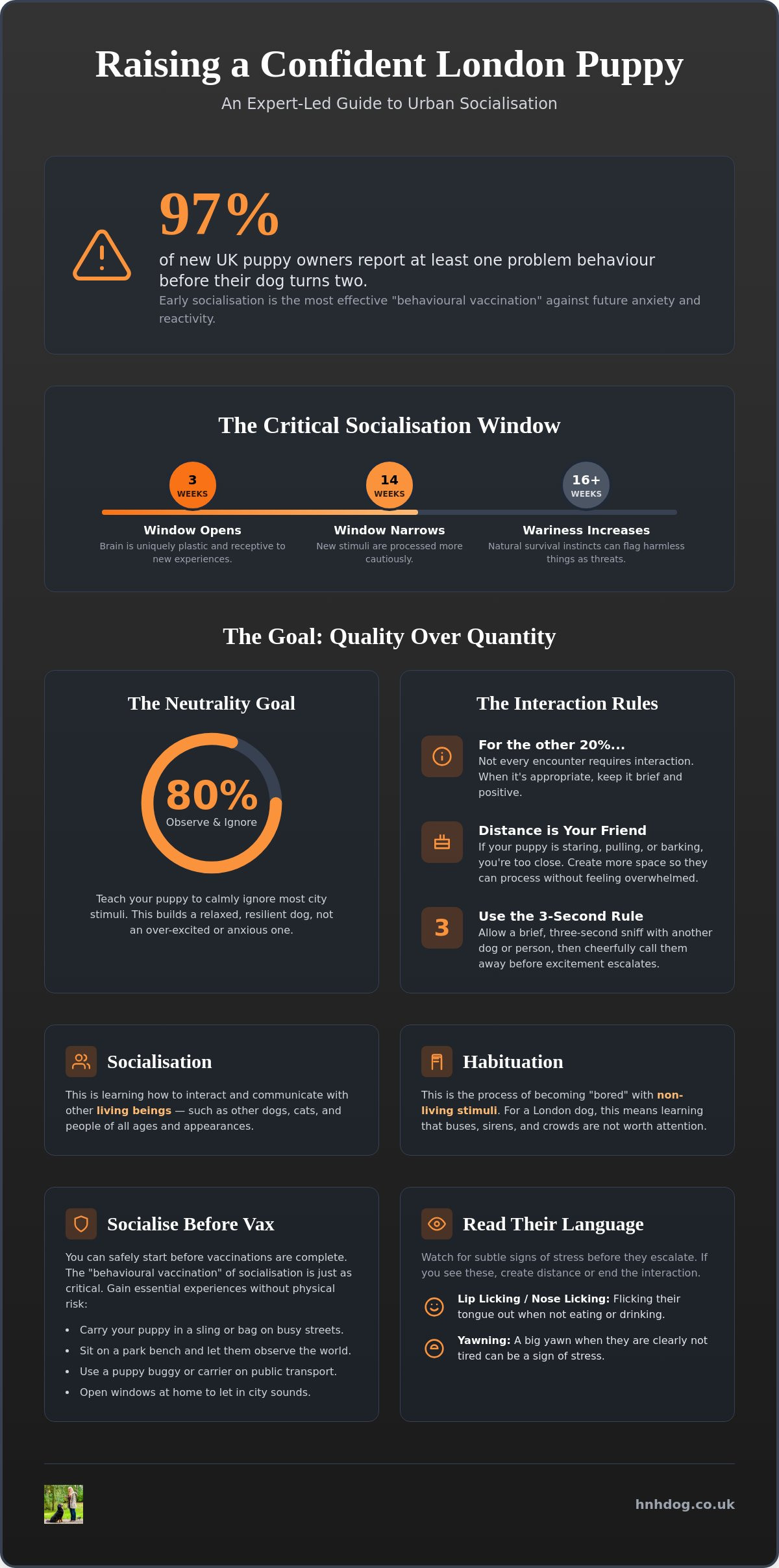
Did you know that 97% of owners who brought home a puppy during the recent surge in UK dog ownership reported at least one problem behaviour before their dog reached two years old? This 2026 data from Jennie’s Positive Paws highlights the vital importance of the early months for a dog’s long-term emotional health. You likely feel the pressure of this “critical window” while navigating the unique intensity of London life. It is entirely natural to feel overwhelmed by the conflicting advice on vaccination schedules and the sheer volume of city stimuli, from sirens to crowded pavements.
We believe that every urban challenge has a manageable, ethical solution. This expert-led puppy socialization checklist is designed to demystify the process, moving away from forced interactions toward building genuine, neutral confidence. We will show you how to introduce your companion to the roar of a London bus or the bustle of a high street without triggering fear. By following this structured path, you will learn to read your puppy’s subtle communication cues and foster a partnership built on mutual respect. You can raise a dog that is calm, resilient, and perfectly suited to a shared life in the heart of the city.
Key Takeaways
- Understand the biological “safety gate” between 3 and 14 weeks to help your puppy form positive, lifelong associations with their environment.
- Learn why “neutrality” is your primary goal, teaching your puppy to calmly observe and ignore 80% of what they encounter in the city.
- Utilise our expert-led puppy socialization checklist to systematically introduce your dog to London’s unique sounds, environments, and handling requirements.
- Discover safe methods to begin exposure before vaccinations are complete, ensuring your dog gains essential experiences without physical risk.
- Explore how specialized services like a Puppy’s First Groom or 1-to-1 Dog Training can bridge the gap between home learning and real-world confidence.
Why the “Critical Window” Matters for Your Puppy’s Future
The first few months of your puppy’s life are governed by a biological “safety gate” known as the sensitive period. Between approximately 3 and 14 weeks of age, a puppy’s brain is uniquely plastic. During the critical period of socialization, every new sight, sound, and smell is catalogued as either “safe” or “dangerous.” This is why a thorough puppy socialization checklist is so valuable. It ensures you cover the essential urban stimuli before this window begins to close and the brain’s flexibility reduces.
As a puppy matures past 16 weeks, their natural curiosity begins to give way to a survival instinct: a natural wariness of the unknown. In a wild environment, this instinct prevents a young animal from approaching a predator. In a city like London, however, this instinct can mistakenly flag a harmless cyclist or a rattling Tube train as a significant threat. By introducing these elements early, you help your dog form permanent, positive associations that last a lifetime. While learning continues throughout a dog’s life, the foundation built now determines their baseline emotional state.
Socialisation vs. Habituation: What is the Difference?
It is helpful to distinguish between two key concepts that often get grouped together. Socialisation refers to learning how to interact and communicate with living beings, such as other dogs, cats, and people of all ages. Habituation is the process of becoming “bored” with non-living stimuli. For a city dog, habituation is the secret to a calm life. You want your puppy to hear a siren or see a double-decker bus and decide it simply isn’t worth their attention. This neutrality is the ultimate goal of any effective puppy socialization checklist, allowing your dog to exist peacefully in a busy environment.
The Consequences of Under-Socialisation
When a puppy misses out on varied, positive exposures, the world can quickly become a frightening place. This often manifests as anxiety, fear-based reactivity, or extreme shyness in adulthood. Think of early exposure as a “behavioural vaccination.” Just as medical vaccines protect against physical illness, socialisation protects your dog’s long-term emotional well-being. If you notice your puppy struggling to recover from a startling event or showing consistent signs of fear, seeking professional dog behaviourist London support early can prevent these feelings from becoming deep-seated habits. Taking action now ensures your companion feels safe and supported in their urban home.
The “Quality Over Quantity” Rule of Exposure
A common misconception is that socialisation means your puppy must interact with every person and dog they encounter. In reality, successful exposure is about quality, not quantity. Your primary objective should be the “Neutrality Goal,” where your puppy learns to calmly ignore 80% of what they see. This mindset prevents over-excitement and helps your companion remain composed amidst the unpredictable bustle of London. By focusing on calm observation rather than constant interaction, you build a dog that is relaxed in any environment.
Distance is your friend when introducing new stimuli. If your puppy is staring intensely, barking, or pulling, you are likely too close to the object of their attention. Providing extra space allows their brain to process information without feeling threatened. You can use high-value treats to create positive associations from a distance, rewarding your puppy for simply looking at a stimulus and then looking back at you. Following an expert-led puppy socialization timeline helps you understand that slow, steady progress is far more effective than a rushed schedule of forced meetings.
For the remaining 20% of encounters where interaction is appropriate, employ the “Three-Second Rule.” Allow a brief, three-second sniff with another dog or person, then gently move away before the energy level spikes. This prevents the interaction from escalating into over-arousal or tension, ensuring every social experience remains positive and controlled.
Reading Your Puppy’s Body Language
To execute your puppy socialization checklist effectively, you must become fluent in your dog’s silent language. Subtle signs of stress often precede more obvious reactions. Watch for these indicators:
- Lip licking or flicking the tongue when not eating.
- Yawning when they aren’t tired.
- “Whale eye,” where you can see the whites of their eyes.
- Lifting a single front paw while standing still.
You can use the “Look at That” (LAT) game to build confidence. When your puppy notices a potential trigger and remains calm, offer a reward. If they cannot look away or take a treat, they are over-stimulated. In these moments, it is best to “abort and retreat” to a distance where they feel safe again.
The Role of Sleep in Learning
Learning is an exhausting process for a developing brain. Puppies require 18 to 20 hours of sleep per day to properly process the new information they gather during their socialisation sessions. Without adequate rest, a puppy can become cranky and reactive, much like a tired toddler. Our bespoke puppy training programmes place a heavy emphasis on balancing environmental exposure with structured downtime. If you find the process overwhelming, a 1-to-1 dog training session can provide the personalized guidance needed to tailor an exposure plan to your puppy’s individual temperament.
The Ultimate Urban Puppy Socialisation Checklist
Navigating our capital requires a specific set of skills for a young dog. This bespoke puppy socialization checklist is designed to help you tick off essential experiences without overwhelming your companion’s developing senses. We recommend introducing just two or three items from this list each day. Repetition is your most powerful tool; seeing a stimulus once isn’t enough to build lasting confidence. You should aim to repeat these exposures in different weather conditions, at various times of day, and in multiple locations across your neighbourhood.
As we discussed previously, the goal is often calm observation rather than direct interaction. In many cases, “seeing” is far more valuable than “touching.” Your puppy doesn’t need to be petted by every stranger to learn that people are safe. In fact, teaching them to simply watch the world go by helps prevent the frustration-based barking that often occurs when a dog expects to greet everyone they see. By prioritising neutrality, you ensure your dog remains a relaxed participant in your urban adventures.
People & Appearance
London is one of the most diverse cities on earth, and your puppy should see that reflected in their early life. Focus on exposing them to a wide variety of human appearances from a comfortable distance. This includes:
- People wearing uniforms, particularly high-visibility jackets, helmets, and heavy boots worn by delivery drivers or construction workers.
- Individuals using “accessories” that change the human silhouette, such as umbrellas, walking sticks, large backpacks, or wide-brimmed hats.
- Children of all ages. Start by watching a playground from across the street so your puppy can process the high-pitched sounds and erratic movements safely.
- A broad range of ethnicities, hair textures, and beard styles to ensure your dog feels comfortable with everyone they meet.
The Urban Environment (London Edition)
The city presents unique challenges that a generic checklist might overlook. To raise a truly confident London dog, you must account for high-density stimuli. Spend time near bus stops to help them habituate to the loud “hiss” of air brakes and the looming presence of double-deckers. Introduce them to various ground textures, such as the vibrating metal grates on pavements, shiny linoleum in shop foyers, and the crunch of gravel in a local square. Simply sitting on a bench near a Tube station entrance for ten minutes can provide a masterclass in handling crowds, electric scooters, and the distant rumble of trains.
Handling & Grooming Preparation
Physical confidence is just as vital as environmental resilience. You can begin preparing your puppy for a lifetime of care by gently desensitising them to being touched in sensitive areas. Regularly handle their ears, lift their paws, and touch their tail in a calm, rewarding manner. This foundational work is essential for stress-free 1-to-1 sessions or mobile dog grooming Watford services later in life. You can also practice placing them on a raised, non-slip surface to mimic a grooming bench and play recordings of hairdryers or clippers at a low volume while they enjoy a high-value treat. These small steps ensure that professional care remains a positive, cooperative experience rather than a frightening one.
How to Socialise Before Full Vaccinations
A common anxiety for new owners is the conflict between medical safety and behavioural development. While your vet’s advice on vaccinations is paramount, waiting until 12 or 14 weeks to leave the house means missing a significant portion of the sensitive period. It’s a common misconception that your puppy socialization checklist requires your dog to have their paws on the ground. You can safely bridge this gap by carrying your puppy in a sling or a secure carrier. This allows them to experience the sights and sounds of North London while remaining physically protected from pathogens.
The “Car Boot” method is another highly effective tool for urban dwellers. By parking in a busy supermarket car park or near a popular park entrance, you can sit with your puppy in the open boot of your car. This provides a safe, elevated vantage point where they can process the movement of trolleys, the slamming of doors, and the chatter of strangers without the pressure of direct interaction. This passive observation is often more beneficial than active meeting, as it teaches your puppy that the world is something to be observed calmly rather than something that requires an immediate reaction.
The “Window Watcher” Technique
Your own home offers valuable opportunities for observation. If you have a front window or a balcony, allow your puppy to watch the street below. This is an ideal time to reward calm, quiet behaviour as pedestrians or other dogs pass by. If they begin to bark, it’s usually a sign that they’re becoming over-aroused or slightly worried. In these instances, simply close the curtains or move them away to prevent barking from becoming a self-reinforcing habit. You want them to view the outside world as a series of non-threatening events.
Garden Socialisation
Secure private gardens are excellent arenas for controlled exposure. You can introduce various textures such as crinkly tarpaulin, bubble wrap, or plastic tunnels to build their physical confidence. This is also the safest environment to introduce “vetted” adult dogs. These are dogs you know are healthy, fully vaccinated, and possess a gentle, predictable temperament with youngsters. Invite a friend over for a quiet garden visit to help your puppy learn that guests are a normal, non-threatening part of life. Safe socialisation is defined as controlled exposure to environmental stimuli and vetted companions without direct contact with unknown dogs or potentially contaminated public ground.
If you are unsure how to balance safety with exposure, our 1-to-1 dog training sessions provide a bespoke plan tailored to your puppy’s current vaccination status and temperament.
Professional Support for Your Puppy’s Journey
Professional guidance acts as a vital bridge between the foundational work you do at home and the complex stimuli of the real world. While your puppy socialization checklist provides a roadmap, having a knowledgeable mentor can help you navigate the nuances of your dog’s individual personality. Many owners find that traditional, crowded puppy classes are often too intense, potentially leading to over-stimulation or negative associations. In contrast, bespoke 1-to-1 dog training offers a calm, controlled environment where we can focus entirely on your puppy’s internal emotional state. This customized approach ensures that every new experience remains positive, preventing the development of fear-based habits before they begin.
As your puppy grows, transitioning from solo garden play to managed dog walking is a natural next step for social maintenance. Expertly led sessions allow your companion to practice their communication skills in a safe, structured way. By delegating these key developmental milestones to professionals who understand the unique pressures of urban puppyhood, you gain peace of mind and a clearer path toward a well-adjusted adult dog. This support doesn’t just benefit the animal; it empowers you with the confidence to handle any situation the city might present.
The First Groom: A Gentle Introduction
Grooming is a lifelong requirement for many breeds, and the first experience sets the tone for years to come. At H&H Dog, our Puppy’s First Groom approach is rooted in patience and advocacy for the animal. We don’t rush into a full haircut; instead, we focus on creating positive vibes around the unique sensations of a grooming session. Our mobile dog grooming service is particularly beneficial for young pups, as it removes the stress of a busy high-street salon. By bringing the experience to your doorstep, we eliminate the noise of other barking dogs and the frantic energy of a commercial shop. To prepare, you can continue the handling exercises from your puppy socialization checklist, ensuring they are comfortable with their paws and ears being touched in a relaxed setting.
Safe Group Walking for Social Maintenance
Maintaining social skills requires consistent, high-quality interaction. Our group dog walking services in North West London parks are carefully curated to ensure a “balanced” dynamic. We match your puppy with calm, socially mature adult dogs who serve as excellent role models for neutral behaviour. These walks aren’t just about physical exertion; they are structured lessons in how to exist peacefully alongside others without the need for constant, high-energy play. This expert supervision ensures that your dog develops a sophisticated social vocabulary, helping them remain a confident and composed member of the London dog community.
Ready to start? Book a puppy training consultation or first groom with H&H Dog today.
Cultivating a Confident Future for Your London Dog
Navigating the complexities of urban puppyhood is a significant undertaking, but it is one you don’t have to face alone. By focusing on the “Neutrality Goal” and following a structured puppy socialization checklist, you are laying the groundwork for a resilient, well-adjusted adult dog. Quality exposure always outweighs quantity. Teaching your companion to remain calm while the city moves around them is the greatest gift you can provide for their long-term emotional health. You’ve already taken the most important step by prioritising their perspective and internal needs.
With over 20 years of professional training and grooming experience, we understand the unique pressure of raising a pet in the capital. We offer bespoke 1-to-1 puppy training tailored specifically to London life and stress-free mobile grooming vans that come directly to your door. Our mission is to act as your knowledgeable mentor, ensuring every challenge has a manageable, ethical solution. Book Professional Puppy Support in London & Watford to ensure your puppy’s journey begins with kindness and expert care. You have the tools to build a beautiful shared life; we are simply here to help you lead the way with confidence.
Frequently Asked Questions
Is it safe to socialise my puppy before they are fully vaccinated?
Yes, it is both safe and recommended to begin socialisation before full vaccinations as long as you avoid direct contact with unknown dogs or public ground. You can carry your puppy in a sling or sit with them in a car to observe the city. This approach allows you to utilise the sensitive developmental period while protecting your pet from medical risks.
What should I do if my puppy is scared during a socialisation outing?
You should immediately increase the distance between your puppy and whatever is causing them distress. If they show signs of fear like tucking their tail or refusing treats, move away until they can look at the stimulus calmly. Never force an interaction; your role is to ensure they feel safe and supported at all times.
How many new things should I show my puppy every day?
Aim for two or three brief, positive exposures each day to prevent over-stimulation. Using a structured puppy socialization checklist helps you maintain a steady pace without rushing the process. It is better to have one successful, calm encounter with a delivery driver than five frantic, overwhelming meetings that leave your puppy exhausted.
Can I socialise an older dog if I missed the puppy window?
You can certainly improve an older dog’s confidence through a process called remedial socialisation or counter-conditioning. While the biological “safety gate” of the first 14 weeks has closed, adult dogs remain capable of learning new associations. This journey simply requires more patience, a slower pace, and a focus on rewarding calm behaviour in previously stressful environments.
Why is my puppy barking at other dogs even though I socialised them?
Barking often results from frustration or over-arousal rather than a lack of exposure. If a puppy is used to greeting every dog they see, they may bark when a lead prevents them from approaching. Focus on rewarding your dog for remaining neutral and looking at you when other dogs pass by, rather than allowing constant interaction.
What are the best dog-friendly places in London for socialisation?
Quiet garden squares or the outer edges of parks like Primrose Hill offer excellent opportunities for calm observation. Avoid the high-intensity crowds of central tourist spots in the early stages. Instead, choose a local cafe with outdoor seating where your puppy can practice settling on a mat while watching the urban world pass from a safe distance.
Should I take my puppy to a puppy party?
Only participate in puppy parties that are strictly managed by qualified professionals who prioritise calm observation over unrestricted play. Free-for-all sessions can be frightening for sensitive pups or teach bolder ones to be too pushy. A well-run session will include structured rest periods and supervised interactions between puppies with compatible temperaments and energy levels.
How do I prepare my puppy for their first professional grooming session?
Begin by gently touching their paws, ears, and tail during quiet moments at home while offering high-value treats. You can also play recordings of grooming sounds, such as clippers or dryers, at a very low volume. Including these handling exercises in your puppy socialization checklist ensures that professional care feels like a predictable, rewarding extension of their home routine.