
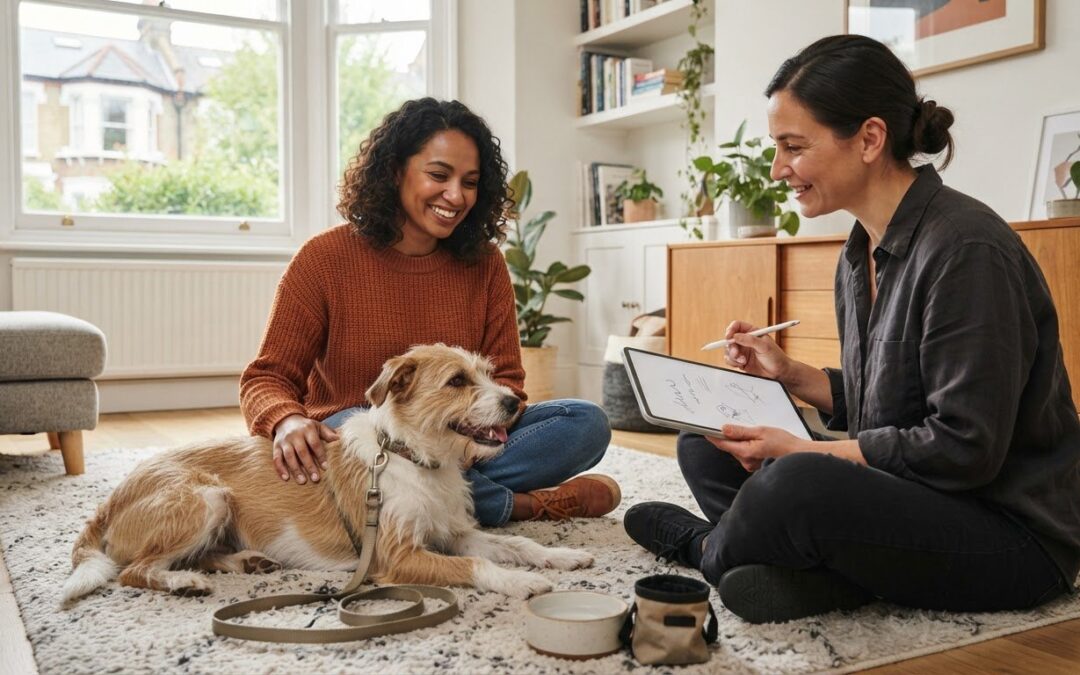
What if your dog doesn’t show the behaviour you’re concerned about during the consultation? That’s a common worry, but your dog doesn’t need to “perform” for the meeting to be useful. If you’re wondering how to prepare for a behavioural consultation, remember that the aim is to understand your dog and the circumstances around their behaviour, not to judge you.
It’s understandable to feel unsure about which details matter, or concerned that you’ll leave with advice that doesn’t fit your dog. A clear account of what you’ve noticed can help the professional see the bigger picture, even if your dog acts differently on the day. Details about routine, surroundings and what happens before and after a behaviour can all provide useful context.
This guide explains what to observe, what information to bring and how to make the appointment as comfortable as possible for your dog. You’ll also learn how to describe your concerns clearly and set welfare-led goals, so the conversation can focus on practical next steps for your individual dog.
Key Takeaways
- Prepare for a behavioural consultation by choosing a helpful goal focused on understanding your dog, not making them demonstrate a behaviour.
- Build a simple timeline of what happens, where it happens, who is present and how your dog responds afterwards.
- Gather relevant health, home and routine information, including when the concern began and any changes you’ve noticed.
- Check the consultation format in advance so you can plan a setup that helps your dog feel as comfortable as possible.
- Turn the discussion into clear next steps by noting agreed actions, questions and signs of progress to watch for.
How to Prepare for a Behavioural Consultation and Set a Helpful Goal
A behavioural consultation is a structured discussion about what your dog does, the situations in which it happens and what practical support may help. It’s an opportunity to build a clearer picture of your individual dog, not to decide whether you’ve been a “good” or “bad” owner. Preparing for a behavioural consultation doesn’t mean rehearsing a behaviour or arranging for your dog to demonstrate it.
Before the appointment, choose one or two priorities. You might want to understand what could be contributing to barking at visitors, make walks feel less stressful, or find a manageable routine for times your dog is left alone. If you’re unsure how to prepare for a behavioural consultation, start with the part of daily life that feels most difficult for you or your dog. Reading about understanding dog behavior may also help you think beyond the visible action to your dog’s communication and possible emotional state.
What should you want to understand by the end?
Separate your immediate concern from your broader hopes. The immediate concern might be that your dog growls when someone approaches their bed. Your wider hope could be calmer, safer interactions at home. Goals are most useful when they describe observable changes and support your dog’s comfort, rather than simply demanding that a behaviour stops.
Write down what you’d like help understanding, what a more manageable day might look like and any questions you want answered. Keep the goal realistic and open. Behaviour can have several contributing factors, so avoid assuming there’s one simple cause or expecting a quick fix. A professional can use the context you share to discuss practical next steps suited to your dog.
Why your dog does not need to perform during the appointment
Dogs may respond differently in a consultation setting. New people, surroundings or changes to routine can affect what they feel comfortable doing. If your dog doesn’t show the behaviour, that doesn’t make your account less useful. A natural description of what you’ve observed at home or on walks can provide more relevant context than staging a situation that might worry them.
Describe what you see without labelling your dog as “difficult” or “disobedient”. For example, note that they bark and move away when a person approaches, rather than simply saying they’re naughty. Include what was happening beforehand and how your dog responded. Honest detail keeps the focus on understanding their experience and finding support that respects their welfare.
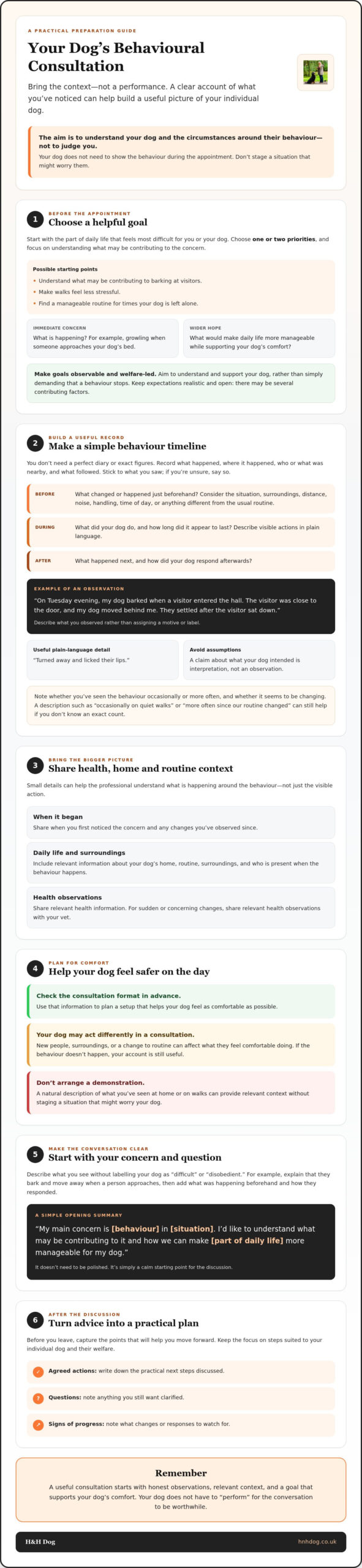
To open the conversation, prepare a short summary in your own words: “My main concern is [behaviour] in [situation]. I’d like to understand what may be contributing to it and how we can make [part of daily life] more manageable for my dog.” It doesn’t need to be polished. It gives you a calm starting point and helps direct the discussion towards what matters most.
Build a Clear Behaviour Timeline Before Your Dog’s Consultation
A short timeline can turn a worrying incident into useful information. You don’t need a perfect diary or exact figures. Note what happened, where it took place, who or what was nearby, and what followed. Over time, these details may reveal patterns that are hard to recall during a conversation.
A useful behaviour record captures the action, its context and what happened next. For example: “On Tuesday evening, my dog barked when a visitor entered the hall. The visitor was close to the door, and my dog moved behind me. They settled after the visitor sat down.” Stick to what you saw. “They were trying to control the visitor” is an interpretation, not an observation.
Which details help explain a behaviour?
For each event, think about what happened immediately before, during and after. Include relevant details such as distance, noise, handling, time of day and anything different from the usual routine. Describe visible actions in plain language. “Turned away and licked their lips” is more useful than assigning a diagnosis or assuming how your dog felt.
- Before: What changed or happened just beforehand?
- During: What did your dog do, and how long did it appear to last?
- After: What happened next, and how did your dog respond?
Note how often you’ve noticed the behaviour and whether it seems to be changing. If you can’t give an exact count, a description such as “occasionally on quiet walks” or “more often since our routine changed” is still helpful. If you’re unsure about a detail, say so rather than filling in the gaps. For sudden or concerning changes, share relevant health observations with your vet. The American College of Veterinary Behaviorists offers information on veterinary expertise at the intersection of health and behaviour.
How to use notes, photos and videos responsibly
Keep existing notes, photos or clips in date order, with a brief label explaining what was happening. A short video may add context, but only use one if it was safely obtained and recording didn’t increase risk or distress. Don’t recreate a trigger, ask someone to approach a worried dog, or delay helping your dog so you can film. Their comfort comes first.
Even a few clear examples can give the consultation a more grounded starting point. You can also read about H&H Dog’s behavioural consultations as you consider the observations most relevant to your dog.
What to Share About Your Dog’s Health, Home and Daily Routine
Behaviour is part of a wider picture. Health, past experiences, household routines and the places your dog spends time can all provide useful context. You don’t need to arrive with a complete history. Gather what you know and be clear about anything you’re unsure of. Sharing these details isn’t an invitation to blame yourself; it helps the professional understand your dog’s circumstances.
Which health and background details should you gather?
Make a brief note of known health conditions, recent changes in your dog’s wellbeing and any veterinary advice you’ve received. If your dog takes medication, bring the relevant information or write down its name and any changes you’ve noticed. Include when the behaviour concern began and whether it appeared alongside a change in health, routine or living circumstances.
If you know your dog’s adoption, rehoming or previous-care history, include what may be relevant. It’s fine if parts of their earlier life are unknown. A behavioural consultation isn’t a substitute for veterinary care. If you’re concerned about a possible health problem, speak to your vet. Don’t wait for a behaviour appointment if your dog needs prompt veterinary attention.
How do home and neighbourhood routines affect the picture?
Describe the practical details that shape your dog’s day. These might include who lives at home, other animals, visitor patterns, alone time and the usual walking routine. Note any constraints that affect what’s manageable, such as shared entrances, limited space or set times for walks. This helps keep the conversation grounded in your real life, not an ideal routine that’s difficult to maintain.
Location matters where it changes your dog’s experience. For one dog, building noise may be relevant; for another, a busy street or close encounters on a familiar route may be part of the picture. If you live in Watford or London, describe the specific features your dog responds to rather than assuming all urban dogs face the same challenges. For more context, see this guide to dog behaviourist support in London.
As you think about how to prepare for a behavioural consultation, try this simple prompt: “A usual day for my dog looks like…” Then add any recent changes and explain which parts of home or routine seem connected to your concern. Even small details can help the professional consider support that fits your dog and household.
How to Help Your Dog Feel Safer on Consultation Day
A calmer appointment starts with planning around your dog’s needs, rather than expecting them to adapt to an unknown setup. The right arrangements depend on the consultation format, so confirm the practical details with the provider in advance. Your dog may not need to be present for every part of the discussion. Don’t assume the meeting will take place at home, at a clinic or online.
What should you check before the appointment?
Ask who should attend, whether your dog needs to be present, and what notes or other materials to prepare. If your dog will be there, check where the meeting will happen and whether you should bring familiar equipment, such as their usual lead or harness. Agree on any comfort items or setup beforehand. Where the setting allows, give your dog space to settle and the choice to move away rather than encouraging greetings or close interaction.
These checks are a practical part of preparing for a behavioural consultation. They can also help you avoid last-minute surprises that might make the experience harder for your dog.
What if your dog becomes worried or reactive?
Tell the professional in advance about situations your dog finds difficult, including known triggers, escape risks and any history of biting. Share what helps you manage those situations safely. This isn’t about being judged; it gives the professional information to plan thoughtfully with your dog’s welfare in mind.
Prioritise distance and safety over getting a close-up observation. Don’t force a greeting, punish your dog for showing discomfort or deliberately expose them to a trigger to make them demonstrate a behaviour. If your dog looks worried, ask what adjustments are possible. You can explain what typically happens in everyday settings instead.
- Keep your dog at a distance they can manage, where the setting allows.
- Use familiar equipment that fits securely and is comfortable for them.
- Let the professional know if your dog needs more space or a pause.
- Don’t arrange for someone to approach or handle your dog to test their reaction.
If crowded streets are part of the challenge, describe the specific situations your dog finds difficult, such as passing people or dogs on a narrow pavement. Their response may vary with distance, noise and available space, so there’s no need to recreate the encounter during the appointment.
H&H Dog offers behavioural consultations shaped around each dog’s needs and temperament. Read about H&H Dog’s behavioural consultations and confirm the appointment arrangements that will help you and your dog feel prepared.
What Happens After a Behavioural Consultation? Turn Advice into a Plan
A consultation is a starting point for understanding your dog and considering practical support. Afterward, take a few minutes to write down the agreed actions, any questions that remain and what you’ll watch for. This helps turn a useful conversation into a plan you can revisit, rather than relying on memory once everyday life takes over.
How can you make recommendations manageable at home?
Choose actions that fit your household, your dog’s needs and any immediate safety considerations. If a recommendation feels difficult to apply, ask the professional how to adapt it before making a change. Agree on how to notice progress, such as changes in how often a situation occurs or how quickly your dog settles. Progress may not be perfectly steady, and a response that varies can still offer useful information.
- Write down: the agreed action and when you plan to try it.
- Observe: what your dog does and how they respond, without expecting instant change.
- Keep questions: note new situations or uncertainties as they arise.
When should you ask for further support?
Ask for clarification if advice feels unclear, unsafe or hard to put into practice. If your dog’s behaviour changes or worsens, share what you’ve noticed with the relevant professional. Contact your veterinary surgeon about new health concerns or changes that may need veterinary attention. You don’t have to work through uncertainty alone.
Some plans need adjustment as you learn more about your dog’s responses and circumstances. That doesn’t mean you’ve failed. It means the guidance may need to reflect what is happening in real life. Keep your notes factual and specific, then use them to explain what you tried, what felt manageable and where you need more direction.
H&H Dog offers behavioural consultations and one-to-one dog training, with personalised support shaped around each dog’s needs and temperament. Based in Watford, the team serves communities across North London and North West London. For more information about training, see this guide to one-to-one dog training in North London.
Preparing for a behavioural consultation means gathering context, not having every answer. Clear notes and realistic, welfare-led next steps can help you build a better understanding of what your dog needs.
Take the Next Step With Confidence
A useful behavioural consultation doesn’t depend on having every answer or seeing your dog behave exactly as they do at home. Your observations, background information and understanding of what would make daily life more manageable can give the conversation a grounded starting point.
Knowing how to prepare for a behavioural consultation means bringing relevant context, being open about what feels difficult and keeping your dog’s comfort at the centre. Afterward, use the agreed next steps as a guide, and ask for clarification if anything feels uncertain or impractical.
H&H Dog offers behavioural consultations and one-to-one dog training, with personalised care shaped around each dog’s needs and temperament. The team brings over 20 years of industry experience and supports communities across North London and North West London from Watford. Explore H&H Dog’s behavioural consultations to discuss tailored guidance for your dog.
You’re taking a thoughtful step by looking for support. With patience, useful information and a plan that respects your dog, you can move forward together.
Frequently Asked Questions
How do I prepare for a behavioural consultation?
To prepare for a behavioural consultation, write down what concerns you, when it happens and what tends to happen before and after. Gather relevant health and routine details, along with questions you’d like answered. Be open about safety concerns and what feels manageable at home. You don’t need to make your dog demonstrate the behaviour. Everyday observations can help the professional understand the situation without putting your dog under extra pressure.
What should I bring to a dog behaviour consultation?
Bring your behaviour notes, relevant veterinary or medication information, and any video that was safely recorded and helps explain the situation. Details about your dog’s routine, household and meaningful changes can also provide useful context. Check with the provider beforehand about specific documents and whether your dog should attend. Don’t recreate a difficult situation or put anyone at risk to capture footage.
Should my dog be present at a behavioural consultation?
Whether your dog should attend depends on the consultation format, the concern and the provider’s guidance. Ask in advance if your dog needs to be present or whether an initial conversation without them may be more suitable. Share known triggers and safety concerns before the appointment. Your dog shouldn’t be pressured into a situation just to demonstrate a behaviour; your account of everyday events can help explain what happens.
What if my dog behaves differently during the consultation?
That’s okay. Dogs may respond differently around unfamiliar people or in a new setting, so one appointment may not show what happens in every situation at home. Explain what’s typical and what seems unusual, and share your notes and examples to give the professional more context. Don’t try to provoke or recreate a behaviour if it could cause distress or create a safety risk.
Should I speak to my vet before a behavioural consultation?
Contact your veterinary practice if the behaviour is sudden, changing or accompanied by signs of illness or discomfort. Health and behaviour can influence one another, and a behavioural consultation doesn’t replace veterinary assessment. Bring any relevant veterinary advice or records you have. If you’re worried about an urgent health concern, seek veterinary care rather than waiting for a behaviour appointment.
What questions should I ask during a dog behaviour consultation?
Ask what factors might be contributing to the behaviour and what steps could support safety and comfort in the short term. Check how recommendations can fit your household routine, what to do if a situation becomes difficult, and how to recognise changes in your dog’s responses. You can also ask what observations would be useful to record or share if you need further guidance.
Can a behavioural consultation guarantee that my dog’s behaviour will change?
No consultation should promise a particular result. Behaviour is shaped by the individual dog, their environment and their circumstances, so progress can take time and may not follow a straight line. A consultation can help explore possible contributing factors and discuss practical support, but it can’t guarantee an outcome. Ask how recommendations can be reviewed and adapted as your dog’s needs or responses become clearer.