
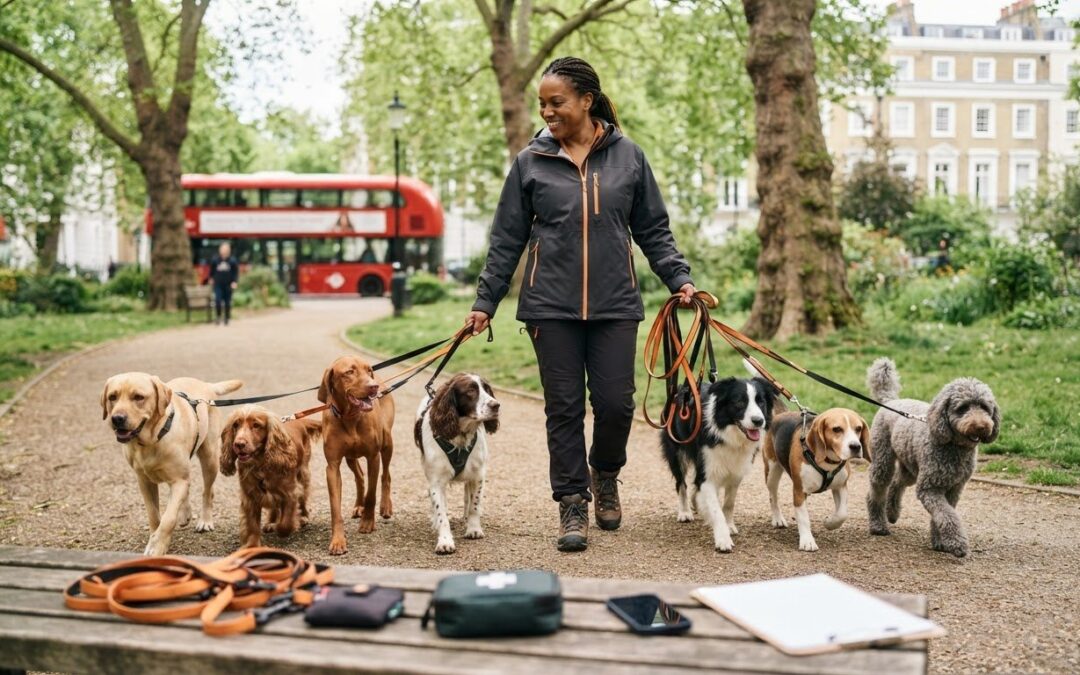
A dog slips its lead and damages someone’s property. Another is injured while in your care. These are the kinds of situations that make the question “what insurance should a dog walker have UK” more than a box-ticking exercise. Each policy needs to match the responsibilities you take on.
It’s understandable to feel unsure. Public liability and care, custody and control cover can sound similar, but they address different risks, and the details sit in the policy wording. Insurance also isn’t a substitute for safe, thoughtful handling. It can, however, help you understand where financial protection may apply if something goes wrong.
This 2026 guide explains the main covers to consider, including employers’ liability if you hire staff, and what policies may exclude. You’ll learn how to check limits, conditions on the number or type of dogs, and whether transporting dogs or holding clients’ keys is covered. Understanding the wording helps you compare policies and explain your cover clearly to clients, building trust around the care each dog receives.
Key Takeaways
- To answer “what insurance should a dog walker have UK”, match each type of cover to your business responsibilities and risks.
- Public liability and care, custody and control cover address different risks, so check what each policy actually includes.
- Compare policy limits, excesses and exclusions, including conditions related to group size, transport and the dogs in your care.
- Before arranging cover, describe your activities, staffing and client arrangements accurately, then keep written evidence of the policy.
- For dog owners, clear insurance information can support trust, alongside thoughtful communication, safe handling and attention to each dog’s needs.
Why dog walker insurance matters: the responsibilities behind every walk
Caring for someone else’s dog brings real responsibility. You’re trusted with an individual animal’s safety and wellbeing, as well as the practical arrangements agreed with their owner. Dog walker insurance is business cover intended to respond to specified risks arising from your work. It doesn’t guarantee protection against every loss: what may be covered depends on the policy wording, the activities insured, and any limits, conditions or exclusions.
Insurance works alongside careful handling, clear client agreements and accurate records; it doesn’t replace them. Knowing each dog’s needs, recording handover arrangements and keeping useful incident notes can support responsible care, whether or not an insurance claim follows. For background on the welfare framework, the Animal Welfare Act 2006 is covered in this overview of animal welfare in the UK.
What can go wrong during a professional dog walk?
A dog could pull free and run towards a road, injure a passer-by or damage someone’s property. An escape may distress the dog and worry their owner, while an injury could require prompt attention. These examples don’t determine who is legally responsible or whether an insurer would pay. The circumstances and policy terms matter.
Group walks add coordination demands. Several dogs may respond differently to traffic, other animals or unfamiliar surroundings, and each owner may have distinct instructions. One incident can therefore affect dogs, owners, members of the public and property owners. Your policy should reflect how you actually work, not an assumed version of your service.
Is dog walker insurance legally required in the UK?
Public liability insurance isn’t a universal legal requirement for every sole trader, but it’s commonly expected in professional dog walking. Some councils or managed locations may set insurance conditions for permits or access, so local rules matter. Check the requirements for the places where you plan to work, including applicable council rules or Public Spaces Protection Orders.
Employers’ liability insurance is generally a legal requirement when you employ staff, including part-time or casual workers, although specific exceptions may apply. Rules can depend on your working arrangements and business structure, so don’t rely on a general summary to decide whether you’re exempt. Before taking on staff, consult current GOV.UK guidance on employers’ liability insurance and seek appropriate advice if your circumstances are unclear. Review legal requirements and exceptions against current 2026 UK guidance.
If you’re asking what insurance should a dog walker have UK, start by separating legal obligations from sensible business protection. Then consider the dogs in your care, how walks are organised and the expectations of clients or local authorities. This gives you a practical foundation for comparing the covers discussed in the next section.
What insurance policies can cover a UK dog walking business?
There isn’t one policy label that tells the whole story. Policy names alone don’t establish what a policy covers; the wording, limits, conditions and exclusions do. To decide what insurance should a dog walker have UK, compare the risks of your actual work with the cover described in the policy documents, including the schedule and any endorsements.
Public liability and third-party claims
Public liability insurance may respond if a third party claims that your business caused their injury or damaged their property. Depending on the wording and circumstances, this could involve a passer-by injured during a walk or property damaged by a dog in your care. The policy must include the activities you undertake. Check that professional dog walking is covered and that your working arrangements fit its definition.
It won’t necessarily respond to every incident or allegation. Insurers may require particular conditions to be met, and cover can depend on whether the claim falls within the policy’s terms. Read the exclusions and claims conditions rather than assuming every incident involving a client’s dog is included.
Care, custody and control: cover for dogs in your care
Care, custody and control (CCC) is a term to examine for cover involving an animal entrusted to you. Depending on the policy, it may address a dog’s injury, loss or death while in your care. The precise scope varies, so don’t treat CCC wording as identical between insurers or assume it automatically covers veterinary costs, escape or every cause of harm.
Check the overall limit and any per-dog cap, as well as exclusions and conditions. Look for wording that applies to group walks, the number of dogs walked at once, and any requirements for supervision or handling. If the policy treats certain dogs differently, understand how that affects the cover before accepting the booking.
Insurance is only one part of responsible care. GOV.UK explains responsibilities under the Animal Welfare Act 2006 and duty of care; a policy doesn’t replace the need to make welfare-led decisions for each dog.
When employers’ liability and optional covers matter
If you employ staff, employers’ liability is a separate consideration from public liability and cover for dogs. The Employers’ Liability (Compulsory Insurance) Act 1969 is central to the rules, but whether an exception applies can depend on the business and employment arrangement. Check current GOV.UK guidance for your circumstances before hiring, including part-time or casual staff.
Personal accident cover may relate to injury to you; legal expenses cover may help with specified legal costs; and equipment cover may protect eligible business items. These are optional, policy-dependent features, not standard inclusions. Check what events, people, items and costs each feature actually covers. If you’re a dog owner, learning how professional group dog walking is organised can also help you have a clearer conversation about care and communication.
How to compare dog walker insurance and spot gaps in cover
Compare policies against the work you actually do, not just the name on the front page. A policy described as public liability doesn’t automatically cover injury to a dog in your care. That may depend on a separate care, custody and control section, its definition of an insured animal, and its limits and exclusions.
| Risk or activity | Potentially relevant cover | Wording to check |
|---|---|---|
| A member of the public is injured, or their property is damaged | Public liability | Does the insured activity include your dog-walking work and the circumstances of the claim? |
| A dog in your care is injured, lost or harmed | Care, custody and control, if offered | Which animals, events and costs are included? Are there per-dog or total limits? |
| A dog is transported as part of your service | Relevant business motor or animal transit cover | Does the policy cover transporting clients’ dogs, and under what conditions? |
| You use a subcontractor | Relevant liability cover | Are subcontractors included, and are their own activities or policies subject to conditions? |
Which activities and dogs must the policy include?
Check that the stated business activity matches your work, including individual walks, group walks, and collection or drop-off if you provide it. Review any terms on off-lead walking, dog numbers, breeds or dogs with additional needs. These are insurer-dependent checks, not universal exclusions: one policy’s conditions shouldn’t be assumed to apply to another.
Be accurate about how you work. If the policy describes a maximum number of dogs or requires particular control arrangements, compare that wording with your usual practice. A mismatch between your application and your real activities can create uncertainty when you need to rely on cover.
What exclusions, limits and excesses should you understand?
An exclusion describes a situation or loss the insurer says it won’t cover. A policy limit is the maximum amount payable under the relevant cover, subject to its terms; an excess is the amount you may have to contribute towards a claim. Compare both, and check whether limits apply per claim, per dog or across the policy period.
Hypothetical example: if a covered claim falls within a policy section with an excess, you may have to pay that excess before the insurer contributes, up to the applicable limit. The figures and outcome depend on the actual policy, so there’s no universal limit or excess that suits every walker.
Does one policy cover every dog-walking risk?
No. Different sections may address third-party claims, animals in your care, staff, vehicles or equipment, and each can have separate terms. Policy schedules and wording matter more than labels because they identify the insured activities, limits, conditions and exclusions that determine how cover may respond.
To decide what insurance should a dog walker have UK, compare those details against your own work, including group size, transport and subcontracting. Note unclear wording and seek clarification from the insurer or broker before relying on an assumption.
A practical checklist for arranging dog walker insurance
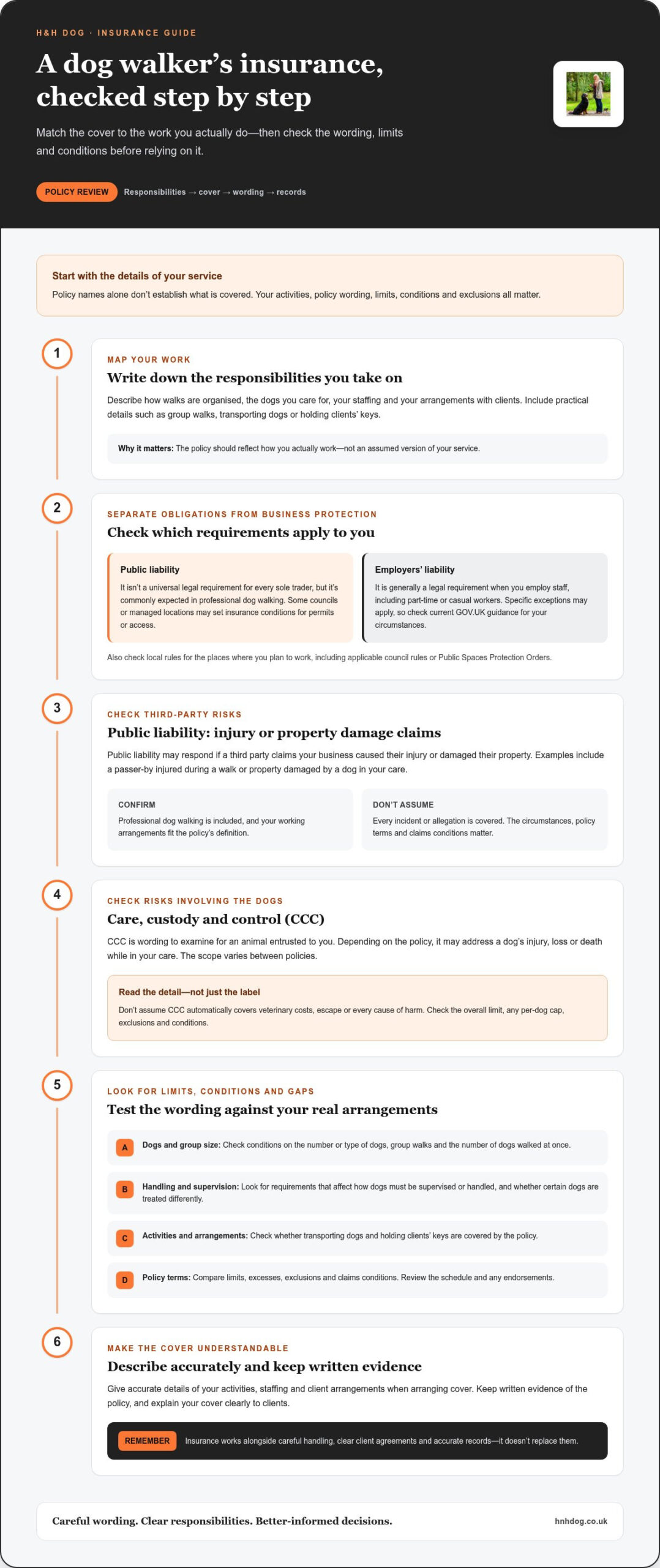
Before comparing quotes or relying on a policy, write down what your dog-walking work involves. A clear description helps you check whether the cover relates to your real responsibilities, rather than an incomplete or assumed version of the service. Use this checklist to organise the details and documents you’ll need.
- Describe your business activities. Include individual or group walks, collection and drop-off, off-lead activities, and any transport of dogs. Note whether staff or subcontractors are involved, and explain how dogs are handed over and cared for.
- Be precise about the dogs and arrangements. Give accurate information about the number of dogs you walk at once, their needs, and the instructions owners provide. If an activity or arrangement changes, review whether your policy description still reflects it.
- Compare cover against each responsibility. Identify the policy sections relevant to third-party claims, dogs in your care, employees, vehicles or equipment. Don’t assume one section responds to every kind of incident.
- Read the policy documents in full. Review the schedule, definitions, exclusions, conditions, limits and excess. Check that the insured activities match your work, and note any requirements about supervision, group size or transport.
- Check dates and reporting steps. Confirm when cover starts and ends, note the renewal date, and find out how and when the insurer expects incidents to be reported. Keep those instructions accessible so you’re not searching for them under pressure.
- Keep evidence organised. Save the policy documents and renewal details, alongside relevant client permissions, care instructions and incident records. These records support clear communication and good practice; they don’t guarantee that an insurer will accept a claim.
Describe your dog walking work accurately
Be candid about practical details, including pick-up and drop-off, group size, staffing, transport and client arrangements. If activities are left out or described inaccurately, there may be questions about whether the policy applies to a claim. The effect depends on the policy and circumstances, so use the wording and seek clarification from the insurer or broker if a term is unclear.
Review documents and keep client communication clear
Clients may reasonably want to understand what types of cover you hold and where its scope begins and ends. Explain the policy accurately, without promising that a particular event or claim will be covered. Written permissions and incident notes can help you keep each dog’s instructions clear, but they aren’t a substitute for insurance or a guarantee of an outcome.
Walking dogs in London doesn’t remove the need to check policy terms. Routes, transport arrangements and the way walks are organised should all match the activities described in the cover. If you’re considering group care for your dog, explore group dog walking with H&H Dog and discuss the arrangements that help your dog feel supported.
Working through these steps gives you a practical basis for answering what insurance should a dog walker have UK: describe your work honestly, understand the documents, and keep evidence easy to find.
Choosing a responsible dog walking service in London: insurance and trust
For dog owners, handing over a lead means trusting someone else to keep a much-loved companion safe. Insurance can be one useful signal of professional responsibility, but it isn’t the whole picture. Clear communication, considerate handling and attention to your dog’s individual needs matter too. A thoughtful conversation can help you understand how a walking arrangement works before your dog joins a walk.
If you’ve searched “what insurance should a dog walker have UK”, it’s natural to want a simple answer. As an owner, ask what relevant cover the walker has and what it is intended to cover. Policy terms differ, so a clear, accurate explanation is more helpful than a broad assurance that every eventuality is covered.
What dog owners can ask about a walking arrangement
Ask how the walker learns about your dog’s routine, comfort around other dogs, and any needs that could affect a walk. You can also ask how they respond if a dog becomes unwell, goes missing or an incident affects someone else, and how they’ll keep you informed. These questions help you understand the care plan, not just the paperwork.
- How are individual care instructions and handovers shared?
- What happens if there’s an incident, and how will you be updated?
- Can the walker clearly describe the relevant insurance arrangements and any important limits?
Open answers support a shared understanding. A walker should describe cover truthfully, without promising that an insurer will pay for a particular event or claim. You can also explain what helps your dog feel settled, so the arrangement takes their perspective into account.
How H&H Dog approaches professional dog walking
H&H Dog provides group dog walking with pick-up and drop-off in designated service areas across Watford, North London and North West London. The team brings over 20 years of pet-care experience to its work. In group settings, understanding each dog’s needs and communicating clearly with owners helps shape a more considered walking arrangement.
When choosing a walking service, owners can discuss the arrangements that matter for their dog, including how instructions are handled and how updates are shared. These details give you a fuller basis for deciding whether a service feels right for your companion.
For a closer look at the approach to urban walks and practical details owners may want to consider, explore H&H Dog’s professional dog walking guide and learn more about its dog walking service.
Make your dog’s next walk a considered choice
Choosing someone to care for your dog is personal. Think about what helps your companion feel safe and comfortable: their pace, social preferences, routine and the kind of communication that gives you confidence. These details can shape a more thoughtful walking arrangement, while an open conversation helps you understand how the service will fit your dog.
H&H Dog brings over 20 years of pet-care experience to group dog walking, training and grooming, with walking in designated North London and Watford service areas. If you’re still considering what insurance should a dog walker have UK, keep the discussion grounded in clear descriptions rather than assumptions about what any policy will pay.
Take a practical next step and explore H&H Dog’s professional dog walking service. With the right questions and attention to your dog as an individual, you can move forward with greater confidence and care.
Frequently Asked Questions
How much does dog walker insurance cost in the UK?
Dog walker insurance costs depend on the covers, limits and business details selected. As examples of advertised starting prices, Simply Business reported public liability from £5.05 per month for up to £2 million of cover in September 2026, while Protectivity advertised cover from £5.41 per month in October 2026. These aren’t guaranteed quotes or like-for-like comparisons. Check the price and policy wording for your own activities before deciding what suits your business.
Can I walk dogs without public liability insurance?
A sole trader isn’t universally required by law to hold public liability insurance, but local conditions can make it necessary in practice. A council, park or other managed site may require proof of cover for a professional dog-walking permit or access. Before accepting work in London, check the requirements for the specific places you’ll use. Clients may also want to understand what cover is in place, so be ready to explain it clearly.
Does dog walker insurance cover a dog that goes missing?
Not automatically. Some policies may include cover for a dog lost while in a walker’s care, but this depends on the relevant section, its definitions and exclusions. Check whether disappearance or escape is specifically addressed, what steps the policy requires, and whether any limit applies per dog. If a dog goes missing, act promptly to keep them safe, inform the owner and follow the insurer’s incident-reporting instructions.
Do dog walkers need employers’ liability insurance in the UK?
Generally, a business that employs staff must have employers’ liability insurance, though specific exceptions can apply. The Employers’ Liability (Compulsory Insurance) Act 1969 is central to the rules, so check current GOV.UK guidance for your employment arrangement before engaging staff. Don’t assume that calling someone a casual worker or subcontractor settles their status. If the relationship is unclear, get advice relevant to your circumstances.
Does public liability insurance cover dogs in a dog walker’s care?
Usually, public liability is intended for claims involving injury to other people or damage to their property, not automatically for injury to a dog entrusted to you. Check whether the policy has a separate care, custody and control section and what it says about veterinary costs, injury or death. For example, a claim after a dog is hurt during a walk may be treated differently from a passer-by’s injury.
Does dog walker insurance cover group walks and off-lead walking?
It can, but the policy must allow for the way you walk dogs. Check whether group walking and off-lead activity are included, and look for conditions on the number of dogs, supervision or specific circumstances. For a London route, also consider local restrictions on dogs and leads. If your usual walk changes, such as adding more dogs or a new off-lead area, review the policy terms before relying on the existing cover.
What should a dog walker do after an incident?
First, make the situation safe and attend to any dog or person who needs urgent help. Contact the owner promptly, then record what happened while details are fresh, including the time, location, people involved and any relevant photos or messages. Follow the policy’s instructions for notifying the insurer and keep copies of related records. Avoid promising that a claim will be paid; the insurer assesses it under the policy terms.