
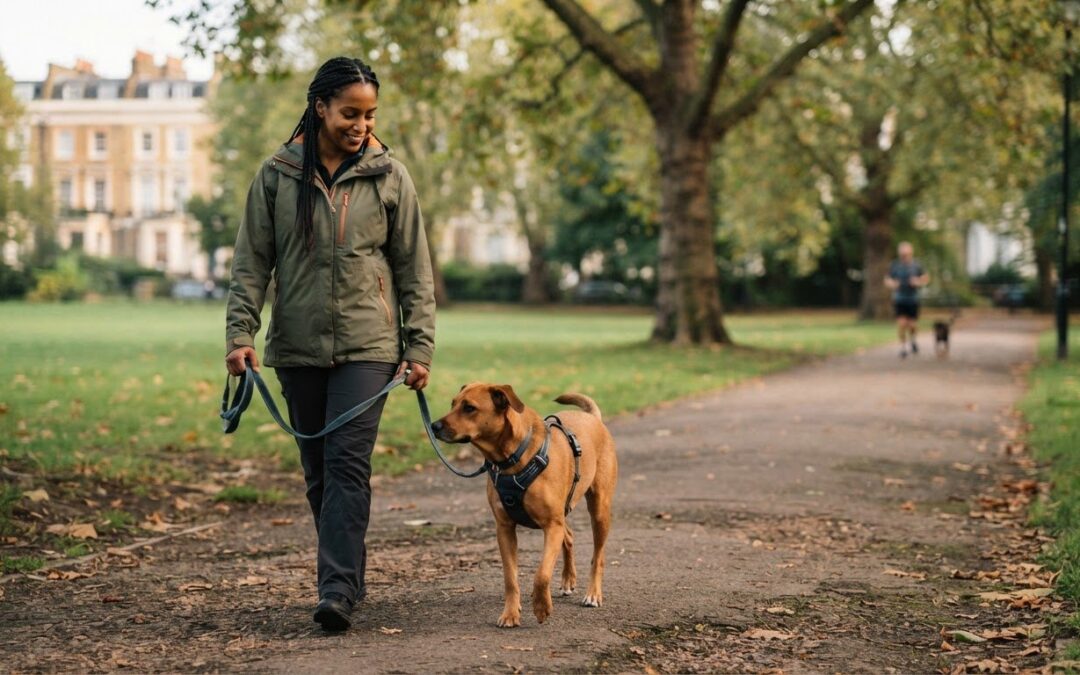
The best walk for a reactive dog isn’t necessarily the longest or busiest one. If encounters with dogs or people leave your dog overwhelmed, it’s understandable to wonder whether group walking is right for them or whether a walker will notice when they need more space. Choosing a dog walker for reactive dog management means looking beyond exercise to how your dog feels and communicates along the route.
You deserve clear answers and a plan shaped around your dog’s triggers, comfort and current skills. This guide explains how to assess a walker’s experience, handling approach and safety practices, so you can make a calm, informed decision. It also covers how to weigh up group walking and individual support without assuming one option suits every dog.
At H&H Dog, walks are tailored to each dog’s fitness and personality, with positive-reinforcement training and behavioural support available alongside walking. With Over 20 years of experience serving North London and Watford, the team prioritises thoughtful handling, clear communication and your dog’s wellbeing.
Key Takeaways
- Barking, lunging or moving away can signal that a dog is struggling with a trigger, not being “bad” or deliberately disobedient.
- A thoughtful dog walker for reactive dog management notices early stress signals, creates space and adjusts the route to reduce pressure.
- Use your dog’s comfort and responses to weigh up group walking and training support. There’s no single option for every dog.
- Before walks begin, share your dog’s triggers, handling cues, routines and emergency information, and understand how routes and safety procedures are planned.
- H&H Dog combines customised walking in North London and Watford with 1-to-1 training and behavioural help, including reactivity support.
What should a dog walker for reactive dog management understand?
A good walker looks beyond the noise or movement to consider what the dog may be experiencing. Reactivity describes a response to a particular trigger, such as another dog, a person or a sudden sound. It doesn’t make a dog bad, disobedient or automatically aggressive. Barking, pulling, lunging, freezing or trying to move away can all indicate that a dog is finding a situation difficult to cope with.
The same dog may respond differently depending on the trigger, surroundings and amount of space available. A busy London pavement, a narrow path or an unexpected approach can change what feels manageable. One behaviour alone doesn’t explain why a dog reacted, so a responsible walker won’t diagnose the cause from a brief description. They’ll pay attention to the individual dog and follow the information you share.
A useful definition: Trigger-aware management means helping a dog feel safer by noticing their signals, respecting their need for space and adjusting the walk, rather than simply trying to tire them out.
What does reactivity look like on a walk?
Look at the whole picture, not just barking or lunging. Your dog might pull towards a trigger, stop moving, turn their head away or try to increase distance. Responses can vary from one walk to another. A thoughtful walker observes what happens before and after a reaction, then shares those details with you without treating one moment as a complete explanation.
What qualities matter in a reactive-dog walker?
Patience and careful observation matter as much as practical handling. A suitable walker listens to what you know about your dog, follows their established routine and responds calmly rather than forcing an interaction. Respectful, reward-based methods can support trust and cooperation without pressuring or punishing a dog for communicating discomfort. Clear updates also help you understand how your dog experienced the walk.
Before walks begin, discuss the signals you notice and the strategies already used at home or in training. For example, explain if your dog needs extra space from approaching dogs or settles more easily on familiar routes. A useful conversation makes room for your concerns and helps shape walking support around your dog, rather than a generic routine.
Safety planning is part of responsible walking. H&H Dog’s approach includes planned routes, trained staff, emergency protocols and local veterinary connections. Walks are customised to each dog’s fitness and personality, with positive-reinforcement methods supporting considerate handling. H&H Dog also provides 1-to-1 training and behavioural help, including reactivity support, so walking and behavioural needs can be considered together.
How should a walker manage triggers and support calmer walks?
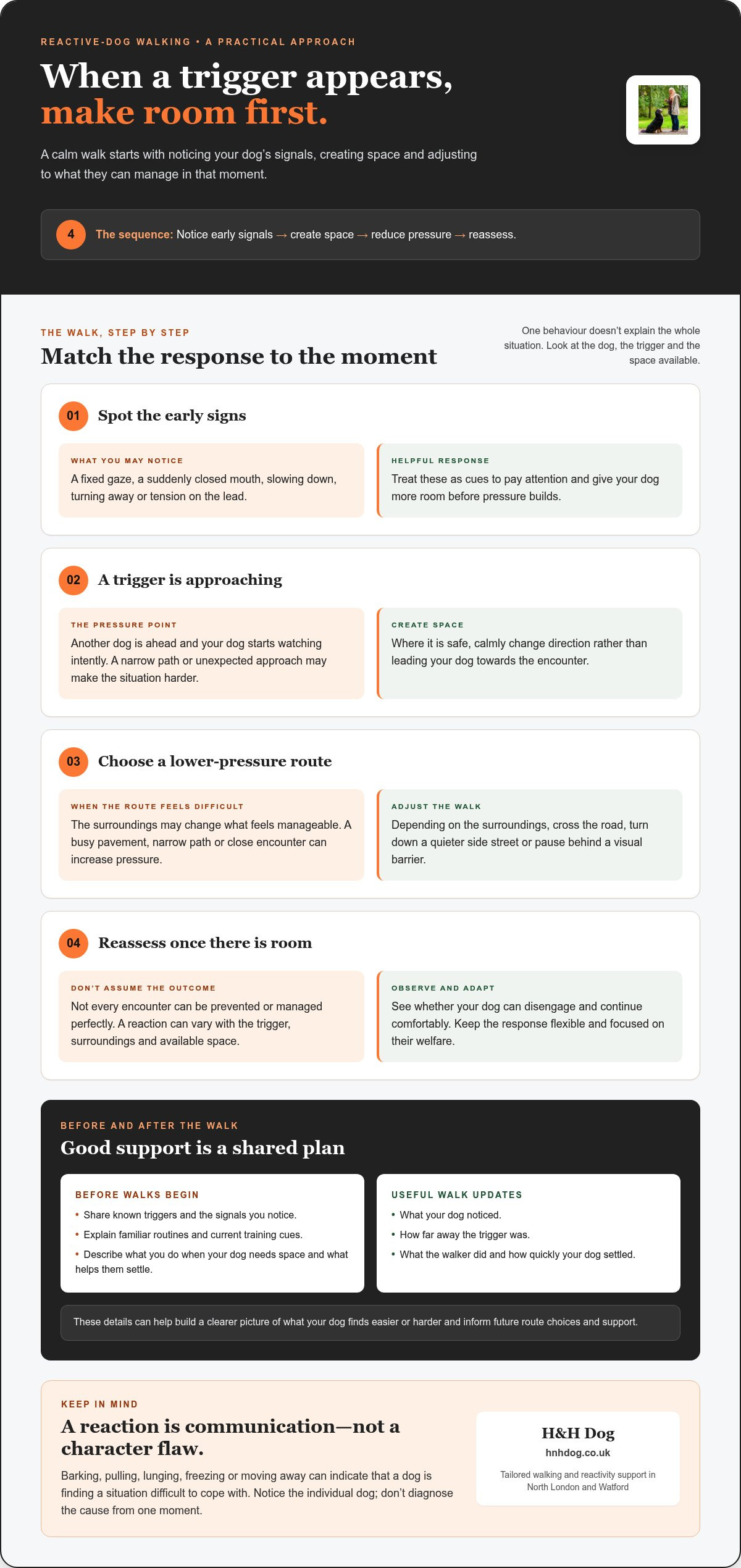
A calm response starts before a dog barks or lunges. A walker should watch for changes such as a suddenly closed mouth, a fixed gaze, slowing down, turning away or becoming tense on the lead. These signs don’t predict exactly what will happen, but they can prompt the walker to give the dog more room before pressure builds.
Increasing distance can reduce a dog’s immediate exposure to a trigger, giving them more room to cope without being forced closer. Depending on the surroundings and the dog’s response, a walker might cross the road, turn down a quieter side street or pause behind a visual barrier. Route choices aren’t about avoiding every challenge forever. They’re a practical way to keep a walk manageable in that moment.
How can a walker respond when a trigger appears?
Use a simple sequence: notice early signals, create space, reduce pressure, then reassess. If another dog appears ahead and your dog starts watching intently, the walker can calmly change direction where it’s safe, rather than leading the dog towards the encounter. Once there’s more room, they can see whether the dog can disengage and continue comfortably. Not every encounter can be prevented or managed perfectly, so the response should remain flexible and focused on the dog’s welfare.
Planned routes help a walker make thoughtful choices about the environment, while trained staff can observe the dog and respond with care. H&H Dog’s walking safety approach includes planned routes, trained staff, emergency protocols and local veterinary connections. These measures support responsible handling, but they can’t prevent every unexpected encounter.
Why consistency and communication matter
Before walks begin, share your dog’s known triggers, usual routines and current training cues. Explain what you do when your dog needs space, which words or signals they recognise and what helps them settle afterwards. This gives the walker useful context without asking them to guess what a behaviour means. A dog walker for reactive dog management should listen and keep their handling consistent with the agreed approach.
After a walk, concise updates can help you spot patterns. Useful details include what the dog noticed, how far away the trigger was, what the walker did and how quickly the dog settled. This isn’t about judging a walk as a success or failure. It builds a clearer picture of what your dog finds easier or harder, which can inform future route choices and support.
For guidance on how training cues and everyday handling can work together, explore expert dog training in North London. If you’re considering walking support alongside reactivity-related needs, you can also learn about H&H Dog’s walking and behavioural support.
Group walks, individual support or training: which fits your dog?
A group walk isn’t automatically the easiest or most social choice. Some dogs may manage familiar canine company, while others find close proximity, noise or the unpredictability of other dogs difficult. The useful question isn’t which format sounds best in general. Consider how your dog responds in that setting and what support they need now.
Use this comparison as a starting point, not a fixed prescription. Suitability depends on your dog’s comfort, known triggers and observed responses, which may change across locations or circumstances.
| Support option | What it can offer | What to consider |
|---|---|---|
| Individual attention | A walker can focus on one dog’s pace, signals and routine. | Consider whether your dog settles more readily with fewer social demands and how they respond to the walking environment. |
| Group setting | Dogs walk alongside other dogs, with the opportunity for shared activity. | Proximity, noise and unplanned encounters may feel difficult for some dogs. Watch your dog’s response rather than assuming company will be enjoyable. |
| Training support | 1-to-1 training or behavioural help can address reactivity-related needs through a considered plan. | Training is distinct from a routine walk. It may complement walking support, but a walk alone shouldn’t be treated as behaviour modification. |
When might a group setting feel difficult?
Several dogs moving close together can mean more sounds, movement and social pressure. A dog who seems comfortable in a quiet space might find a busier route challenging, or respond differently depending on which dogs are present. That doesn’t mean every group setting is unsuitable or that your dog must avoid all dogs. It means their comfort and responses should guide decisions, rather than an assumption that group walks are always enriching.
Notice what happens before, during and after the walk. Can your dog settle, take breaks and engage with their surroundings, or do they seem increasingly tense? Share your observations with the walker and review the fit over time. A dog walker for reactive dog management should take those individual responses seriously, without promising that one walking format will suit every dog.
When can training support be part of the plan?
Walking support focuses on managing the outing and meeting the dog’s needs during it. Training has a different role: 1-to-1 training and behavioural help can address reactivity-related needs as part of a more considered plan. These forms of support can work alongside walking, but they aren’t interchangeable. For more context on behaviour support, see this London dog behaviourist guidance.
H&H Dog offers group dog walking as well as 1-to-1 training and behavioural help, including support with reactivity. Walks are customised to each dog’s fitness and personality, so decisions should centre on the individual dog, not a blanket rule about groups. If you’re considering support in North London or Watford, explore H&H Dog’s walking and training support.
What should you discuss before choosing a reactive-dog walker?
A useful conversation should leave you feeling that the walker understands your dog as an individual, not as a label or a list of difficult behaviours. Prepare practical details, then notice whether the walker listens, asks relevant follow-up questions and explains how they’ll use what you’ve shared. This can help you decide whether their approach fits your dog’s needs.
What information helps a walker understand your dog?
Write down what you know, including situations your dog finds easier as well as those they find difficult. You don’t need a perfect explanation of every reaction. Clear observations are a helpful start. Discuss:
- Known triggers, early stress signals and the distances or settings where your dog seems more comfortable.
- Handling preferences, familiar equipment and any health information that could affect a walk.
- Your dog’s usual routine, including established training cues and what helps them settle.
- What you’d like to hear after walks, such as notable encounters, changes in behaviour or anything that seemed to help.
Agree how updates will be shared and what information is useful to you. A concise, factual account can help you notice patterns without turning each walk into a pass-or-fail test.
How can you judge whether the approach feels individual?
Notice whether the discussion covers your dog’s personality, fitness and current walking routine, rather than relying on a standard plan. A considerate walker should take your observations seriously and avoid blaming or dismissing your dog. Their answers should give you a clear picture of how your dog’s comfort will guide handling and route choices.
Safety is another practical topic. H&H Dog’s walking approach includes planned routes, trained staff, emergency protocols and local veterinary connections. Discuss how these inform the walk and how the walker will respond if an unexpected situation arises. You can also agree how they’ll let you know about concerns. Clear communication helps you understand the plan and share relevant information in return.
Use the conversation to judge whether the proposed support fits the dog in front of you. A dog walker for reactive dog management should listen to what you know about your dog and explain their approach calmly, without promising that every encounter will go smoothly. For a broader view of walking considerations, read this professional dog walking guide for London.
H&H Dog’s walks are customised to each dog’s fitness and personality, and the walking safety approach includes planned routes, trained staff, emergency protocols and local veterinary connections. Dog walking is offered in North London and Watford. If you’re in either area, explore H&H Dog’s dog-walking support.
How H&H Dog combines tailored walking with reactivity support
Choosing walking support for a reactive dog can feel like a big decision. Your dog’s comfort, fitness and personality matter more than a standard idea of what a walk should look like. H&H Dog provides dog walking in North London and Watford, with walks customised to each dog. The team also offers 1-to-1 training and behavioural help, including reactivity support, so owners can consider walking and behaviour needs together.
That doesn’t mean one walking format or approach will suit every dog. Discuss what your dog finds difficult, what helps them feel at ease and what support makes sense now. Sharing your observations gives the team a more complete picture of your dog’s temperament and routine.
What personalised support means at H&H Dog
H&H Dog uses positive-reinforcement, humane training methods. This approach respects the dog’s signals and builds cooperation without relying on intimidation or punishment. Share your dog’s triggers, familiar cues, daily routine and the situations where they seem most comfortable. This context helps inform tailored care without assuming that a particular walking arrangement or behavioural outcome is right for every dog.
H&H Dog brings Over 20 years of experience to its work with dogs and their owners. The business also has a 5-star rating from 77+ Google reviews and is recognised as a Top 3 trainer in Watford. These details offer context as you consider support, alongside a conversation about your own dog’s needs.
How to take a clear next step
Before settling on a plan, think about what would help you feel informed and what your dog needs to feel secure. Explain the triggers you’ve noticed, describe the cues your dog already knows or talk through how their fitness and personality affect their routine. An open discussion can help align expectations between you and the team.
H&H Dog’s walking service is for owners in North London and Watford. Group dog walking, 1-to-1 training and behavioural help are distinct forms of support. The right conversation begins with your dog, not an assumption that every reactive dog should join a group or needs the same training. Walking can support a dog’s routine, while behavioural help can address reactivity-related needs separately. Neither guarantees a particular outcome.
You don’t need every answer before exploring support. Start with what you’ve observed and what you hope your dog’s walks can feel like. Explore H&H Dog’s walking and training support and consider the next step with your dog’s comfort at the centre.
Choose support that can grow with your dog
Your next step doesn’t need to solve everything at once. Start with one clear aim: helping your dog feel safer and more comfortable during their walks. Share what you’ve noticed, stay open to adjusting the plan and let your dog’s responses guide the pace. The right dog walker for reactive dog management will treat those responses as useful information, not a reason to rush or blame.
For some dogs, walking support may be one part of a wider plan that also includes training or behavioural help. What matters is that the support respects your dog’s welfare and fits the needs you see day to day. Thoughtful decisions can give you a steadier way forward.
If you’re ready to explore support for your dog in North London or Watford, explore H&H Dog’s walking and training support. With personalised care, you can discuss a practical next step while keeping your dog’s comfort at the centre.
Frequently Asked Questions
Can a reactive dog go on a group walk?
Possibly, if the dog can remain comfortable in that group and setting, but reactivity alone doesn’t decide suitability. For example, a dog may cope with familiar dogs in a spacious area yet struggle on a narrow path with unfamiliar dogs nearby. Consider how your dog behaves around the specific group and whether they can take breaks. Group walking should be based on observed comfort, not the assumption that company will automatically help.
What should I tell a dog walker about my reactive dog?
Share details that help someone care for your dog safely: what tends to worry them, what they do when uncomfortable and what helps them recover. Mention practical matters too, such as how they respond to their name, any handling sensitivities, relevant health needs and equipment they’re used to wearing. If a trigger is hard to predict, say so. A short written note can help keep key information clear.
Can a dog walker help with leash reactivity?
A walker can support safer outings by handling the environment thoughtfully and following agreed cues, but a walk isn’t automatically a behaviour-modification session. A dog walker for reactive dog management can share observations that help you understand which situations are challenging. H&H Dog also provides 1-to-1 training and behavioural help for owners seeking direct support with reactivity. Keep the roles clear and align walking support with any training plan already in place.
How do I know if my reactive dog is ready for a dog walker?
Your dog may be ready when you can explain their needs and the walker understands the routine and handling that help them feel secure. A gradual introduction can give you useful information: notice whether your dog can engage with the walker, respond to familiar cues and recover after mild excitement. If they appear persistently distressed or their behaviour has changed suddenly, pause to consider what support or advice is appropriate before progressing.
Should I stop walking my dog if they react to other dogs?
Not necessarily. Regular outings may still be possible with adjustments that make the environment more manageable, such as choosing quieter times or familiar routes and avoiding close approaches where practical. If a walk repeatedly leaves your dog highly unsettled, consider changing its demands rather than pushing through the same situation. If reactions are sudden, worsening or create a safety concern, speak with your vet or a qualified behaviour professional about next steps.
Can a dog walker follow my dog’s existing training routine?
Yes, sharing your established routine and cues can help a walker handle your dog more consistently. Explain the words you use, what your dog has learned to do and how you reward them. For instance, if your cue is to turn away from a distraction, describe when and how you use it. Keep expectations realistic: the walker needs clear instructions, and your dog may respond differently with another person or in a new place.