
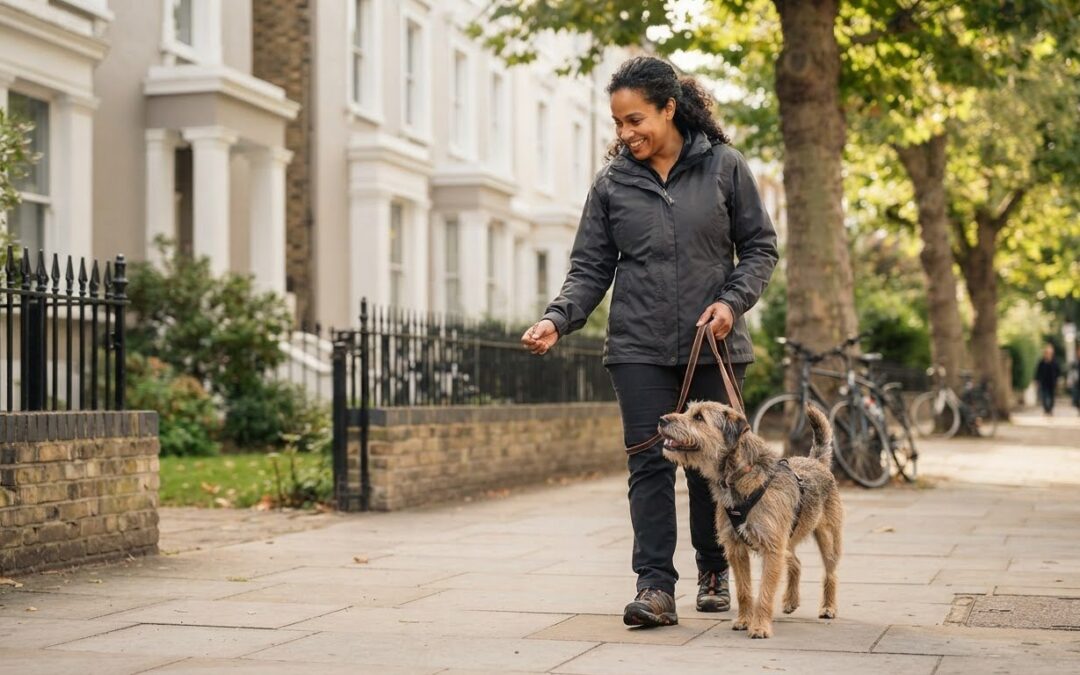
What if your dog pulls not because they’re being stubborn, but because the pavement feels full of things to reach, avoid or investigate? If walks along busy St John’s Wood streets leave you tense or struggling to manage the lead, you’re not alone. Finding leash pulling solutions St John’s Wood owners can use starts with understanding what’s driving the behaviour for their individual dog.
Pulling can reflect excitement, uncertainty, a desire to move faster or a habit that’s been rewarded by getting somewhere. A tighter lead or louder instruction may not address the reason behind it. You’re right to want an approach that feels kind, not forceful or frustrating for your dog.
In this guide, you’ll learn how to notice what your dog may be communicating and practise a clear, reward-based loose-lead routine for everyday walks. We’ll also consider the demands of local pavements and nearby green spaces, and how tailored one-to-one training can help when general advice isn’t enough. Calm walks are built through understanding and steady practice, one step at a time.
Key Takeaways
- Loose-lead walking is a skill to practise, not a demand for your dog to stay in a constant heel.
- Rewarding moments of slack in the lead helps make walking beside you worthwhile, even before progress feels consistent.
- Start in a calmer spot, then adjust the distance from distractions if your dog is finding it hard to focus.
- A simple prepare, practise and pause routine can make busy St John’s Wood pavements more manageable.
- Explore leash pulling solutions St John’s Wood owners can tailor to their dog, including positive-reinforcement one-to-one support from H&H Dog.
Why dogs pull on the lead around St John’s Wood
A dog pulling along a busy pavement can make an ordinary walk feel tiring and uncomfortable. You may be managing traffic, other dogs and a lead that never seems to loosen, while wondering whether you’re doing something wrong. Pulling isn’t a verdict on your dog’s character, and it doesn’t mean you need to insist on a perfect heel. Loose-lead walking is a skill that develops through practice, with the approach shaped around what your dog is experiencing.
Pulling can become a habit because it sometimes works. If your dog leans forward and reaches a favourite patch of grass, a scent or another dog, moving ahead may reward the pulling. They learn that tension can bring them closer to something interesting. That doesn’t mean you should blame yourself or your dog. It means the walk offers clues about what matters to them and where training can help.
Loose-lead walking means your dog can move with you while the lead stays slack, rather than being expected to hold a rigid heel position. The goal is a more comfortable connection, not identical steps or constant eye contact. Understanding the different dog training methods and principles can help explain why a dog’s surroundings, learning history and emotional state all matter.
What might your dog be communicating by pulling?
Pulling may reflect excitement about an upcoming walk, curiosity about a smell or a wish to move faster. For another dog, reaching the end of the lead may be an attempt to create distance from something unsettling. The same dog can pull for different reasons on different outings, so avoid treating it as a fixed personality trait or assuming it signals dominance or defiance.
Observe what happens just before the lead tightens. Does your dog speed up near a familiar turning, stretch towards a passing dog or hang back when traffic gets louder? Notice their overall posture too. A loose, eager posture can suggest a different feeling from a lowered body, tucked tail or repeated glances away. These patterns can help you decide what support your dog needs, though one moment alone may not explain the cause.
Why St John’s Wood walks can feel especially distracting
A busy St John’s Wood pavement can bring several challenges together: traffic noise, people passing close by, dogs approaching and sudden changes in movement or sound. A dog who walks comfortably on a quieter street may find it much harder to focus when these distractions arrive in quick succession. That difference reflects the environment, not a failure to learn.
Think about transitions as well as destinations. The walk from a residential street towards an open green space can change your dog’s pace and attention as new scents, sounds and sights appear. A quieter route may give you more room to notice and respond to your dog, while a crowded stretch can be a demanding place to practise. Tailoring leash pulling solutions St John’s Wood owners use begins with recognising these changing demands and reading the dog in front of you.
How reward-based loose-lead training works in everyday walks
Reward-based training teaches your dog which actions are worthwhile by following them with something they value. If a slack lead brings a small treat, praise or the chance to continue towards an interesting smell, your dog has a reason to repeat that behaviour. The reward should suit the individual dog: some are keen on food, while others value sniffing or moving forwards.
Timing matters. Offer the reward as your dog walks near you with the lead loose, rather than waiting until they’ve surged ahead again. A reward delivered while the lead is slack helps your dog connect comfortable walking with something they value. These small, timely moments build a clearer pattern than expecting your dog to understand a broad instruction straight away.
Progress isn’t a perfect walk from the front door. Look for more moments when the lead softens, your dog checks in or they can respond to you before moving on. A study discussed by the University of the District of Columbia considers the impact of dog leash pulling on human gait and balance, a reminder that comfortable lead skills matter for both ends of the lead.
Choose comfortable equipment and a manageable starting point
Use walking equipment that fits securely and allows your dog to move comfortably. No particular collar or harness teaches loose-lead walking by itself. Equipment supports safe handling, while learning comes from the experience you create together. Start somewhere your dog can still notice you and respond, such as a quieter stretch or a calm area before setting off along a busier pavement.
If your dog is scanning, pulling hard or unable to take a reward, the surroundings may be too demanding for useful practice. Begin farther from distractions or choose a quieter moment, then build towards busier conditions as your dog becomes more able to engage. Keep the first goal modest: a few relaxed steps can be a useful start.
Use rewards, pauses and calm resets consistently
As you walk, notice when the lead hangs in a soft curve and your dog is close enough to connect with you. Mark that moment with calm praise or a reward, then continue. You can also reward a voluntary glance in your direction. This encourages attention without asking your dog to watch you constantly.
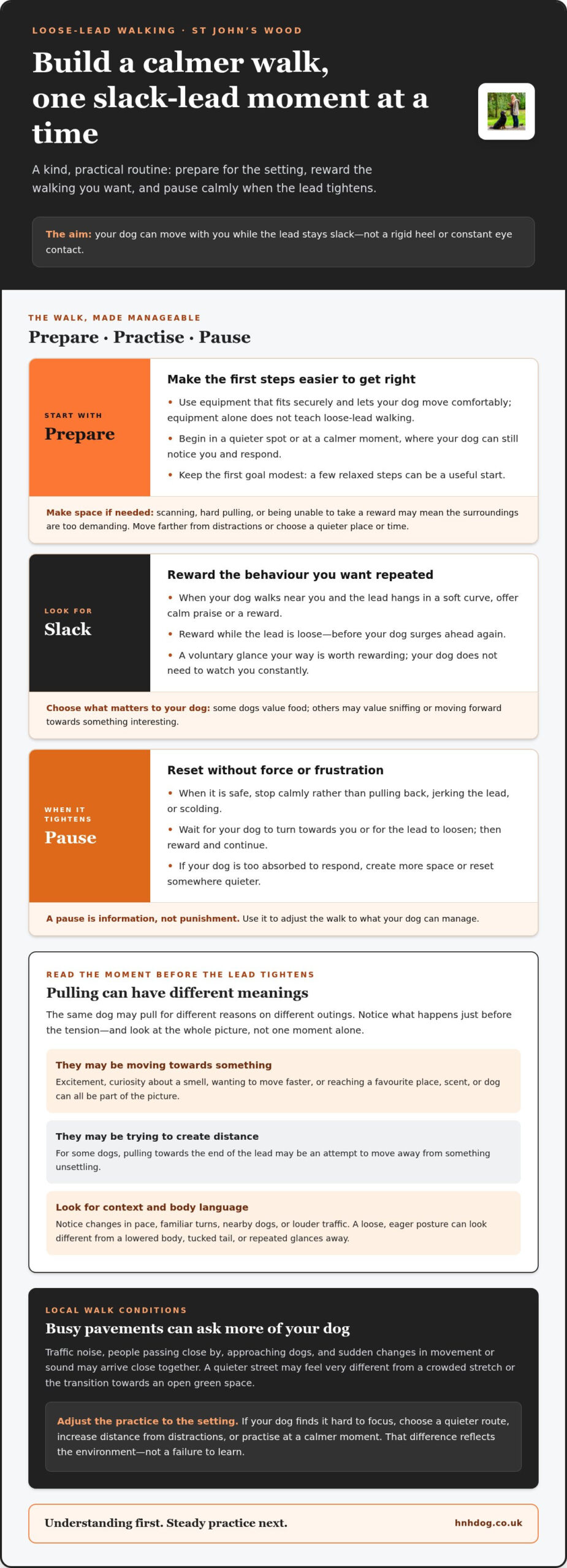
If the lead tightens, pause calmly when it’s safe rather than pulling back, jerking or scolding. Wait for your dog to turn towards you or for the lead to loosen, then reward and move on. If they’re too absorbed to respond, create more space or reset in a quieter spot. A pause is information, not a punishment.
Keep practice brief enough that both of you can stay patient. Take a break while your dog can still focus, rather than turning the whole outing into a training test. For tailored leash pulling solutions St John’s Wood owners can practise around their own routines and surroundings, H&H Dog’s personalised one-to-one dog training offers positive-reinforcement guidance for your individual needs.
Which leash-pulling approaches suit your dog and local walks?
The right practice setting depends on how your dog is coping, not simply how busy the route is. A calm street may give them space to notice you and respond; a crowded pavement can make the same exercise much harder. If your dog can’t engage, take a step back rather than repeating a cue more insistently. Adjusting the setting helps keep practice supportive and achievable.
Use this comparison to choose a helpful next step:
- Situation: Your dog can take a reward and respond on a quieter route. Likely challenge: The skill may not yet carry over to busier surroundings. Adjustment: Practise there first, then introduce more activity when your dog remains able to engage.
- Situation: Your dog pulls towards passing dogs or becomes fixed on sudden movement. Likely challenge: The trigger may be too close for learning at that moment. Adjustment: Increase distance, change direction if safe or wait for a calmer opportunity to practise.
- Situation: Pulling happens mainly on familiar stretches or towards interesting scents. Likely challenge: Moving ahead may have become part of the routine. Adjustment: Notice where the lead tightens and practise rewarding slack before continuing towards what interests your dog.
- Situation: Your dog shows ongoing distress, struggles to settle or pulls while trying to escape a trigger. Likely challenge: Fear or stress may be affecting the walk. Adjustment: Prioritise space and consider individual behavioural guidance rather than treating it as ordinary excitement.
When to practise on quieter routes before busier streets
Choose a simpler stretch when your dog is unable to respond, take a reward or turn their attention back to you amid intense activity. For example, practise on a quieter residential road before walking towards a busier street, or use a calmer section before a transition towards green space. Build difficulty gradually: move to a more stimulating setting when your dog can still engage, not because a set number of walks has passed. There’s no fixed timetable that suits every dog.
Ordinary pulling and fear-related behaviour can look similar from a distance, so avoid trying to diagnose the cause from one incident. Look for patterns across walks: what was nearby, how quickly your dog recovered and whether they could respond once given more space. Those observations can guide your next adjustment.
When pulling may need individual behavioural support
If your dog appears persistently distressed, can’t settle after a trigger or repeatedly pulls to get away, consider one-to-one help. A tailored approach can take account of your dog’s triggers, emotional state and usual walking environment, rather than applying the same exercise in every situation. H&H Dog provides positive-reinforcement training and behavioural help, and its guide to dog behaviourist support in London explains how individual support can help with urban challenges.
Effective leash pulling solutions St John’s Wood owners use should fit both the dog and the route. A quieter practice walk and a busy pavement may call for different expectations. Adapting is part of kind, practical training.
A practical loose-lead routine for St John’s Wood pavements
A repeatable routine gives you something calm to return to when a pavement gets busy. Keep the aim modest: help your dog make a few comfortable choices, then adapt if the surroundings become too much. One difficult stretch doesn’t erase what your dog has learnt, and the walk doesn’t need to become a test of obedience.
Before leaving home: set up a calmer walk
Choose comfortable, secure equipment that suits your dog and have suitable rewards ready before you set off. Plan a route with options to change direction or create space, such as turning onto a quieter street rather than pressing through a crowded stretch. At the door, pause for a brief check-in and give your dog a moment to orient to you before moving on.
During the walk: practise, reward and adjust
Use this sequence as a flexible guide, not a rigid drill. Repeat the steps when they’re useful, and make the walk easier if your dog is finding it hard to engage.
- Begin somewhere manageable. Start on a calmer section where your dog can notice you and take a reward. Walk at a comfortable pace, leaving enough room for them to explore without reaching the end of the lead straight away.
- Reward slack before tension builds. As your dog walks near you with a loose lead, offer a reward or calm praise. You can reward a voluntary glance, too. Deliver it while the lead is still slack, so the moment you want to encourage is clear.
- Pause calmly if the lead tightens. Stop without jerking or scolding when it’s safe to do so. Give your dog time to notice the pause and turn back or soften the lead. When they can reconnect with you, reward and continue at an easy pace.
- Reset after a distraction. If a dog, vehicle or sudden noise draws your dog’s attention, don’t keep asking for the same response as the pressure builds. Create distance, turn towards a quieter direction or pause somewhere with more space. Resume practice when your dog is able to engage again.
A reset isn’t a setback. It’s a way of responding to what your dog is telling you, so they can feel more at ease and you can return to a level of difficulty where learning is possible. On a St John’s Wood pavement, even a brief change of direction can make a demanding moment more manageable.
After the walk, note what was happening when the lead tightened and when your dog managed to stay with you. Record useful details, such as the location, nearby distractions and what helped them re-engage. Look for patterns across outings rather than judging progress by one difficult walk. It varies by dog and context, so there’s no fixed timeframe to expect.
If you’d like tailored help putting this routine into practice, explore one-to-one dog training with H&H Dog, using positive-reinforcement methods to support your dog’s individual needs. This can help you shape leash pulling solutions St John’s Wood walks call for, one manageable step at a time.
Get personalised leash-pulling support from H&H Dog in North London
Practising on your own can be a helpful start, but it isn’t always easy to work out what to change when your dog pulls on particular streets, reacts to certain triggers or struggles to settle during a walk. One-to-one training gives you space to look at the full picture: your dog’s behaviour, the places you walk and what happens just before the lead tightens. From there, guidance can be shaped around your dog rather than relying on a standard routine.
H&H Dog provides one-to-one dog training and behavioural help, including support with leash pulling. The team uses humane, positive-reinforcement methods, focusing on helping your dog feel supported enough to learn while showing you practical ways to encourage more comfortable walking. This isn’t about expecting instant perfection. It’s about understanding your dog and building useful skills at a pace that suits them.
What tailored one-to-one training can address
A tailored session can explore whether your dog pulls from excitement, habit, uncertainty or a wish to move away from something. The trainer can consider how these responses show up in your everyday environment, then help you practise suitable strategies for real walks. For instance, the approach for a dog who rushes towards interesting scents may differ from support for a dog who becomes worried near passing dogs. H&H Dog’s North London dog training guide offers further context on training for urban life.
H&H Dog brings over 20 years of experience to its work. Its team includes IMDT-certified professionals, and the business has a 5-star rating from 77+ Google reviews. These details offer reassurance about the experience behind the guidance, while the training itself remains centred on your dog’s individual needs and welfare.
How to take the next step with H&H Dog
If the same walking challenges keep returning, or you’re unsure how to adapt your practice, consider one-to-one support for leash pulling and related behaviour. Roland is the lead trainer, and H&H Dog is recognised as a Top 3 trainer in Watford. Training is tailored, so you can discuss the behaviours and walking situations you’d like help with and work towards practical next steps without pressure to follow a one-size-fits-all plan.
For leash pulling solutions St John’s Wood dog owners can adapt to their routines, individual guidance can help turn observations from everyday walks into a clearer plan. If local walking is part of the picture, H&H Dog’s professional dog walking guide also covers considerations for urban outings.
Every dog learns differently, and progress can vary with the dog, the setting and the challenge. If you’d value a humane, personalised approach, explore H&H Dog’s one-to-one training and take the next step when it feels right for you and your dog.
Make your next walk a fresh starting point
You don’t need to solve every challenge on the next outing. Choose one useful focus, such as noticing what happens just before the lead tightens, and let that observation guide your next decision. A short note after each walk can help you spot patterns and recognise moments that felt easier, even if other parts were still challenging.
That gives you a practical way to shape leash pulling solutions St John’s Wood walks call for, with your dog’s comfort and the real conditions around you in mind. If you’d like support turning those observations into a plan that fits your dog, explore personalised one-to-one dog training with H&H Dog.
With patient practice and the right guidance, you and your dog can find a calmer rhythm together. Start with the next manageable step.
Frequently Asked Questions
Why does my dog pull on the lead when we walk in St John’s Wood?
Your dog may pull because the street offers exciting smells, passing dogs, traffic or unfamiliar activity, but the reason can vary from walk to walk. Notice what happens just before the lead tightens: your dog might be eager to reach a familiar corner or uneasy as someone approaches. These clues help you choose suitable leash pulling solutions St John’s Wood walks call for, instead of assuming every pull has the same cause.
Is a harness better than a collar for a dog that pulls?
Neither a harness nor a collar teaches loose-lead walking on its own. Choose equipment that fits securely and comfortably, considering your dog’s size, shape and movement. Check for rubbing, slipping or pressure that seems uncomfortable, and adjust your choice if you notice these problems. The lead should give you safe control without relying on equipment to stop the behaviour. If you’re unsure about fit or comfort, seek advice from your vet.
Can an older dog learn to walk on a loose lead?
Yes, older dogs can learn new walking habits, although their comfort, health and past experiences should shape the approach. Keep practice manageable and consider whether stiffness, pain or reduced mobility could be affecting their pace. For example, a dog who slows down and then surges forward may need a different plan from one who pulls eagerly throughout the walk. If pulling changes suddenly, speak with your vet to rule out a health concern.
How long does it take to teach a dog not to pull?
There isn’t a reliable fixed timeframe because learning depends on the dog, their history and the situations they encounter. Your dog may manage well on a quiet road but find a busy junction much harder, so progress can look uneven. Track small changes, such as recovering attention sooner or walking comfortably for a short stretch. If you’re not seeing patterns or aren’t sure what to adjust, individual guidance can help you refine your practice.
Should I stop walking whenever my dog pulls?
You can pause when it’s safe and practical, but you don’t need to stop mechanically at every moment of tension. On a narrow pavement or near traffic, prioritise moving your dog to a safer, less crowded place. Once there, wait for a chance to reconnect, then continue calmly. Avoid pulling back sharply or scolding. The aim is to respond thoughtfully to the situation, not turn the entire outing into repeated standstills.
What should I do if my dog pulls towards other dogs?
Create space before your dog becomes overwhelmed. You could cross the road where safe, turn down a quieter street or step aside with enough room for the other dog to pass. Don’t force a greeting. Reward your dog for noticing the other dog and then turning attention back to you, even briefly. If they remain tense or cannot settle after the dog has passed, increase distance and make the rest of the walk calmer.
Can one-to-one dog training help with leash pulling in North London?
Yes. One-to-one training can help you understand the situations behind your dog’s pulling and practise a plan suited to your everyday walks. H&H Dog provides personalised dog training and behavioural help, including leash-pulling support, using positive-reinforcement methods across North and North West London. This can be useful if your dog’s response changes around particular triggers or if you’d like an experienced trainer to help adapt your practice to your dog.