
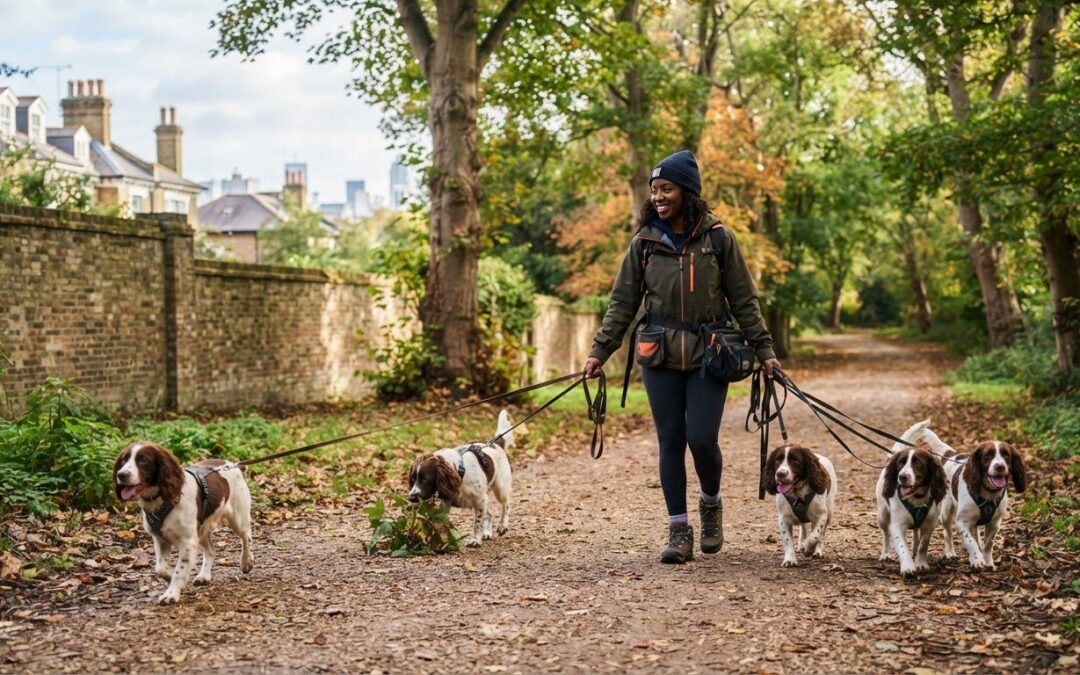
Energetic spaniels need more than a brisk circuit. Group walks for energetic spaniels in Highgate should allow time to move, sniff and settle into a pace that suits the dogs taking part. Longer outings can offer more opportunity to explore, while off-lead freedom depends on the setting and each dog’s ability to respond reliably around others.
It’s natural to want to know where the walk goes, how long your dog will be out and how they’ll be kept safe. These details help you decide whether a group outing will enrich your spaniel or feel overwhelming. When considering walks around Highgate, focus on the route, the dog’s needs and how the handler manages the group. Thoughtful, individual care can help a lively dog enjoy company while respecting their comfort and pace.
Key Takeaways
- Compare local Highgate routes with longer outings, and consider which setting best suits your spaniel’s energy and confidence.
- Learn what can shape a walk’s duration, including the route, travel and opportunities to pause and sniff.
- Understand why off-lead exploration should build on recall and your dog’s ability to stay comfortable around others.
- Use group size and dog-to-walker attention as practical factors when weighing up whether a shared walk suits your dog.
- Find out what to look for in a walk that balances exercise with your spaniel’s individual needs.
Highgate and nearby service areas
When choosing a Highgate dog walker, ask about insurance, any licence relevant to the service and procedures for collection, group introductions and emergencies. Discuss lead control and transport arrangements, too. Canine first-aid training and Enhanced DBS clearance are useful credentials to ask about, alongside clear, practical safety procedures.
For group walks for energetic spaniels in Highgate, the route matters as much as the postcode. A local walk starts near N6 5SZ and finishes near N19 5FG, giving you a practical reference for where the outing begins and ends. Ask how the route’s pace, surroundings and opportunities to pause fit your dog’s confidence and energy.
Archway Station is a useful local landmark: the Highgate walk finishes there on the Northern Line. This can help you picture the route’s endpoint, but it doesn’t mean every group outing follows the same path. Before a walk, establish the collection area and where your dog will return, then consider whether that journey fits your daily routine.
Highgate’s streets, green spaces and landmarks can make local walks varied. A community route passes Peter Sellers’ former home, Lubetkin’s Highpoint, Highgate School, Pond Square, The Flask PH and Highgate Cemetery. These places give a sense of the area, but your dog’s comfort depends on the route itself, including busy sections and opportunities for a calmer pause.
A separate example is the Redbridge Group Highgate walk, a 4.8 km route that was scheduled for Saturday, 14 February 2026. It met at the Highgate Station ticket barrier on the Northern Line Barnet Branch, with an estimated finish at 1:00 pm. Its route illustrates how a named meeting point and clear finish estimate help people plan, but it was a scheduled community walk, not a promise about regular dog-walking arrangements.
Highgate also has monthly community walks organised collaboratively by Highgate Society, Holly Lodge Community Centre and Lauderdale House. Guided walks in Highgate Wood meet at the information hut beside the café. These are community and nature walks, not dog group walks, so check each event’s details before bringing a dog.
To judge whether a nearby group walk suits your spaniel, clarify the collection and return arrangements, learn about the route and discuss how the handler manages introductions and changes in your dog’s comfort. A route around Highgate may be stimulating, but the best fit depends on your dog, not just the map.
Longer adventures for active dogs
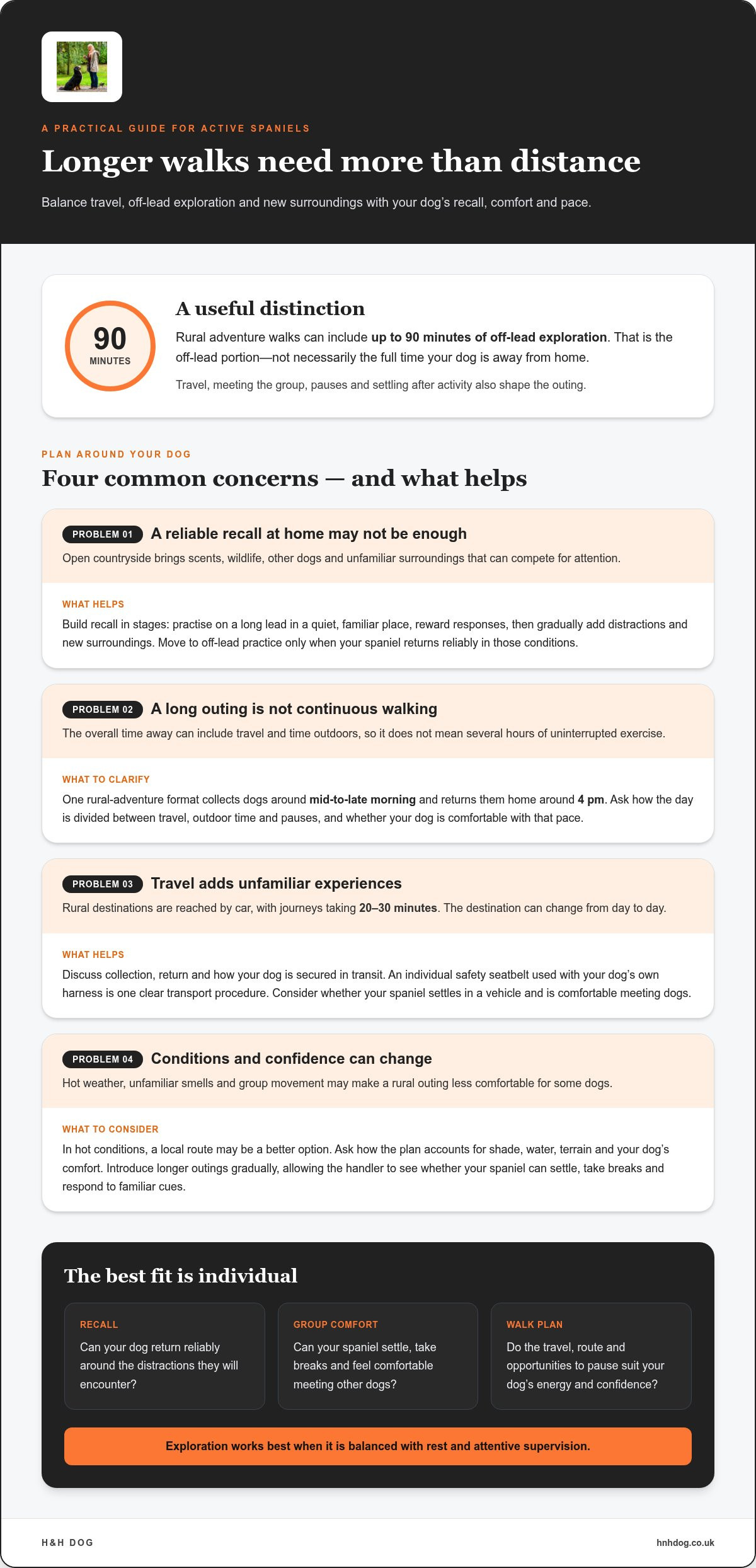
A longer outing can give an energetic spaniel more time to explore beyond familiar Highgate streets. One rural-adventure format involves collecting dogs around mid-to-late morning and returning them home around 4 pm. The full outing includes travel and time outdoors, so it isn’t the same as several hours of continuous walking.
In this format, rural locations are reached by car, with journeys taking 20-30 minutes. The destination can change from day to day, creating different surroundings for sniffing and exploration. For your dog, that change brings new scents and terrain, but it also adds travel and unfamiliar experiences. Consider whether your spaniel settles in a vehicle and feels comfortable meeting dogs before choosing a longer group adventure.
Travel arrangements are part of your dog’s wellbeing, not an afterthought. Before agreeing to a regular walk, discuss collection and return and how your dog will be secured in transit. For example, an individual safety seatbelt used with your dog’s own harness is a clear transport procedure. Familiar equipment may also help a dog who is still getting used to the journey.
Weather can affect which setting is suitable. In hot conditions, a local route may be a better option than travelling to a rural destination. Shade, access to water, terrain and your dog’s comfort all matter. Ask how the walking plan adapts to the conditions rather than assuming the same route works every day.
Ask how a longer walk is introduced. A dog who loves open spaces may still need time to adjust to the vehicle, unfamiliar smells and moving with a group. A gradual first outing lets the handler see whether your spaniel can settle, take breaks and respond to familiar cues.
Recall should progress gradually, too. Begin practising on a long lead, then build towards off-lead exploration when your dog responds reliably in that setting. Group movement, wildlife and unfamiliar surroundings can make returning to the handler harder than practising at home. Longer outings work best when exploration is balanced with rest and attentive supervision.
Before choosing a walking format, clarify collection and return arrangements, discuss travel comfort and ask how routes adapt in hot weather. Then consider your spaniel’s experience in groups and their recall. A longer outing may offer more variety, but the right pace depends on your dog’s needs and comfort.
Off-lead exploration and walk duration
Off-lead time can give a spaniel space to explore, but freedom works best alongside a reliable recall plan. Rural adventure walks around Highgate can include up to 90 minutes of off-lead exploration. That figure describes the off-lead portion, not necessarily the whole time away from home. Travel, meeting the group, pauses and settling after activity also shape the outing.
Build recall in stages. Start by practising on a long lead in a quiet, familiar place. Reward your dog for responding, then gradually introduce distractions and new surroundings. Move to off-lead practice only when your spaniel returns reliably in the conditions they’ll encounter. A good response at home does not automatically carry over to open countryside, where scents, wildlife and other dogs compete for attention.
Consider behaviour as well as recall. Notice whether your dog can disengage from play, respond to their name and settle after excitement. A spaniel who repeatedly chases movement, for example, may need more supported practice before exploring freely. A dog who checks in with the handler and pauses comfortably may be ready for more independence. These observations make off-lead time a considered step, rather than an assumption based on breed or energy.
Duration also depends on what “walk length” means. A Highgate Wood guided walk lasts approximately 1 to 1.5 hours, while a rural outing may include transport and a separate period of exploration. These are different formats, so compare the time your dog is actively walking with the full collection-to-return period. Ask how the outing includes rest, water and transitions between activities.
Weather can change the plan. In hot conditions, a rural outing may give way to a local walking area to support dogs’ comfort. A shaded route with opportunities to pause may suit a warm day better than exposed terrain. Your spaniel’s pace, coat, age and response to heat also affect how long active exploration remains comfortable.
Before increasing walk duration, check your dog’s recall on a long lead, observe how they respond to group movement and note how quickly they recover after excitement. Consider the setting and weather, too. These observations can help you decide whether a shorter local walk or longer outing better suits your dog that day.
For energetic spaniels, a satisfying walk is about more than distance or off-lead time. Sniffing, calm social contact and responsive handling all matter. If your dog struggles with recall or becomes unsettled around other dogs, structured training can help you understand their behaviour and decide what to practise before offering more freedom.
Group dog walks in Highgate
In Highgate, a group walk can provide shared activity and opportunities to learn around other dogs. Whether it suits your spaniel depends on their needs and comfort. Compare the route, introductions and attention from the handler, not just the amount of exercise.
Group Walks Compared with One-to-One Walks
A group walk gives an energetic spaniel the chance to move alongside other dogs, explore shared scents and practise responding amid activity. A one-to-one walk lets the handler focus on your dog’s pace, breaks and individual cues. Consider how your spaniel behaves around unfamiliar dogs: relaxed interest may suit a group, while stress or over-arousal may call for more individual support.
Joining Requirements
Before joining a group, expect to discuss vaccination history, registration details and your dog’s behaviour around other dogs. This information helps the walker understand your dog’s needs and plan suitable handling. Introductions should be gradual: share relevant history, observe your spaniel near the group, and consider whether they can settle and respond to cues. Clarify what records and behaviour details are needed to arrange the walk.
Group Sizes and Walker Ratios
A Highgate group can include up to six dogs. That describes the group maximum, not the number of walkers, so also consider how the handler gives attention across the outing. Discuss how they manage leads, changing excitement and opportunities for quieter dogs to take space. A spaniel who needs frequent pauses, for example, may benefit from a routine that allows the handler to adjust the pace.
Parks and Routes Near Highgate
Highgate Wood is a local green space, and a community route passes Pond Square and Highgate Cemetery. These examples show the variety of nearby settings, not a fixed dog-walking itinerary. Consider how your spaniel handles wooded paths, busy streets and places with people nearby. Route choice should reflect your dog’s confidence and the group’s ability to move calmly.
To arrange a trial walk, contact H&H Dog and ask how an introductory session works. Discuss collection and return, group composition, route planning, lead management and how the handler responds if a dog becomes overwhelmed. Share your spaniel’s recall, social history and known sensitivities. A clear conversation helps you judge whether the first outing feels manageable for your dog.
During an initial introduction, watch your spaniel rather than expecting instant play. Can they notice other dogs, take a break and reconnect with the handler? These small signs help distinguish excitement from discomfort. If the group feels too intense, a slower introduction can give your dog more time to adjust before regular walks begin.
What are the maximum group sizes and dog-to-walker ratios?
A Highgate group can include up to six dogs. That maximum is a useful starting point, but group size alone does not show how much attention each dog receives. The number of handlers, route conditions and dogs’ individual needs all affect how manageable the walk feels for an energetic spaniel.
Dog-to-walker ratio means the number of dogs each handler supervises. A group maximum of six does not, by itself, establish how many walkers will attend. Ask how the walk is staffed and how the handler maintains supervision at crossings, during introductions and when dogs become excited. A clear answer should explain how the group is managed in practice, not just state its maximum size.
For example, a spaniel who pulls towards new scents may need close guidance when the group pauses or changes direction. Another dog might become unsettled if play gets too boisterous. The handler needs to notice these differences, create space when needed and keep the group moving safely. A suitable ratio supports observation and timely responses rather than treating every dog as if they have identical needs.
Before a first outing, consider these practical points:
- Ask how many dogs may join the walk and how many handlers supervise them.
- Find out how introductions are managed and whether dogs can be given space.
- Discuss your spaniel’s recall, lead behaviour and response to lively dogs.
- Ask how the handler adapts if one dog needs a pause or calmer handling.
Use your dog’s behaviour to judge whether the group feels appropriate. If your spaniel can respond to familiar cues, recover after excitement and move comfortably near other dogs, a shared walk may suit them. If they become overwhelmed, bark repeatedly or struggle to disengage, a smaller or more individual introduction may be a better starting point. Those observations help the handler plan support around your dog’s actual responses.
“Up to six dogs” is a maximum, not a promise that every walk will include six. Group composition can change, and temperaments matter as much as numbers. Discuss how the handler considers compatible energy levels and whether dogs can take a break from close interaction. These details show how the group can support movement and emotional comfort.
When discussing group walking for your spaniel, share practical examples: how your dog greets unfamiliar dogs, what happens around strong scents, and which cues work outdoors. Specific information helps shape a thoughtful introduction and gives the walker a clearer picture than “very energetic” alone.
The group limit is up to six dogs. Discuss how that limit applies to your outing and how the walk is supervised. You can then consider whether the arrangement suits your spaniel’s comfort and the level of guidance they need, rather than relying on the maximum alone.
H&H Dog: Full Groom
H&H Dog offers Full Groom for owners looking to include grooming in their dog’s care routine. If your main need is regular exercise and social time for an energetic spaniel, Group Dog Walking is the relevant service to explore. The right choice depends on what your dog needs: grooming, shared walks or both as separate parts of their care.
When deciding what to arrange, consider your spaniel’s comfort and routine. Personalised care keeps their individual needs at the centre of each service.
To discuss the right option for your dog, contact H&H Dog.
Choose a Walk That Fits Your Spaniel
The best next step is to consider what helps your spaniel feel settled as well as active. Notice how they respond to unfamiliar dogs, new environments and time away from home. Sharing those observations can make a conversation about group walking more useful and help you focus on the experience you want for your dog.
If you’re considering group walks for energetic spaniels in Highgate, tell H&H Dog about your dog’s temperament, routine and walking experience. H&H Dog also offers Full Groom, Bath & Brush and Puppy’s First Groom, so grooming can be considered separately as part of their care.
Contact H&H Dog about group walks and take a thoughtful next step towards a routine that suits your spaniel.
Frequently Asked Questions
Which group dog walks for energetic spaniels are available in Highgate, London?
H&H Dog offers Group Dog Walking in North London, including Highgate. Care is personalised to each dog’s needs and temperament, so share what your spaniel enjoys and finds challenging before they join. For group walks for energetic spaniels in Highgate, explain how your dog responds to unfamiliar dogs, exciting scents and changes of pace. That helps set useful expectations for their outings.
Which Highgate dog walkers or walking groups specialise in spaniels or high-energy dogs?
H&H Dog provides Group Dog Walking with personalised care for dogs, not a spaniel-exclusive service. When discussing your lively spaniel, describe their exercise routine, response to other dogs and ability to settle after excitement. For example, mention whether they become highly focused on birds or scents. These practical details help identify the support that may suit your dog better than choosing a walk by breed alone.
What are the walk times, durations and meeting points for group walks near Highgate?
Highgate Wood guided walks meet at the information hut beside the café and last approximately 1 to 1.5 hours. Upcoming listed examples include an autumn walk at 11.30am on Saturday 24 October and a winter walk at 11.30am on Sunday 6 December. These are guided woodland walks, not dog-walking group schedules. For a dog outing, ask about its collection plan and the expected time your dog will be away.
Are off-lead walks available, and what recall or consent rules apply?
Some rural adventure walks around Highgate include up to 90 minutes of off-lead exploration. A sensible progression begins with recall practice on a long lead, then moves to off-lead freedom when the dog can respond in that setting. Agree your preferences with the walker before the outing, including whether you consent to off-lead time. Your spaniel’s recall, comfort around dogs and response to distractions should guide that decision.