
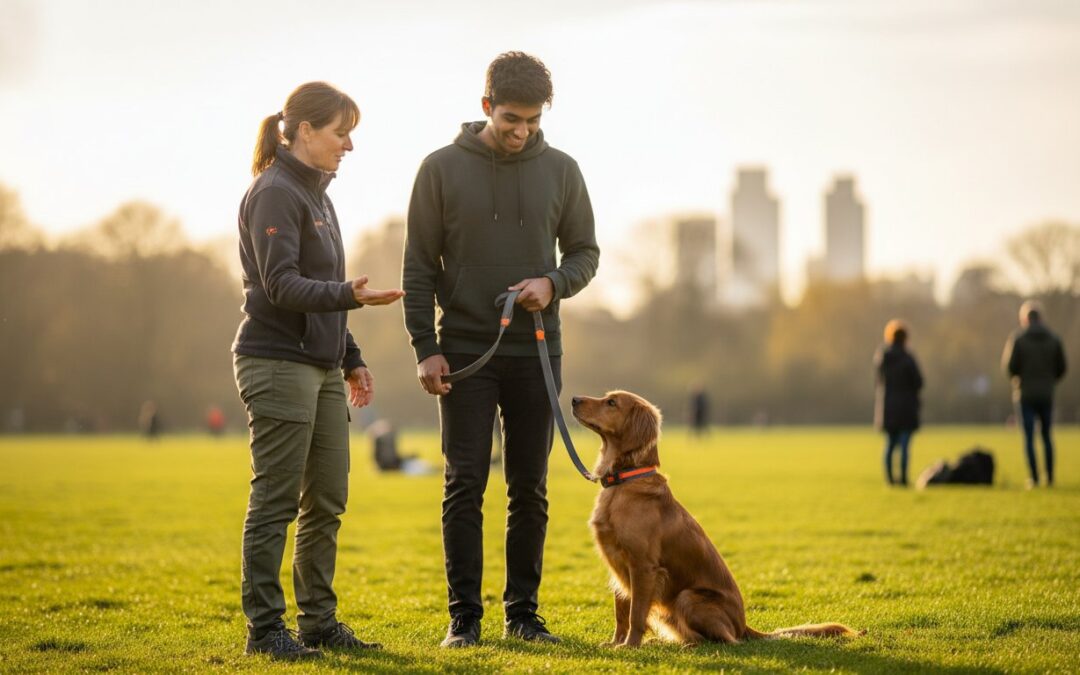
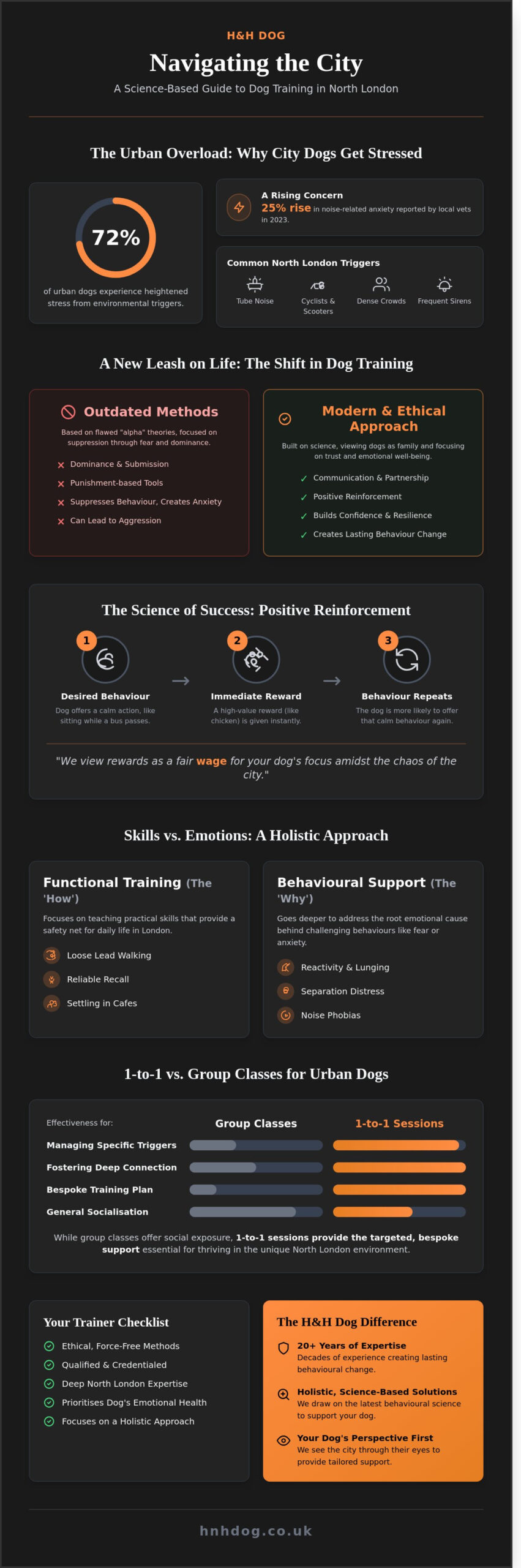
You’re standing on the edge of Hampstead Heath on a busy Saturday, watching your dog lunge toward a passing cyclist while your coffee goes cold and your frustration rises. It’s a scenario many of us face; the sensory density of our local streets can be overwhelming for even the most patient animal. You aren’t alone in feeling that the conflicting advice found in 3 a.m. Google searches only adds to the confusion. With recent data showing that 72% of urban dogs experience heightened stress from environmental triggers, our approach to dog training North London helps you understand that your dog isn’t being difficult; they’re simply overwhelmed.
We believe that every behavioural challenge has a manageable, ethical solution that respects your dog’s emotional health. Discover how to transform your canine companion into a confident, well-behaved city dog with our expert-led guide to local training. We’ll walk through science-based strategies to manage over-stimulation, master reliable recall among the distractions of Highgate Woods, and build a partnership based on mutual trust. It’s time to see the city through your dog’s eyes and provide the tailored support they need to thrive in the capital.
Key Takeaways
- Understand the unique environmental pressures of the city and why professional dog training North London is essential for navigating busy streets and noisy traffic with ease.
- Discover the science behind positive reinforcement and how focusing on your dog’s emotional state builds a more resilient, confident companion without the need for punishment.
- Learn why bespoke 1-to-1 sessions are often more effective than group classes for managing specific urban triggers and fostering a deeper connection with your pet.
- Identify the essential ethical credentials and “dog-first” tools to look for when selecting a qualified professional to support your training journey.
- Gain insight into a holistic approach that prioritises your dog’s perspective, drawing on over 20 years of expertise to create lasting behavioural change.
What is Professional Dog Training in North London?
Modern dog training in a metropolitan context focuses on building a bridge of understanding between species. It’s no longer about barking orders or demanding submission. Instead, dog training North London owners can rely on prioritises clear communication and emotional regulation. This shift is vital because our dogs aren’t just pets; they’re urban companions living in one of the world’s most stimulating environments.
North London presents a specific set of behavioural hurdles that rural dogs simply don’t face. Data from local veterinary consultations in 2023 indicated a 25% rise in noise-related anxiety among city dogs. Between the constant hum of the Northern Line and the dense foot traffic of Upper Street, your dog’s nervous system is often under significant pressure. Professional support helps you decode your dog’s body language so you can intervene before their stress turns into reactive behaviour. We’ve discarded the “alpha” myths of the past. We know now that a dog who “misbehaves” is usually a dog who is struggling to cope with their surroundings.
Early intervention is the most effective way to ensure a peaceful life in the city. Addressing minor lead pulling or slight waryness around delivery bikes today prevents these habits from calcifying into lifelong fears. By focusing on the dog’s internal emotional state, we create a foundation of trust that makes the chaos of London feel manageable for them.
The Difference Between Training and Behavioural Support
Training focuses on functional skills. These are the “how-to” elements of life, such as walking on a loose lead or staying settled while you enjoy a coffee in Crouch End. These skills provide a safety net for your dog’s daily life. Behavioural modification goes deeper. It addresses the “why” behind actions like lunging, barking, or separation distress. In busy boroughs like Camden or Islington, a holistic approach is essential. We don’t just fix the bark; we address the underlying anxiety caused by living in close proximity to neighbours and other territorial triggers. When these challenges run deeper than everyday training can address, working with a qualified dog behaviourist in London provides the specialist insight needed to resolve complex emotional issues at their root.
Why Local Expertise Matters in North London
A trainer who understands the local landscape is invaluable. They know the specific lead requirements and seasonal bylaws for spaces like Alexandra Palace or Highgate Wood. They’re also familiar with the specific “triggers” of your neighbourhood, from the frequent sirens near Whittington Hospital to the heavy skateboard traffic in local plazas. Force-free training is the gold standard for ethical dog care in 2026, prioritising a dog’s emotional well-being and psychological safety over simple compliance. Choosing a professional who knows your streets means your dog training North London sessions are tailored to the real world you walk in every day.
Understanding the Science of Positive Reinforcement
Effective dog training North London owners can rely on is built upon the mechanics of operant conditioning. At its simplest, this scientific principle explains that a dog’s future behaviour is determined by the immediate consequence of their current action. When a dog performs a desired behaviour and receives a reward, they are significantly more likely to repeat that action. This modern approach, often referred to as Humane Dog Training, focuses on teaching your dog what to do rather than punishing them for what they shouldn’t do.
Choosing rewards over punishment creates a resilient, confident companion. Punishment often suppresses behaviour through fear, which can lead to unpredictable “fallout” like increased anxiety or redirected aggression. In contrast, positive reinforcement encourages your dog to be an active participant in the learning process. They become problem-solvers who feel safe enough to try new things. This is particularly vital when navigating high-distraction environments like the busy stalls of Camden Market or the crowded paths of Finsbury Park. In these settings, you must provide high-value rewards; think small pieces of roast chicken or dried liver; to compete with the intense sensory input of the city. We view these rewards as a fair “wage” for your dog’s focus amidst the chaos.
It’s time to retire the “Alpha” myth. The theory that dogs are constantly vying for dominance is based on flawed 1947 studies of unrelated wolves in captivity. Modern science confirms that domestic dogs view us as family, not as rivals in a hierarchical pack. Your dog isn’t trying to dominate you when they jump up or pull on the lead; they’re simply doing what has worked for them in the past or responding to their environment. Building a partnership based on trust is always more effective than attempting to be a “pack leader.”
These principles of trust and communication are not just limited to our canine companions; they form the foundation of all successful partnerships. For those interested in exploring how trust and teamwork apply in other areas, you can read more.
The Power of Enrichment and Mental Stimulation
Physical exercise is only one part of the puzzle. A 20-minute “sniffari” in Highgate Wood, where your dog leads the way and explores every scent, can be more tiring than a 1-hour run. Scent work and food puzzles are essential tools for lowering cortisol levels in city dogs. For those living in North London flats, mental enrichment reduces destructive behaviours like chewing or excessive barking by providing a healthy outlet for natural instincts. If you need help creating a plan for your dog, our tailored training sessions offer bespoke solutions for urban living.
Reading Your Dog’s Body Language
Understanding communication is the key to preventing “reactions” before they happen. By spotting subtle signs of stress, such as lip licking, yawning, or “whale eye” (showing the whites of the eyes), you can support your dog before they reach the higher rungs of the ladder of aggression. It’s a common misconception that a moving tail equals a relaxed pet. A wagging tail does not always signify a happy dog. It can often indicate high arousal, frustration, or even a warning. Learning these nuances allows you to advocate for your dog’s emotional well-being in every situation.
1-to-1 Dog Training vs. Group Classes: Which is Best for You?
Deciding between a group environment and private tuition is a pivotal step in your journey. Group classes provide a controlled space to practice focus around distractions. However, the high-arousal atmosphere of a community hall can sometimes overwhelm a sensitive or reactive pet. This is where 1-to-1 dog training North London offers a distinct advantage. By working in your dog’s actual living environment, we address the specific triggers they face daily. Recent scientific research into dog training methods published in 2024 emphasises that reward-based protocols lead to significantly better welfare outcomes than older, confrontational styles. We prioritise this ethical, evidence-based approach in every session.
Training on a busy street rather than a quiet village hall ensures your dog learns to remain calm amidst sirens and heavy footfall. This “Home Advantage” builds real-world reliability. It’s about teaching your dog that they can trust you, even when the environment feels unpredictable. We focus on the dog’s internal emotional state to ensure they’re truly comfortable, not just suppressed.
When to Choose 1-to-1 Sessions
Individual sessions are essential for complex behaviours like lead reactivity, separation anxiety, or poor recall. These issues require a bespoke plan that a group setting cannot provide. For a busy London professional, these sessions offer vital flexibility. We structure dog training North London around your specific calendar, ensuring you get support without the stress of a fixed weekly commute. Book a 1-to-1 session in North London to begin your tailored programme today.
The Reality of Socialisation in London Parks
Many owners believe that socialisation means meeting every dog they encounter. In reality, forced interactions in crowded spaces like Primrose Hill or Finsbury Park often lead to over-arousal or fear. True socialisation is about teaching your dog to be neutral and calm. Quality interactions with one or two balanced dogs are far more valuable than a chaotic encounter with ten strangers. Focus on these key elements:
- Observation: Let your dog watch the world from a distance before moving closer.
- Body Language: Watch for lip licking or ear pinning which signal discomfort.
- Disengagement: Reward your dog for choosing to look away from another animal.
Managing these interactions in busy areas requires a steady hand and a clear understanding of canine communication. We help you navigate these public spaces with confidence, ensuring your dog feels supported rather than overwhelmed.
Sometimes, the biggest challenge is managing our own anxiety, which our dogs can sense. For owners looking to build their own inner calm and confidence, services like London Hypnotherapy & NLP can provide valuable support, complementing the training you do with your dog.
How to Choose the Right Dog Trainer in North London
Selecting a professional for dog training North London requires more than a quick internet search. The UK dog training industry remains unregulated, meaning anyone can print a business card regardless of their actual expertise. To protect your dog’s emotional health, look for credentials from the Animal Behaviour and Training Council (ABTC) or the Association of Pet Dog Trainers (APDT), which was founded in 1995 to promote kind, science-based methods. These bodies require members to adhere to a strict code of conduct that prohibits punitive equipment and prioritises animal welfare.
- Verify their insurance: Ensure they carry professional indemnity and public liability insurance specifically for canine professionals.
- Check local references: Ask for 3 recent testimonials from owners in your specific borough, such as Hackney or Haringey, to ensure they understand the local environment.
- Examine their toolkit: If they suggest prong collars, choke chains, or spray devices, they are using fear rather than education. Modern trainers rely on harnesses, long leads, and positive reinforcement.
- Assess their urban experience: Training a dog in a quiet rural field is vastly different from navigating the heavy foot traffic of Upper Street or the distractions of Hampstead Heath.
A consultation is your opportunity to see if the trainer’s communication style suits you. You are looking for a mentor who explains the “why” behind a behaviour, helping you feel more in control of your dog’s progress. If you’re ready to start a journey based on trust and modern science, explore our bespoke dog training North London services.
Red Flags to Avoid in Canine Professionals
Be wary of any professional offering “guaranteed results” within a set timeframe. Dogs are sentient individuals with unique learning speeds; 100% certainty is a marketing tactic, not a scientific reality. Avoid those using terms like “pack leader,” “alpha,” or “balanced training.” These are often euphemisms for using physical pressure to suppress behaviour. Similarly, “boot camps” where you send your dog away for 2 weeks often rely on high-stress environments that damage the bond you’ve worked hard to build.
Questions to Ask During Your Initial Consultation
Ask how they support a dog that is too fearful to take treats. A skilled professional will have a “plan B” involving distance, environmental management, or different reinforcement types. Inquire about their specific strategy for lead reactivity in busy areas like Camden. If they can’t provide a case study of a dog they’ve helped in your local park within the last 6 months, they may lack the necessary urban experience to help you succeed in a bustling city environment. For comprehensive guidance on evaluating potential trainers, our detailed resource on finding a professional dog trainer in London provides essential insights into identifying qualified experts who understand the unique challenges of urban canine behaviour.
Bespoke Training Solutions with H&H Dog
Since 2004, H&H Dog has provided expert support to families across North London and Hertfordshire. We operate with a “Dog-First” philosophy. This means we prioritise seeing the world through your pet’s eyes to understand the emotional drivers behind their actions. We don’t believe in one-size-fits-all fixes. Instead, we offer personalised 1-to-1 training and behavioural consultations that fit into your specific lifestyle and home environment.
Our approach is holistic. We integrate our training techniques with our professional dog walking services and grooming services to ensure consistency. When a dog experiences the same positive reinforcement and clear communication across all H&H Dog services, they learn faster. This joined-up thinking reduces confusion for the dog and provides a seamless experience for you. We focus on four core pillars:
- Individual Assessment: Every dog is unique; we start by identifying their specific triggers and motivators.
- Science-Based Methods: We use force-free, ethical techniques that build trust rather than fear.
- Lifestyle Integration: Training is designed to work in your real-life environment, not just a quiet hall.
- Emotional Welfare: We prioritise the dog’s mental health to ensure long-term behavioural changes.
From Puppies to Rescue Dogs: Tailored Support
Starting life in a bustling city requires specific skills. Our puppy foundations focus on building confidence amidst the noise of the capital. We help your new addition master socialisation and lead work before small habits become big problems. For those who’ve opened their homes to a rescue, we provide specialised transition support. Helping a rescue dog adapt to a North London flat or a busy street requires patience and an expert hand. For busy professionals who need additional support during the day, our professional dog walking in London services complement training by providing consistent, structured exercise that reinforces positive behaviours. You can learn about our behavioural consultations to see how we address complex issues like separation anxiety or reactivity with a calm, steady approach.
Join the H&H Dog Community
We believe in empowering the owner. Effective dog training North London relies on you feeling confident in your ability to lead and support your pet. Our team provides the mentorship you need to understand canine body language and communication. You’ll gain access to local knowledge that helps you find the best dog-friendly spots and quiet walking routes in the area. We are your partners in this journey, offering ongoing support as your dog matures. Get in touch today to start your journey with H&H Dog and build a life of mutual respect with your companion.
Begin Your Journey Toward a Calmer Urban Life
Navigating the bustling streets of the capital requires more than just basic obedience; it demands a deep, mutual understanding between you and your dog. By prioritising force-free, science-based methods, you ensure your pup feels secure even amidst the city’s constant distractions. We’ve seen how bespoke, 1-to-1 attention often outperforms generic classes, especially when addressing the unique anxieties of urban living. Choosing the right support means looking for a mentor who advocates for your dog’s emotional well-being as much as their outward behaviour.
At H&H Dog, we bring over 20 years of expert canine experience to every session. Our 5-star reputation across North London, Watford, and Hertfordshire is built on tailored, ethical solutions that respect your dog’s perspective. Whether you’re navigating busy pavements or quiet parks, our approach provides the steady hand you need. It’s time to move past the stress of forceful fixes and build a lasting connection rooted in kindness and modern science for the best dog training North London has to offer.
Book Your Bespoke 1-to-1 Training Session in North London
We’re ready to help you and your dog thrive together in the city.
Frequently Asked Questions
How much does dog training cost in North London?
Professional dog training North London typically costs between £60 and £120 per hour for private, 1-to-1 sessions. Group classes in local areas like Highgate or Islington usually range from £150 to £250 for a comprehensive six-week course. These prices reflect the bespoke nature of modern, force-free coaching and the high demand for qualified experts in the capital. Investing in tailored support early on prevents the financial burden of complex behavioural rehabilitation in the future.
How many sessions will my dog need to see improvement?
Most owners observe a positive shift in their dog’s communication and focus within 3 to 5 sessions. While basic skills like a reliable recall can be established quickly, complex emotional responses require a longer commitment to ensure lasting change. We focus on teaching you to read your dog’s body language so you can continue the progress independently. Every dog is a unique individual, so we adapt the pace to ensure they never feel overwhelmed or stressed.
Can an older dog still be trained, or is it too late?
It is never too late to support an older dog, as canine brains remain capable of learning and adapting throughout their entire lives. Senior dogs often benefit from cognitive enrichment and modified exercises that respect their physical limits and lower energy levels. We have successfully helped 10 year old rescues settle into new North London homes by focusing on building trust and clear communication. Training at this stage is less about “obedience” and more about enhancing their emotional well-being.
What is the difference between a dog trainer and a dog behaviourist?
A dog trainer focuses on teaching specific skills and manners, whereas a dog behaviourist addresses deep-seated emotional issues like aggression, phobias, or separation anxiety. Behaviourists often hold postgraduate qualifications and work on a referral basis from your vet to rule out physical pain or medical causes. If your dog’s actions are driven by fear or intense distress, a behaviourist provides the clinical insight needed for a recovery plan. Trainers are your go-to for socialisation, lead walking, and foundation cues. When searching for the right professional, understanding these distinctions is crucial, and our comprehensive guide on choosing a professional dog trainer in London can help you identify which type of expert best suits your dog’s specific needs.
Is 1-to-1 dog training better than group classes for a nervous dog?
1-to-1 sessions are significantly more effective for nervous dogs because they eliminate the overwhelming sensory input of a busy group environment. In a private setting, we can control every variable and keep your dog below their stress threshold. Data suggests that 85% of anxious dogs learn faster when they feel safe in their own familiar surroundings without the distraction of other animals. This tailored approach allows us to focus entirely on your dog’s specific emotional needs and your personal goals.
Do I need to be present for the training sessions?
Your presence is essential during our sessions because our goal is to coach you, not just the dog. Successful dog training North London relies on the bond between you and your companion, which grows through shared learning and mutual understanding. We provide the tools and confidence you need to handle real-world situations when we aren’t there to assist. By participating, you’ll learn to interpret subtle signals and respond with the empathy and consistency your dog deserves.
Can you help with my dog barking at the doorbell in our flat?
We can certainly resolve doorbell barking by using science-based desensitisation and counter-conditioning techniques tailored for apartment living. In North London flats, where neighbours live in close proximity, this common challenge is often rooted in alertness or territorial anxiety. We’ll teach your dog that the chime predicts something positive, shifting their emotional state from alarm to calm anticipation. Most owners see a 70% reduction in barking frequency after implementing our structured 4-step protocol over three weeks.
What should I bring to my first dog training session?
Please bring a variety of high-value, pea-sized treats, a standard 1.5-metre lead, and your dog’s favourite non-squeaky toy. Avoid using extendable leads or restrictive harnesses, as these can interfere with clear communication and your dog’s physical comfort. If your dog has a specific mat or bed they settle on at home, having that nearby helps create a safe zone for learning. Most importantly, bring an open mind and a willingness to see the world through your dog’s eyes.