
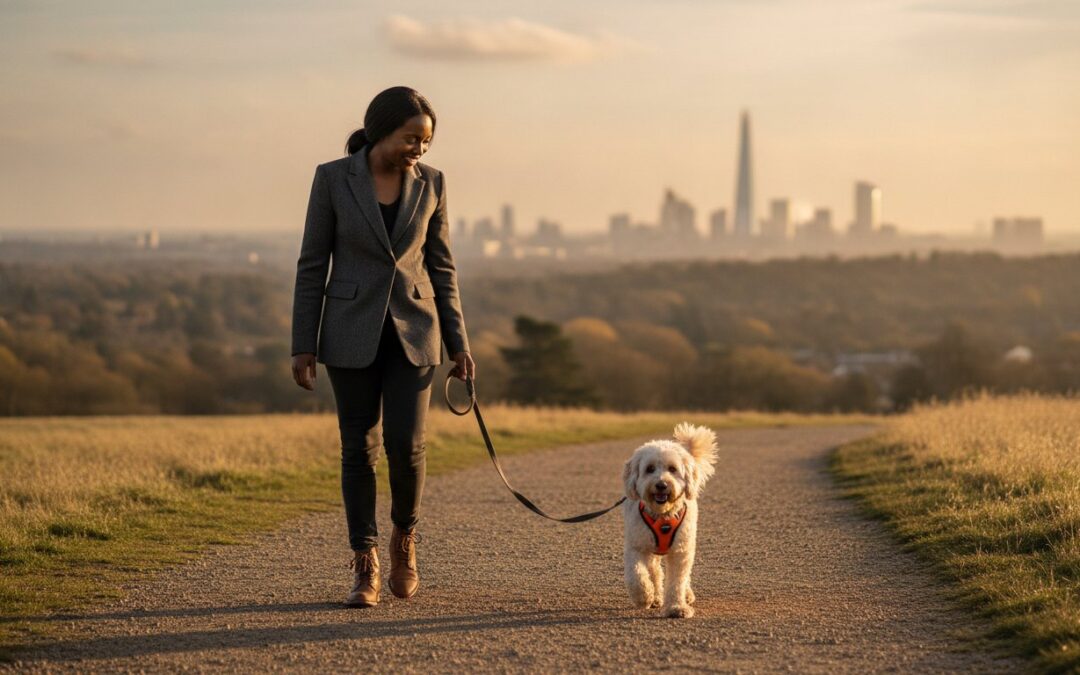
Why does your dog behave perfectly in the quiet of your hallway, only to transform into a relentless steam train the moment you reach the Parliament Hill entrance? It is a common frustration for North London owners who find their peaceful morning strolls overshadowed by aching wrists and the stress of a lunging pet. You likely feel the weight of social expectation in our local parks, where the pressure for a well-behaved dog can feel as heavy as the physical pull on your arm. We understand that this struggle often stems from a place of over-arousal rather than disobedience. Learning how to stop dog pulling on lead Hampstead is not about exerting more force; it is about managing your dog’s engagement with a high-stimulation environment through empathy and clear communication.
We promise that by shifting your focus from control to connection, you can master the art of loose-lead walking and reclaim your weekend enjoyment. This guide provides a calm, expert perspective on the psychological triggers of pulling and outlines a modern, evidence-based approach to building a deeper bond. We will explore how to transition from stressful tug-of-war sessions to a partnership where your dog chooses to walk by your side, allowing you both to enjoy the beauty of the Heath in harmony. Improvement is inevitable with the right, ethical guidance.
Key Takeaways
- Learn why viewing loose-lead walking as a mental connection rather than a physical position is the first step to navigating the high-stimulation environment of the Heath.
- Understand the “Opposition Reflex” and how to reframe your dog’s pulling as a sign of being overwhelmed rather than an act of disobedience.
- Identify the most effective equipment for safety and communication, including the benefits of Y-shaped harnesses over traditional collars for long-term neck health.
- Follow a structured, step-by-step guide on how to stop dog pulling on lead Hampstead by building focus in low-distraction environments before tackling busy parks.
- Discover how rewarding the “Value of the Side” fosters a calm partnership, transforming your stressful North London strolls into a shared, connected experience.
Understanding the Hampstead Pull: Why North London Dogs Struggle
True loose-lead walking is far more than a specific physical position or a lack of tension in the fabric. It is a shared state of mental connection where your dog is actively checking in with you, rather than just being tethered to you. In the quiet hallways of NW3, this connection often feels easy to maintain. However, once you cross the threshold onto the Heath, the environment shifts dramatically. Understanding how to stop dog pulling on lead Hampstead requires acknowledging that your dog isn’t being “naughty”; they are reacting to a sensory landscape that is uniquely challenging. The transition from the structured, narrow pavements of Hampstead’s side streets to the wide, scent-heavy expanse of the park triggers a surge of adrenaline that can make even the most obedient pet lose their focus.
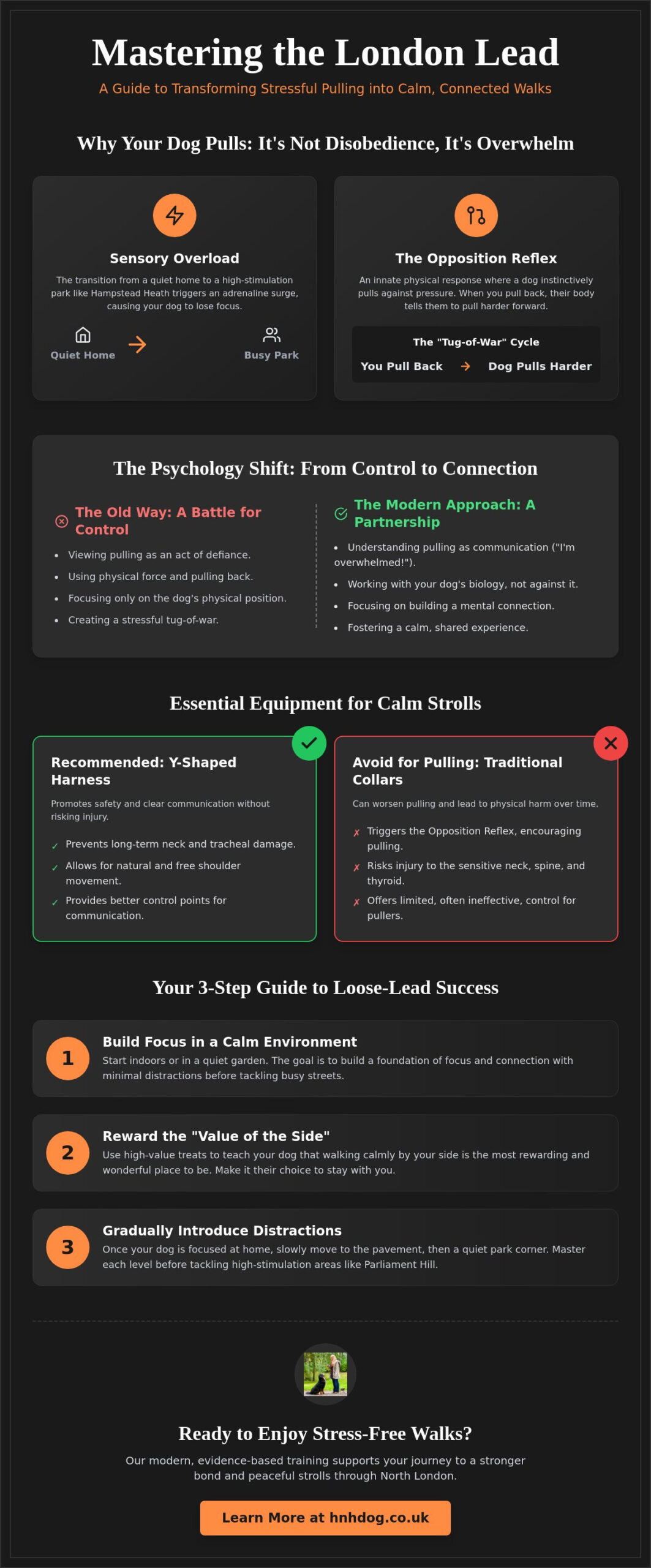
One of the biggest hurdles owners face is a biological phenomenon known as the Opposition Reflex. The Opposition Reflex is an innate physical response where a dog instinctively leans or pulls against any pressure felt on their neck or body. When you pull back to gain control, your dog’s body tells them to pull harder in the opposite direction. This cycle creates a constant tug-of-war that is physically draining for you and stressful for your pet. By applying the foundational principles of dog training, we can learn to work with your dog’s biology rather than against it, fostering a partnership built on mutual understanding.
The Sensory Overload of Hampstead Heath
Hampstead Heath represents a “perfect storm” for lead tension. The ancient woodlands and bathing ponds carry complex scent trails that are irresistible to hunting breeds and curious crossbreeds alike. High-traffic areas like Parliament Hill add another layer of complexity; the sheer social density of joggers, other dogs, and families can push a dog’s arousal levels into the “red zone” before they have even reached the grass. This is why many owners notice the “zoomies” or frantic pulling the moment the lead is clipped on at the gate. The anticipation of the freedom ahead becomes a powerful motivator that overrides their focus on you.
Urban Stressors vs. Natural Instincts
It is helpful to distinguish between exploratory pulling, where a dog is simply eager to reach a new scent, and stress pulling. On narrow Hampstead streets, dogs are often forced into uncomfortable proximity with triggers like passing delivery vans or other reactive dogs. This lack of space can cause a dog to pull forward simply to escape a perceived pressure. Recognising the subtle signs of over-stimulation, such as flicking ears, a stiffened tail, or a refusal to take treats, is essential. When you understand how to stop dog pulling on lead Hampstead, you begin to see that managing the environment is just as important as the physical act of walking.
The Psychology of the Lead: Why Pulling is a Communication, Not a Crime
To truly understand how to stop dog pulling on lead Hampstead, we must first look past the physical strain and examine the emotional state of our companions. Many owners view a tight lead as an act of defiance or a lack of respect. In reality, pulling is almost always a form of communication. Your dog is likely telling you they’re overwhelmed by the environment or frustrated by the restriction of the lead itself. When a dog is over-stimulated, their cognitive brain often shuts down, and their reactive brain takes over. They aren’t choosing to ignore you; they’re simply unable to process your requests in that moment.
This frustration often builds into lead reactivity. When a dog feels restricted and cannot reach a person, a squirrel, or another dog they wish to investigate, that pent-up energy has nowhere to go but into the lead. Cultivating calmness as a default in your North London home is a vital prerequisite for success. If your dog is constantly pacing or hyper-vigilant indoors, expecting them to be serene on the Heath is unrealistic. Progress starts with a relaxed mind long before you reach the front door.
Understanding the Opposition Reflex
The Opposition Reflex is a physiological urge to push against any pressure felt on the body. Think of it as the “Sled Dog” effect. If you pull back, your dog’s natural instinct is to lean forward. Conventional “jerk and release” methods are counter-productive because they trigger this reflex and damage the trust between you. Instead, we suggest using “following” exercises that encourage the dog to move with you voluntarily. If you find these concepts challenging to implement alone, a bespoke session of 1-to-1 Dog Training can provide the hands-on guidance needed to break this cycle through partnership rather than force.
The Link Between Grooming and Walking Behaviour
It’s easy to overlook how physical discomfort affects a dog’s patience. Matted fur that pulls on the skin or long nails that alter a dog’s gait can significantly increase their irritability. A dog in physical discomfort has a much lower threshold for environmental stress. Investing in a full dog grooming session does more than just make your pet look pristine; it improves their overall sensory comfort. Reducing baseline cortisol levels through a “spa day” can make a noticeable difference in their ability to stay calm on a walk. A comfortable dog is a more attentive student.
Essential Equipment for Calm Strolls in NW3
While the psychological connection we discussed previously is the foundation of a good walk, the physical tools you choose act as the bridge for that communication. Understanding how to stop dog pulling on lead Hampstead involves selecting equipment that facilitates clear signals rather than physical suppression. In a high-stimulation environment like North London, your gear should prioritise your dog’s safety and your own comfort. The right equipment doesn’t just stop the pull; it creates a neutral canvas where learning can actually happen. If you’re struggling to find the right fit, our 1-to-1 Dog Training sessions can help you trial different options tailored to your dog’s unique gait and size.
Harness vs. Collar: The Great Debate
For dogs that lunge or pull consistently, a traditional flat collar can pose significant risks to the delicate structures of the neck, including the trachea and thyroid gland. We strongly advocate for a well-fitted, Y-shaped harness that allows for completely restricted shoulder movement. Front-clip harnesses are particularly effective for heavy pullers. By attaching the lead to the chest rather than the back, you can gently redirect your dog’s momentum back towards you without triggering that Opposition Reflex we explored earlier. It’s essential to ensure a bespoke fit; a harness that is too loose can rub, while one that is too tight can alter your dog’s natural movement and cause long-term joint issues.
Lead Length and Material
Retractable or “flexi” leads are often the enemy of loose-lead walking in urban environments. They teach your dog that the only way to gain more freedom is to keep tension on the line, which is the exact opposite of our goal. A fixed lead of 1.5m to 2m is the “sweet spot” for Hampstead’s pavements. This length provides enough room for your dog to sniff comfortably while keeping them close enough for safety near busy roads. We prefer materials like biothane or high-quality leather. These offer a superior grip and remain comfortable in your hands even during a drizzly morning on the Heath. For training in open spaces, a 5m to 10m long line can be a wonderful tool, allowing your dog to practice “checking in” from a distance while remaining safely tethered.
To enhance your control, consider the “Double-Ended Lead” technique. By using a lead with clips at both ends attached to both the front and back of a harness, you create two points of contact. This provides better balance and allows you to steer your dog’s body more effectively without using force. For high-distraction areas like the busy ponds or Parliament Hill, we recommend using moist, high-value rewards such as small pieces of cooked chicken or low-fat cheese to maintain focus. These rewards serve as a powerful motivator that can compete with the intense scents of the park, ensuring your dog stays mentally engaged with you throughout the journey.
A Step-by-Step Guide to Loose-Lead Training in London
Learning how to stop dog pulling on lead Hampstead is a progressive journey that begins long before you reach the ponds. We view training as a series of successful repetitions in increasingly complex environments. If you jump straight into the high-arousal setting of the Heath, your dog’s brain will be too busy processing scents to learn new skills. Success requires a structured approach that builds confidence and focus in layers. For those seeking personalised support during this process, our bespoke dog training in North London offers a steady hand to guide you through these transitions.
- Step 1: The Boring Zone. Start your practice in a low-distraction environment like your hallway or garden. This allows your dog to focus entirely on you without the competition of squirrels or other pets.
- Step 2: Master the Value of the Side. Focus on rewarding the position, not just the action. Deliver treats right at your trouser seam to teach your dog that being by your side is the most profitable place to be.
- Step 3: The Penalty Yard. When the lead goes taut, stop immediately. Do not pull back. Wait for your dog to create slack themselves, perhaps by looking back at you, before moving forward again.
- Step 4: Introducing Controlled Distractions. Gradually move your practice to the quiet side streets of NW3. Practice walking past the park gate several times without entering to lower the anticipation levels.
- Step 5: The Hampstead Proofing. Once your dog is consistent on pavements, begin short sessions near high-stimulation areas like Parliament Hill. Keep these sessions brief to ensure your dog finishes with a sense of achievement.
Building Focus Before You Leave the House
The walk begins the moment you pick up the lead. We recommend the “Check-In” game, where you reward your dog for making eye contact before the front door even opens. This sets a tone of partnership rather than one of frantic escape. Use a clear “Let’s Go” cue to signal that the training walk has officially started. Remember that a tired dog isn’t always a well-behaved one. Physical exhaustion often leads to a lack of impulse control, whereas mental fatigue from focus-based games creates a much calmer companion. If you find the initial steps overwhelming, booking a session of 1-to-1 Dog Training can help you establish these foundational habits in the comfort of your own home.
Handling Real-World Distractions
North London presents unique challenges, from narrow mews to sudden squirrel sightings. When your dog spots a distraction, use the “Find It” game by scattering a few treats on the ground to redirect their nose and lower their arousal. For high-stress encounters on narrow paths, master the “Emergency U-Turn.” This involves a cheerful cue and a smooth change in direction to move away from a trigger before your dog has a chance to lunge. These proactive management techniques ensure that how to stop dog pulling on lead Hampstead becomes a manageable daily practice rather than a weekend battle.
How H&H Dog Supports Your Journey to Stress-Free Walks
At H&H Dog, we believe that every dog is an individual with unique emotional needs and specific environmental triggers. Our philosophy is rooted in providing personalised care tailored to the individual dog, ensuring that we never apply a one-size-fits-all solution to a complex behaviour like lead tension. If you have been struggling with how to stop dog pulling on lead Hampstead, you likely know that the theory is often easier than the practical application. This is where our integrated approach provides the steady hand you need to bridge the gap between training concepts and your daily reality on the Heath.
One of the biggest pitfalls for owners is the inconsistency between their training efforts and the habits formed during standard walks. Our professional dog walking service is designed to reinforce your progress rather than undo it. We don’t just exercise your dog; we manage their engagement with the world. Our walkers are trained to maintain the same lead consistency you use at home, ensuring that your dog receives clear, non-conflicting signals every time they step outside. This professional oversight prevents the “rehearsal” of pulling behaviours that often occurs when a dog is walked without a focus on connection.
When pulling is driven by deep-seated anxiety or intense reactivity, our behavioural consultations provide a deeper dive into the emotional root of the behaviour. We look beyond the physical act of pulling to understand the underlying motivations, such as the fear or frustration we explored in previous sections. By addressing the internal state first, we make the external action of walking calmly a manageable task for your pet. Our goal is long-term emotional health, not just a temporary fix.
The Synergy of Training and Walking
Consistency is the cornerstone of any successful training plan. Our walkers are specifically trained to handle group dynamics while maintaining individual lead standards. Socialising in a structured group walk can actually reduce frustration-based pulling, as dogs learn to move calmly in the presence of their peers without the need to lunge. After every outing, we provide bespoke feedback so you can track your dog’s progress. This collaborative approach ensures that your dog is learning even when you aren’t the one holding the lead, making the process of how to stop dog pulling on lead Hampstead a true team effort.
Expert One-to-One Coaching
Traditional classroom training often fails to translate to the real world because it lacks the specific triggers found in our local environment. Our 1-to-1 Dog Training sessions take place in-situ, right where the challenges actually occur. Whether it is the distraction of the bathing ponds or the social density of Parliament Hill, we work with you in real-time to refine your technique. This hands-on mentorship gives you the confidence to handle high-stimulation situations with a calm, expert perspective. If you are ready to transform your strolls into a connected partnership, book a consultation with our expert team today.
Reclaiming Your Peaceful Heath Strolls
Reclaiming your morning walk on Hampstead Heath is within reach when you shift from a mindset of control to one of connection. We’ve explored how understanding your dog’s sensory experience and using the right tools, like Y-shaped harnesses, creates a foundation for success. By following a structured training path that begins in the quiet of your home, you can effectively master how to stop dog pulling on lead Hampstead. This journey is about more than just a loose lead; it’s about fostering a partnership built on mutual trust and clear communication. Every step taken with patience brings you closer to the calm partnership you both deserve.
Our expert team brings over 20 years of professional experience to help you navigate North London’s unique urban challenges. We offer bespoke 1-to-1 training in your local environment to ensure your progress translates directly to the real-world distractions of the Heath. Transform your walks with H&H Dog’s expert training and walking services and rediscover the joy of a calm, connected stroll. You don’t have to face the struggle alone. Improvement is inevitable with the right, ethical guidance and a steady hand to support you.
Frequently Asked Questions
How long does it take to stop a dog from pulling on the lead?
The timeframe for seeing progress depends on your dog’s age, breed, and how long the pulling habit has been rehearsed. You’ll often see initial improvements in focus within a few days of starting in low-distraction zones. However, achieving reliable loose-lead walking in high-arousal areas like the Heath usually requires several weeks of consistent, daily practice. Patience is essential as you work to rewire their emotional response to the environment.
Is a harness or a collar better for a dog that pulls?
A well-fitted, Y-shaped harness is significantly better for a dog that pulls because it protects the delicate structures of the neck. Traditional collars can cause tracheal damage or thyroid issues if a dog lunges suddenly. A harness distributes pressure across the chest and shoulders, allowing for safer management. When learning how to stop dog pulling on lead Hampstead, using a front-clip harness can also provide gentle redirection without triggering the natural opposition reflex.
My dog only pulls when they see another dog – what should I do?
This behaviour often stems from frustration or over-excitement rather than aggression. Your first priority should be increasing the distance between your dog and the trigger. Use high-value rewards to encourage a “check-in” before they reach their threshold. If you find yourself trapped on a narrow Hampstead path, use the “Emergency U-Turn” technique we discussed earlier to move away calmly. Consistent management prevents the behaviour from becoming a permanent habit.
Can an older dog learn to walk on a loose lead?
Absolutely, dogs can learn new communication skills at any age. While an older dog may have years of rehearsed pulling to overcome, they often have better impulse control than a boisterous puppy. The process involves identifying their specific motivators and gradually introducing new associations with the lead. It’s never too late to foster a deeper bond based on mutual understanding rather than physical force. A calm, senior dog often makes an excellent student.
Why does my dog pull more on the way to the park than on the way home?
This is driven by anticipation and high arousal levels. Your dog has learned that the route to the park leads to intense sensory rewards like squirrels and social interaction. This excitement makes it difficult for them to maintain cognitive focus. On the way home, their physical and mental energy is often lower, making them more receptive to your cues. Managing this excitement through “Check-In” games before you even leave the house is vital for balance.
What is the best lead for a dog that pulls in a city like London?
A fixed-length lead of 1.5 to 2 metres is the most effective choice for urban walking. It provides enough freedom for sniffing while ensuring you maintain control near busy North London roads. Avoid retractable leads, as they teach dogs that tension is the key to gaining more space. Materials like biothane are ideal because they offer a secure grip and remain easy to clean after a muddy morning session on the Heath.
Should I use a “Halti” or head collar for my dog in Hampstead?
Head collars can be useful management tools for very strong pullers, but they aren’t a permanent fix for the underlying behaviour. Many dogs find them restrictive or uncomfortable, which can actually increase their stress levels in busy areas. We prefer using a double-ended lead on a harness for better balance and steering. If you choose a head collar, it must be introduced slowly with positive associations to ensure it doesn’t damage your dog’s trust.
How can a professional dog walker help with my dog’s pulling?
A professional dog walker provides the essential consistency needed to master how to stop dog pulling on lead Hampstead. When a walker uses the same cues and techniques you do at home, it prevents your dog from becoming confused by conflicting signals. Our walkers are trained to prioritise mental connection over physical distance. This ensures that every outing reinforces your training goals, helping your dog remain calm and attentive even when you aren’t there.
Hello
https://shorturl.fm/feM6h
https://shorturl.fm/Pr0S2
https://shorturl.fm/d3EXo
https://shorturl.fm/TNItN
https://shorturl.fm/lJMoG
https://shorturl.fm/FjIAR
https://shorturl.fm/IHFM4
https://shorturl.fm/Am7nA
https://shorturl.fm/afx5Z
https://shorturl.fm/fRqc5
https://shorturl.fm/ZV2Tr
https://shorturl.fm/AtFUz
https://shorturl.fm/4wwvG
https://shorturl.fm/ytknA
https://shorturl.fm/SXBhV
https://shorturl.fm/pX3T8
Great content! Keep up the good work!
https://shorturl.fm/lShGX
https://shorturl.fm/9Vo8M
https://shorturl.fm/IKb4y
https://shorturl.fm/bddUK
https://shorturl.fm/We5ac
https://shorturl.fm/TdTCj
https://shorturl.fm/SRjNA
https://shorturl.fm/uDXOf
https://shorturl.fm/cS69T
https://shorturl.fm/xNmT2