
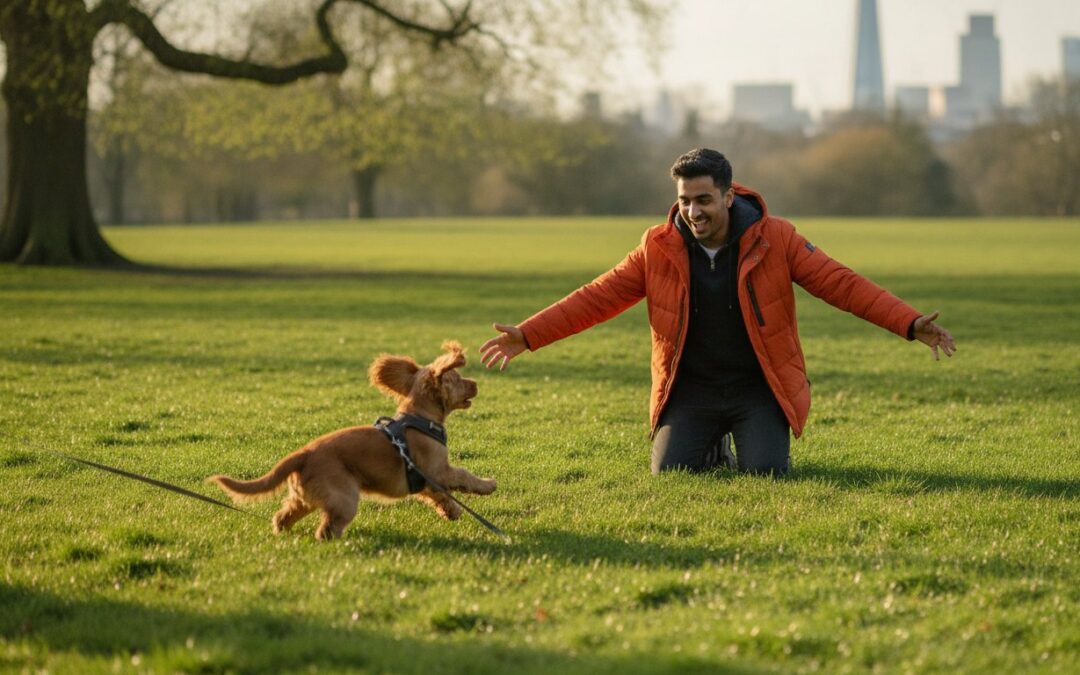
Imagine standing in the middle of a busy Hampstead Heath, calling your puppy’s name as they sprint toward a group of picnickers or a distant squirrel. It is a heart-stopping moment that many owners face, especially when the reality of recall training for puppies in North London meets the heavy distractions of our urban green spaces. You’ve likely felt the sting of embarrassment when your dog ignores you, or the genuine fear that they might head toward a nearby road. It’s a common challenge, made more difficult by the sea of conflicting online advice that often leaves you feeling more overwhelmed than prepared.
You deserve a dog that listens because they trust you, not because you’re shouting. This guide will help you build that reliable, life-saving recall, ensuring your puppy returns immediately regardless of what is happening around them. We will look at how to navigate the recent Crime and Policing Act 2026, which has seen fines for dog control breaches rise to £500, and provide a clear, evidence-based strategy for stress-free walks in Finsbury Park or Highgate Woods. By focusing on your dog’s internal emotional state rather than just their outward compliance, you can foster a partnership that ensures safety and peace of mind for years to come.
Key Takeaways
- Learn why a reliable recall is the most critical life-saving skill for navigating the unique risks of North London’s busy roads and parks.
- Discover how to shift your perspective from basic obedience to a genuine partnership where you’re the most interesting part of your puppy’s world.
- Master the “Distance and Duration” rule to help your puppy ignore squirrels and cyclists during recall training for puppies North London.
- Use a long-line training lead in controlled environments to ensure success and prevent your puppy from learning that running away is rewarding.
- Explore how bespoke 1-to-1 puppy training provides a more effective, personalized solution for the specific challenges of urban living than generic group classes.
Why Recall is the Essential Skill for North London Puppies
Recall is often framed as a simple obedience exercise, but for those of us raising dogs in the city, it is a fundamental safety requirement. In an environment as vibrant and unpredictable as North London, a reliable recall is the most critical life-saving skill your dog will ever learn. It goes beyond mere politeness; it is the invisible lead that keeps your puppy safe when the physical one is detached. When we discuss contemporary dog training principles, we must always consider the specific context of your puppy’s daily life.
We refer to this specific level of responsiveness as “Urban Recall.” This isn’t just about coming back in a quiet garden. It means your puppy can process your request and respond immediately, even while a cyclist zips past or a bus brakes nearby. Mastering recall training for puppies North London ensures that you aren’t just reacting to problems as they arise. Instead, you’re proactively building a foundation of mutual trust that functions under pressure.
The Safety Reality in North London
The geography of North London presents unique challenges that suburban or rural owners rarely face. Many of our most beloved green spaces, such as Highbury Fields or the edges of Alexandra Park, sit in close proximity to major arterial routes like the A1 or the North Circular. A single moment of distraction or a sudden fright can lead a puppy toward heavy traffic in seconds. In these high-stakes environments, a “mostly reliable” response simply isn’t enough to guarantee safety.
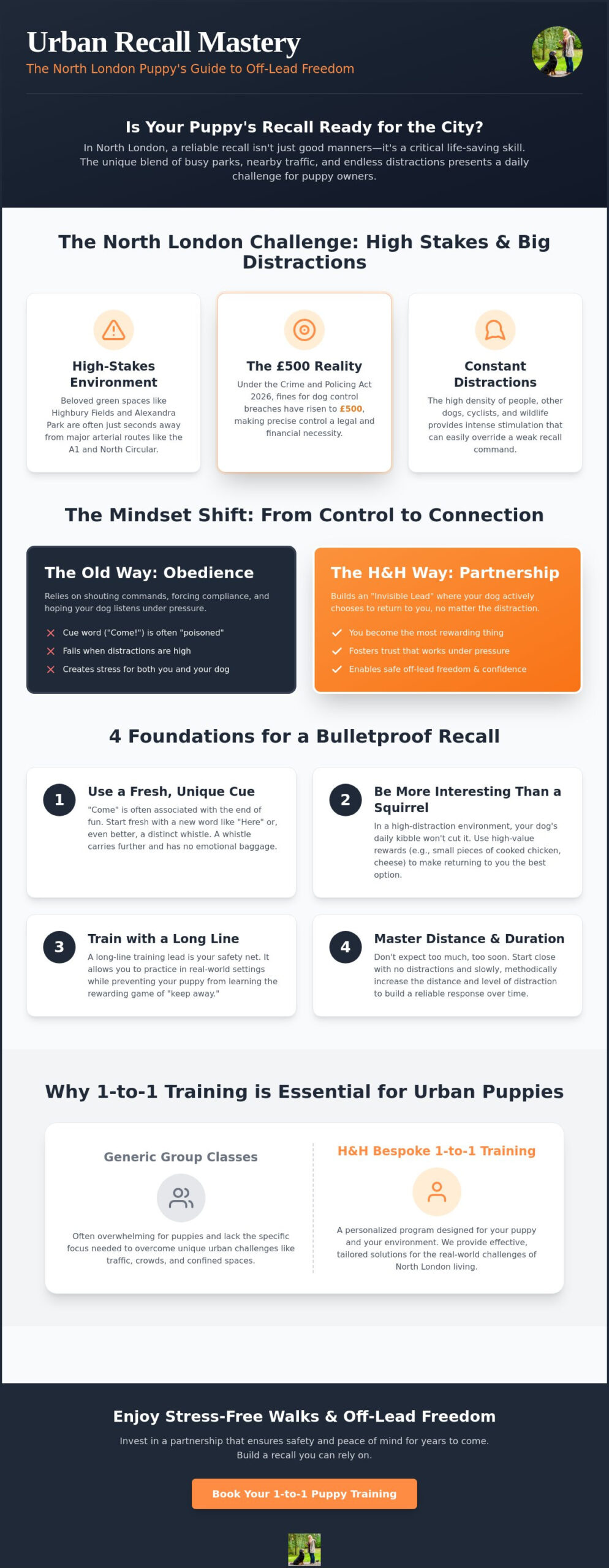
Beyond the roads, we also manage a high density of people, other pets, and wildlife in our communal spaces. Effective recall training for puppies North London is about navigating these social complexities with ease. Being able to call your puppy away from a picnic or a nervous dog is essential for community harmony. It is also worth noting that under the Crime and Policing Act 2026, fines for dog control breaches in public spaces have increased to £500. Having precise control over your puppy’s movements is now a legal and financial necessity as much as an ethical one.
The Emotional Benefit of Off-Lead Freedom
While safety is the primary driver, the emotional rewards of a solid recall are equally profound for the animal. Off-lead time is essential for a puppy’s physical development and mental stimulation. It allows them to engage with their environment at their own pace, sniffing and exploring in a way that is physically impossible while restricted by a lead. This freedom builds genuine confidence. When a puppy knows they can explore and still feel connected to you, their overall anxiety levels drop.
This isn’t about achieving control through force. It is about a partnership. By investing in their education, you provide them with a richer, more fulfilling life. You move from a state of constant worry to one of shared enjoyment. Every time your puppy chooses to return to you amidst the bustle of the city, that bond of trust strengthens, making your walks a source of connection rather than stress.
The Foundations of a Reliable Recall
A reliable recall is not a feat of mechanical obedience; it is a manifestation of your relationship. When we approach recall training for puppies North London, we must move away from the idea of “making” a dog return. Instead, we focus on building a partnership where your puppy actively chooses you over the environment. This emotional connection acts as an “Invisible Lead,” a psychological bond that keeps your puppy checking in even when they are physically free. If your dog doesn’t want to be with you, no amount of shouting will bring them back when a squirrel appears.
To achieve this, you must become the most interesting thing in their world. This is a significant challenge in North London’s parks, where the scent of other dogs and the movement of cyclists provide intense biological stimulation. Many owners struggle because they rely on standard kibble. In a high-distraction environment, dry food is rarely enough to compete with the dopamine hit of a chase. You need high-value rewards, such as small pieces of cooked chicken or cheese, to make returning to you the most rewarding event of their day.
Choosing Your Recall Cue
The word “Come” is often the first casualty of early training. If you’ve ever used it to end a play session or when you were frustrated, the word may now be “poisoned” in your puppy’s mind. It signals the end of fun or a potential scolding. Choosing a fresh, unique cue like “Here” or using a whistle can provide a clean slate. Whistles are particularly effective for distance and consistency. Their tone never changes, regardless of how stressed or tired you might feel, ensuring the message remains clear to your puppy.
Understanding Puppy Motivation
Puppies are biologically wired to explore. Their brains are seeking information about the world, and every new scent is a reward in itself. When your puppy ignores you, they aren’t being “naughty.” They’re simply following a stronger biological drive to learn about their surroundings. By understanding this, we can work with their curiosity rather than fighting it. One of the most effective ways to build this is through the “Check-in” habit. Reward your puppy every time they look back at you without being prompted. This reinforces the idea that staying connected to you is always beneficial. If you find the distractions of the city are consistently winning, professional one-to-one puppy training can help you tailor these foundations to your specific environment and your puppy’s unique personality.
Overcoming North London’s Urban Distractions
Moving from the quiet of your hallway to the vibrant energy of a local park is the most challenging phase of recall training for puppies North London. While the theory of partnership is vital, the practical reality of a squirrel darting across a path in Queen’s Park or a cyclist speeding through Finsbury Park can test even the strongest bond. These urban distractions are not just minor inconveniences; they are high-value biological triggers that compete directly with your voice. To succeed, you must understand how to manage these triggers without causing frustration for you or your puppy.
The most effective tool in your arsenal is the “Distance and Duration” rule. If your puppy cannot return to you when a distraction is ten metres away, they are simply too close to that stimulus to process your request. Their brain is currently occupied by the “seeking” system, making it physically difficult for them to hear you. By increasing the distance between your puppy and the distraction, you lower the intensity of the trigger. This allows them to succeed, building a history of positive choices that eventually allows you to work in closer proximity to those same busy areas.
In wooded environments like Highgate Wood, the challenge often shifts to predatory drive. The scent of wildlife is a powerful motivator that can lead a puppy to wander deep into the undergrowth. Managing this requires a bespoke approach tailored to your specific walking route. A generic “one size fits all” method fails because it doesn’t account for the unique layout of your local green space. You need a strategy that considers where the highest density of squirrels resides and where the boundaries of the park meet the road.
The Hampstead Heath Challenge
Hampstead Heath offers a scale of freedom that is rare in London, but its wide-open spaces can be overwhelming for a young dog. With the mix of professional dog walkers, families, and the lure of the bathing ponds, maintaining focus is a constant task. It is easy for a puppy to get out of sight behind a ridge or a thicket of trees. In these vast areas, you must be proactive. Don’t wait for your puppy to be 50 metres away before you engage them. Frequent, low-stakes check-ins near the ponds or wildlife areas ensure they remain mentally tethered to you even when the physical distance grows.
Managing Street-to-Park Transitions
The success of your walk is often decided before you even unclip the lead. The transition from the pavement to the park gate is a high-arousal moment where many puppies lose their focus. If they are pulling and frantic at the gate, they are already in a state of mind that makes recall unlikely once they are free. Use the gate as a training opportunity. Require calm behaviour and a moment of eye contact before the lead comes off. The first five minutes of your walk dictate the emotional tone for the rest of the session. Starting with a calm, connected state makes it far more likely that they will listen when you call them back later.
Training Steps for a Bulletproof Recall
Building a reliable response requires a structured, tiered approach. You cannot expect a puppy to ignore a squirrel if they haven’t yet mastered the basics in your living room. The goal of recall training for puppies North London is to ensure success at every stage, preventing the puppy from learning that they can ignore you. By creating a series of small, manageable wins, you foster a sense of competence in your puppy and a feeling of control for yourself. Each successful repetition reinforces the idea that returning to you is the most rewarding choice they can make.
Phase 1: The Home Foundation
Start in your hallway or garden where distractions are minimal. This is where you build the powerful association between your chosen cue and a high-value reward. Positive reinforcement is the delivery of a valued reward following a desired behaviour to increase that behaviour’s frequency. At this stage, your puppy should receive their favourite treat every single time they respond. Use games like “Hide and Seek” to tap into their natural curiosity. Hide behind a sofa or an open door and call them. When they find you, celebrate with genuine enthusiasm. This teaches them that finding you is an engaging game rather than a restrictive command.
Phase 2: The Long-Line Transition
Once your puppy is responsive at home, move to a quiet corner of a park using a 5-metre or 10-metre long-line training lead. This tool is essential for safety in London’s open spaces. It prevents your puppy from “self-rewarding” by running away while giving them the feeling of freedom. Hold the line loosely and don’t use it to reel them in like a fish. Instead, use it as a safety net. If they hesitate, a gentle vibration on the line can remind them of your presence. Start proofing the recall around mild distractions, such as a rolling tennis ball or a dog walking in the distance. This ensures they can maintain focus even when the world becomes more interesting.
To reach a bulletproof level, you must systematically increase the “Three Ds”: Distance, Distraction, and Duration. Only change one variable at a time. If you move to a busier area (Distraction), keep the distance short. If you increase the distance, ensure the environment is quiet. This logical progression prevents the puppy from becoming overwhelmed. Never punish a slow recall. If they take their time, they’re still making the right choice to return. If you scold them upon arrival, you teach them that returning to you is unpleasant. Always make yourself the best place to be. If you find the transition from garden to park difficult to manage alone, our bespoke 1-to-1 Dog Training offers the expert support needed to master these steps in your local environment.
Professional Support: 1-to-1 Training with H&H Dog
While the steps outlined in this guide provide a solid framework, the practical reality of recall training for puppies North London often requires a more nuanced touch. Every puppy is an individual with a unique temperament, and North London’s parks present a specific set of challenges that generic advice cannot always address. At H&H Dog, we bring over 20 years of experience working across North London and Watford to help you navigate these complexities. Choosing one-to-one puppy training ensures that the focus remains entirely on your specific needs, allowing for a bespoke plan that respects your dog’s personality and your urban lifestyle.
Why a Personal Mentor Matters
You may have reached a plateau where YouTube videos and training books no longer provide the answers you need. This is a common experience for urban owners. A video cannot observe your handling skills or provide real-time feedback on your timing. Having a professional mentor by your side allows for immediate adjustments that can make the difference between a hesitant response and a bulletproof recall. We offer a calm, ethical solution that prioritises your puppy’s emotional welfare, ensuring they return to you because they want to, not because they are afraid. This personalised approach demystifies complex psychological concepts, making you feel more in control of your puppy’s education.
Beyond the Recall: A Happy Urban Life
A reliable recall is just one element of a well-adjusted city dog. It sits within our wider framework of comprehensive North London dog training, which aims to build confidence and resilience in all aspects of urban living. For those managing more complex emotional challenges, predatory drives, or deep-seated fears, our dog behaviourist services provide a holistic, evidence-based approach to support your pup’s long-term health. We look beyond the outward action to understand the internal emotional state, ensuring a permanent shift in behaviour.
Consistency is the final piece of the puzzle. Integrating your training goals with our professional dog walking services ensures that the foundations you build are reinforced even when you aren’t there. Every puppy is an individual, and their path to freedom should be as unique as they are. We invite you to book a consultation with us today. Securing your puppy’s safety and your own peace of mind is the greatest gift you can give your pet as they grow. Together, we can ensure that every walk in North London is a source of joy and connection.
Secure Your Puppy’s Freedom in the City
Building a life-saving recall is one of the most rewarding investments you can make in your puppy’s future. It transforms your daily walks from a source of potential anxiety into a shared adventure, allowing your dog to explore the richness of our local parks with confidence. By focusing on a partnership built on trust and systematically managing urban distractions through a tiered approach, you provide your pet with the freedom they deserve while ensuring their safety.
Expert recall training for puppies North London ensures that your dog remains mentally tethered to you, even when the city’s sights and sounds are at their most intense. If you’re ready to move beyond generic advice, we offer bespoke, non-coercive training methods tailored to your puppy’s unique temperament. With over 20 years of professional experience across North London and Watford, we provide the empathetic mentorship needed to master these essential skills. Book a 1-to-1 Puppy Training Session in North London to begin building a bond that lasts a lifetime. You have the tools to create a safer, happier life for your puppy; with the right guidance, a reliable recall is well within your reach.
Frequently Asked Questions
How long does it take to train a puppy to have a reliable recall?
A reliable recall is a journey rather than a destination, usually requiring several months of consistent, daily reinforcement to become habitual. While your puppy might grasp the basic concept in a week, true reliability amidst urban distractions requires proofing across different developmental stages. It’s essential to remain patient as their brain matures, especially during the adolescent phase when they naturally seek more independence from you.
My puppy comes back at home but ignores me in the park. What should I do?
Puppies often struggle to generalise behaviours, meaning they don’t automatically understand that a command in the kitchen applies to Highbury Fields. The park offers high-value biological rewards like scents and squirrels that compete with your voice. To bridge this gap, you must use higher-value rewards and practice recall training for puppies North London in quieter corners of the park before moving to busier areas.
Is it ever too late to start recall training for a puppy?
It is never too late to begin recall training for puppies North London, though older dogs may require more repetitions to replace established habits. Dogs are lifelong learners, and the principles of partnership and trust apply at any age. While a younger puppy is a “blank slate,” an adult dog often has a longer attention span, which can actually make certain parts of the training process smoother.
Should I use a whistle or my voice for recall training in London?
A whistle is often superior to the human voice because its tone remains consistent regardless of your emotional state or the distance. In a busy city environment, your voice can easily be drowned out by traffic or wind, whereas a whistle’s sharp frequency cuts through urban noise. Using a whistle also prevents your verbal cue from becoming “poisoned” if you’ve previously used it in frustration.
What are the best treats for recall training with high distractions?
The best treats for high-distraction environments are “high-value” proteins that your puppy doesn’t receive at home, such as small pieces of plain cooked chicken, cheese, or liver paste. These rewards must be more enticing than the environment. Soft, smelly treats are usually more effective than dry biscuits because they are easier to consume quickly, keeping the focus entirely on the interaction with you.
How do I handle a puppy that thinks being called is a game of chase?
If your puppy thinks being called is a game of chase, you should immediately stop moving toward them and instead turn and run in the opposite direction. Moving away triggers their natural instinct to follow you, turning the game back in your favour. When they catch up, reward them heavily. You should never chase a puppy, as this reinforces the idea that staying away is fun and rewarding.
Can I practice recall training on a busy North London street?
You should never practice off-lead recall on a busy North London street due to the extreme safety risks involved. Instead, use these high-traffic areas to practice “focus” and “engagement” while your puppy is securely on a short lead. You can reward them for looking at you or sitting calmly as buses pass, which builds the foundations of attention needed for successful park recall later.
Is a long-line lead safe to use in a busy park like Hampstead Heath?
A long-line lead is a safe and effective tool for training, provided it is attached to a well-fitted harness rather than a collar. This prevents neck injuries if the puppy reaches the end of the line at speed. In busy areas like Hampstead Heath, stay mindful of other park users and cyclists to ensure the line doesn’t become a trip hazard or get tangled in undergrowth.