

Imagine standing on a narrow North London pavement as a jogger approaches with a calm retriever. Before you can even react, your dog is lunging, barking, and spinning at the end of the lead. You feel the heat of embarrassment rise as passersby offer judgmental glances, and suddenly, the park you once loved feels like a sensory minefield. You aren’t alone in this struggle. Many owners find that the high-density environment of the city turns a simple stroll into a high-stakes ordeal. Seeking professional leash reactivity training London residents can trust is the first step toward reclaiming your peace of mind and your dog’s emotional well-being.
It’s exhausting to feel like every walk is a battle or a source of public shame. You likely dread the daily outing, fearing that your dog might hurt themselves or someone else in the chaos. This article will help you move past that fear, promising to transform your stressful walks into calm, connected experiences through evidence-based methods tailored specifically for the city. We will explore the underlying motivations behind these outbursts, identify your dog’s specific triggers, and outline a bespoke path to restoring the bond with your pet.
Key Takeaways
- Learn to distinguish between fear-based reactivity and barrier frustration to better support your dog’s emotional needs on busy city streets.
- Discover how “trigger stacking” affects urban dogs and why professional leash reactivity training London residents use focuses on managing sensory overload before it leads to an outburst.
- Identify the essential management gear, such as front-clip harnesses, that provides you with the confidence and mechanical advantage needed for safe urban walks.
- Master a step-by-step training foundation, starting with simple check-ins at home before progressing to identifying your dog’s critical distance in public spaces.
- Understand why bespoke, 1-to-1 behavioural support is often more effective than group classes for navigating the unique psychological challenges of the London environment.
What is Leash Reactivity and Why is London So Challenging?
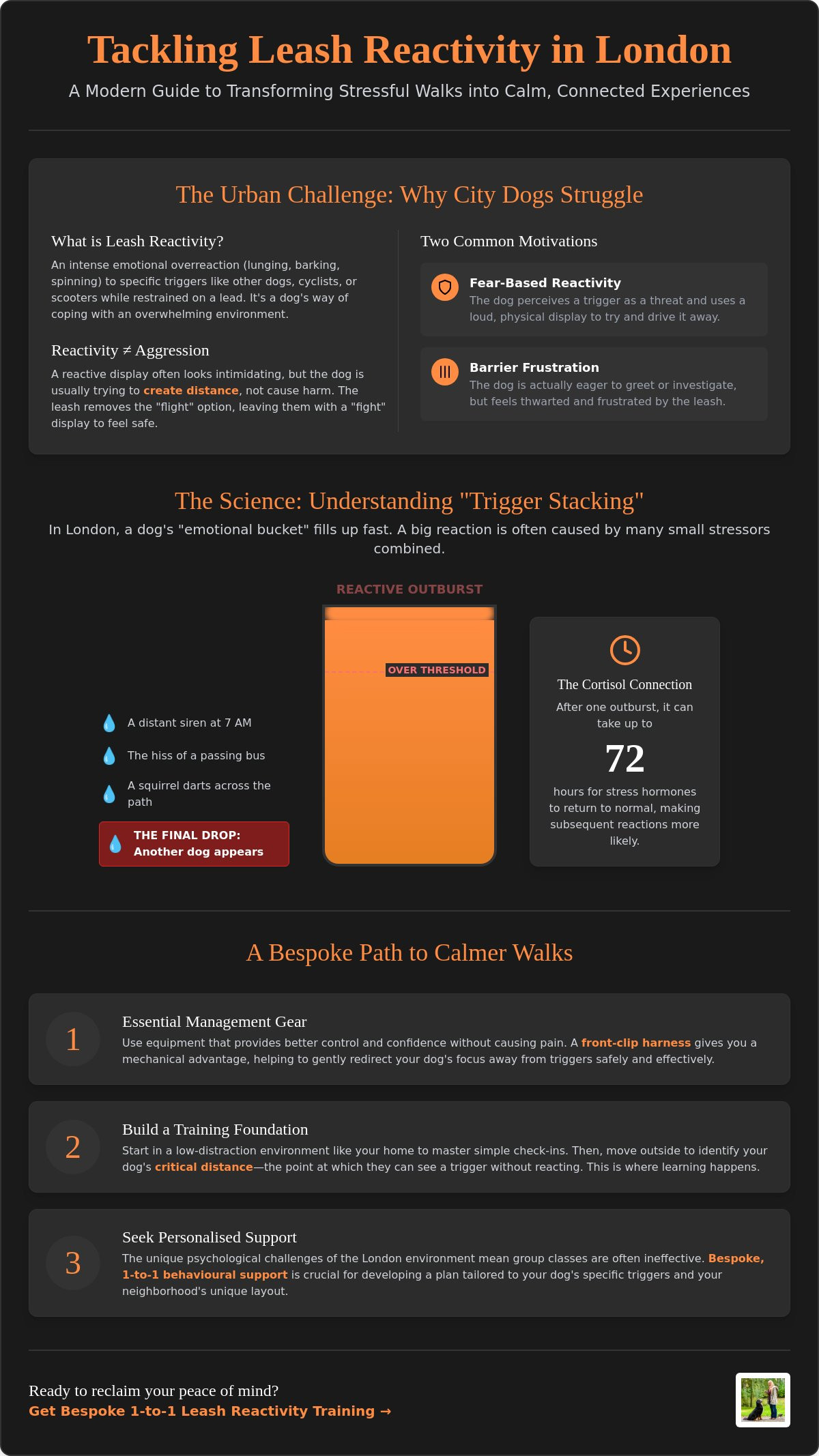
Living in high-density areas like North West London presents unique challenges that rural dog owners rarely encounter. When we discuss What is Leash Reactivity, we are describing an intense emotional overreaction to specific stimuli, such as other dogs, cyclists, or delivery scooters, while the dog is restrained on a lead. This behaviour often manifests as lunging, barking, or spinning. It’s a common struggle for urban pet parents, and seeking professional leash reactivity training London services is often the most effective way to address the root cause rather than just the symptoms. It’s vital to remember that your dog isn’t being “bad”; they are simply struggling to cope with the environment.
Understanding the motivation behind the reaction is the first step toward a solution. Most cases fall into two distinct categories: fear-based reactivity or barrier frustration. In fear-based cases, the dog perceives a threat and uses a loud, physical display to drive that threat away. Barrier frustration occurs when a dog is actually eager to greet or investigate but feels thwarted by the physical constraint of the lead. Both states result in a dog that is “over threshold,” meaning their brain is flooded with stress hormones and they are no longer capable of processing your instructions. In the tight confines of the city, these emotional states escalate with incredible speed.
The Difference Between Aggression and Reactivity
It is a common misconception that a reactive dog is an aggressive one. While the display looks intimidating, a lunging dog is usually trying to create distance, not cause harm. The lead is a significant factor here because it prevents the natural “flight” response. When a dog feels they cannot move away from a perceived threat on a narrow pavement, they feel forced into a “fight” display to protect themselves. Even the “frustrated greeter” who just wants to say hello can be reactive. Their inability to reach the other dog creates a surge of cortisol and adrenaline that looks and feels identical to a fearful outburst.
Why London Pavements Amplify the Problem
The geography of London itself often works against our dogs’ natural instincts. In areas like Belsize Park or Islington, narrow pavements offer almost no space for a dog to move away. When two dogs walk directly toward each other on a slim stretch of concrete, it’s seen as a confrontational, rude approach in canine body language. In more open spaces, dogs naturally curve their approach to signal peaceful intentions. Urban life also introduces high-frequency triggers like delivery scooters and the constant hum of traffic. This persistent sensory input keeps a dog’s nervous system on high alert. This makes specialized leash reactivity training London protocols essential for teaching dogs how to navigate these unavoidable urban pressures without feeling overwhelmed.
Understanding the Science: Trigger Stacking and Sensory Overload
To understand why your dog reacts so explosively on a Tuesday morning, we must look at their internal “emotional bucket.” This concept, known as trigger stacking, is particularly relevant for those seeking leash reactivity training London residents need for their urban pets. In a quiet village, a dog might only encounter one or two stressors a day. In London, the bucket fills quickly. A distant siren at 7 am, the hiss of a passing bus, and a squirrel darting across a garden all add layers of stress before you even leave your street.
By the time you reach a busy park, your dog’s bucket is already brimming. The sight of another dog isn’t just a single event; it’s the final drop that causes the bucket to overflow. At this point, your dog is no longer choosing to misbehave. They are in a state of physiological survival. This shift in perspective is crucial. We must value their internal emotional health over outward obedience. A dog who is “sitting” but trembling with tension is not truly succeeding. They are simply suppressed and still suffering internally.
The Cortisol Connection
Cortisol is the primary stress hormone that prioritises immediate survival over the brain’s ability to process new information or logic. This biological flood explains why your dog seems to “forget” their training the moment a trigger appears. They aren’t being stubborn; they are physically incapable of listening. After a significant reactive incident, it can take up to 72 hours for these cortisol levels to return to a baseline state. This “hangover” effect means your dog will be significantly more sensitive for several days following an outburst. If you’re struggling to manage these spikes, our behavioural consultations offer a supportive way to identify and manage these hidden stressors.
Assessing Your Dog’s Threshold
Progress relies on keeping your dog in the “Green” or “Yellow” zones where they still feel safe enough to learn. The Yellow Zone is where the magic of change happens. You might notice subtle signs like a fixed stare, a closed mouth, or a sudden stillness. This is the moment to intervene before they hit the “Red Zone” of barking and lunging. Research from Cornell University on managing reactivity highlights that distance is your most valuable tool. In London, finding space is hard, but it’s vital. Effective leash reactivity training London programmes always prioritise keeping the dog below their threshold. Forcing a dog to “face their fears” through flooding only causes further trauma and breaks the bond of trust you’ve worked so hard to build.
Essential Management Gear and Urban Survival Strategies
Your confidence on the street is directly linked to your sense of control. When you feel physically capable of managing your dog’s strength, your anxiety drops, which in turn helps your dog stay calmer. This is why choosing the right equipment is a core pillar of effective leash reactivity training London residents rely on. We aren’t looking for tools that punish or cause pain. Instead, we want gear that offers mechanical advantage and safety while respecting the dog’s emotional state. Proper equipment acts as a safety net, allowing you to focus on the environment rather than a slipping collar.
The Reactive Dog Toolkit
A front-clip harness is often superior to a traditional collar for urban management. It redirects the dog’s momentum back toward you rather than allowing them to pull forward with their full weight. For additional security, a double-ended lead attached to both a harness and a collar provides a steering-wheel effect. This gives you two points of contact, which is vital for peace of mind when walking near busy London roads. While some owners consider head collars, these require careful introduction as they can be quite aversive if used incorrectly. For more on these distinctions, ASPCApro’s guide to leash reactivity provides excellent detail on gear selection and management tactics.
In high-distraction zones like Camden or Watford, standard kibble often fails to keep a dog’s attention. You need “high-value” rewards. Small pieces of roast chicken, cheese, or even wet food in a squeeze tube are excellent choices. These rewards must compete with the intensity of the urban environment, helping your dog remain focused on you rather than the passing delivery scooter.
Navigating Tight Spaces
Survival strategies are just as important as gear. The “Emergency U-Turn” is perhaps the most vital skill for any London owner. It’s a practiced, 180-degree turn that allows you to exit a confrontational situation before an outburst occurs. If a trigger is unavoidable, try the “Find It” game. Scattering treats on the ground encourages your dog to lower their head and use their nose. Sniffing is naturally calming and provides a grounding focus on a busy high street. You can also use the urban landscape to your advantage. Parked cars, wheelie bins, and shop doorways act as visual barriers to break your dog’s stare. If you’re on a narrow footpath in Islington, the “Magnet Move” (holding a handful of treats to your dog’s nose to guide them past a trigger) can be a lifesaver. When communicating with others, be direct. Saying “my dog needs space” is more helpful than “my dog is aggressive,” as it provides a clear instruction for the other person to follow.
A Step-by-Step Training Plan for London Success
Training a reactive dog in a city requires a methodical approach that prioritises emotional safety over physical compliance. While management gear helps you survive the walk, a structured training plan is what eventually makes those outings enjoyable again. The goal of leash reactivity training London owners often seek is to help the dog feel safe enough to look at a trigger and then look back at their owner for guidance. We begin this process in the quietest possible environment before slowly testing our progress in the real world. This gradual exposure ensures the dog’s “emotional bucket” stays at a manageable level.
Step 1: Building Value in the Owner
Before you can ask your dog to focus on you in a busy park, you must ensure you are the most rewarding presence in their life. We start with “Check-ins” at home, where there are no distractions. Reward your dog every time they choose to look at you without being asked. This builds a history of reinforcement that carries over to the street. Using name recognition games helps break hyper-fixation; your dog’s name should be a cue that something wonderful is about to happen. For those starting with younger dogs, our foundational puppy training advice provides the perfect base for building this essential focus.
Step 2: Desensitisation and Counter-Conditioning
The core of our work involves changing how your dog feels about their triggers. We use the “Open Bar/Closed Bar” technique to ensure the timing is precise. When the trigger (a dog or scooter) appears, the “bar” opens and high-value treats flow. When the trigger disappears, the treats stop. This teaches the dog that the presence of the scary thing actually predicts good things. You can use a clicker or a specific marker word like “Yes” to precisely communicate the exact moment your dog sees a trigger while remaining calm. We also implement “Look at That” (LAT) training, where your dog is rewarded for simply noticing a trigger at a distance without reacting, giving them a sense of choice and control.
Step 3: Generalisation in Urban Environments
Success in the garden doesn’t immediately translate to a busy London park. We must generalise the behaviour by slowly increasing the difficulty. Start in a quiet street in Watford or a suburban cul-de-sac before attempting a walk near a canal path. Identifying your dog’s “Critical Distance” is vital. This is the closest they can get to a trigger while still being able to take a treat. If an off-lead dog approaches, don’t panic; use your emergency U-turn or the “Magnet Move” discussed previously to maintain space. Setbacks are a natural part of the learning curve. If your dog has an outburst, it simply means the environment was too challenging for their current skill level. If you feel stuck, our 1-to-1 dog training sessions provide the personalised guidance needed to navigate these hurdles safely.
Why Personalised Support is Essential for Reactive Dogs
While the training steps outlined previously provide a clear roadmap, applying them in the unpredictable environment of a busy city is often easier said than done. Many owners initially attempt group classes, only to find that their dog is too overwhelmed to even enter the building. For a dog that is already struggling, being in a room full of other dogs is like trying to learn a new language in the middle of a loud nightclub. This is why professional leash reactivity training London residents choose often focuses on individualised care. A one-to-one setting ensures your dog remains below their threshold, allowing for genuine cognitive change rather than just temporary suppression.
A qualified dog behaviourist London brings a trained eye to your walks, spotting the subtle physiological shifts that occur long before a bark or lunge. They can identify a slight tensing of the jaw, a change in ear position, or a subtle weight shift that most owners naturally miss. By catching these micro-expressions, you can intervene much earlier, preventing the emotional bucket from overflowing. This personalised support also allows for a plan tailored to your specific reality, whether that involves navigating the narrow pavements of North West London or managing the high-frequency triggers of a local high street.
The Value of One-to-One Training
A “one size fits all” approach rarely works for complex behavioural issues because every dog’s internal world is different. Some dogs may be perfectly calm around buses but lose all focus when they see a specific breed, such as a Labrador or a Shepherd. Customising the training to address these specific triggers is vital for long-term success. Beyond the dog’s progress, one-to-one sessions focus heavily on building your own confidence. When you feel supported, you stop “telegraphing” anxiety down the lead. This reduction in tension is often the missing piece of the puzzle, as it signals to your dog that you are capable of handling the environment.
How H&H Dog Supports London Owners
With over 20 years of experience navigating the unique challenges of North and North West London, we understand the pressure you feel. Our approach is that of a gentle mentor; we offer non-judgmental, ethical support for both the dog and the human at the end of the lead. We don’t just give you a list of instructions; we partner with you to ensure your dog’s long-term emotional welfare is protected. This holistic perspective values the bond you share with your pet above all else, making improvement an inevitable result of the right guidance. To begin your journey toward calmer walks, Book a behavioural consultation with H&H Dog today and let us help you reclaim your peace of mind.
Reclaiming Your Peace on the London Pavements
Walking through the city shouldn’t feel like a daily trial of endurance. By understanding the science of trigger stacking and respecting your dog’s internal emotional state, you’ve already begun the journey toward a more harmonious life together. You now recognise that the right equipment and a structured, step-by-step training plan are essential tools for navigating our narrow streets with confidence. However, the most profound change often comes from bespoke support that addresses your dog’s specific triggers and your unique walking routes.
At H&H Dog, we bring over 20 years of professional training experience specifically tailored to the North London urban environment. Our evidence-based, ethical, and non-coercive methods ensure that your dog’s welfare remains the priority. We specialise in leash reactivity training London owners can rely on for long-term results rather than quick, forceful fixes. If you’re ready to transform your walks from stressful encounters into calm, connected experiences, we’re here to guide you. Book your 1-to-1 Leash Reactivity Consultation with H&H Dog today. You don’t have to face these challenges alone; with the right mentorship, a peaceful walk is well within your reach.
Frequently Asked Questions
How long does leash reactivity training take to see results in London?
Progress varies depending on your dog’s history and the frequency of urban triggers, but you can often see a reduction in the intensity of outbursts within the first few weeks of consistent management. True emotional counter-conditioning is a marathon rather than a sprint. Lasting change typically requires several months of dedicated leash reactivity training London owners can integrate into their daily routines to ensure the new behaviours become permanent habits.
Can an older dog be cured of leash reactivity?
Dogs are capable of learning new emotional responses at any stage of their lives. While an older dog might have more ingrained habits, the underlying principles of desensitisation remain effective. The process simply requires a bit more patience and a steady hand from the owner. We focus on building new, positive associations to replace the old, fearful ones, ensuring your senior companion feels safe in their environment regardless of their age.
Should I use a muzzle for my reactive dog on London streets?
Using a well-fitted basket muzzle is a responsible choice that provides a vital safety net in crowded city spaces. It often helps the owner feel more relaxed, which prevents tension from travelling down the lead to the dog. If you choose this path, it’s essential to introduce the muzzle slowly using positive reinforcement. This ensures your dog views it as a comfortable piece of equipment rather than a stressful punishment.
Are group dog walks suitable for a reactive dog?
Standard group dog walks are generally unsuitable and often detrimental for dogs struggling with reactivity. The proximity of other dogs in a confined van or a busy park can keep your pet in a state of constant sensory overload. For these dogs, 1-to-1 attention is necessary to ensure they stay below their threshold. This personalised approach prevents the emotional bucket from overflowing and allows for meaningful progress that group settings cannot provide.
Why does my dog only react when they are on the lead?
This phenomenon is often caused by barrier frustration or the loss of the “flight” option in the flight-or-fight response. When off-lead, dogs can use body language and distance to navigate social encounters peacefully. On a lead, they feel trapped and unable to communicate naturally. This physical restriction creates a sense of vulnerability that leads to the loud, defensive displays you see on the pavement when they encounter a perceived threat.
Should I punish my dog for barking at other dogs?
Punishing a reactive dog is counterproductive and increases the underlying stress. Correcting a bark only suppresses the outward symptom while intensifying the internal fear or frustration that caused the behaviour. This approach can lead to a dog that bites without warning because they’ve been taught that growling or barking is unsafe. We focus on addressing the underlying emotion to create a dog that feels no need to bark in the first place.
How can I find quiet places in London to train my reactive dog?
Finding space in the city requires a bit of local detective work and timing. Industrial estates on Sunday mornings or quiet residential cul-de-sacs during mid-morning on weekdays are often deserted. You might also consider visiting larger parks at dawn when the crowds are thinner. These low-distraction environments are perfect for the initial stages of leash reactivity training London pets need before moving to busier high streets or canal paths.
What should I do if an off-lead dog approaches us?
Stay as calm as possible and try to create a “treat magnet” by holding food to your dog’s nose while moving away smoothly. You can also try a “treat scatter” on the ground to distract the approaching dog, giving you time to exit the situation safely. If the other owner is nearby, clearly call out that your dog needs space. Your primary goal is always to protect your dog’s emotional threshold and get to a safe distance as quickly as possible.
https://shorturl.fm/XFxz9
https://shorturl.fm/XaB2V
https://shorturl.fm/pGKT5
https://shorturl.fm/D2g9v
https://shorturl.fm/CTT7c