
You’ve barely reached the bottom of the communal stairs before the first howl echoes through the hallway, followed by the frantic scratching that makes your heart sink. For many, living with a dog who can’t be left alone feels less like companionship and more like being a prisoner in your own home. It’s exhausting to live in a constant state of guilt, worrying about noise complaints from neighbours or the genuine distress your dog is feeling while you’re just trying to buy groceries. You aren’t alone in this struggle. Research suggests that 8 out of 10 dogs in the UK find it difficult to cope when left alone, and in a city where 49% of households own a pet, the pressure of urban living makes this a particularly sharp challenge. Professional dog separation anxiety training London owners can rely on is about more than just quiet; it’s about emotional recovery.
This guide offers a path toward a different life, where you can enjoy dinner out or a quick trip to the shops without a second thought. We’ll show you how to replace panic with peace using evidence-based, sub-threshold methods that prioritise your dog’s sense of safety. We’ll explore why traditional “tough love” fails and how to build a manageable, bespoke plan that respects your dog’s emotional limits. You’ll learn the specific steps needed to help your dog finally understand that being alone is a safe, quiet time for rest, giving both of you the freedom you deserve.
Key Takeaways
- Reframe separation anxiety as a clinical panic disorder rather than “naughty” behaviour, allowing for a more compassionate and effective starting point for recovery.
- Master the concept of sub-threshold training to ensure your dog never reaches a state of panic during the desensitisation process.
- Implement urban-specific lifestyle management to handle communal hallway noise and lift dings while following a bespoke plan for dog separation anxiety training London.
- Identify why generic DIY advice often falls short and how professional 1-to-1 assessments catch the subtle micro-signals of stress that indicate a dog’s true emotional state.
- Build a sustainable, non-coercive roadmap for your dog’s recovery that values long-term emotional safety and restores your personal freedom.
What is Dog Separation Anxiety? Understanding the Panic Response
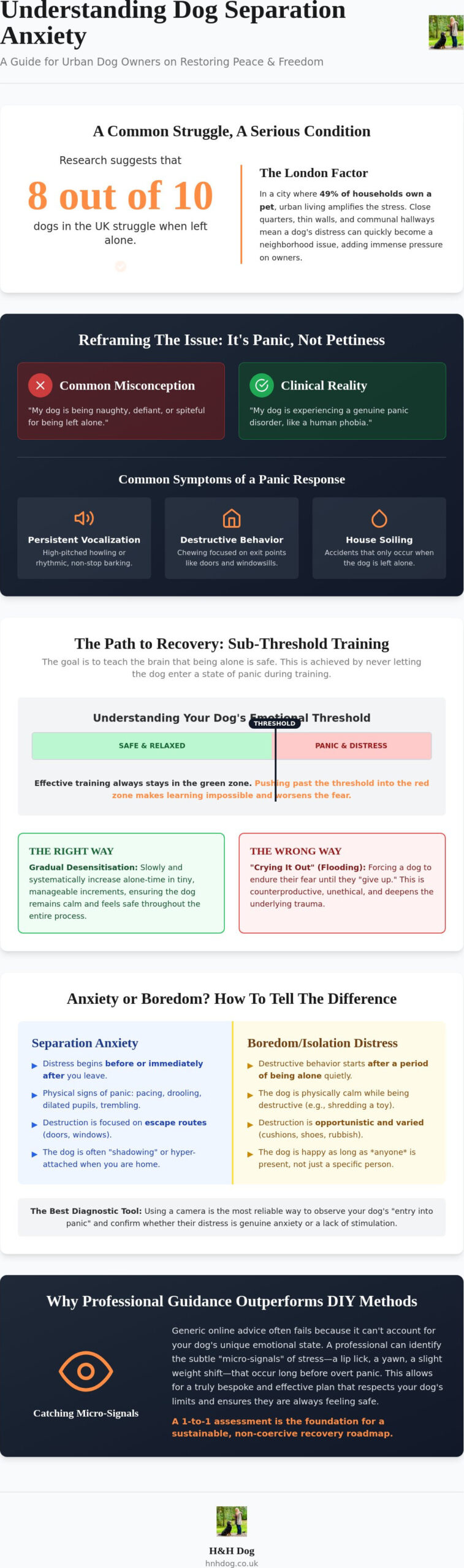
When you return home to find a chewed doorframe or a puddle on the rug, it’s easy to feel frustrated. However, it’s vital to understand that your dog isn’t acting out of spite or a lack of discipline. True separation anxiety is a clinical panic disorder, very similar to a human phobia. Your dog isn’t being “naughty”; they’re experiencing a profound loss of coping mechanisms. By understanding dog separation anxiety as a physiological emergency, we can move away from blame and toward effective, compassionate solutions.
In a city like London, this condition carries a unique weight. Living in close quarters means that your dog’s distress is often shared with the entire building. The “London factor”—characterised by thin walls in Victorian conversions or the echo of communal hallways in modern flats—turns every bark into a potential neighbour dispute. This pressure often forces owners into a state of hyper-vigilance, making dog separation anxiety training London residents require as much about human support as it is about canine behaviour.
Common symptoms of this panic response include:
- Persistent vocalisation: High-pitched howling or rhythmic barking that continues long after you’ve left.
- Destructive chewing: Usually focused on “exit points” like doorframes, window sills, or the carpet near the entrance.
- House soiling: Accidents that happen only when the dog is alone, regardless of their toilet training history.
The Physiology of a Canine Panic Attack
When a dog with separation anxiety is left alone, their amygdala—the brain’s emotional processing centre—takes over. This triggers an immediate “fight or flight” response, flooding their system with cortisol and adrenaline. Their heart rate spikes and their ability to think logically vanishes. Because this is a primal survival mechanism, punishment or “alpha” corrections are entirely ineffective. In fact, scolding a dog for their panic only adds a new layer of fear to their experience. Separation-related behaviour is an involuntary physiological response.
Separation Anxiety vs. Boredom: How to Tell
It’s important to distinguish between true anxiety and simple boredom or “isolation distress,” where a dog is happy as long as anyone is there. Boredom-based destruction is often opportunistic; the dog might shred a cushion because it’s fun, but they’ll remain physically calm. True anxiety presents differently. You might notice dilated pupils, pacing, excessive salivation, or “shadowing” where the dog follows you from room to room as you prepare to leave. Using a camera to monitor your dog’s “entry into panic” is the most reliable way to see if they’re truly distressed or just looking for something to do.
The Gold Standard: Sub-Threshold Training and Desensitisation
To help a dog recover from separation-related distress, we must work within their “threshold.” This is the invisible line where your dog transitions from feeling relaxed to feeling worried. Effective dog separation anxiety training London relies on staying below this line at all times. When we push a dog past their threshold, they enter a state of panic where learning becomes impossible. Our goal is to build a long history of departures where the dog remains entirely calm, slowly teaching their brain that your exit is no longer a threat to their safety.
You might have heard advice suggesting you should let your dog “cry it out.” In the professional community, this is known as extinction, and it’s both unethical and counterproductive. Forcing a dog to endure their greatest fear often leads to “flooding,” a state where the animal becomes so overwhelmed that they shut down. This doesn’t solve the anxiety; it simply masks it while the internal trauma worsens. When implementing behavior modification strategies, we prioritise the dog’s emotional health by ensuring they never feel the need to panic. Progress in this work is rarely a straight line. You’ll have days that feel like a leap forward and others that feel like a step back, but remember that patience is the fastest way to reach your goals.
Step-by-Step: A Typical Desensitisation Session
We begin by identifying “pre-departure cues”—those small actions you take before leaving that signal to your dog that panic is coming. This includes picking up keys, putting on shoes, or the dreaded touch of the door handle. A typical session involves performing these actions without actually leaving. You might pick up your keys, sit back down, and read a book. By repeating these cues in a “sub-threshold” manner, we break the association between the action and the departure. Gradually, we move to opening the door and stepping out for just a few seconds, only increasing the duration when your dog remains in a calm “rest and digest” state.
The Role of “Absence Management”
The most important rule of this training is that the dog cannot be left alone outside of training sessions. If your dog panics for two hours on a Tuesday, it can undo weeks of successful sub-threshold work. Management is the foundation that allows the brain’s neural pathways to heal. In a busy city, this often requires a village. Many owners rely on dog sitters, family members, or professional group dog walking to ensure their dog is never left to struggle. If you’re feeling overwhelmed by the logistics, a behavioural consultation can help you design a bespoke management plan that fits your London lifestyle while keeping your dog’s welfare at the forefront.
Living with an Anxious Dog in London: Practical Urban Strategies
Living in a bustling city adds a layer of complexity to your dog’s recovery. Unlike a detached suburban home, a London flat is rarely truly quiet. The constant hum of the city, the chime of a lift, or the heavy tread of a neighbour in the communal hallway can keep an anxious dog in a state of high alert. Successfully dog separation anxiety training London pets requires you to look beyond the departure itself and manage the environment that surrounds your dog. By controlling these external variables, you create a sanctuary where your dog feels safe enough to learn.
One of the most stressful aspects for Londoners is the fear of noise complaints. We recommend a proactive “Neighbour Strategy.” If you live in a North London conversion or a high-rise, speak to your neighbours early. Explain that your dog is suffering from a panic disorder and that you’re working with a professional plan to resolve it. Most people are significantly more patient when they know there’s a light at the end of the tunnel. This communication buys you the time and peace of mind necessary to focus on your dog’s progress without the looming threat of a landlord’s notice.
To help dampen the city’s soundtrack, use white noise machines or specific calming music designed for canines. These tools aren’t a cure on their own, but they provide a consistent auditory “blanket” that masks the sudden dings of intercoms or sirens. Managing separation anxiety in an urban setting is often about reducing the number of “shocks” your dog experiences while you’re away.
Communal Hallways and Door Sensitivity
For many dogs, the front door is the source of all worry. You can help lower this sensitivity by using baby gates to create a physical distance between your dog and the entrance. This prevents them from “camping” at the door, which only serves to keep their arousal levels high. You can also desensitise them to hallway sounds by recording the buzz of your intercom and playing it back at a very low volume while pairing it with high-value treats. The constant accumulation of urban stressors like sirens and hallway footsteps leads to trigger stacking, making it nearly impossible for a dog to remain calm during a departure.
Enrichment for the Urban Dog
While physical exercise is important, an anxious mind needs mental decompression. Before a training session, engage your dog in “calming” activities like lick mats or snuffle rugs. These encourage repetitive licking and foraging, which naturally lowers a dog’s heart rate. When you’re out in a local park, shift the focus from high-intensity ball throwing to “sniffing” walks. Allowing your dog to process the world through their nose is deeply tiring and emotionally grounding. For those looking to build a stronger overall bond, seeking dog training North London support can provide the foundation of focus and confidence your dog needs to tackle their separation challenges.
Why 1-to-1 Professional Guidance Beats DIY Methods
When you’re desperate for a solution, it’s tempting to rely on “quick fixes” found in online forums. However, generic advice like “leave a radio on” or “give them a stuffed bone” rarely addresses the root cause of a true panic disorder. For a dog experiencing a physiological crisis, a treat is often left untouched because their body has suppressed its appetite in favour of survival. Professional dog separation anxiety training London provides a level of clinical scrutiny that an internet search simply cannot replicate. We focus on the internal emotional shift rather than just the outward symptoms.
An objective expert identifies the micro-signals of stress that owners often miss in the heat of a stressful moment. You might see your dog sitting quietly by the door, but a professional sees the dilated pupils, the subtle paw lift, or the shallow breathing that indicates a rising heart rate. By catching these signals early, we can adjust the training plan before your dog reaches their threshold. This precision ensures that every session remains a “win,” preventing the frustrating setbacks that frequently lead to owner burnout. Every dog has a different “safe” time; for some, it’s two seconds, while for others, it’s twenty minutes. A bespoke plan respects these individual boundaries.
Beyond the technical aspects, professional coaching offers the emotional support you need to stay the course. Training for separation anxiety is a marathon, not a sprint. Having a knowledgeable mentor to review your progress, celebrate the small victories, and offer a steady hand when things feel difficult is what makes the process sustainable. We provide the logical framework that helps you feel more in control of a situation that often feels chaotic.
The Difference Between a Trainer and a Behaviourist
It’s important to understand when you need a dog behaviourist London rather than a standard trainer. While a trainer might focus on cues like “sit” or “stay,” a behaviourist looks at the underlying motivations and emotional health of the animal. In many cases of severe separation anxiety, we collaborate closely with your veterinarian. This partnership ensures that if medication is required to lower your dog’s baseline anxiety, it’s integrated seamlessly into a comprehensive behavioural plan.
Bespoke Training vs. Online Courses
Online courses offer a one-size-fits-all approach that ignores the nuances of your living situation. An in-person assessment in your actual London home provides vital context that a screen cannot capture. Whether it’s the specific layout of a North West London property or the unique triggers of your communal hallway, we customise the protocol to fit your reality. If you’re ready to stop guessing and start making real progress, our 1-to-1 dog training sessions provide the personalised roadmap your dog deserves.
The H&H Dog Approach to Separation Anxiety in London
With over 20 years of experience managing complex canine behaviours in urban settings, we understand that London dogs face a unique set of challenges. Our philosophy is rooted firmly in non-coercive, evidence-based methodology that prioritises your dog’s emotional safety above all else. We don’t believe in “one size fits all” solutions because every household, from a quiet terrace in Highgate to a bustling apartment in Canary Wharf, requires a different strategy. Our goal is to foster a shared life where both you and your dog feel confident and secure.
We take a holistic view of your dog’s welfare, recognising that high stress in one area of life can make separation-related issues harder to resolve. This is why we integrate our wider services to create a low-arousal lifestyle. For example, high-stress environments like traditional grooming salons can contribute to trigger stacking, making it difficult for a dog to remain sub-threshold during training. By opting for mobile dog grooming, you ensure your dog remains in a familiar, calm environment, keeping their baseline cortisol levels low. This comprehensive approach is a cornerstone of the dog separation anxiety training London owners trust to achieve long-term results.
Compassionate 1-to-1 Consultations
Your journey begins with a thorough 1-to-1 behavioural assessment. We don’t just look at the moments you leave; we look at your dog’s entire daily routine, their health history, and their specific urban triggers. During this initial session, we build a clear, manageable roadmap that respects the constraints of your busy London schedule. We act as your knowledgeable mentor and steady hand, providing the logical explanations and ethical guidance needed to navigate what can often be a stressful recovery process. You’ll never feel judged; instead, you’ll feel empowered with a plan that actually works for your specific dog.
A Lifetime of Support for You and Your Dog
Our commitment to your family doesn’t end when your dog can finally settle while you’re at dinner. We believe in building lasting relationships that support your dog through every life stage. Whether you are starting with puppy training to prevent future issues or seeking support for a senior dog, we grow alongside you. We value partnership and mutual understanding, ensuring that your pet’s perspective is always represented with kindness and respect. If you’re ready to reclaim your freedom and help your dog find peace, we are here to guide you every step of the way.
Book a behavioural consultation with H&H Dog today and take the first step toward a calmer, happier home.
Reclaiming Freedom for You and Your Dog
Helping your dog overcome separation anxiety is one of the most rewarding journeys you can undertake as an owner. We’ve explored how shifting your perspective from “naughty behaviour” to a clinical panic disorder allows for a more compassionate, effective approach. By committing to sub-threshold training and managing the unique triggers of urban life, you can slowly replace your dog’s fear with a deep sense of security. Finding the right dog separation anxiety training London provides the structured roadmap you need to move from feeling like a prisoner in your home to enjoying our city again.
At H&H Dog, we bring over 20 years of expert canine experience to every case, specialising in evidence-based, non-coercive training methods. We understand the pressures of city living and offer holistic support, including specialists in stress-free mobile care, to ensure your dog’s baseline anxiety remains low. If you’re ready to stop worrying and start seeing real progress, Book a Professional Behavioural Consultation for Separation Anxiety today. Your dog’s peace of mind is within reach, and we’re here to provide the steady hand you need to achieve it. You don’t have to face this challenge alone.
Frequently Asked Questions
How long does it take to train a dog with separation anxiety?
The timeline for recovery is highly individual and depends on your dog’s history and the severity of their panic. Most owners see meaningful progress within three to six months of consistent, sub-threshold work. It’s a marathon rather than a sprint; rushing the process often leads to setbacks that extend the total training time. Consistency in your daily management is the most significant factor in how quickly your dog heals.
Is it true that I should never say goodbye to my dog when I leave?
You should maintain a calm, predictable routine, which can include a quiet, low-key goodbye. While old advice suggested ignoring your dog, a gentle, consistent cue can actually help reduce anxiety by making your departure predictable. The key is to avoid high-energy interactions that spike your dog’s arousal levels right before you leave the house. A simple, calm phrase helps your dog understand what’s happening without triggering a panic response.
Can I use a crate to help my dog with separation anxiety?
Generally, crates are not recommended for dogs with true separation anxiety. Crating a dog who is panicking can lead to severe self-injury and increased distress as they feel trapped during a “fight or flight” response. Unless your dog already views their crate as a profound sanctuary, it’s often safer to use a larger, dog-proofed area. This allows them more physical freedom to move, which can help some dogs self-regulate their stress levels more effectively.
Will getting another dog help my dog’s separation anxiety?
Adding a second dog is seldom a solution for separation-related distress. Most anxious dogs are specifically bonded to their human caregivers rather than suffering from a general fear of being alone. In some cases, a second dog can even become stressed by the first dog’s panic, potentially leaving you with two pets requiring behavioural support. It’s better to focus on the individual dog’s emotional security before considering adding another animal to the home.
Do calming treats or pheromone diffusers actually work?
Pheromone diffusers and calming supplements can help lower a dog’s baseline stress, but they won’t teach them that being alone is safe. Think of these tools as support mechanisms that make the brain more receptive to learning. For effective dog separation anxiety training London owners should use these aids alongside a structured desensitisation protocol. They are most useful for taking the “edge” off a dog’s anxiety so they can focus on the training sessions.
Can older dogs be cured of separation anxiety?
Senior dogs are just as capable of learning new emotional responses as puppies, though they may have more deeply ingrained habits to overcome. The physiological process of desensitisation remains the same regardless of age: we work at their pace to build a history of safe, calm departures. With patience and a bespoke plan, older dogs can absolutely learn to feel relaxed and secure when left by themselves, even if the condition has persisted for years.
What should I do if my neighbours complain about my dog’s barking?
Proactive communication is your best tool when dealing with noise complaints in London flats. Explain to your neighbours that your dog has a clinical panic disorder and share that you’re working with a professional on a recovery plan. Most people are significantly more tolerant when they understand the situation isn’t a result of neglect but a medical-style emergency you’re actively treating. This transparency builds a supportive community environment while you work on the training.
Is separation anxiety training covered by pet insurance in the UK?
Whether dog separation anxiety training London is covered depends entirely on your specific policy and provider. Many “lifetime” or premium policies in the UK include a budget for behavioural therapy, provided the dog is referred by a veterinary surgeon for a diagnosed issue. You should always check your policy’s “Behavioural Cover” section and confirm that your chosen behaviourist holds the specific credentials required by your insurer for a successful claim.