
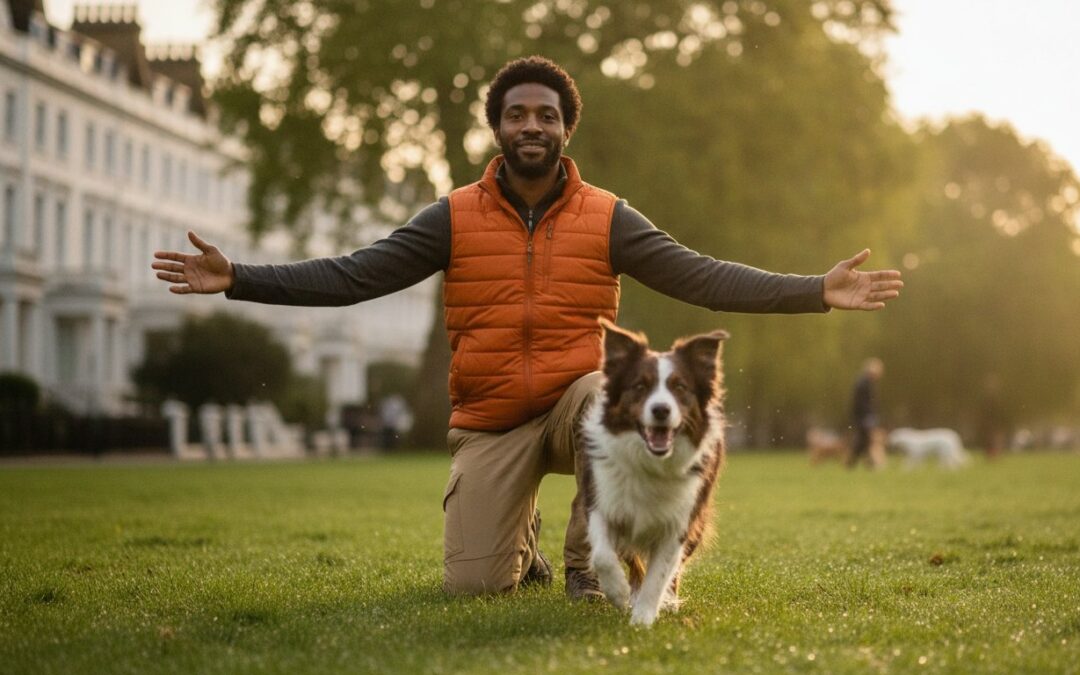
Have you ever stood near the Boating Lake, watching your dog sprint toward a cluster of squirrels while your voice disappears into the London breeze? It’s a moment of sharp anxiety, especially when the Outer Circle traffic is humming nearby or the scents from the Zoo perimeter prove too tempting to ignore. Mastering advanced recall training Regent’s Park requires more than just basic obedience; it demands a partnership that can withstand the unique, high-stakes pressures of a Royal Park. You likely feel the frustration of “selective hearing” and the embarrassment that comes when your dog ignores a command in front of a crowd.
We understand that the stakes are higher in the city, where safety and public etiquette are paramount. This guide provides a professional roadmap to achieving unshakeable off-lead control, giving you the tools to ensure your dog chooses you over every distraction. You’ll learn how to proof your commands against high-value triggers and foster a deep, non-coercive connection that makes London walks genuinely stress-free. We will examine the specific environmental challenges of the park, the logic behind canine motivation, and the structured steps required to turn “maybe” into a definitive, immediate return every time you call.
Key Takeaways
- Understand the critical difference between basic obedience and advanced recall, focusing on interrupting high-arousal states when your dog is most distracted.
- Learn how to apply the Premack Principle to transform the park’s smells and sights into rewards that actually reinforce your dog’s connection to you.
- Evaluate your dog’s current skill level using the “Three D’s” framework to ensure they’re truly prepared for the unique pressures of a Royal Park.
- Master practical exercises like the “Ping-Pong” recall to build enthusiasm and speed during your sessions of advanced recall training Regent’s Park.
- Discover why tailored 1-to-1 training sessions offer the most effective path to achieving total confidence and safety in busy urban environments.
What Is Advanced Recall Training and Why Is It Essential for Regent’s Park?
Advanced recall isn’t simply a refined version of basic obedience. It represents a fundamental shift in communication where your dog can disengage from a high-arousal state, such as spotting a squirrel or another dog, and return to you instantly. In a controlled environment like your garden, your dog likely has a 100% success rate. However, once you step into a 410-acre distraction field, the psychological cost of returning to you increases significantly. This is where basic training often collapses because the environment offers more value than the owner.
Achieving success with advanced recall training Regent’s Park means preparing for a landscape that is constantly shifting. The park is a sensory overload of scents, sounds, and movement. If your dog’s recall is only “good enough,” a sudden dash toward the Outer Circle traffic or the London Zoo perimeter could lead to a dangerous situation. We view recall as a functional necessity for urban living rather than an optional skill. By applying modern dog training principles, we can bridge the gap between selective hearing and reliable safety, ensuring your dog remains protected even in the most chaotic moments.
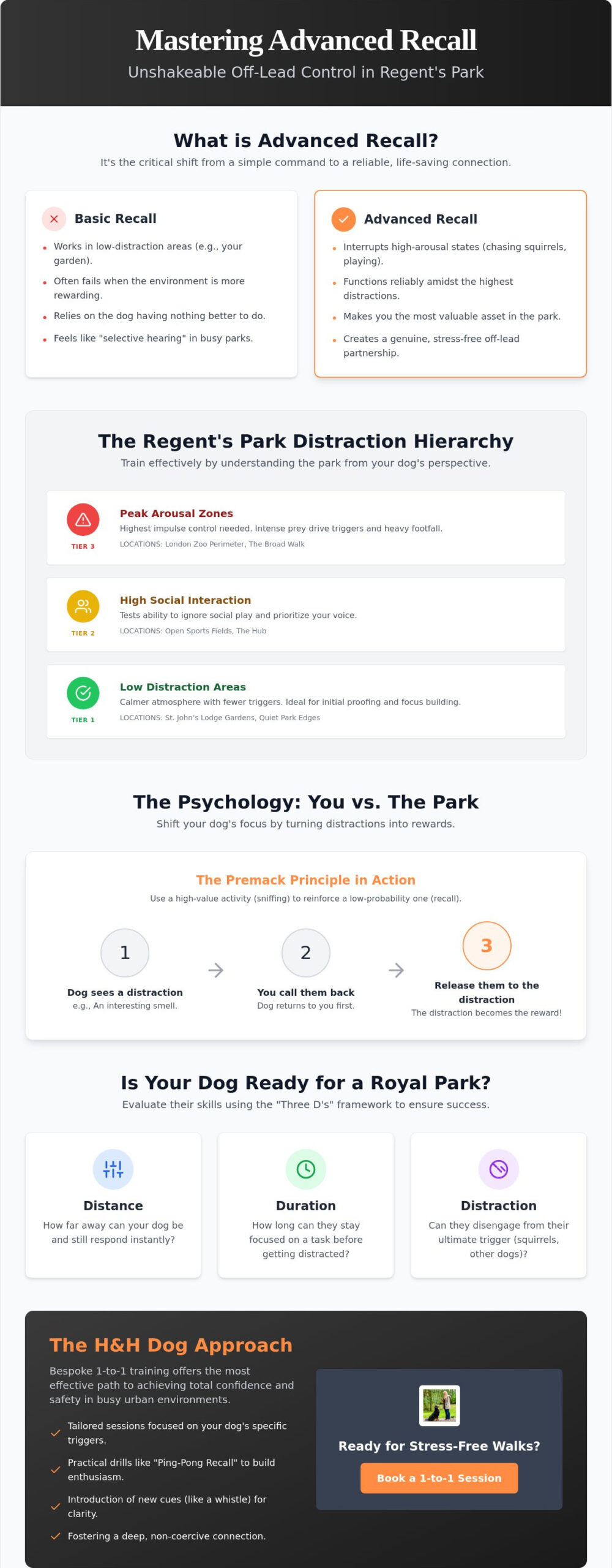
The Regent’s Park Distraction Hierarchy
To train effectively, you must understand the park’s layout from your dog’s perspective. We categorize the environment into three distinct tiers of difficulty to help you manage progress:
- Tier 1: Low Distraction. Areas like St. John’s Lodge Gardens or the quieter corners near the park edges offer a calmer atmosphere. These spots have fewer sudden triggers, making them ideal for initial proofing and building focus.
- Tier 2: High Social Interaction. The open sports fields near The Hub are often filled with other dogs, flying frisbees, and running humans. These areas test your dog’s ability to ignore social play and prioritize your voice.
- Tier 3: Peak Arousal. The Zoo perimeter and the Broad Walk provide intense prey drives and heavy footfall. These locations demand the highest level of impulse control and responsiveness.
Moving Beyond the “Come” Command
Many owners find that the word “Come” eventually becomes white noise. If it’s been used ineffectively or repeated without a response during stressful walks, it loses its functional meaning. In a noisy city park, a verbal command can also be muffled by wind or distant traffic. This is why we often introduce a whistle as a clean signal. It carries further and lacks the emotional baggage or frustration often heard in a human voice. It provides a clear instruction that your dog can hear over the bustle of London life. Advanced recall is a life-saving safety protocol, not just a trick.
The Psychology of Engagement: Why Your Dog Chooses the Park Over You
It’s a common frustration to label a dog “stubborn” when they ignore a whistle in the middle of a chase. However, this is rarely about defiance or a lack of respect. From your dog’s perspective, Regent’s Park is a giant vending machine of biological rewards. Every squirrel, patch of fox scent, and passing jogger offers a massive hit of dopamine. When the environment provides more value than the owner, the dog makes a logical choice based on their internal reward system. Advanced recall training Regent’s Park isn’t about winning a battle of wills; it’s about shifting the economy of your relationship so that you become the most valuable asset in the park.
The “Hunt” cycle is particularly addictive near areas like the Broad Walk. The sight of a squirrel triggers a predatory sequence that floods the dog’s brain with chemicals designed to keep them focused on the prize. This makes the environment your primary competitor. To counter this, we use the Premack Principle, which suggests that a high-probability behavior, like sniffing a tree, can be used to reinforce a low-probability behavior, like returning to your side. Instead of fighting the park’s distractions, you begin to use them as the ultimate reward for cooperation.
Building the “Invisible Long-Lead”
The foundation of off-lead control is the voluntary check-in. This is when your dog chooses to look back or move toward you without being asked. We want to foster a “value transfer” where the dog associates your presence with the safety and permission to explore the park’s wonders. If you’re struggling to read your dog’s arousal levels before they bolt, consulting a dog behaviourist London can provide the bespoke insight needed to understand their emotional state. Understanding whether your dog is motivated by play, scent, or prey drive allows you to tailor your engagement strategies effectively.
The Role of High-Value Reinforcement
In a high-stakes environment, kibble often fails. You’re asking your dog to give up a high-octane experience, so the reward must match the effort. We recommend functional rewards that satisfy the dog’s immediate needs. Sometimes, the best reward for a successful recall isn’t a treat, but the command to “go sniff” the very thing they were interested in. For emergency situations, we utilize the “jackpot” technique. This involves delivering a sudden, massive amount of high-value treats to mark an exceptionally difficult recall. It creates a powerful memory that makes the next return even more likely. If you’re finding it difficult to compete with the park’s many charms, our 1-to-1 Dog Training sessions can help you build a customized reinforcement schedule that works for your specific dog.
Assessing Your Dog: Basic vs. Advanced Recall Skills
Before unmasking your dog’s lead in a Royal Park, you must objectively evaluate their current skill level. Many owners fall into the trap of assuming that a reliable return in the living room translates to success near the Boating Lake. This mismatch in expectations often leads to the frustration of “selective hearing.” To avoid this, we use the “Three D’s” of training: Distance, Duration, and Distraction. While distance and duration are relatively easy to manage, the intense distraction of a central London environment is what separates basic obedience from advanced recall training Regent’s Park. If you move through the proofing stages too quickly, you risk “poisoning the cue.” This happens when you repeat a command while your dog is over-aroused and unable to respond. Shouting “Come” repeatedly while they’re chasing a squirrel essentially teaches them that the word is optional. It becomes background noise to their fun. We want every signal to be meaningful and effective.
The Recall Competency Checklist
Use this simple diagnostic to see where your partnership currently stands. It’s better to be honest now than to face an emergency later.
- Basic: Does your dog return 10/10 times in the hallway or a quiet garden?
- Advanced: Does your dog return immediately when playing with another dog or sniffing a high-value scent?
- Elite: Does your dog return when a cyclist passes on the Broad Walk or when they spot a squirrel near the Zoo perimeter?
Most dogs operating in Regent’s Park need to be at the Advanced level before they’re safely granted full off-lead freedom. If they can’t disengage from a social interaction, they aren’t ready for the park’s busier zones.
When to Reintroduce the Long-Line
Regression is a natural part of any learning process, especially during the adolescent phase. If you notice your dog is starting to hesitate or ignore cues they previously mastered, it’s time to reintroduce the long-line. This isn’t a step backward; it’s a safety net that prevents them from practicing “ignoring” you. It’s particularly useful if you’re navigating puppy training regressions where hormonal changes make the park’s scents suddenly more compelling than your rewards. If your dog’s arousal levels are consistently too high, the long-line allows you to maintain control while you work on lowering their emotional response to the environment. Watch for signs like frantic sniffing, “zoomies,” or a glazed expression, as these indicate your dog is no longer in a state where they can process learning effectively.
Advanced Recall Drills for Busy London Parks
To transition from theory into practice, you need a structured set of drills that mirror the complexity of the city. Implementing advanced recall training Regent’s Park requires moving beyond static repetitions. You need to build a dog that finds the act of returning more exhilarating than the distraction they are leaving behind. This involves creating high-energy scenarios where the return itself is the most rewarding part of the walk. By practicing in varied locations, you ensure the skill is “park-proof” rather than just “garden-proof.”
The “Ping-Pong” Recall is an excellent way to build speed and enthusiasm. This drill involves two people standing roughly twenty yards apart, taking turns to call the dog. Each successful return is met with a high-value jackpot or an intense game of tug. It creates a rhythmic, high-speed game that teaches your dog to pivot away from distractions with joy. In a busy environment, this builds the muscle memory needed to disengage from a social interaction near The Hub or a tempting scent trail in the tall grass.
Sometimes, a full return isn’t the safest option for your dog. If they are heading toward a cyclist on the Broad Walk or moving too close to the Outer Circle traffic, an “Emergency Stop” can be life-saving. This command interrupts forward momentum instantly, asking the dog to drop or sit exactly where they are. It allows you to close the gap and secure them without the risk of them crossing a path or road to get back to you. We view this as an essential component of urban safety.
Step-by-Step: The Whistle Recall Transition
Whistles provide a distinct, non-emotional frequency that cuts through urban noise far better than the human voice. We recommend a consistent pitch, such as a 211.5 frequency, which remains audible even on windy days near the Boating Lake. Start by “charging” the whistle at home; blow the signal and immediately provide a premium reward. Once the Pavlovian response is set, gradually move this practice to Tier 1 areas of the park. You must proof the signal against the “Regent’s Park Specials,” such as the sudden roar from the Zoo perimeter, passing joggers, or the enticing scent of a summer picnic.
Handling Recall Failures Gracefully
When a recall fails, your immediate reaction dictates your future success. If you sound frustrated or move toward the dog aggressively, you become a predictor of a negative experience. Instead, stay calm and move closer to reduce the distance before trying again with a lower-intensity cue. Once the dog eventually chooses to return to you, your response must be welcoming. Reward the return, regardless of how long it took. If you find your dog is consistently struggling with the park’s intensity, our 1-to-1 Dog Training offers a bespoke way to rebuild focus in a controlled, supportive manner.
Bespoke 1-to-1 Training: The H&H Dog Approach to Advanced Recall
While group classes provide a solid foundation for socialisation, they often fail to replicate the specific intensity of a central London landmark. In a controlled class, the distractions are predictable and the environment is managed. In Regent’s Park, the variables are organic, sudden, and high-stakes. This is why we advocate for a tailored, individual approach. Our 20 years of experience in dog training North London has taught us that every dog processes the environment differently. A one-size-fits-all model cannot account for the unique psychological profile of your pet or the specific triggers they face near the Zoo or the sports fields.
Working with a professional trainer provides you with a steady hand during high-stress situations. We act as a mentor, helping you read the subtle shifts in your dog’s body language before they reach a point of no return. This partnership ensures that advanced recall training Regent’s Park is conducted safely, ethically, and with patience. We focus on building a relationship based on mutual understanding rather than force. By creating a customised plan, we respect your dog’s temperament while giving you the confidence to enjoy the park together without anxiety.
Personalised Behavioural Assessments
Success begins by identifying the “why” behind the “no.” If your dog ignores a recall, we must determine if the choice is driven by fear, a high prey drive, or simple environmental distraction. We conduct deep behavioural assessments to uncover these underlying motivations. Once we understand what drives your dog, we can tailor reinforcement schedules to match their specific motivators. This makes it easier to integrate reliable recall into your daily dog walking routine, turning every outing into a positive training opportunity that strengthens your bond.
Booking Your Session in Regent’s Park
During a 1-to-1 session, we meet you exactly where the challenges occur. We practice the drills discussed in previous sections under real-world conditions, providing immediate feedback and adjustments as the environment shifts. Our goal is to empower you so that you can transition from our guided sessions to confident, solo walks. You deserve to feel the peace of mind that comes with knowing your dog will return every time you call, regardless of the squirrels or the crowds. Ready for a stress-free walk? Book your 1-to-1 consultation with H&H Dog today.
A Future of Freedom and Focus in the Park
Achieving success with advanced recall training Regent’s Park is a journey of building trust rather than demanding compliance. By understanding that the environment is your partner and using clear, non-emotional signals, you can cut through the noise of the city. Assessing your dog’s emotional state and applying structured drills allows you to move away from the frustration of selective hearing toward a life of mutual freedom. It’s about ensuring your dog feels safe and connected, even when the squirrels near the Broad Walk are calling.
We bring over 20 years of London pet care experience to every session, using personalised, non-coercive training methods designed for high-distraction urban environments. You don’t have to navigate these challenges alone. We’re here to provide the steady hand and expert insight needed to turn your walks into a source of joy. Master off-lead control with our expert 1-to-1 training in Regent’s Park. With patience and the right methodology, a stress-free walk in the heart of London is closer than you think.
Frequently Asked Questions
Is it legal to have my dog off-lead in Regent’s Park?
Yes, dogs are permitted off-lead in most open areas of Regent’s Park, provided they are kept under “effective control” at all times. You must ensure your dog does not worry wildlife or disturb other park users. Some specific zones, such as Queen Mary’s Gardens and certain sports pitches during match times, require dogs to be on leads, so always check the local signage for seasonal updates.
How long does advanced recall training usually take to master?
The timeline for mastering advanced recall training Regent’s Park varies based on your dog’s age and history. Most owners notice a significant improvement in reliability within six to twelve weeks of consistent, daily practice. It’s a progressive skill that requires regular maintenance to ensure your dog can handle the shifting distractions of a busy Royal Park throughout their life.
Can I train a dog with a high prey drive to return when they see a squirrel?
Yes, dogs with a high prey drive can learn to return, though it requires a focused approach to impulse control. We use the environment as a reward, teaching your dog that checking in with you is the gateway to the activities they enjoy. By building a high-value partnership, we help your dog choose you over the chase, even near the squirrel-heavy Broad Walk.
What is the best whistle for recall training in a noisy city park?
We recommend using an ACME 211.5 whistle for urban training sessions. This specific frequency is designed to remain clear and consistent regardless of wind or traffic noise from the Outer Circle. It provides a distinct, non-emotional signal that is much easier for your dog to process than a verbal command when the park is at its busiest.
Should I use an e-collar for advanced recall in London?
We don’t recommend or use e-collars, as our philosophy is rooted in non-coercive, evidence-based methods. These devices rely on aversive pressure which can damage the trust between you and your dog. Ethical training focuses on building a positive emotional connection, ensuring your dog returns because they want to be with you, not because they are avoiding discomfort.
How do I stop my dog from running towards the London Zoo fence?
Preventing a dash toward the Zoo perimeter involves managing the environment while you build up your dog’s focus. Use a long-line as a safety net during the early stages of training to prevent them from practicing the unwanted behavior. By rewarding voluntary check-ins before they reach their threshold, you teach them that staying close is more rewarding than investigating exotic scents.
What should I do if another off-lead dog approaches us during training?
If an unfamiliar dog approaches, stay calm and avoid creating tension on the lead. You can use a treat scatter on the ground to distract the other dog or calmly move your dog to a quieter area. It’s important to protect your dog’s focus, so don’t hesitate to politely ask other owners for space while you are working on specific drills.
Is my dog too old for advanced recall training?
No dog is too old to refine their communication and learn new skills. While older dogs may have established habits, they often have better focus and impulse control than younger puppies. Advanced recall training Regent’s Park is about adapting your communication to your dog’s current life stage, ensuring they can enjoy their senior years with safety and freedom.