
Did you know that a May 2026 study involving over 43,000 dogs found that a staggering 91% exhibit some degree of fear or anxiety? If you find yourself avoiding the busy paths of Cassiobury Park or feeling trapped at home because your dog is too terrified to walk, you are certainly not alone. It’s incredibly difficult to watch your companion struggle; the weight of responsibility and the guilt of seeing their world shrink can feel overwhelming. Finding the right training for fearful and anxious dogs Watford offers is the first vital step toward reclaiming your shared freedom and peace of mind.
We believe that anxiety is a communication gap, not a character flaw. You deserve a life where walks are a joy rather than a source of stress, and your dog deserves to feel safe in their own skin. This guide will help you discover how to transform your dog’s fear into quiet confidence using expert-led, ethical strategies tailored specifically for our local community. We’ll explore a modern, evidence-based approach that prioritises your dog’s emotional welfare. By moving beyond simple management and focusing on partnership, you can build a foundation of mutual trust and lasting emotional health.
Key Takeaways
- Identify the subtle differences between immediate fear and anticipatory anxiety while recognising how specific Watford environments impact your dog’s stress levels.
- Explore why bespoke training for fearful and anxious dogs Watford provides a more effective, low-stress alternative to traditional group classes for sensitive pups.
- Demystify the science of behaviour modification, focusing on how gentle desensitisation and counter-conditioning can gradually expand your dog’s comfort zone.
- Learn to set up a dedicated safe haven at home, using management strategies to protect your dog’s emotional well-being while they progress.
- Discover how over 20 years of experience helps us integrate behavioural consultations with low-stress mobile grooming to support your dog’s long-term confidence.
Understanding Fear and Anxiety in Watford’s Canine Community
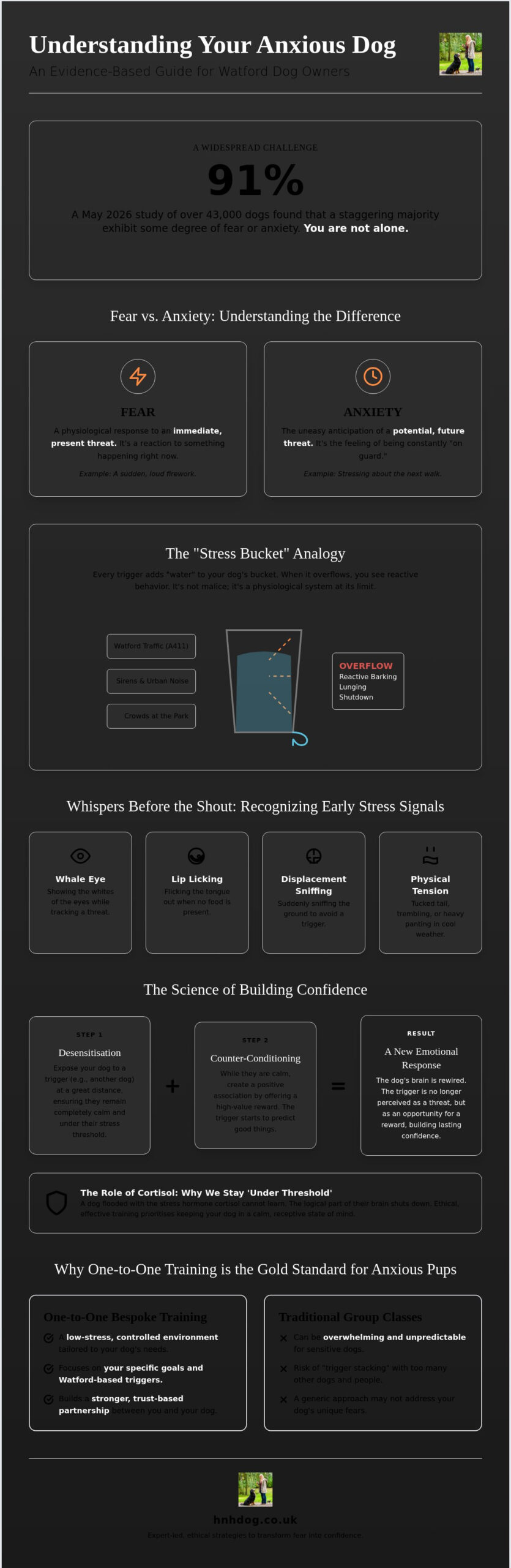
To help your dog find their way back to confidence, we must first understand the emotional landscape they inhabit. Many owners use “fear” and “anxiety” interchangeably, but they represent different internal states. Fear is a physiological response to an immediate, present threat, like a sudden loud bang. Anxiety is the uneasy anticipation of a future threat. For many, Understanding Fear and Anxiety in Watford’s Canine Community involves recognising that your dog might be constantly “on guard” for the next scary event. When seeking effective training for fearful and anxious dogs Watford owners should look for approaches that address these internal emotions rather than just suppressing the outward behaviour.
Canine anxiety is an adaptive survival mechanism that has become maladaptive in a modern environment.
The “Stress Bucket” is a helpful way to visualise your dog’s capacity to cope. Imagine every trigger adds a splash of water to a bucket. The rumble of traffic on the A411, a siren near Watford General, or a busy crowd at Cassiobury Park all add up. If the bucket is already full from a stressful morning, a single cyclist might cause it to overflow. This overflow is when we see reactive barking or lunging. It’s not “bad” behaviour; it’s a physiological system that has reached its limit and can no longer process information calmly.
The Signs of a Fearful Dog: Beyond the Growl
Your dog often speaks through subtle body language long before they growl or snap. Recognising these whispers allows you to intervene before they feel the need to shout. Look for these indicators during your local walks:
- Whale Eye: Seeing the white part of your dog’s eye as they track a threat.
- Lip Licking: Flicking the tongue out when no food is present.
- Displacement Sniffing: Suddenly sniffing the ground to avoid eye contact with a passing dog.
- Physical Tension: Tucked tails, trembling, or heavy panting even in cool weather.
Acting out is rarely about dominance. It’s almost always a desperate plea for space and safety.
Why Watford Dogs Experience Anxiety Differently
Our local environment presents unique challenges. Watford’s high-density housing and narrow terraced streets in areas like North Watford mean dogs have very little “buffer zone” from neighbours or passing traffic. This lack of personal space can be exhausting for a sensitive animal. If you’ve adopted a rescue dog from a quiet, rural background, the transition to the Watford bustle can be jarring. Our town is part of a high-pressure commuter belt, and dogs often mirror the subtle, high-frequency stress of their owners. Effective training for fearful and anxious dogs Watford requires acknowledging these specific urban pressures and providing bespoke solutions that fit our busy town life.
The Science of Confidence: How Behavioural Modification Works
Building confidence in a nervous dog isn’t about “fixing” a broken animal; it’s about rewiring their emotional brain through evidence-based methodology. When we provide training for fearful and anxious dogs Watford pet owners often see the best results by using two core scientific principles: desensitisation and counter-conditioning. Desensitisation involves exposing your dog to a trigger, such as a passing car or another dog, at such a great distance that they remain entirely calm. Counter-conditioning then layers a positive association on top of that calm state. For example, if your dog sees a car on the A411 from a distance and receives a high-value treat, their brain begins to shift from “danger” to “good things happen when I see cars.”
Ethical training focuses on the ‘why’ of the behaviour, not just the ‘what’.
Understanding the role of cortisol is vital for successful learning. Cortisol is the primary stress hormone that prepares the body for a fight-or-flight response. When your dog is over their “threshold”, meaning they are already barking, lunging, or shut down, their brain is flooded with cortisol. In this state, the prefrontal cortex, which handles learning and logic, effectively shuts off. You cannot teach a dog who is terrified. This is why we prioritise keeping your dog under threshold throughout every session, ensuring they are physically and mentally capable of absorbing new information. If you’re feeling overwhelmed by your dog’s reactions, a professional behavioural consultation can help you map out these triggers safely.
Positive Reinforcement vs. Force-Based Methods
We strictly avoid outdated concepts like “alpha” or “dominance” theories. These adversarial approaches are particularly dangerous for anxious dogs because they rely on suppression and intimidation, which only deepens the underlying fear. Instead, we advocate for the power of choice. Allowing your dog to move away from what scares them empowers them, actually reducing their need to react aggressively. We aim to build a partnership rather than a hierarchy, a philosophy we detail in our guide to dog training North London. When your dog trusts that you won’t force them into scary situations, they feel safe enough to explore the world with you.
Threshold Management: The Key to Progress
Progress in training for fearful and anxious dogs Watford is measured in millimetres, not miles. Identifying your dog’s “safe distance” is the first step in any plan. If they can watch a trigger from fifty metres away without reacting, that is your starting point. We never use “flooding,” which is the practice of forcing a dog to face their fear until they stop reacting. While flooding might look like a “quick fix” because the dog stops moving, it often leads to “learned helplessness,” a state where the dog has simply given up. A bespoke training plan moves at your dog’s individual pace, ensuring every step forward is built on a foundation of genuine security.
Why One-to-One Training is the Gold Standard for Anxious Pups
While group classes are a staple of the industry, they are often the least effective environment for a dog struggling with deep-seated fear. Imagine trying to learn a complex new skill while standing in the middle of a crowded, noisy station; it’s nearly impossible to focus. For a nervous pet, a hall full of other dogs is a sensory overload that triggers the “fight or flight” response we discussed earlier. Finding the right training for fearful and anxious dogs Watford owners need means prioritising a calm, controlled setting where learning is actually possible.
One-to-one sessions provide the quiet necessary for your dog to feel safe. By working in your dog’s natural environment, we remove the stress of travel and unfamiliar territories. This setting allows us to conduct deep behavioural consultations that look beyond the surface. We don’t just treat the bark; we address the root cause of the anxiety within the very walls where your dog spends most of their time. This focused approach ensures that every minute of our time together is spent building your dog’s confidence rather than simply managing their reactions to a room full of strangers.
Personalised Care vs. Generic Classes
In a group setting, anxiety can be contagious. If one dog reacts, it often ripples through the room, raising the cortisol levels of every animal present. 1-to-1 training eliminates this risk entirely. It allows us to focus exclusively on your handling skills without the distraction of a crowd or the pressure to “keep up” with other puppies. Every dog is an individual. Some might need a shorter, high-intensity twenty-minute session, while others thrive with an hour of slow, steady engagement. We customise the pace to suit your dog’s emotional threshold, ensuring they never feel overwhelmed or “flooded” by the presence of others.
Real-World Practice in Watford
The ultimate goal is a dog that can navigate the real world with you. Generic classes can’t replicate the specific challenges of your daily life. We take the training to your front door. We can practise calm exits onto your street or walk specific routes through your neighbourhood together. Whether it’s finding a quiet corner of Oxhey Park for some low-stress engagement or navigating a particular alleyway that usually causes a reaction, this is training for fearful and anxious dogs Watford residents can rely on for practical, everyday success. Having a mentor by your side in these real-world moments builds your confidence as much as your dog’s, turning stressful walks into a shared journey of progress.
Creating a ‘Safe Haven’ at Home: Immediate Strategies
While we work on the long-term goal of building confidence, your immediate priority is management. Think of management as a protective shield that prevents your dog’s “stress bucket” from overflowing. Effective training for fearful and anxious dogs Watford pet owners can implement starts by simply removing the need for the dog to feel afraid. If your dog never encounters the scary thing, they never have the chance to practice the fearful response. This period of rest allows their cortisol levels to drop, creating a biological state where learning eventually becomes possible.
Setting up a “Safe Zone” is a foundational step. This should be a sanctuary where the dog is never disturbed, such as a crate, a specific bed, or a quiet spare room. Ideally, this space should be situated away from high-traffic areas of the house or windows facing the street. Pheromone diffusers and calming music can be useful supportive tools here. While they aren’t a cure for deep-seated anxiety, they can help lower baseline stress levels by creating a more soothing sensory environment. If you need help tailoring these home setups, consider booking 1-to-1 dog training to get expert eyes on your living space.
Mental stimulation is another powerful confidence builder that doesn’t require leaving the safety of your home. Scent work, where a dog uses their nose to find hidden treats, is naturally rewarding and calming. It shifts their focus from external threats to a task they can successfully complete. Using food puzzles and enrichment toys provides a sense of accomplishment, helping your dog feel more capable and in control of their surroundings. These “quick wins” are essential for rebuilding a fragile ego.
Reducing Environmental Stress
Watford’s busy urban environment can be loud and visually overstimulating. If your dog spends their day “street watching” and barking at passersby, use frosted window film or close the curtains to break the visual trigger. White noise machines or even a fan can help mask the sound of traffic from the A411 or noisy neighbours. Establishing a predictable daily routine is equally important. When a dog knows exactly when they will be fed, walked, and allowed to rest, their anticipatory anxiety significantly decreases because their world becomes predictable.
The Owner’s Role: Becoming a Calm Anchor
Your dog is incredibly sensitive to your internal state. If you are tense, holding your breath, or anticipating a reaction, your dog will mirror that stress. Learning to become a “calm anchor” involves conscious breathing and relaxed body language. Sometimes, the most productive thing you can do is “do nothing” together, simply existing in a quiet space without any demands. This transition from a stressed handler to a confident puppy training mentor is a journey of mutual growth. By modelling the calm you want to see, you provide the emotional safety your dog needs to begin their recovery.
Bespoke Training with H&H Dog: Restoring Peace to Your Watford Home
Choosing the right support for a sensitive dog requires more than just technical skill; it requires a partner who understands the emotional weight you carry as an owner. With over 20 years of experience managing complex canine temperaments, we’ve developed a mentorship approach that prioritises your peace of mind alongside your dog’s welfare. We understand that training for fearful and anxious dogs Watford residents need isn’t a one-size-fits-all solution. Instead, we offer a steady, expert hand to guide you through what can often feel like a lonely journey, ensuring every step forward is built on a foundation of mutual trust and ethical practice.
What sets our approach apart is the seamless integration of our core services. We recognise that for an anxious dog, every interaction with a professional is a training opportunity. By combining our behavioural expertise with mobile dog grooming Watford services, we eliminate the traditional stressors of a busy salon. This holistic synergy ensures that your dog’s emotional health is protected during every aspect of their care. Once your dog has built sufficient resilience through our 1-to-1 sessions, we can even discuss integrating them into structured dog walking, providing a safe path toward social confidence when they are truly ready.
A Holistic Approach to Welfare
Grooming is often a significant trigger for nervous dogs, but it doesn’t have to be a source of trauma. When you book a Full Groom in our mobile van, the environment is controlled, quiet, and entirely focused on your dog’s comfort. We use our 1-to-1 training techniques to prepare your dog for handling, using desensitisation to make the brush and bath a predictable, low-stress experience. Having a single, trusted provider for both behavioural support and physical care ensures a consistent communication style that your dog can actually understand. This consistency is the key to reducing confusion and building long-term confidence.
Taking the First Step
Your journey toward a calmer life begins with a comprehensive behavioural assessment. During this initial session, we’ll map out your dog’s specific triggers and design a bespoke roadmap tailored to your Watford home and lifestyle. We’re committed to using only non-coercive, evidence-based methods that respect your dog’s perspective and foster a genuine partnership. There are no forceful fixes here; only patient, logical steps that lead to lasting change. If you’re ready to move beyond management and start building a shared life of confidence, book a consultation with our Watford team today. Together, we can turn your dog’s fear into the security they deserve.
Reclaiming a Life of Confidence and Calm
Transforming your dog’s world from one of fear to one of security is a journey built on patience and evidence-based methodology. By identifying local triggers and establishing a dedicated safe haven at home, you’ve already begun the vital work of lowering your dog’s baseline stress. Remember that progress is rarely linear; it’s a series of small, intentional steps that prioritise your dog’s internal emotional state over simple outward compliance. Every moment of calm observation is a victory in building a more resilient companion.
With over 20 years of specialist experience, we provide the expert support needed for rescue and reactive dogs to thrive in our busy town. Our bespoke plans are specifically designed for the unique challenges of the local urban environment, ensuring that training for fearful and anxious dogs Watford owners receive is practical and sustainable. You don’t have to navigate these challenges in isolation. Book a Behavioural Consultation for Your Anxious Dog today to start building a future where walks are a shared pleasure. We’re here to act as your steady hand, helping you and your companion find the peace and security you both deserve.
Frequently Asked Questions
How do I know if my dog is anxious or just being ‘naughty’?
‘Naughty’ is often a label for a dog who is simply unable to cope with their environment. If your dog is destroying furniture, ignoring cues, or reacting to passersby, they are likely experiencing a stress response rather than a lack of discipline. Look for physical indicators like dilated pupils, tucked tails, or excessive panting. We focus on the underlying emotion to change the outward action, helping you understand your dog’s perspective.
Can an older rescue dog really be trained to be less fearful?
Yes, older rescue dogs are highly capable of learning new emotional responses through neuroplasticity. While their history might be complex, the principles of desensitisation remain effective at any age. We adapt the pace to their specific physical and cognitive needs. Age is rarely a barrier to building confidence; it just requires a patient, mentor-led approach that respects the dog’s individual timeline and past experiences.
How many training sessions will my anxious dog need to see results?
The number of sessions varies depending on the severity of the anxiety and how long the behaviour has been practised. Some owners see a shift in communication after three sessions, while deep-seated phobias may require longer-term support. We focus on sustainable progress rather than quick fixes. Each dog’s roadmap is bespoke to ensure the results stick for life, providing you with the tools to manage their long-term welfare.
Is it better to avoid the things my dog is scared of entirely?
Initially, avoiding triggers is a vital management strategy to let your dog’s ‘stress bucket’ empty. However, the long-term goal is to gradually reintroduce these elements at a distance where your dog feels safe. Total avoidance forever isn’t the aim. We want to expand their comfort zone so they can navigate Watford’s streets without fear. This gradual exposure ensures they build genuine resilience rather than just hiding from the world.
My dog is aggressive when scared—can you still help us?
Absolutely, we can help. Fear-based aggression is a common survival mechanism where the dog feels they must ‘shout’ to stay safe. Our training for fearful and anxious dogs Watford focuses on changing the emotional root of this reaction. By building trust and providing safe alternatives, we can reduce the need for defensive behaviours. We work with you to create a safety plan that protects everyone while we address the fear.
What is the difference between a dog trainer and a behaviourist in Watford?
A trainer typically focuses on teaching specific skills like ‘sit’ or ‘heel,’ whereas a behaviourist looks at the psychological ‘why’ behind complex issues like anxiety. In Watford, we combine these roles. We address the internal emotional state through behavioural consultations while providing the practical training skills you need to manage daily life. This holistic approach ensures we aren’t just suppressing symptoms but are solving the underlying problem.
Can anxiety medication help my dog during the training process?
Medication can be a helpful tool when used alongside a structured training plan. It can lower a dog’s baseline stress enough for them to actually start learning. We always recommend discussing this with your vet. If a dog is constantly over threshold, pharmaceutical support can sometimes provide the ‘breathing room’ required for behavioural modification to take effect. It’s about opening a window for learning to happen.
How much does one-to-one training for anxious dogs cost in London?
Industry rates for 1-to-1 training in the London and Watford area often range from £70 to £110 per session, according to 2026 market data. Some providers offer hourly rates while others focus on comprehensive assessment packages. While costs vary, investing in specialist training for fearful and anxious dogs Watford ensures you are receiving evidence-based care. This bespoke approach is tailored to your dog’s specific needs rather than a generic, mass-market class.