
What if your dog’s frantic barking at the door isn’t a sign of disobedience, but a desperate plea for a better way to communicate? Living in a terraced house or a flat makes every doorbell ring feel like a high-stakes crisis. You’ve likely felt that spike of adrenaline as you rush to quiet the noise before the neighbours complain, feeling entirely out of control of the situation. It’s exhausting to live in a home where the sound of the postman’s footsteps triggers a domestic meltdown. To truly stop dog barking at the door, we must move beyond simply suppressing the sound and start understanding the underlying motivation.
I agree that the constant noise is more than just a nuisance; it’s a source of genuine stress for both you and your pet. This article promises to reveal evidence-based techniques to transform your dog’s door-side reactivity into calm, confident behaviour. We will look at why your dog feels the need to guard the entrance and provide a structured, modern path toward a quieter household. You’ll learn how to replace frantic reactions with a manageable routine, ensuring your dog feels safe and you feel back in command of your living space.
Key Takeaways
- Identify whether your dog is motivated by territoriality, fear, or over-excitement to tailor your training approach effectively.
- Discover immediate management strategies, such as visual barriers, that help stop dog barking at the door while you work on long-term solutions.
- Learn how desensitisation and counter-conditioning can shift your dog’s emotional response from high alert to calm confidence.
- Explore the connection between general impulse control and door-side manners to build your dog’s overall emotional resilience.
- Recognise when deep-seated reactivity requires a bespoke, professional plan to ensure the best outcome for your dog’s welfare.
Decoding the Doorbell: Why Your Dog Barks When Someone Arrives
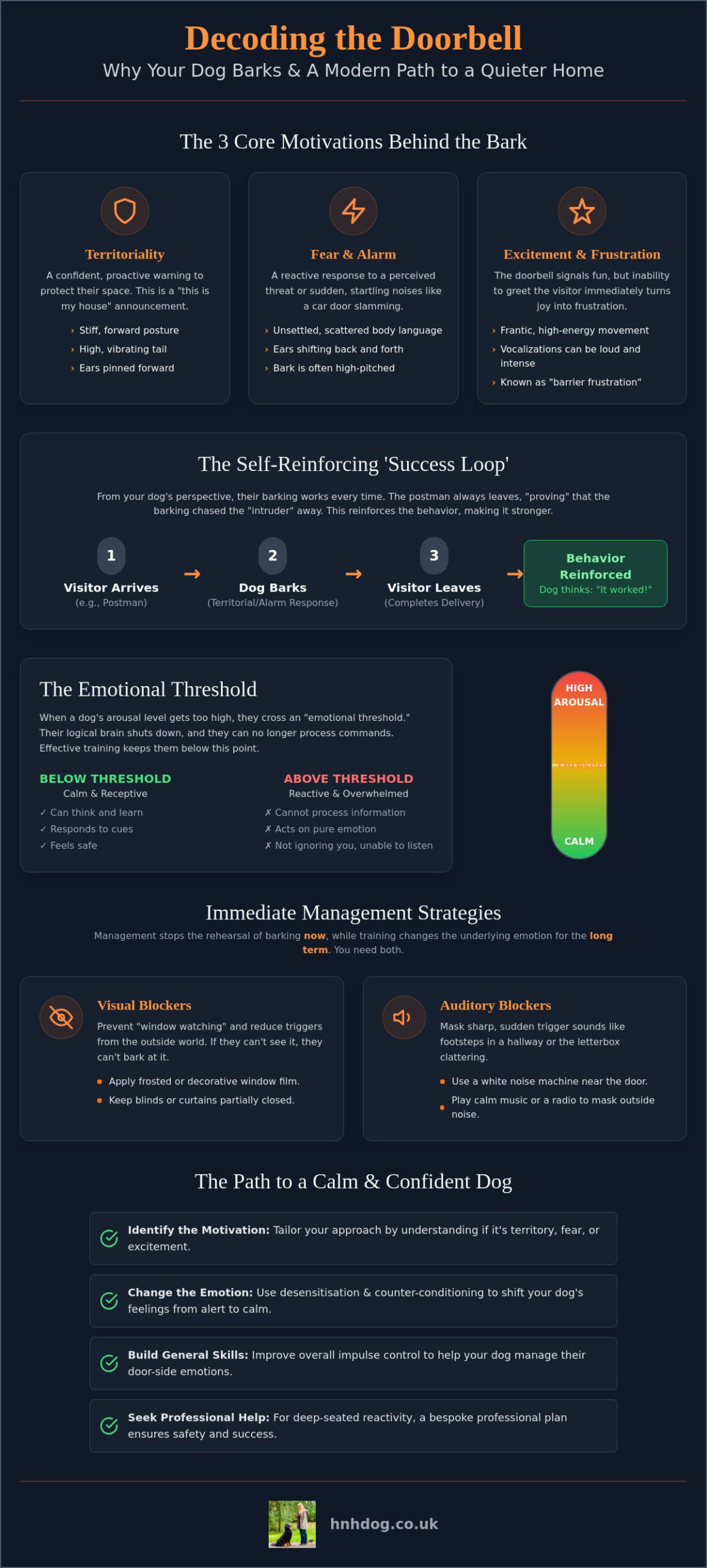
If you want to stop dog barking at the door, you first need to look past the noise and see the emotion driving it. Your dog isn’t trying to be difficult or defiant. Instead, they’re likely responding to an internal state they can’t quite manage. Most door-side barking stems from three core motivations: territoriality, fear-based reactivity, or pure, unbridled over-excitement. Each of these requires a slightly different approach, but they all share a common thread: your dog is trying to communicate something important about their environment.
Dogs are masters of association and often get stuck in what we call a “Success Loop”. Think about the daily arrival of the postman or a delivery driver. Your dog barks, the driver drops the parcel, and then they leave. In your dog’s mind, their barking successfully chased the “intruder” away. Because the person always leaves, the dog believes their actions were the direct cause of safety being restored. This self-reinforcing cycle makes the behaviour incredibly persistent because, from your dog’s perspective, it works every single time.
There is a significant difference between a functional “watchdog” bark and out-of-control nuisance barking. A watchdog bark is a brief, controlled notification that someone is approaching. Nuisance barking is repetitive, intense, and often continues long after the visitor has gone. This usually happens when a dog crosses their “Emotional Threshold”. Once they reach this state of high physiological arousal, their logical brain essentially shuts down. They aren’t ignoring you; they’ve simply lost the ability to process your instructions. To effectively stop dog barking at the door, we have to help them stay below that threshold where they can still think and learn.
Territorial vs. Alarm Barking
Territorial barking is a specific “this is my space” warning. You’ll typically see a stiff posture, a high, vibrating tail, and ears pinned forward. It’s a confident, proactive stance. Alarm barking is broader and more reactive. It’s a response to any sudden sound, whether it’s a car door slamming or a neighbour in the hallway. Understanding Why Dogs Bark helps us see that these vocalisations are often rooted in a desire for communication rather than simple aggression. During alarm barking, a dog’s ears might shift back and forth, and their body language often appears more unsettled or scattered than territorial.
The Role of Frustration and Excitement
Excitement can be just as loud and disruptive as fear. If your dog loves visitors, the doorbell becomes a “fun” trigger that sends them into a frenzy. However, when they can’t reach the person through the door, that excitement quickly turns into barrier frustration. This frustration intensifies the barking, turning what should be a happy greeting into a chaotic event. We must address this emotional build-up by teaching the dog that the door is a place for calm, rather than a gateway to high-intensity interaction.
Immediate Management Strategies to Lower the Temperature
Before we can change how your dog feels about visitors, we must stop the rehearsal of the unwanted behaviour. There is a vital distinction between management and training. Management involves changing the environment to prevent the barking from happening right now, while training focuses on changing the dog’s internal emotional response for the long term. If you want to stop dog barking at the door, you must first lower the daily stress levels by removing the triggers they can’t yet handle. Every time your dog barks at the door, they’re practicing a habit; management breaks that cycle.
Visual and Auditory Blockers
Living in urban environments like London or Watford presents unique challenges. The constant flow of delivery drivers and the echoing hallways of a terraced house can keep a dog in a permanent state of high alert. Reducing visual triggers is a simple yet powerful first step. Applying frosted window film or keeping blinds partially closed prevents “window watching,” where your dog scans the street for approaching “intruders.” This simple barrier helps them disengage from the outside world and settle more deeply into a relaxed state.
Auditory management is equally crucial. For dogs sensitive to footsteps in the hallway or the clatter of the letterbox, white noise machines or a radio playing calm music can be transformative. These sounds mask the sharp, sudden noises that trigger a reactive response. As noted in the ASPCA’s guide to dog barking, providing these environmental adjustments allows a dog’s nervous system to reset. Moving your dog’s primary resting area to a “Safety Zone” further away from the front door also helps them feel less responsible for guarding the entrance.
The “Stationing” Technique
Providing your dog with a clear, alternative task is often more effective than simply asking them to be quiet. Stationing involves teaching your dog to go to a specific mat or bed located away from the door whenever the doorbell rings. When a dog has a “job” to do, such as staying on their mat to receive a high-value, long-lasting chew, their focus shifts from the visitor to the task at hand. This creates a positive association with the door while physically moving them away from the trigger point.
This proactive approach helps build a new routine that replaces the frantic rush to the entrance. If you find that environmental changes aren’t enough to settle your dog’s nerves, seeking 1-to-1 dog training can help you refine these management steps into a bespoke plan. By lowering the temperature today, you create the mental space your dog needs to begin the real work of learning to be calm.
Training for Calm: Desensitisation and Counter-Conditioning
While management stops the rehearsal of the habit, training is what creates a lasting transformation. We achieve this through two core psychological processes: desensitisation and counter-conditioning. Desensitisation involves exposing your dog to the trigger at such a low intensity that it becomes “boring” rather than alarming. Counter-conditioning takes this a step further by changing the dog’s emotional response from “intruder alert” to “treat time.” By combining these methods, you can systematically stop dog barking at the door by rewriting the script your dog follows when they hear a visitor.
The secret to success lies in working “under threshold.” This means keeping the trigger far enough away or quiet enough that your dog notices it but doesn’t react. If they start barking, they’ve crossed the threshold; their ability to learn has vanished. Use a clear marker word like “Yes!” to pinpoint the exact moment of silence or calm. This marker acts as a bridge, telling your dog exactly which behaviour earned them a reward. To stop your dog from barking, you must be consistent with this feedback, rewarding the decision to remain calm rather than just the absence of noise.
The Doorbell Desensitisation Drill
Start by recording your doorbell on your phone. Play it back at a very low volume, barely audible, while your dog is relaxed. If they remain calm, mark with “Yes!” and provide a treat. Gradually increase the volume over several sessions, only moving forward when your dog remains completely indifferent to the sound. Once they can handle the recording at full volume, enlist a helper to stand outside and press the actual doorbell. This gradual progression ensures you stop dog barking at the door without causing unnecessary distress, preventing the “Success Loop” from restarting.
Changing the Meaning of the Door
The “Open/Closed” game is a fantastic way to teach your dog that the door’s movement isn’t a threat. When you touch the handle or crack the door open, treats should rain down. The moment the door closes, the treats stop. This teaches the dog that the presence of the “trigger” is what makes good things happen. Deliver a treat immediately after a gentle knock occurs to build a predictive link between the sound and a positive outcome. Real-world interruptions, like an unexpected delivery, will happen. When they do, revert to your management strategies from the previous section to prevent a setback in your training progress.
Building Impulse Control and Emotional Resilience
Barking at the door is often an impulsive reaction to a sudden change in the environment. If your dog hasn’t learned how to regulate their emotions in low-stress situations, they’ll find it nearly impossible to remain quiet when the doorbell rings. Strengthening their “internal brakes” is a vital part of the process to stop dog barking at the door. A dog who can’t wait patiently for their dinner bowl will naturally struggle with the high-arousal event of a visitor arriving. By building resilience elsewhere, we give them the tools to handle door-side triggers with more composure.
Developing emotional resilience means teaching your dog that they don’t need to react to every stimulus. The “Relaxation Protocol” is an excellent tool for high-arousal dogs, helping them learn to settle even while you move around the house or simulate door-related sounds. This resilience is often supported by proper physical and mental outlets. If your dog has pent-up energy, they’re far more likely to fixate on external noises. Engaging in group dog walking provides a structured way to burn off that physical steam in a social, controlled setting. This directly reduces the intensity of their reactions at home because their basic needs for movement and exploration have already been met.
Impulse Control Exercises
Foundational skills like “Leave it” and “Wait” are about much more than simple obedience. They are exercises in self-restraint. When you practice these, you’re essentially teaching your dog how to pause before they act. Start in low-distraction environments, like your living room, before moving closer to the hallway. I recommend the “Three-Second Rule”: when your dog notices a sound, give them three seconds to check in with you for guidance before you offer a reward. This encourages them to look to you for information rather than defaulting to a bark.
The Impact of Mental Enrichment
A bored dog is often a vigilant dog. When a dog’s brain isn’t occupied with constructive tasks, they often find their own “jobs,” which usually involves guarding the entrance. Using puzzle feeders, snuffle mats, and scent work sessions can tire a dog out more effectively than a long run. These activities require focus and problem-solving, which naturally lowers their overall arousal levels. For those with younger pets, starting puppy training early ensures these habits of calm and focus are established from the start. If your current routine isn’t quite hitting the mark, booking 1-to-1 dog training can help you stop dog barking at the door by creating a customised enrichment and impulse control plan.
Professional Behavioural Support in North London and Watford
Sometimes, despite your best efforts with management and desensitisation, progress feels slow or stagnant. Deep-seated reactivity often involves complex emotional layers that are difficult to peel back without professional guidance. It’s perfectly okay to admit that “DIY” training isn’t enough for your specific situation. To truly stop dog barking at the door, we often need to look deeper than just the outward action. Our behavioural consultations are designed to identify the “why” behind the behaviour before we ever attempt to fix the “how”. With over 20 years of experience, H&H Dog provides a steady, knowledgeable hand to guide you through these challenges.
The most effective way to address door-side distress is within the environment where it actually happens. Opting for 1-to-1 dog training allows us to observe your dog’s natural reactions in real-time. We can assess the layout of your home, the specific sounds of your street, and how your dog interacts with different family members. This personalised approach ensures that the solutions we implement are practical for your daily life, rather than generic advice that might not fit your unique household dynamic. We focus on building a partnership between you and your dog, fostering mutual understanding rather than just compliance.
Bespoke Training Plans for London Living
Living in busy North West London postcodes presents specific environmental pressures that rural dogs simply don’t face. We specialise in creating customised strategies for dogs navigating the complexities of flat-living and communal hallways. If your dog barks at every neighbour passing your door, we’ll design a programme that addresses these specific triggers. We involve the whole family in the training process to ensure consistency. This shared approach means everyone knows exactly how to respond when the doorbell rings, preventing the mixed signals that often stall progress in multi-person households.
The H&H Dog Difference: Empathy Meets Expertise
Our commitment to non-coercive, welfare-first methods is at the heart of everything we do. We believe that every dog deserves to feel safe and understood in their own home. We never use “quick-fix” tools like bark collars, which only serve to suppress the sound while increasing the dog’s internal distress. Instead, we use evidence-based techniques that value long-term emotional health over forceful shortcuts. This ethical approach ensures that your dog’s perspective is always respected. Contact us today to start your journey toward a quieter, happier home and discover how we can help you stop dog barking at the door for good.
Towards a Quieter, More Harmonious Home
Reclaiming the peace in your household starts with moving beyond frustration and looking at the world through your dog’s eyes. By implementing immediate management to lower stress and using evidence-based desensitisation, you can effectively stop dog barking at the door. Understanding that this behaviour is often rooted in internal emotional states allows you to act as a mentor rather than an adversary. Building emotional resilience is a steady journey, not a quick fix; it requires patience and a consistent commitment to your dog’s long-term welfare.
If your current situation feels overwhelming or your dog’s reactivity is deeply ingrained, you don’t have to navigate this alone. With over 20 years of professional experience, our expert trainers in Watford and North London are here to provide bespoke, ethical solutions tailored to your specific environment. You can Book a 1-to-1 Behavioural Consultation with H&H Dog to receive a customised plan rooted in non-coercive, modern methodology. A calm entrance is within your reach, and we’re ready to help you and your dog find that steady path forward together.
Frequently Asked Questions
Should I shout “No” when my dog barks at the door?
Shouting “No” is often misinterpreted by your dog as you joining in with the barking. This increases the overall noise and arousal levels in the hallway, making the situation feel more chaotic. Instead of suppressing the sound with force, focus on providing a calm instruction like a “wait” or “mat” command. This helps your dog understand what they should be doing rather than just what they shouldn’t.
How long does it take to train a dog to stop barking at visitors?
Training timelines vary based on your dog’s history and the consistency of your management. While you might see small improvements in a few days, establishing a reliable, calm response typically takes several weeks of daily practice. To stop dog barking at the door effectively, you must commit to short, regular sessions that focus on changing the underlying emotion rather than rushing for a quick, superficial fix.
Will a “bark collar” help stop my dog from barking at the door?
Bark collars are not recommended because they use pain or discomfort to suppress a natural form of communication. These devices fail to address the fear or excitement driving the behaviour and can actually increase your dog’s anxiety. Over time, this often leads to more severe behavioural issues or a breakdown in your relationship. Ethical, evidence-based training focuses on teaching your dog how to feel safe and relaxed instead.
Can older dogs learn to stop barking at the doorbell?
Older dogs are perfectly capable of learning new routines and emotional responses. While their habits may be more deeply ingrained, the principles of desensitisation and counter-conditioning remain highly effective. You may need to be slightly more patient and ensure any physical discomfort from age isn’t contributing to their irritability. A structured, gentle approach helps senior dogs feel more secure and less reactive to sudden entrance noises.
Why does my dog only bark at certain people, like the postman?
Dogs often target the postman because of the self-reinforcing cycle where the person leaves immediately after the dog barks. This convinces your dog that their vocalisation successfully defended the home. They may also react to specific triggers like high-visibility clothing or the unique sound of a delivery van. Identifying these specific cues allows you to target your desensitisation drills more accurately for better results.
Is my dog barking at the door because they are aggressive?
Barking at the door is rarely a sign of pure aggression; it’s more often a manifestation of fear, territoriality, or over-excitement. Your dog is likely feeling overwhelmed by the sudden intrusion into their safe space and doesn’t know how else to respond. Distinguishing between these emotional states is the first step in our behavioural consultations, ensuring we address the root cause of the distress with empathy and precision.
What is the best treat to use for door-side training?
The best treats for door-side training are high-value, soft rewards that your dog can consume quickly without losing focus. Think small pieces of plain cooked chicken, cheese, or specialised training treats with a strong scent. These rewards help create a powerful positive association with the doorbell. Using something significantly better than their standard kibble ensures you maintain their attention even when the environment becomes challenging.
How can I stop my dog from barking at the door when I am not at home?
Managing barking when you’re away requires a combination of environmental control and sound masking. Using white noise or a radio can drown out external triggers, while window film prevents your dog from seeing people approach. To stop dog barking at the door during your absence, consider providing a long-lasting enrichment toy in a quiet room far from the entrance. This keeps them occupied and lowers their overall vigilance levels.