
What if your dog’s growl over a bone isn’t a challenge to your authority, but a request for safety from a place of deep insecurity? It is incredibly stressful when a mealtime or a simple game of fetch turns into a tense standoff. You likely feel a flash of fear or confusion, especially when outdated advice suggests you must dominate your pet to stay safe. We understand that this tension affects the harmony of your entire household. This guide will show you how to implement effective resource guarding training for dogs using modern, trust-based methods that prioritise safety and emotional health.
By shifting your role from a taker to a provider, you can resolve these conflicts without the need for force or confrontation. We’ll explore how to read subtle body language, manage your home environment to prevent conflict, and master the art of the trade to build a lasting partnership. You can return to a peaceful home environment where both you and your dog feel secure. Through a clear, step-by-step approach, we will help you demystify your dog’s motivations and replace stress with mutual understanding.
Key Takeaways
- Understand why your dog guards items like food or toys by viewing it as an expression of insecurity rather than a desire to dominate.
- Learn the “Trade-Up” method, the gold standard for resource guarding training for dogs, to safely exchange items without conflict.
- Identify why traditional punishment-based advice fails and how suppressing warning signs like growling creates dangerous situations.
- Gain practical tips for managing guarding during grooming and walks to keep professionals and the public safe.
- Spot the specific red flags that signal it’s time to seek a professional behavioural consultation for a customised, long-term solution.
What is Resource Guarding and Why Does it Happen?
Resource guarding is a deeply misunderstood behaviour, frequently mislabelled by outdated advice as a bid for dominance. In reality, it’s a natural survival instinct that exists in almost every canine. In the wild, protecting a meal or a safe sleeping spot was a matter of life and death. While your pet doesn’t need to hunt for their dinner, those ancient biological hard-wirings remain. Understanding What is Resource Guarding through this lens helps us move away from frustration and towards empathy.
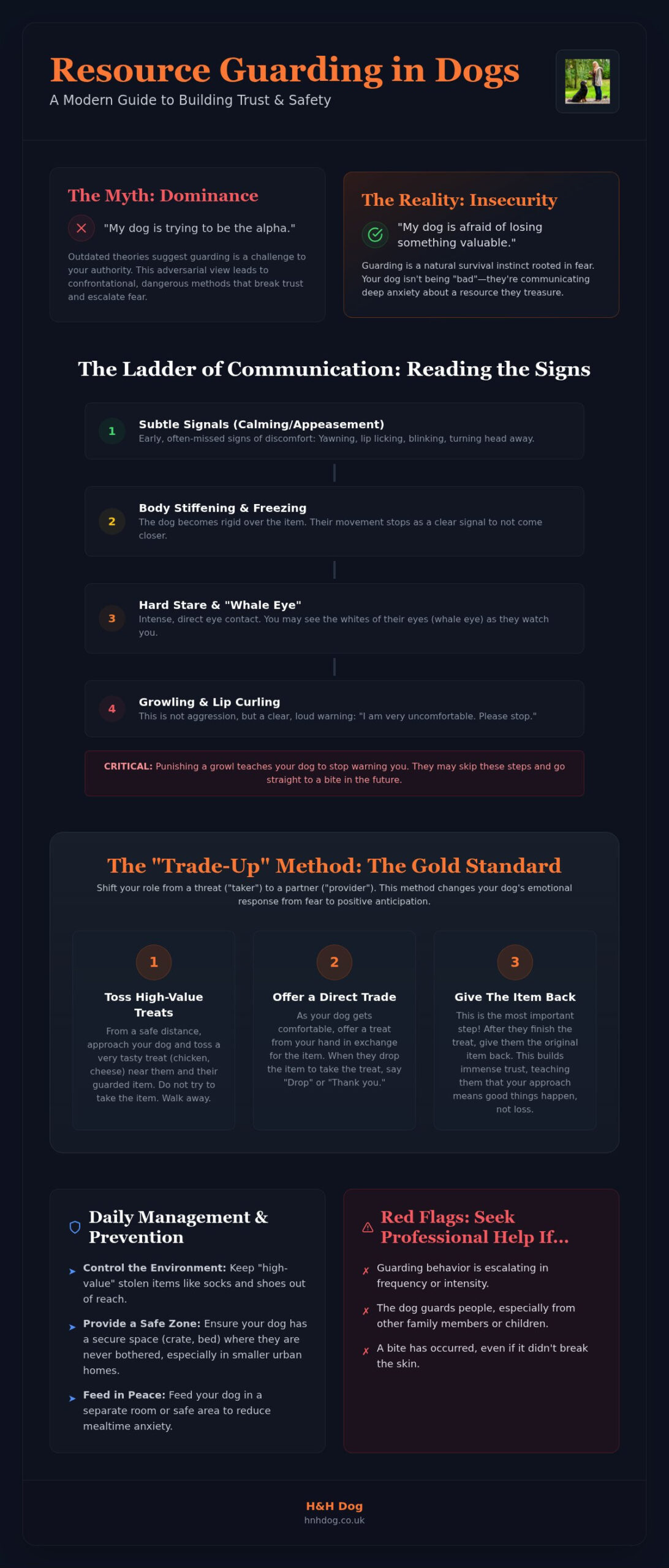
This behaviour is an emotional response rooted in the fear of loss. When a dog guards, they aren’t trying to be “the boss”; they’re expressing anxiety that a valuable asset is about to be taken. Value is entirely subjective and defined by the dog, not the human. You might see a discarded tissue as rubbish, but to your dog, it’s a high-value prize. This is why effective resource guarding training for dogs focuses on changing the underlying emotion rather than just the outward action. Common items dogs might protect include:
- Food bowls and high-value treats like chews.
- Stolen items, such as socks or laundry.
- Specific pieces of furniture or “their” spot on the rug.
- Favourite humans or even certain areas of the home.
Recognising the Early Warning Signs
Dogs communicate through a sophisticated ladder of signals. Before they ever resort to a growl, they will offer subtle physical shifts that indicate their discomfort. You might notice “whale eye,” where the whites of the eyes are visible, or a sudden stiffening of the body. A dog might “freeze” over an item, hoping you’ll simply move on. If these signs are ignored, they often progress to a hard stare or a low growl. A lip curling is a clear request for space. Recognising these early indicators is vital for maintaining safety during resource guarding training for dogs.
The Urban Stress Factor in London
Living in a bustling city like London adds unique pressures to our pets. Our homes, particularly compact North West London flats, often lack the square footage dogs need to feel they have a secure “safe zone.” When visitors enter a small living area, a dog may feel their personal space is being invaded, triggering a guarding response over a toy or a person. The constant noise and activity of urban life can keep a dog in a state of high vigilance. This environment makes it harder for them to relax, which is why bespoke, individualised care is so important for city-dwelling dogs.
Debunking the Dominance Myth in Dog Training
For decades, the “Alpha” theory dominated dog training conversations. Many owners were told they must eat before their dog or forcefully take items away to “show them who is boss.” When it comes to resource guarding training for dogs, these adversarial methods are not just outdated; they’re dangerous. Attempting to dominate a dog who is already feeling vulnerable only confirms their fears. It teaches them that you are a threat to their resources, which naturally increases their need to defend them. We must move away from the idea of hierarchy and focus on building a partnership based on mutual trust.
The most critical risk of dominance-based training is the suppression of communication. A growl is a dog’s way of saying, “I’m uncomfortable; please give me space.” If you punish that growl, the dog learns that warning you doesn’t work or gets them into trouble. They don’t stop feeling anxious; they just stop expressing it. This often leads to what owners describe as “unprovoked” bites, where the dog has been forced to skip the warning and go straight to a physical defence. We must view these moments not as “naughtiness,” but as a plea for safety from a dog who feels their world is unpredictable.
Why Taking Things Away Backfires
Every time you forcibly remove an item from your dog, you reinforce a “scarcity mindset.” From their perspective, you’ve become a “thief” rather than a trusted partner. This creates a cycle of hyper-vigilance where the dog feels they must guard even more intensely next time. Instead of building a wall between you, focus on becoming a “provider.” Our The Ultimate Guide to Dog Training in North London details how modern methodology prioritises this shift in perspective. If you’re struggling with these dynamics, a 1-to-1 dog training session can help you reset the relationship safely.
The Role of Positive Reinforcement
Positive reinforcement is about more than just giving treats; it’s about changing the dog’s internal emotional state. By rewarding your dog for allowing you to approach their “treasure,” you replace fear with a positive association. You’re effectively building a “bank account” of trust. Over time, the dog learns that your presence near their resource actually predicts something better happening, rather than a loss. For complex cases involving aggression, seeking professional behavioural support ensures that these methods are applied safely and effectively. This evidence-based approach values long-term emotional health over quick, forceful fixes.
The “Trade-Up” Method: Step-by-Step Training
The “Trade-Up” method is the gold standard for resource guarding training for dogs because it shifts the focus from confrontation to cooperation. Instead of acting as a “taker” who triggers your dog’s defensive instincts, you become a “provider” who offers something even better. This approach is rooted in the logic of classical conditioning; we want your presence near a resource to predict a positive outcome. Safety must always be your first priority. You should never place your hands near a dog who is actively guarding. This structured approach is a cornerstone of effective resource guarding training for dogs, ensuring that the process remains stress-free for both of you.
To succeed, you’ll need high-value rewards that your dog finds irresistible. Think beyond standard kibble. Small pieces of roast chicken, cubes of cheddar cheese, or a favourite squeaky toy are excellent choices. By using “jackpot” rewards, you demonstrate that giving something up is a winning strategy for the dog. We want to set up “training wins” in a controlled environment where the stakes are low and the rewards are high, building a foundation of trust that can eventually be applied to more challenging situations.
How to Execute a Successful Swap
Success lies in the details of the execution. You want to ensure your dog feels safe and relaxed throughout the entire process. Follow these steps to build a history of positive exchanges:
- Step 1: Identify a low-value item your dog is willing to share, such as a rubber toy they enjoy but don’t obsess over.
- Step 2: Approach your dog at a distance where they remain completely relaxed. If you see any stiffening or “the stare,” you’re too close; back away until they soften.
- Step 3: Toss a high-value treat away from the item. This encourages the dog to move their body and break their mental “lock” on the resource.
- Step 4: While the dog is occupied with the treat, gently remove the item. Crucially, return the item once they finish their reward. This teaches them that “trading” doesn’t mean losing the item forever.
This cycle is essential for managing resource guarding effectively. It proves to your dog that your approach is never a threat to their security.
Teaching the “Drop” and “Leave” Commands
Foundational cues like “Drop” and “Leave” are your best preventative tools for a peaceful home. “Leave” tells the dog not to engage with an item in the first place, while “Drop” facilitates a safe release of something already in their mouth. For these cues to remain reliable, they must be built on a history of positive outcomes. The “Drop” command should always result in a reward, ensuring the dog feels they have gained something rather than lost out. Establishing these habits early is the best way to foster a shared life without tension. If you’re starting with a young pet, our Puppy Training in London guide offers expert advice on early prevention techniques.
Managing Guarding in Daily Life: Grooming and Walking
Resource guarding often extends beyond the boundaries of your living room, manifesting in public spaces or during professional handling. These situations require a proactive approach to ensure the safety of everyone involved. Integrating resource guarding training for dogs into these daily routines helps your pet feel secure even when their environment changes. Whether it’s a found stick at the park or a brush during a grooming session, the principles of trust and management remain the same. Clear communication with professionals is the first step in creating a safe, supportive network for your dog.
Stress-Free Grooming for Guarding Dogs
Grooming involves intimate physical contact that can feel invasive to a dog prone to guarding their body. Some dogs may protect their paws, their tail, or even the grooming table itself. It’s vital to be transparent and inform your mobile dog groomer about these tendencies before the appointment begins. Mobile grooming offers a significant advantage for guarding dogs because it eliminates the high-arousal atmosphere of a traditional salon. A professional can tailor the pace, perhaps starting with a simple “Bath & Brush” to build confidence without the pressure of a full clip. This bespoke approach ensures the dog doesn’t feel the need to defend themselves during necessary care.
Socialisation and Group Walk Safety
Public parks are treasure troves of high-value items, from discarded tennis balls to interesting scraps of food. In a social setting, guarding can quickly escalate if another dog approaches your pet’s “prize.” During group dog walks, a professional walker must manage the group dynamic to prevent these conflicts. This might involve using high-value treats to distract the pack or ensuring that toys are only introduced in a controlled manner. For dogs with significant guarding histories, management tools like a basket muzzle or a long line serve as essential temporary measures. These tools allow for safe socialisation while you continue the work of behavioural modification.
In multi-dog households, management is your strongest ally. Feed dogs in separate areas and pick up high-value chews when the dogs are together. If children are present, they must be taught to respect the dog’s space entirely during mealtimes. Safety protocols are not about restriction; they are about creating a predictable world where your dog never feels the need to guard. If you’re concerned about your dog’s reactions in public, booking a behavioural consultation can provide the professional guidance needed to navigate these challenges safely. Consistent, calm management prevents the “scarcity mindset” from taking root in your dog’s daily life.
When to Seek Professional Behavioural Support
While many cases of resource guarding can be managed using the trust-based techniques we have discussed, there are times when the situation requires a more specialised approach. Recognising your own limits is a sign of responsible ownership, not a failure. If your dog has progressed to “red flag” behaviours, such as snapping, lunging, or guarding multiple unrelated items simultaneously, the risk of injury increases. This is particularly urgent if the guarding involves space or people, making it difficult for family members to move freely through the home. In these complex scenarios, the safety of your household depends on professional intervention.
Before beginning any intensive resource guarding training for dogs, a veterinary check-up is a vital first step. Dogs are masters at hiding physical discomfort, and underlying pain or medical issues can significantly lower their threshold for frustration. A dog who is sore or unwell will naturally be more protective of their space and resources. Once health concerns are ruled out, a dog behaviourist in London can help you navigate the unique challenges of urban living. Our bespoke behavioural consultations at H&H Dog provide a clear, ethical roadmap for recovery, focusing on the root cause of the anxiety rather than just the outward symptoms.
The Difference Between Training and Behaviour Modification
It is important to understand that training and behaviour modification are two distinct processes. Training typically involves teaching cues like “sit” or “stay,” which are essential for communication. However, obedience alone rarely fixes a deep-seated guarding issue because it doesn’t address the dog’s internal emotional state. Behaviour modification focuses on changing how the dog feels about a situation. During a 1-to-1 behavioural assessment in Watford, we look at your dog’s environment, history, and individual personality to create a plan that fosters genuine emotional security.
Creating a Long-Term Management Plan
Recovery is rarely a straight line, and setting realistic goals is essential for maintaining momentum. Your progress might be measured in small wins, such as your dog remaining relaxed while you walk past their bowl at a distance. Consistency among all family members is non-negotiable; everyone must follow the same protocols to ensure the dog feels the world is predictable. While resource guarding is a significant challenge, it is a solvable one. With patience, the right guidance, and a commitment to non-coercive methods, you can rebuild the bond of trust and enjoy a peaceful, shared life with your dog.
Restoring Harmony in Your Home
Navigating resource guarding can feel overwhelming, but shifting your perspective from conflict to communication changes everything. You now understand that guarding is an expression of insecurity rather than a bid for power. By implementing the “Trade-Up” method and prioritising management in daily life, you’re building a foundation of safety. Effective resource guarding training for dogs succeeds when it replaces fear with trust, ensuring your pet feels secure in their environment.
Every dog is an individual, and some require a more tailored approach to overcome deep-seated anxieties. With over 20 years of experience, we specialise in providing personalised care for North London and Watford dogs through evidence-based, non-coercive methods. If you’re ready to resolve these challenges with expert guidance, Book a Behavioural Consultation with H&H Dog today. You don’t have to manage this alone. With patience and the right support, a peaceful and happy household is well within your reach.
Frequently Asked Questions
Is resource guarding a sign of aggression in dogs?
Resource guarding is primarily a communication of insecurity rather than a sign of innate aggression. While behaviours like growling or snapping are defensive, they stem from a dog’s fear that a valuable asset will be taken away. Understanding this distinction is the core of resource guarding training for dogs. It helps you address the underlying anxiety instead of simply punishing the outward symptoms.
Can I fix resource guarding myself or do I need a trainer?
You can manage mild guarding through consistent trust-building exercises, but complex cases usually require professional support. If your dog has already escalated to lunging or biting, you should consult a qualified behaviourist to ensure everyone’s safety. A professional assessment helps uncover specific triggers and provides a bespoke plan that prevents the behaviour from worsening in high-pressure urban environments.
What should I do if my dog growls at me when I approach their bowl?
If your dog growls, you should immediately stop your movement and give them space. A growl is a vital warning signal that your dog feels threatened; punishing it can lead to bites without warning. Instead of confronting them, work on building a positive association with your approach from a distance where they remain relaxed. This ensures they view your presence as a predictor of good things.
Is resource guarding in puppies normal?
Resource guarding is a natural survival instinct that often appears in puppies as they explore their world. While it’s common, it isn’t something they will simply outgrow without proactive guidance. Early intervention through gentle “trading” games and preventing scarcity mindsets is essential. Teaching a puppy that your approach is always rewarding sets a foundation for a lifetime of trust and cooperative behaviour.
Should I hand-feed my dog to prevent resource guarding?
Hand-feeding can be a useful tool for building trust, provided the dog remains relaxed and comfortable throughout the process. It helps your dog associate your hands with the delivery of food rather than its removal. However, you should never force a dog to eat from your hand if they show signs of tension. The goal is to create a partnership where the dog feels secure, not pressured.
How long does it take to train a dog to stop resource guarding?
The timeline for improvement depends on the severity of the guarding and how consistently you apply trust-based methods. While you might see small wins within a few weeks, deep-seated emotional changes often take several months of dedicated work. Resource guarding training for dogs is a gradual process of changing internal states. Patience is your most valuable asset as you help your dog feel safe again.
Can resource guarding be cured completely?
Resource guarding is generally considered a manageable behaviour rather than something that is permanently “cured.” Most dogs can learn to be relaxed and cooperative, but their natural instincts may resurface during times of extreme stress or illness. Long-term success relies on maintaining consistent management protocols and respecting your dog’s boundaries to prevent the return of the scarcity mindset.
What is the best way to trade an item with a dog safely?
The safest way to trade is by tossing a higher-value treat away from the item your dog is holding. This physical movement encourages them to drop the object and move away voluntarily. Once they’re occupied with the reward, you can safely remove the original item. Always try to return the item if it’s safe to do so, as this reinforces the idea that you aren’t a thief.