
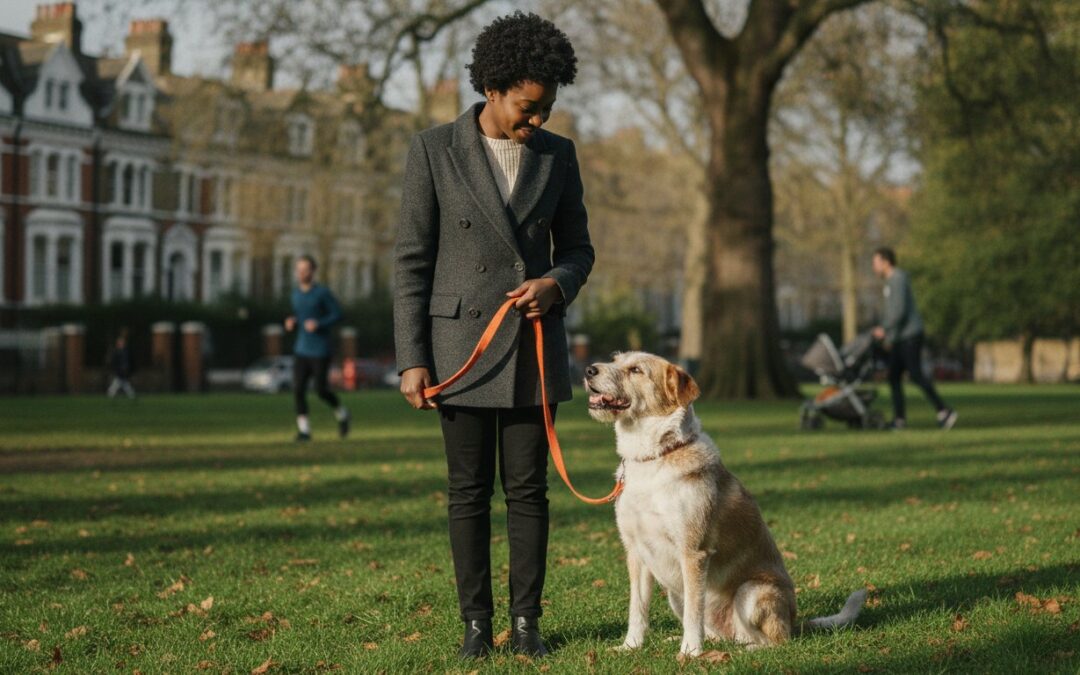
Have you ever wondered why your dog behaves perfectly in the quiet of your kitchen but becomes a lunging, barking whirlwind the moment you step into a busy London park? It is a common struggle that can leave you feeling isolated and deeply embarrassed, especially when conflicting online advice fails to address the root cause of your dog’s distress. You aren’t alone in this; recent data indicates that 90% of dogs experienced at least one behaviour issue in the last year. Finding a qualified dog behaviourist in London is often the first step toward moving past the fear that your pet is untrainable or naturally aggressive.
We understand that you want more than just a dog that sits on command; you want a companion who feels safe and settled in a hectic urban environment. This guide promises to clarify the vital differences between robotic obedience and empathetic behaviour training while showing you how to access expert, non-coercive support. We will examine the underlying motivations of canine stress and provide a clear, actionable plan to restore harmony to your walks and your home.
Key Takeaways
- Understand why traditional obedience often fails to address reactivity and how emotional modification creates lasting change.
- Discover the benefits of non-coercive, evidence-based methods that prioritise your dog’s welfare while strengthening your mutual bond.
- Learn how to identify when your pet requires the specialised expertise of a qualified dog behaviourist London to manage complex issues like fear or aggression.
- Prepare for a professional consultation by understanding the importance of home-based assessments and detailed behavioural histories.
- Explore how bespoke, 1-to-1 support can provide a clear, actionable plan for achieving a calmer lifestyle in urban environments.
Understanding Dog Behaviour Training: More Than Just Sit and Stay
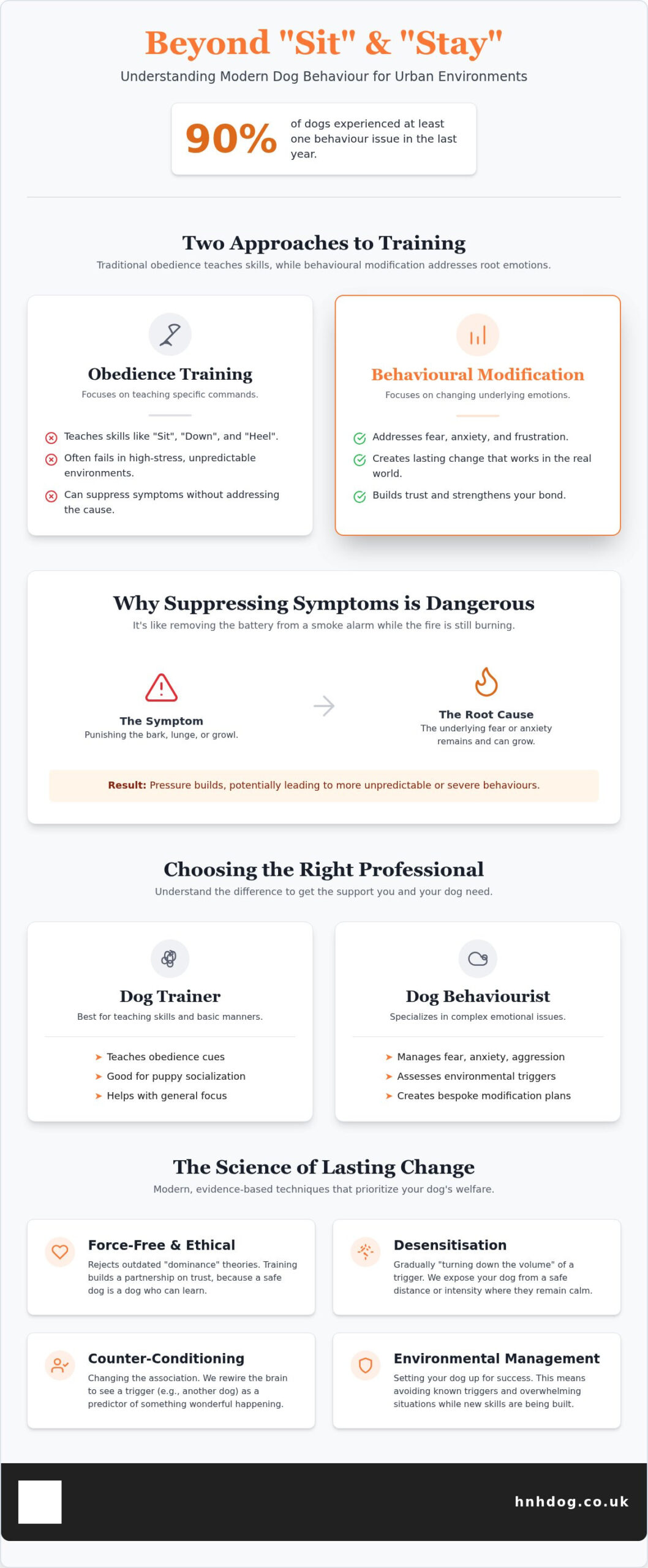
Living in London presents unique challenges for our canine companions. The constant hum of traffic, the density of pedestrians in North West London, and the high-energy environment of local parks can push a dog’s nervous system to its limit. Many owners find that while their dog knows “sit” or “stay” perfectly at home, these skills vanish the moment a siren wails or a cyclist zooms past. This happens because traditional obedience training often fails to reach the deep-seated emotional triggers that drive reactive behaviour. Behaviour training is a methodology designed to address a dog’s underlying emotional responses, such as fear, anxiety, or frustration, rather than merely correcting their outward actions.
Obedience vs. Behavioural Modification
Traditional training focuses on teaching cues like Sit, Down, and Heel. It is about building a vocabulary of skills. While this is useful for basic manners, it rarely addresses why a dog is lunging at a bus or cowering from a stranger. For a comprehensive overview of dog training, it is helpful to see how these disciplines diverge. Behavioural modification targets the internal feeling before the outward action occurs. If you only punish the bark, you are merely suppressing a symptom. This is dangerous; it is like removing the battery from a smoke alarm while the fire is still burning. Without treating the underlying cause, the pressure builds until it manifests in more unpredictable ways.
The Role of the Modern Dog Behaviourist
A professional dog behaviourist London acts as a vital translator between you and your dog. Their job is to demystify complex psychological concepts so you can understand what your dog is trying to communicate through their body language. Instead of applying a generic, mass-market fix, they assess specific environmental triggers in busy urban areas. This might involve observing how your dog reacts to the specific layout of your local North London park or the narrow pavements of your neighbourhood. By focusing on the dog’s perspective, a dog behaviourist London creates a bespoke roadmap. This plan isn’t just about stopping unwanted habits; it’s about fostering a shared life based on mutual trust and long-term emotional health. You gain a clear, actionable path forward that respects your dog’s welfare while restoring your own peace of mind.
The Science of Change: How Modern Behavioural Training Works
Modern canine science has moved decisively away from the adversarial models of the past. Concepts like “alpha” or “dominance” are now recognised as scientifically inaccurate and often counterproductive. Instead, we focus on a partnership. By working with a dog behaviourist London, you learn to view your dog as a sentient being with specific emotional needs rather than a subordinate to be controlled. This ethical, evidence-based approach is the foundation of effective behavioural modification. Force-free techniques aren’t just kinder; they’re more effective at creating long-term change because they build a foundation of trust. When a dog feels safe, they are capable of learning. When they are fearful or suppressed through punishment, they are simply surviving.
While a professional provides the expertise and the roadmap, your role as the owner is the most critical factor in the success of any programme. Consistency is the glue that holds the training together. Your dog needs to know what to expect in every interaction to feel secure in their environment. A bespoke plan only works if it is applied with patience and regularity in your daily life. This commitment ensures that the new, positive associations we build become the dog’s default response over time.
Desensitisation and Counter-Conditioning
These terms often sound intimidating, but they are simple, logical tools. Think of desensitisation as gradually turning down the “volume” of a scary trigger. We expose your dog to the thing they fear at a distance or intensity where they remain calm and below their emotional threshold. Counter-conditioning then steps in to change the internal meaning of that trigger. If seeing another dog currently signals “danger,” we use high-value rewards to rewire that response to mean “something wonderful is happening.” Over time, the sight of the trigger shifts from a source of distress to a predictor of something positive.
The Importance of Environmental Management
In a city as busy as London, you can’t always control the world around you, but you can manage your dog’s immediate experience of it. Setting your dog up for success means avoiding situations that you know will cause a meltdown while you are still in the early stages of training. This might involve choosing quieter times for walks in your local park or using parked cars as visual barriers on busy streets to give your dog space. Your home must serve as a safe zone for decompression. It is the place where initial progress is solidified before you test those skills in the urban bustle. If you’re ready to begin this transformative process, our behavioural consultations offer the individualised support your dog deserves.
Dog Trainer vs. Behaviourist: Choosing the Right Support in London
Deciding whether you need a skill-based trainer or a dog behaviourist London is often the first hurdle for owners. It’s a distinction between teaching a dog what to do and understanding why they feel a certain way. While both professionals work toward a more harmonious life with your pet, their methods and focus areas differ significantly. A trainer builds a vocabulary of cues, while a behaviourist modifies the emotional state that drives unwanted actions.
Before beginning any behavioural programme, a collaborative assessment with your vet is vital. Physical pain or underlying health conditions frequently manifest as irritability, fear, or sudden aggression. A professional behaviourist will often work alongside your veterinary surgeon to ensure that medical factors aren’t sabotaging your dog’s progress. Once health is cleared, we can focus on the psychological and environmental factors at play.
When to Call a Dog Trainer
A dog trainer is your go-to professional for teaching new skills and perfecting physical responses. If you want to perfect your recall for safer off-lead time in North London green spaces like Hampstead Heath, a trainer provides the right support. They specialise in basic puppy manners, foundation skills for new urban owners, and improving lead walking in low-distraction environments. These are essential “how-to” skills that help your dog navigate the world safely and politely.
When a Behavioural Consultation is Essential
When your dog’s actions are driven by intense emotions like fear, panic, or deep-seated frustration, a behavioural consultation is essential. This is particularly true for London dogs facing specific urban stressors. We frequently address issues such as:
- Separation anxiety: Helping dogs who struggle with solitude in urban flats during the work week.
- Leash reactivity: Managing lunging or barking at cyclists, joggers, or other dogs on busy pavements.
- Rescue transitions: Supporting rescue dogs as they adjust to the sights and sounds of the capital with patience and empathy.
In the high-pressure environment of the capital, 1-to-1 bespoke sessions offer a distinct advantage over generic group classes. A community hall environment rarely replicates the specific triggers your dog faces on a daily basis. Individual sessions allow a dog behaviourist London to observe your dog’s temperament in their natural environment. This targeted approach ensures that the plan we create is as unique as your dog’s personality, providing a safe and controlled space for genuine change to occur.
What to Expect from a Professional Behavioural Consultation
Stepping into a professional consultation can feel daunting, but it is designed to be a supportive, non-judgmental experience. Unlike a generic training class, a dog behaviourist London will typically visit you in your own home. This allows us to observe your dog in the environment where they feel most secure and where their daily habits are formed. Seeing the dog’s natural interactions within the household provides vital clues that are often masked in a high-stress clinical setting or a busy public park. We begin by gathering a comprehensive history of your dog’s life, covering everything from their earliest socialisation experiences to their current health status and specific triggers.
During this session, we work together to set realistic, ethical goals that align with your specific lifestyle. We don’t aim for robotic perfection; we aim for a manageable, happy life for both you and your pet. A consultation is as much about coaching the owner as it is about the dog. You are the person who will be implementing the plan daily, so it is essential that you feel confident and empowered by the techniques we discuss.
The Assessment Phase
The assessment phase goes far beneath the surface of the unwanted action. We look at the “whole dog,” which includes evaluating their diet, exercise levels, and sleep patterns. Often, a dog’s reactivity is exacerbated by physical discomfort or a lack of mental decompression. We also identify the specific function of the behaviour. Every action serves a purpose for the dog, whether it is to create distance from a scary object or to relieve internal frustration. By observing subtle body language cues, such as a slight lip lick or a tensed shoulder, we can identify these motivations before they escalate into a full outburst.
The Bespoke Training Plan
Once the assessment is complete, you receive a step-by-step guide tailored to your London lifestyle. This isn’t a one-size-fits-all document; it’s a living roadmap designed for your specific neighbourhood and home setup. If you live in a high-rise flat or walk on narrow, crowded pavements, your plan will reflect those challenges. These 1-to-1 sessions provide a level of focus and customisation that group classes simply cannot offer. You gain a clear path to measurable progress, backed by ongoing support as you practice these new skills in real-world scenarios. If you are ready to move from confusion to clarity, you can book your behavioural consultations with our expert team today.
Bespoke Dog Behaviour Training with H&H Dog in London & Watford
H&H Dog has spent over two decades serving as a dedicated mentor for owners across the capital. Our 20-year legacy is built on a foundation of empathy and professional authority, ensuring that every dog we meet is treated with the respect they deserve. We believe that the most effective way to achieve lasting change is through a partnership between you and your pet. This philosophy moves away from outdated, forceful tactics and focuses instead on ethical, non-coercive solutions that prioritise your dog’s emotional welfare. By choosing a professional dog behaviourist London, you are investing in a methodology that values the internal state of the animal as much as their outward actions.
Our 1-to-1 approach is the gold standard for complex behavioural modification. Unlike group classes where individual needs can be overlooked, our bespoke sessions allow us to focus entirely on your specific challenges. We serve communities throughout North London, North West London, and across other London boroughs, bringing expert guidance directly to your doorstep. This localised support is essential for addressing the unique stressors of urban life, from crowded pavements to high-stimulus parks. We understand the nuances of the city and how they impact your dog’s ability to remain calm.
Personalised Care for Every Temperament
We recognise that no two dogs are the same. A rescue dog with a history of trauma requires a vastly different approach than a high-energy puppy struggling with city-centre distractions. We adapt our evidence-based methods to suit your dog’s unique personality and history; this ensures the pace of training is always comfortable for them. Having a professional mentor by your side provides the calm confidence needed to navigate stressful situations. This individualised attention perfectly complements our dog behaviourist services, providing a holistic support system for your household.
Take the First Step Toward a Calmer Life
Every canine challenge has a manageable, ethical solution, no matter how overwhelming it feels right now. Booking a consultation in North West London or your specific London borough is a straightforward process designed to put you at ease. When you make your first enquiry, it’s helpful to have a brief summary of your dog’s age, breed, and the specific triggers you’ve noticed. We also recommend noting any recent changes in their health or routine. This initial information allows our team to begin forming a mental picture of your dog’s needs before we even arrive. Progress is inevitable with the right guidance and a commitment to understanding your dog’s perspective. You don’t have to manage these challenges alone; expert support is ready when you are.
Restore Harmony to Your Urban Life
Navigating the complexities of canine reactivity in a busy city doesn’t have to be a source of constant stress. By shifting your focus from outward obedience to internal emotional health, you can build a relationship rooted in trust rather than control. We’ve explored how understanding the “why” behind your dog’s actions is the key to lasting change. Whether you’re managing leash reactivity on narrow pavements or separation anxiety in a London flat, working with a qualified dog behaviourist London ensures you have a clear, actionable plan tailored to your specific environment.
H&H Dog brings over 20 years of professional experience to every household, specialising in 1-to-1 urban dog training that respects the animal’s perspective. We remain committed to ethical, non-coercive methods that foster long-term emotional well-being. You don’t have to navigate these challenges alone; expert mentorship is available to help you and your pet thrive together in the capital. It’s time to move past the embarrassment and fear toward a calmer, more manageable future.
Book Your Bespoke Behavioural Consultation with H&H Dog Today and take the first step toward a more peaceful life with your companion. Every challenge has a manageable solution when you have the right support by your side.
Frequently Asked Questions
What is the difference between dog training and dog behaviour training?
Dog training focuses on teaching specific skills and cues, such as sit, stay, or walking on a loose lead. Behaviour training, however, addresses the underlying emotional state that drives a dog’s actions. While a trainer might teach a dog to “leave it,” a behaviourist looks at why the dog feels the need to lunge or bark in the first place. It is the vital difference between managing a symptom and treating the root cause.
How many sessions will my dog need to change their behaviour?
The number of sessions required depends entirely on the complexity of the issue and your dog’s individual history. Deep-seated emotional problems like aggression or severe anxiety often require a structured programme rather than a single visit. Consistency from the owner is the most significant factor in progress. We focus on sustainable, ethical change that respects the dog’s pace, ensuring that improvements are permanent rather than temporary fixes.
Can an older dog still benefit from behaviour training?
Yes, dogs of any age are capable of learning new emotional responses and habits through patient modification. While an older dog might have more entrenched patterns of behaviour, their brains remain plastic and responsive to positive reinforcement. We adapt our methods to suit their physical comfort and cognitive speed, ensuring the process is never stressful. It’s never too late to improve your dog’s quality of life and reduce their daily anxiety.
Do I need a referral from my vet for a behavioural consultation?
While a formal referral isn’t always mandatory, we strongly recommend a full veterinary check-up before our initial assessment. Many sudden changes in temperament are actually caused by undiagnosed physical pain or medical conditions. A professional dog behaviourist London will often work in partnership with your vet to rule out biological factors. This collaborative approach ensures that we are addressing the whole dog and not just a psychological symptom.
Is my dog too aggressive for behaviour training?
No dog is “too aggressive” to benefit from a professional assessment and a tailored management plan. Aggression is almost always a manifestation of fear, frustration, or a perceived need for self-defence. We specialise in managing complex cases using safe, non-coercive techniques that protect everyone involved. By identifying specific triggers and modifying the dog’s internal response, we can help even the most reactive pets find a calmer way to navigate the world.
What happens if my dog doesn’t respond to positive reinforcement?
If a dog isn’t responding to positive methods, it usually means they are over their emotional threshold or the environment is too distracting. We don’t switch to forceful tactics; instead, we adjust the training criteria and the rewards. All sentient beings respond to positive reinforcement when the communication is clear and the dog feels safe enough to learn. We help you find the right balance of motivation and environmental management for success.
How much does a typical dog behaviourist session cost in London?
Rates for a qualified dog behaviourist London vary significantly based on their accreditation level and the depth of the consultation. Since the industry in the United Kingdom is currently unregulated, qualifications and expertise can differ between practitioners. We recommend choosing a professional based on their experience and commitment to evidence-based welfare rather than price alone. Investing in high-quality, bespoke care often saves time and money by providing a clear, effective path forward.
Can behaviour training help with my dog’s separation anxiety?
Behavioural modification is the primary tool for managing separation-related distress in urban pets. This is a complex panic disorder that requires a systematic, patient approach to desensitisation. We help you teach your dog that being alone is not a threat, which is especially important for dogs living in London flats. By creating a safe environment and a predictable routine, we can significantly reduce the stress your dog feels when you leave home.