
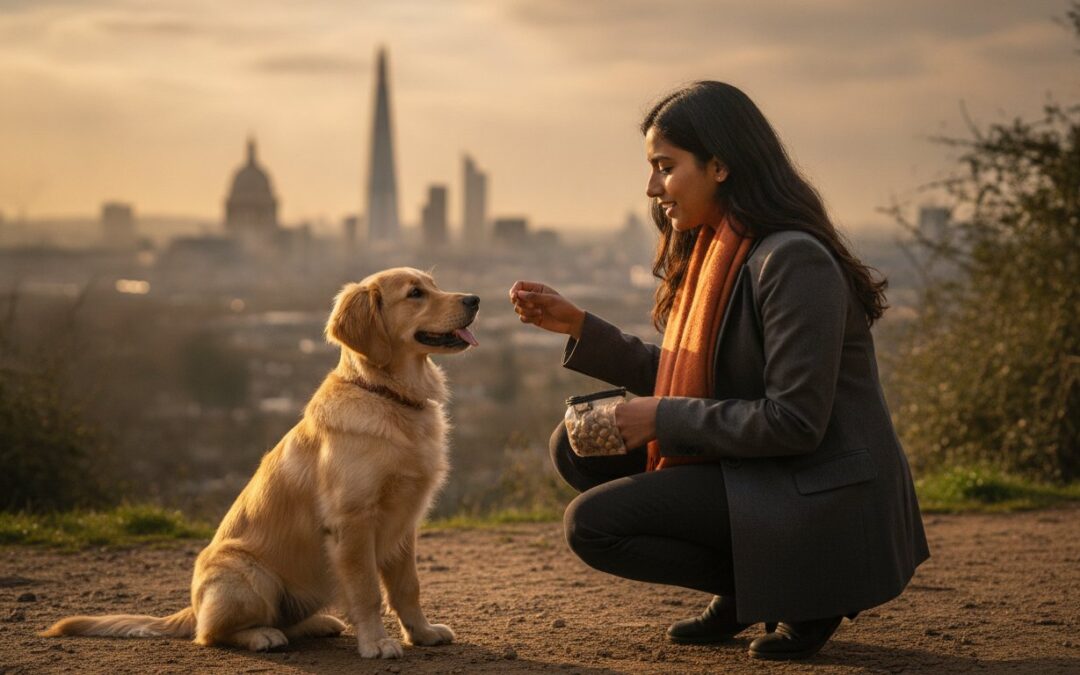
Imagine standing on a narrow pavement in Islington while your dog lunges at a passing bus, or feeling that familiar spike of anxiety as they ignore your call across a crowded Hampstead Heath. You aren’t alone in feeling that the city’s sensory overload is sometimes working against you. When seeking puppy training North London residents often find that traditional, rigid methods fall short in our bustling, high-pressure environment. Urban living demands more than just basic commands; it requires a dog that feels safe and connected to you amidst the chaos.
We understand that your goal isn’t just a dog that sits on cue, but a companion who can calmly enjoy a Sunday roast at a local pub or a peaceful stroll through Highgate Woods. This expert guide provides a modern, evidence-based roadmap to help you manage these unique challenges with empathy and professional insight. You’ll discover how to transform stressful walks into moments of connection, decode the motivations behind your dog’s urban anxiety, and implement bespoke strategies that foster a resilient, lifelong bond.
Key Takeaways
- Understand how the unique sensory demands of North London affect your dog’s emotional state and why urban environments require a specific training mindset.
- Discover how evidence-based puppy training North London methods replace outdated dominance theories with positive reinforcement to build a foundation of mutual respect.
- Evaluate the benefits of 1-to-1 personalised training sessions that address your dog’s specific challenges within the context of your local neighbourhood.
- Learn practical techniques for achieving reliable recall in busy areas like Hampstead Heath and maintaining calm lead manners on narrow city pavements.
- Gain insight into a holistic approach that integrates training, walking, and grooming to support your dog’s long-term well-being and confidence.
Navigating Dog Training in North London: Challenges of the Urban Environment
Living in areas like Highgate or Islington offers a vibrant lifestyle; however, for a dog, the sheer density of these neighbourhoods can be overwhelming. Traditional training often focuses on obedience in quiet, controlled environments. This approach fails when faced with the sensory-heavy reality of North London. A dog might sit perfectly in a kitchen but struggle to maintain focus when a red double-decker bus screeches past on a narrow Islington street. Effective puppy training North London services must address the reality of these high-pressure environments from day one.
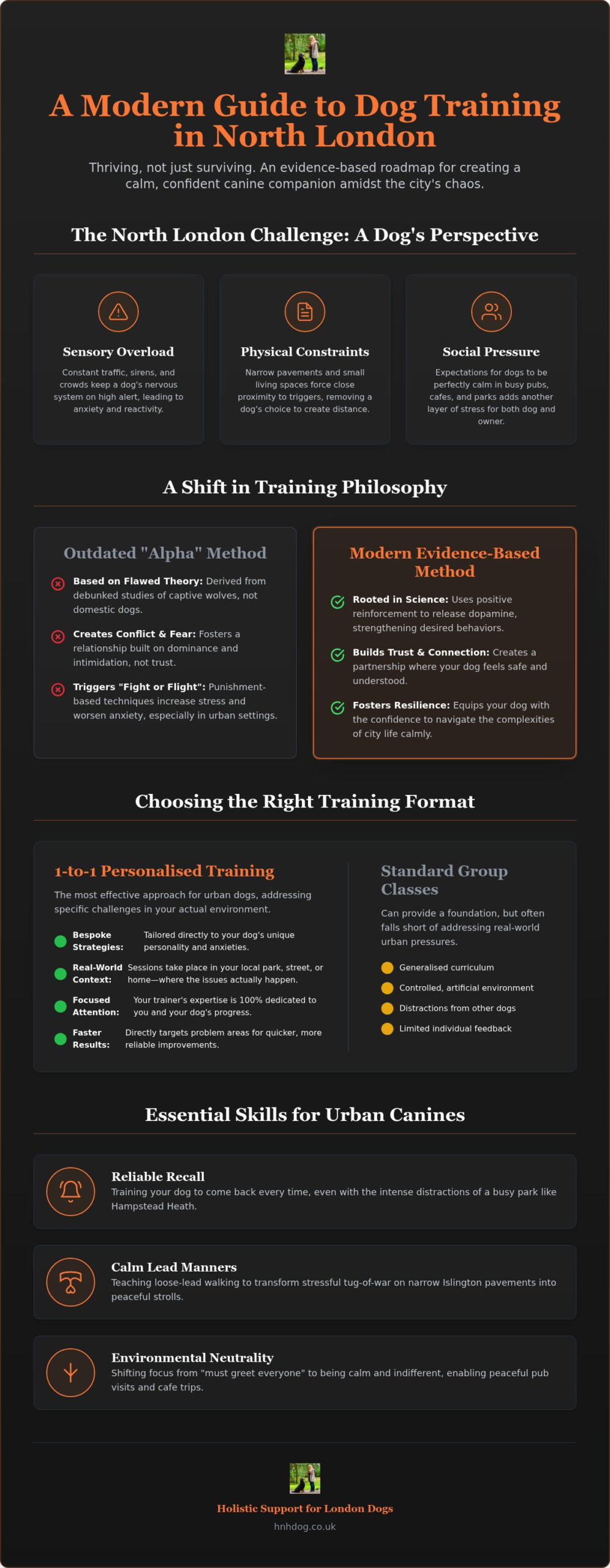
The physical constraints of our city play a significant role in canine stress. Narrow pavements force dogs into close proximity with strangers and other animals, removing their ability to choose a safe distance. In busy green spaces like Hampstead Heath, the constant influx of movement can keep a dog’s nervous system in a state of high alert. This is why we prioritise neutrality over traditional socialisation. Instead of teaching your dog that every person or dog is a playmate, we teach them to be calm and indifferent to the world around them. This shift in perspective reduces the pressure on your pup and builds a more reliable foundation for urban life.
Why North London Requires a Specific Training Approach
The constant hum of sirens, the rattle of cyclists, and the unpredictable movement of urban life demand a high level of cognitive resilience. Effective modern dog training methods must account for this constant stimulation. Without a strategy to filter these inputs, your dog may become reactive or hyper-vigilant. We focus on building focus amidst distractions rather than just in isolation.
North London’s wonderful dog-friendly pub and cafe culture adds another layer of social pressure. There is an unspoken expectation for dogs to be invisible under tables while their owners socialise. For a busy London professional, training isn’t a hobby; it’s a necessity for a harmonious life. We help you integrate these skills into your daily routine, ensuring your pup can navigate the N1 or N6 postcodes with quiet confidence.
The Impact of High-Density Living on Canine Behaviour
Dogs living in flats or terraced houses often experience urban burnout. This occurs when the brain is never truly at rest due to the sounds of neighbours in the hallway or traffic outside. You might notice your dog becoming increasingly jumpy or struggling to settle after a walk. These are clear signs of environmental overstimulation rather than simple bad behaviour. When arranging puppy training North London residents should look for a plan that treats the home environment as a critical factor.
Territorial issues can also intensify in high-density living. When your front door opens directly onto a busy street, your dog may feel the need to guard that threshold more aggressively. Creating a dedicated safe space within your home is vital. This area should be a sensory sanctuary, shielded from the sights and sounds of the street, where your dog’s nervous system can finally decompress. By understanding the animal’s perspective on city living, we can implement bespoke solutions that protect their emotional well-being.
Evidence-Based Training: Moving Beyond “Alpha” Myths
The concept of the “Alpha” or “Pack Leader” remains one of the most persistent yet damaging myths in the world of canine education. This theory was based on flawed studies of captive, unrelated wolves from the 1940s; research that the original authors have since spent decades debunking. When you approach your dog with a mindset of dominance, you risk creating a relationship rooted in conflict and fear rather than trust. This is particularly counterproductive when managing urban dog behavior, where a pup already faces significant stress from the high-density environment of the city. Modern science proves that dogs are not trying to “rule” us; they are simply trying to navigate a world they don’t always understand.
Instead of coercive control, we focus on the science of dopamine and neural pathways. When a dog is rewarded for a specific action, their brain releases dopamine, a neurotransmitter associated with pleasure and motivation. This chemical signal strengthens the neural connections related to that behaviour, making it more likely the dog will repeat it in the future. For anxious or rescue dogs, these non-coercive methods are essential. Punishment-based techniques often trigger the “fight or flight” response, which shuts down the prefrontal cortex and prevents actual learning from taking place. By choosing supportive methods, you ensure your dog remains in a “thinking” state rather than a “reacting” one.
The Science of Positive Reinforcement
Learning is governed by operant conditioning, which is often categorised into four quadrants. While these terms can sound clinical, they simply describe whether we are adding or removing something to increase or decrease a behaviour. Punishment-based methods often focus on “positive punishment” (adding something unpleasant), which only masks a symptom while leaving the underlying emotion unaddressed. For example, a dog might stop barking because they fear a correction, but they remain just as stressed by the trigger. Reinforcement, conversely, addresses the root cause by changing how the dog feels about the situation. Positive reinforcement is a partnership-based learning method that focuses on rewarding desired behaviours to encourage their repetition while maintaining the animal’s emotional safety.
Why Non-Coercive Methods Build Lasting Bonds
Transitioning from a “commander” to a “mentor” changes the entire dynamic of your household. When you act as a steady, predictable guide, your dog looks to you for reassurance in chaotic urban situations. This approach builds a resilient sense of confidence that carries over into every aspect of their life. Our philosophy at H&H Dog always advocates for the animal’s perspective; we believe that every “misbehaviour” is a form of communication about an unmet need or a lack of understanding. If you are ready to move beyond outdated myths and foster a deeper connection, our 1-to-1 dog training provides the bespoke, ethical guidance required for modern puppy training North London owners expect.
1-To-1 Personalised Training vs. Group Classes in London
Choosing the right format for your dog’s education is a pivotal decision. In many North London neighbourhoods, you’ll find a variety of group classes held in local community halls or park corners. While these can offer a sense of community, they often present a “distraction tax” that is too high for a puppy still learning the basics. For effective puppy training North London owners often find that the sensory-heavy environment of a group setting leads to overstimulation rather than education. When a dog is overwhelmed by the presence of five other barking pups, their ability to process new information diminishes significantly. When researching puppy training North London, it’s helpful to consider whether your dog is ready for the high-stimulus environment of a group class or would benefit more from a focused, individual start.
This is where 1-to-1 personalised training excels. By starting in the quiet sanctuary of your own home, we can establish clear communication without the pressure of outside interference. This bespoke approach allows us to use reward-based training methods to build a foundation of trust. We don’t just teach commands; we address the specific architecture of your life. Whether it’s managing door-barking in a Victorian terrace or navigating the specific narrow pavements of your daily walking route, individual sessions provide the focus required for real-world success. H&H Dog brings over 20 years of industry experience to these sessions, ensuring every challenge has a manageable, ethical solution.
The Benefits of In-Home 1-to-1 Sessions
The primary advantage of training within your home is the ability to target issues where they actually occur. Household manners, such as greeting guests calmly or settling while you work, are difficult to replicate in a drafty church hall. For dogs with complex behavioural histories or those who feel vulnerable in crowds, the one-to-one format is essential for emotional safety. It allows us to move at the dog’s pace, ensuring they never feel pushed beyond their threshold. This tailored attention ensures that every minute of the session is dedicated to your specific goals and your dog’s unique personality.
When to Choose Group Socialisation Classes
Group settings do have a valuable place in a dog’s developmental journey, provided the timing is right. Once your pup has a solid grasp of the basics, a controlled group environment can help them learn to maintain focus despite the presence of peers. These classes are less about “play” and more about “neutrality”, which is the ability to remain calm while other dogs are nearby. They also serve as a wonderful way to meet other local owners in North London, creating a support network of like-minded neighbours. However, for initial skill-building and complex behavioural work, the investment in a professional mentor for 1-to-1 guidance usually yields more durable, stress-free results.
Essential Urban Skills: Recall, Lead Manners, and Neutrality
Once you have established a foundation of trust at home, the next step is applying those skills to the high-stimulus streets of the city. For residents seeking effective puppy training North London presents a unique set of variables that standard obedience classes often overlook. Success in a quiet garden doesn’t always translate to the corner of Upper Street. We focus on teaching your dog how to process the environment while remaining connected to you, ensuring they can navigate the world with a sense of calm neutrality rather than constant over-excitement or fear.
Mastering the Recall in Busy Parks
The “North London Recall” is about more than just coming when called; it’s about choosing you over a squirrel in Hampstead Heath or a group of playing dogs. We begin with the “Check-in” game. This involves rewarding your dog every time they look back at you voluntarily. By doing this, you build a magnetic connection that makes you more interesting than the urban distractions around them. When competing with high-level triggers, your rewards must be equally high-value; think fresh chicken or small pieces of cheese rather than standard dry kibble.
To achieve reliability, follow this three-stage process:
- Stage 1: The Foundation. Practice in a long-lead environment with zero distractions. Use a clear, enthusiastic cue and reward immediately upon arrival.
- Stage 2: Proofing. Introduce mild distractions, such as a family member walking nearby. Only call your dog when you are 90% certain they will respond.
- Stage 3: Real-World Application. Gradually move to busier areas. Use a training line for safety while your dog learns that the recall cue remains relevant even in the face of city noise.
Lead Walking on Narrow North London Pavements
Walking on a tight lead is often a physical manifestation of a dog’s internal stress. On narrow pavements, tension travels down the lead, signalling to your dog that they should be on alert. We use the “Silky Lead” technique to encourage a soft, loose connection. This involves micro-adjustments in your own body language to keep the lead in a “J” shape. If the lead tightens, we stop and wait for the dog to reset their emotional state rather than pulling back. This prevents the walk from becoming a physical battle of wills.
Teaching your dog to “yield” is equally important. This means moving to the side to allow oncoming pedestrians or other dogs to pass without a confrontation. You can manage the environment by using your body as a shield, positioning yourself between your dog and the potential trigger. This proactive approach protects your dog’s personal space and prevents the development of leash reactivity. If you’re struggling with pulling or reactivity during your daily walks, our bespoke 1-to-1 training sessions provide the specialised puppy training North London dogs need to thrive in a busy environment.
Finally, we must address the “settle”. In our dog-friendly cafes and pubs, a dog that can relax under a table is a welcome guest. This skill starts with teaching your dog that “nothing is happening” is a cue in itself. By rewarding calm, stationary behaviour, you help your pup understand that they don’t need to be “on” at all times. This emotional regulation is the hallmark of a truly confident urban pup.
The H&H Dog Approach: Bespoke Training for Individual Pups
At H&H Dog, we believe that effective education starts with understanding the individual at the other end of the lead. With over 20 years of industry experience, we’ve refined a methodology that prioritises emotional health over rote obedience. When you choose us for puppy training North London, you aren’t just getting a set of instructions; you’re gaining a knowledgeable mentor invested in your dog’s long-term welfare. We look beneath the surface to address the internal states that drive outward actions. This ensures that the solutions we provide are not just quick fixes, but sustainable changes that strengthen your bond.
We avoid the clinical coldness of generic, mass-market models. Instead, our approach is deeply personal and ethically driven. We advocate for the animal’s perspective in every interaction, ensuring that training is a supportive experience rather than a coercive one. By focusing on partnership and mutual understanding, we help you navigate the complexities of city life with a calm confidence. Whether you are dealing with a new pup or an older dog with established habits, we provide a steady hand to guide you through the process.
Customised Behavioural Assessments
Every successful training journey begins with a comprehensive behavioural assessment. We don’t believe in one-size-fits-all solutions because every dog and household dynamic is unique. During this initial consultation, we focus on understanding the “Why” behind your dog’s actions. We investigate the underlying motivations, such as fear, frustration, or simple overstimulation, before creating a bespoke roadmap for your progress. This holistic view includes an analysis of diet, exercise routines, and mental stimulation needs. By addressing these foundational elements, we ensure that your dog is in the best possible state of mind to learn and thrive in a busy urban environment.
Integrating Training with Grooming and Walking
A distinct advantage of the H&H Dog approach is the seamless synergy across all our services. Consistency is the cornerstone of successful canine education. If your pup is working on building confidence, having a mobile dog groomer who understands canine body language ensures that essential care remains a positive, low-stress experience. This continuity prevents the mixed signals that often hinder progress in traditional models.
Similarly, our professional dog walking service reinforces the positive social skills and lead manners we develop during 1-to-1 training. Our walkers are trained to maintain the same supportive, non-coercive communication styles that we use in our formal sessions. This holistic care package ensures your dog receives consistent guidance throughout their day, regardless of the activity. If you’re ready to begin a customized journey for your pet, you can book a behavioural consultation or a 1-to-1 session to experience the professional puppy training North London owners trust for lasting results.
Building a Confident Future for You and Your Dog
Navigating the specific sensory demands of the city requires moving beyond outdated dominance myths and embracing an evidence-based partnership. By focusing on neutrality and reliable recall, you can transform stressful urban walks into opportunities for genuine connection. Effective puppy training North London owners can rely on is about more than just obedience; it’s about fostering an internal state of calm that allows your dog to thrive amidst the bustle of N1 or N6.
H&H Dog brings over 20 years of professional experience to every consultation, offering bespoke, non-coercive training methods that respect your dog’s perspective. As local experts in North London urban dog care, we’re dedicated to providing the steady, expert guidance you need to build a resilient bond. You don’t have to manage the complexities of city ownership alone. Take the first step toward a more harmonious life together and Book Your Bespoke 1-to-1 Dog Training Session in North London. Improvement is inevitable when you have the right mentor by your side.
Frequently Asked Questions
How much does dog training cost in North London?
Professional fees for canine education vary depending on the specific service and the complexity of the issues being addressed. Fees are typically charged for individual one-to-one training sessions or comprehensive behavioural consultations. Factors such as your location within North London and the level of expert guidance required influence the total investment. We recommend an initial assessment to create a bespoke roadmap that ensures you receive the most effective support for your dog’s unique needs.
Is my dog too old to start training?
Dogs are never too old to learn new skills or adjust their emotional responses to the world around them. While puppies are often seen as sponges for information, senior dogs benefit immensely from the mental stimulation and structured communication provided by professional training. We adapt our methods to suit your dog’s physical capabilities and cognitive pace. It’s often more about unlearning established habits through patient, non-coercive mentorship rather than a lack of ability to learn.
How many sessions will my dog need to see improvement?
Improvement is an individual journey, though most owners notice a positive shift in their dog’s focus after the very first session. Lasting change typically requires a series of visits to “proof” new behaviours against the distractions of busy city streets. We focus on giving you the tools to maintain progress between our appointments. Consistency in your daily routine is the most significant factor in how quickly your dog develops reliable, long-term urban skills.
Can you help with a dog that is reactive to other dogs on the lead?
Leash reactivity is a common challenge on narrow Islington or Highgate pavements, and we specialise in addressing these complex emotional responses. We look beyond the outward barking to understand the underlying fear or frustration driving the behaviour. Through our behavioural consultations, we implement strategies that change your dog’s emotional state rather than just suppressing the action. This involves teaching you how to manage the environment and use body language to protect your dog’s personal space.
Do you offer puppy training for new owners in North London?
We provide dedicated puppy training North London owners can access directly within their own homes. This early intervention is vital for establishing neutrality and confidence before small issues become ingrained habits. We guide you through the critical development periods, focusing on practical skills like calm lead walking and reliable recall. Starting in a low-distraction environment ensures your pup feels safe and supported as they begin their journey into the high-pressure urban landscape.
What is the difference between a dog trainer and a dog behaviourist?
A dog trainer typically focuses on teaching specific skills and cues like “sit” or “heel” through structured exercises. A behaviourist addresses more complex issues rooted in deep-seated emotional states, such as anxiety, aggression, or phobias. At H&H Dog, our 20 years of experience allow us to blend these roles. We provide both the practical skill-building of a trainer and the psychological insights of a behavioural consultant to ensure a holistic approach to your dog’s welfare.
Will you train my dog for me, or do I need to be involved?
Your active involvement is essential for the long-term success of any training plan. While we provide the professional expertise and demonstration, you are the person your dog lives with every day. Our goal is to mentor you so that you feel confident in communicating with your pup when we aren’t there. Training is a shared experience that builds a deeper emotional bond and ensures the results are durable in real-world urban situations.
Do you use treats or clickers in your training sessions?
We utilise reward-based, non-coercive methods, which often involve high-value treats to build positive associations with desired behaviours. Clickers can be a useful tool for marking precise moments of success, but they are not always a requirement. The focus is on finding what motivates your individual dog, whether that is food, play, or praise. By using these supportive techniques, we ensure the learning process is enjoyable for your dog and strengthens your partnership.