
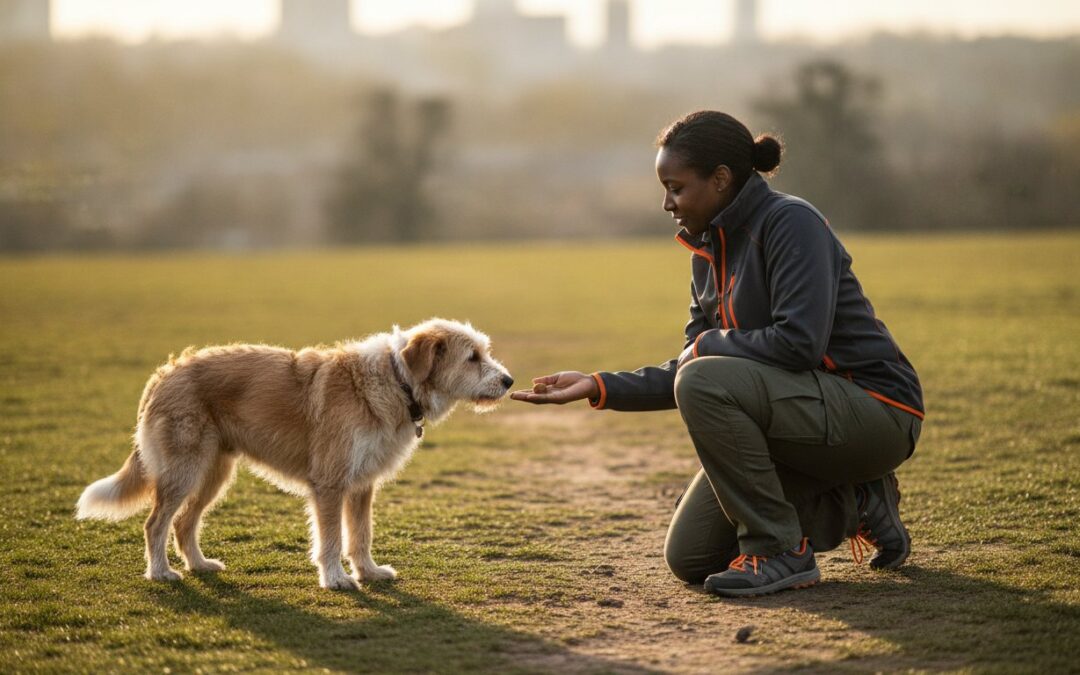
Imagine standing on the edge of Hampstead Heath, your heart sinking as your rescue dog freezes at the sound of a distant siren or lunges at a passing cyclist. You brought them home to provide a sanctuary, yet the sensory intensity of the city often leaves you both feeling exhausted rather than connected. It’s common to feel a sense of frustration when your dog’s fear of strangers or urban noises makes a simple walk feel like a challenge. Finding a specialist dog trainer for rescue dogs North London is the first step in moving past the confusion of conflicting advice and toward a relationship built on mutual understanding.
We agree that your dog’s past shouldn’t dictate their future happiness in the capital. This article will show you how to transform your rescue dog’s transition into North London life with specialist, force-free training tailored to their unique history. We’ll preview the essential steps for building a deep, trusting bond; managing leash reactivity in our busy parks; and creating a peaceful home environment where your dog feels truly safe. By focusing on your dog’s internal emotional state rather than just their outward actions, we can ensure that every challenge has a manageable, ethical solution.
Key Takeaways
- Understand the “3-3-3 rule” of rescue decompression to help you manage expectations during your dog’s first critical months in a new environment.
- Identify the underlying emotional triggers behind urban leash reactivity and separation anxiety to address the cause rather than just the symptom.
- Discover how working with a dedicated dog trainer for rescue dogs North London can rebuild broken trust through evidence-based, non-coercive techniques.
- Learn why prioritising environmental neutrality over forced social interactions is the most effective way to socialise a rescue dog in busy city parks.
- Explore how a holistic approach, combining 1-to-1 training with consistent walking and stress-free grooming, creates a predictable and safe world for your dog.
Understanding the Rescue Dog Journey in North London
Adopting a rescue dog is a profound commitment, but the transition period is often misunderstood by even the most well-meaning owners. Many expect their new companion to feel immediate relief or gratitude. In reality, your dog is likely experiencing a state of sensory and emotional overwhelm. This period, known as “Rescue Decompression,” is a critical window where your dog’s nervous system begins to downregulate from the stress of the shelter environment. As an experienced dog trainer for rescue dogs North London, we focus on this phase to ensure the foundations of trust are laid before any formal training begins. Safety and emotional regulation must always come before obedience.
The 3-3-3 Rule for North London Adopters
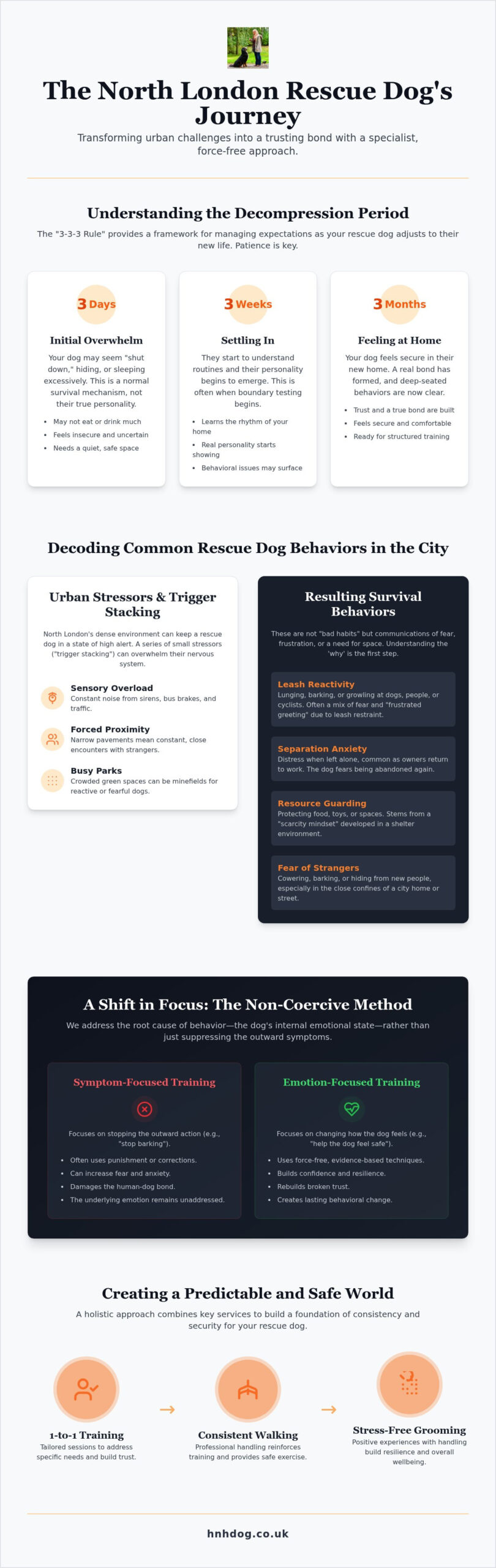
The 3-3-3 rule provides a logical framework for managing your expectations during the first few months. During the first three days, your dog may appear “shut down,” hiding or sleeping excessively as they process their new surroundings. This is a survival mechanism, not necessarily a reflection of their true personality. By the third week, they start to understand the rhythm of your home and learn basic routines. This is often when you will see them begin to test boundaries. By the third month, your dog should feel truly at home. It’s during this final stage that their genuine temperament and any deep-seated behavioural challenges typically emerge. Having a professional dog trainer for rescue dogs North London involved during this timeline helps you navigate these shifts with confidence.
Why Urban Life is Different for Rescues
North London presents specific challenges for a dog accustomed to a quiet kennel or a rural foster home. Postcodes like N1, N6, or N10 are vibrant but incredibly dense. The constant hiss of bus brakes, the wail of sirens, and the proximity of strangers on narrow pavements can keep a rescue dog in a state of high alert. This chronic stress prevents them from learning effectively and can lead to heightened reactivity.
To support your dog’s transition, you must create a dedicated “safe zone” within your home. In a typical London flat or terrace, this might be a quiet corner of the living room or a space under a staircase where they are never disturbed. This predictable sanctuary allows their cortisol levels to drop, making them more receptive to our 1-to-1 dog training sessions. We prioritise environmental management to ensure your dog feels protected from the urban chaos outside your front door. By adopting your dog’s perspective, we can transform a stressful city environment into a predictable and manageable world.
Common Behavioural Challenges for Rescue Dogs
Understanding why your dog acts out is the first step toward harmony. Many owners view behaviours like lunging or barking as “bad habits,” but for a rescue dog, these are often survival strategies. They aren’t trying to be difficult. Instead, they are communicating an internal state of fear or frustration. Working with a dedicated dog trainer for rescue dogs North London allows you to decode these signals and address the emotional root rather than just suppressing the symptom. By adopting your dog’s perspective, we can begin to rebuild the trust that has often been broken by their previous experiences.
Managing Reactivity in Busy Parks
North London’s green spaces, such as Hampstead Heath or Finsbury Park, are wonderful for exercise but can be minefields for a reactive dog. You might notice your dog “barks at everything,” from other dogs to joggers. Often, this is a result of “trigger stacking.” This occurs when a series of small stressors, like a loud siren on the way to the park followed by a crowded pavement, leaves your dog’s nervous system unable to cope with one more encounter. It’s also vital to distinguish between true aggression and a “frustrated greeter.” The latter wants to say hello but feels trapped by the leash, leading to an explosive display. We help you identify these nuances so you can advocate for your dog’s space effectively.
Other common challenges include resource guarding and a fear of strangers. Resource guarding often stems from a “scarcity mindset” developed in shelters where food, toys, or even human attention were limited. Similarly, the high density of our local pavements means your dog is constantly forced into close proximity with strangers. This can be terrifying for a dog that hasn’t been properly socialised to urban life. We focus on building a sense of security, showing your dog that their needs will always be met without conflict or competition.
Separation Anxiety and the Return to Work
London life often involves long commutes and office hours. For a rescue dog who has finally found safety in your home, your departure can trigger intense panic. This isn’t spiteful behaviour; it’s a profound fear of abandonment. We use gradual desensitisation to teach your dog that being alone is safe. This involves creating a predictable routine and slowly increasing your time away at a pace your dog can handle. If you find these challenges are impacting your quality of life, seeking a Dog Behaviourist London can provide the bespoke, deep support needed for complex cases. Our 1-to-1 dog training sessions are designed to build this confidence step by step, ensuring your dog feels secure even when you are out of sight.
The H&H Approach: Non-Coercive 1-to-1 Training
Our philosophy is rooted in the belief that your dog is a partner, not a subject to be dominated. Outdated “alpha” or “dominance” theories often rely on suppression and fear, which can be devastating for a dog already struggling with a traumatic past. When you seek a specialist dog trainer for rescue dogs North London, you are choosing a path that prioritises emotional safety over physical control. We use positive reinforcement not just because it’s ethical, but because it’s the most effective way to rebuild broken trust. By rewarding the behaviours we want to see, we help your dog feel successful and secure in their new life. Working with a dog trainer for rescue dogs North London allows you to navigate the complexities of urban life without ever resorting to coercion.
We focus on internal emotional states rather than just outward obedience. If your dog is lunging on a North London pavement, they are likely communicating fear or intense frustration. Suppressing that bark with a physical correction doesn’t remove the fear; it simply removes the warning sign. Our approach involves understanding the underlying motivation behind the action, allowing us to address the cause directly. This creates a predictable world for your dog where they no longer feel the need to defend themselves. Trust takes time, but it’s the only foundation for a lasting bond.
Why 1-to-1 Sessions Beat Group Classes for Rescues
For many rescue dogs, the environment of a traditional group class is simply too much. The presence of multiple unfamiliar dogs and people in a confined space can trigger the very reactivity you are trying to solve. Our bespoke 1-to-1 sessions allow us to control every variable. We work at a pace that respects your dog’s unique history, reducing environmental stress during the learning process. This personalised coaching also focuses on you, the owner. We help you become your dog’s “safe person” by teaching you how to read their subtle body language and intervene before they feel overwhelmed. In a 1-to-1 setting, we can practice these skills in real-world scenarios, whether that’s in your home or on your local street.
Evidence-Based Training for Long-Term Success
We rely on science-led methods to change your dog’s underlying emotional responses. It’s not enough to stop a dog from barking; we want to change how they feel about the trigger in the first place. This holistic perspective values long-term emotional health over quick, forceful fixes. Patience is mandatory when working with rescues. For a deeper look at how we tailor these methods to the city environment, you can explore The Ultimate Guide to Dog Training in North London. Our commitment is to provide ethical solutions that foster a deep, trusting bond based on mutual understanding and respect. By choosing evidence-based care, you are investing in a peaceful future for both you and your dog.
Practical Socialisation Tips for North London Rescue Owners
Socialising a rescue dog in a city as dense as London requires a significant shift in perspective. Many owners feel pressured to have their dog “make friends,” but for a rescue, forced interaction can be a primary source of stress. As a specialist dog trainer for rescue dogs North London, we prioritise neutrality over interaction. Your goal isn’t for your dog to greet every passerby on the street; it’s for them to remain calm and relaxed while the world moves around them. This “neutrality first” mindset is the foundation of a successful urban life.
To achieve this, you must become an expert in decoding your dog’s body language in real-time. Look for subtle signs of tension like a stiffened tail, a furrowed brow, or a slight lip lick. These are early warning signals that your dog needs more space. Distance is your most powerful tool in these moments. Using wide, open areas like Trent Park allows you to keep a comfortable “buffer zone” between your dog and potential triggers. We also recommend choosing off-peak hours for your walks in North West London, typically mid-morning or mid-afternoon, to avoid the high-intensity rush of the “after-work” crowd.
Navigating North London Parks Safely
Highgate Wood and Queen’s Wood in Muswell Hill offer excellent shaded paths that can feel more secluded than open fields. However, you’ll inevitably encounter off-leash dogs. If a “friendly” dog approaches, stay calm and use your body to gently block their path, advocating for your rescue’s space. After any stressful encounter, engage your dog in a “sniffari.” Allowing them to follow their nose at their own pace helps lower cortisol levels and resets their nervous system, preventing a single event from ruining the rest of the walk.
Urban Desensitisation Techniques
City life involves constant noise from delivery bikes and heavy traffic. We use counter-conditioning to change your dog’s emotional response to these sounds. This involves pairing the “scary” noise with a high-value reward, teaching your dog that a passing bus predicts something wonderful. The “Look at That” (LAT) game is another essential part of your resilience toolkit. By rewarding your dog for calmly noticing a trigger from a safe distance, you build their confidence and focus. Building these skills takes patience and a structured approach. If you’re struggling to manage your dog’s reactions on local streets, our 1-to-1 dog training sessions provide the bespoke support you need to navigate these challenges safely.
Holistic Care: Training, Walking, and Grooming
Training doesn’t happen in a vacuum. A rescue dog’s progress depends heavily on a stable, predictable routine that covers every aspect of their daily life. A specialist dog trainer for rescue dogs North London understands that every interaction, from the morning walk to the evening brush, is an opportunity to reinforce trust. Consistency reduces anxiety. When your dog knows what to expect from their day, their cortisol levels remain lower, making them far more receptive to learning and emotional regulation.
Structured Walking for Confidence
Walks are often the most stressful part of a rescue dog’s day in the city. However, Professional Dog Walking in London can provide the mental stimulation and physical exercise needed to balance their energy. We offer group dog walking for those ready to socialise, but we always start with the individual’s needs. A structured walk isn’t just about movement; it’s about building confidence through positive associations with the environment. We treat your dog as an individual, ensuring they aren’t overwhelmed. Our approach includes:
- Predictable routes that build environmental confidence.
- Mental stimulation through controlled sniffing and exploration.
- Careful assessment before any transition to group dog walking.
Stress-Free Grooming for Rescue Dogs
The first professional groom can be a terrifying prospect for a rescue dog. Traditional salons are often loud, crowded, and filled with unfamiliar scents that can trigger a fear response. This is why our mobile dog grooming service is so beneficial for nervous or reactive rescues. Our mobile vans provide a one-to-one environment right outside your door, removing the stress of travel and the presence of other dogs. We focus on building a positive association with handling and touch, proceeding only at a pace your dog is comfortable with. For those slightly further afield, our Mobile Dog Grooming in Watford offers the same high standard of stress-free care. This setup helps by:
- Eliminating the stress of a noisy, high-traffic salon.
- Removing the need for stressful car journeys.
- Providing undivided attention from a groomer who understands rescue history.
Building a shared life with a rescue dog is a journey that requires patience, expertise, and a holistic approach. Whether you need a dedicated dog trainer for rescue dogs North London to address specific behavioural issues or supportive walking and grooming services, we are here to help. Your first step is booking a behavioural consultation. This allows us to assess your dog’s unique history and create a bespoke plan that respects their perspective and your peace of mind. We act as a steady hand, ensuring that every challenge has a manageable, ethical solution.
Creating a Predictable Life for Your Rescue Dog
Success in rescue rehabilitation isn’t measured by a perfect “sit” but by the quiet confidence your dog shows when navigating the bustle of North London. You now understand that decompression is a journey, not a race. By prioritising your dog’s internal emotional state and using distance as a tool, you can transform stressful walks into moments of shared exploration. Finding a dedicated dog trainer for rescue dogs North London ensures you have an expert mentor to guide you through these complex transitions.
We offer a holistic path to harmony through evidence-based, non-coercive methods that respect the animal’s perspective. With over 20 years of expert pet care experience, our bespoke 1-to-1 sessions are tailored to your dog’s unique history and your specific urban environment. We are proud to serve families across North London, North West London, and Watford, providing a steady hand in what can often feel like a chaotic process. You don’t have to navigate this alone.
Book your bespoke 1-to-1 rescue dog training session today and start building a bond based on mutual understanding. A peaceful, trusting life with your rescue dog is entirely within reach.
Frequently Asked Questions
How long does it take for a rescue dog to trust their new owner?
Trust typically develops in stages, often following the “3-3-3 rule” mentioned earlier: three days to decompress, three weeks to learn routines, and three months to feel secure. However, every dog is an individual. Some may bond within weeks, while others with deep-seated trauma might take a year or more. Consistency, patience, and non-coercive methods are the fastest ways to build this bond. We focus on providing a predictable environment to help your dog feel safe.
Is my rescue dog too old to be trained?
No dog is ever too old to learn new behaviours or emotional responses. While older rescues may have more deeply ingrained habits, they often have better focus than younger puppies. Training at a later stage is about improving their quality of life and strengthening your relationship. We adapt our 1-to-1 sessions to suit your dog’s physical abilities and cognitive pace. It’s about progress and comfort, not perfection or high-intensity obedience.
My rescue dog is aggressive towards other dogs in the park; can you help?
Yes, we specialise in helping dogs that show reactive or aggressive behaviours. As an experienced dog trainer for rescue dogs North London, we look at the underlying fear or frustration causing the reaction. We don’t use punishment, which can worsen aggression. Instead, we use counter-conditioning to change how your dog feels about other dogs. We’ll work together to build a toolkit for managing walks in busy parks like Hampstead Heath safely and calmly.
What should I bring to our first 1-to-1 training session in North London?
For our initial session, please have a variety of high-value treats ready, such as small pieces of plain chicken or cheese. You’ll also need a standard flat collar or a well-fitted harness and a fixed-length lead rather than an extendable one. If your dog has a favourite toy, keep that nearby too. Most importantly, bring a notepad and an open mind. We want to ensure the environment remains as calm and familiar as possible for your dog.
How do I stop my rescue dog from barking at the front door?
Barking at the door is often an alert or a fear response to urban noise. We start by desensitising your dog to the sounds of the hallway or street. This involves rewarding them for remaining calm when they hear a trigger from a distance. We also teach a “place” cue, giving them a specific, safe spot to go to when the bell rings. This provides a clear alternative to barking and helps them feel more in control.
Should I use a crate for my new rescue dog in a London flat?
A crate can be a valuable “den” in a busy London flat, but it should never be forced. If your rescue dog has negative associations with confinement, we may suggest a playpen or a dedicated quiet corner instead. The goal is to create a predictable sanctuary where they feel protected from the sensory overload of the city. We can help you introduce the crate using positive reinforcement to ensure it remains a place of rest.
What is the difference between a dog trainer and a behaviourist for a rescue dog?
A dog trainer typically focuses on teaching specific skills and cues like recall or walking on a loose lead. A behaviourist looks deeper into the emotional motivations behind complex issues like separation anxiety or chronic fear. For many rescues, these roles overlap. We provide both 1-to-1 training and behavioural consultations to ensure a holistic approach. This allows us to address both the outward actions and the internal emotional states that drive them.
Can I book training sessions if I live in North West London or Watford?
Yes, we proudly serve communities across North London, North West London, and Watford. Our local expertise allows us to understand the specific challenges of your neighbourhood, whether you’re navigating the busy streets of Camden or the quieter parks of Watford. As a specialist dog trainer for rescue dogs North London, we bring our 20+ years of experience directly to you. This ensures your dog learns in the environment where they spend most of their time.