
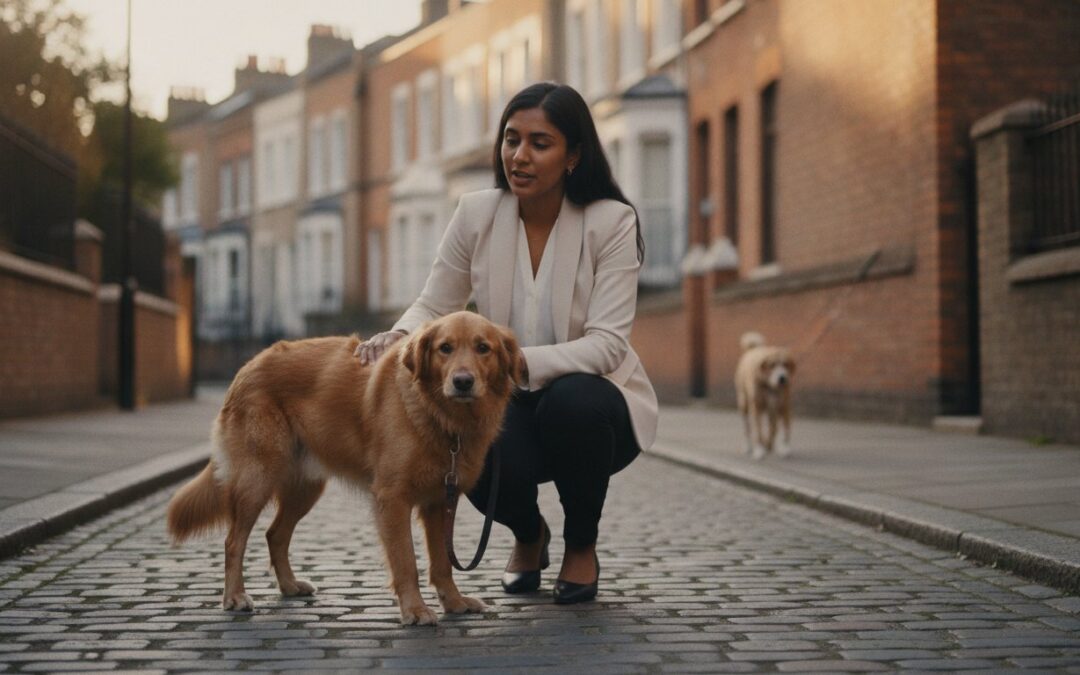
You see a golden retriever approaching on a narrow North London pavement, and your stomach instantly knots. You know what follows: the frantic barking, the physical strain on your shoulder as you shorten the lead, and the stinging feeling of judgment from passing owners. If you’ve ever found yourself searching for “my dog is scared of other dogs what do I do”, you’re likely feeling the weight of a dog who seems unable to cope with the world. It is a lonely experience to worry that your companion might never have “normal” dog friends or enjoy a simple stroll through the park.
We understand that this fear is a physiological response, not a choice or a sign of “bad” behaviour. This guide provides a compassionate roadmap to help you decode your dog’s internal emotional state and manage stressful encounters in busy urban environments. You will discover how to build their confidence through evidence-based training that respects their individual pace. We will explore why forced socialisation often causes more harm than good and how a structured, bespoke approach can finally bring peace to your daily walks. By the end, you will have the tools to become your dog’s greatest advocate and protector.
Key Takeaways
- Shift your perspective from frustration to advocacy by understanding that fear is a physiological survival response rather than a choice or a sign of bad behaviour.
- If you often wonder “my dog is scared of other dogs what do I do”, the solution begins with mastering the “Ladder of Aggression” to spot subtle cues before they escalate.
- Discover how to use the urban environment to your advantage by utilising parked cars and corners as visual barriers to protect your dog’s personal space.
- Learn how to identify your dog’s specific threshold to ensure that training games like “Look at That” remain effective and stress-free.
- Recognise the signs that your dog needs a bespoke behavioural consultation to address complex emotional needs that go beyond standard training.
Understanding Why Your Dog Fears Other Canines
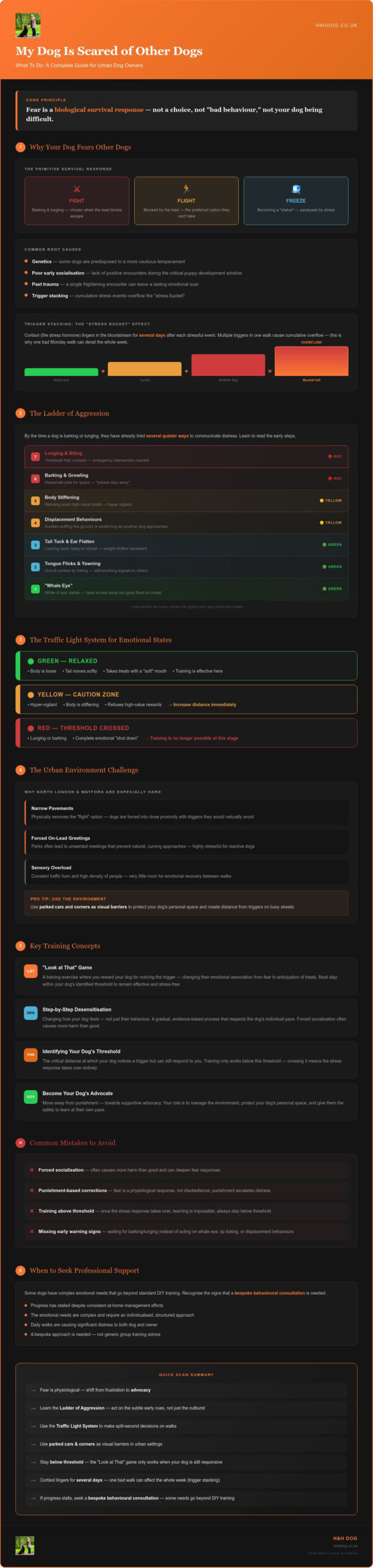
Fear is not a choice; it is a biological imperative. When you find yourself asking, “my dog is scared of other dogs what do I do”, it helps to first view their actions through the lens of survival. Your dog is not being “difficult” or “naughty” for the sake of it. Instead, their brain has identified a potential threat and triggered a primitive survival response. This “Fight, Flight, or Freeze” mechanism is hardwired into canine behaviour and fear responses to ensure they stay safe in an unpredictable world. When a dog lunges or barks, they are often choosing “fight” simply because the lead prevents them from choosing “flight.”
The origins of this fear are often complex and multifaceted. While some dogs are genetically predisposed to a more cautious temperament, others develop fear due to a lack of positive socialising during their critical puppy development window. Past trauma also plays a significant role. A single frightening encounter with an off-lead dog in a park can leave a lasting emotional scar. We must also consider the role of “trigger stacking.” Every stressful event causes a surge of cortisol in the bloodstream. Unlike a quick spike that disappears, cortisol can linger in the system for several days. If your dog encounters a noisy bus, a cyclist, and then another dog in quick succession, their “stress bucket” overflows. This explains why one bad walk on a Monday can seem to ruin their progress for the rest of the week.
Fear vs. Aggression: Is There a Difference?
Most displays that owners label as aggression are actually distance-increasing behaviours. Barking, lunging, and growling are often a dog’s way of saying “please stay away” because they feel they cannot escape the situation. It’s a desperate plea for space rather than a desire to cause harm. Leash reactivity is a fear-based or frustration-based response where the physical restriction of the lead prevents the dog from using natural body language to manage a perceived threat. By understanding this, we can move away from punishment and towards supportive advocacy.
The Impact of the Urban Environment
Living in busy areas like North West London or Watford presents unique challenges for fearful pets. Narrow pavements physically remove the “flight” option, forcing dogs into close proximity with triggers they would naturally avoid. Busy parks often lead to unwanted “on-lead” greetings, which are highly stressful as they prevent dogs from using natural, curving approaches to meet others. Urban dogs are frequently in a state of sensory overload, where the constant hum of traffic and high density of people leave very little room for emotional recovery between walks.
Recognising the Subtle Signals of Canine Fear
Understanding why fear occurs is the first step, but spotting it before an outburst is where the real work begins. If you’ve been searching “my dog is scared of other dogs what do I do”, your focus should shift to the “Ladder of Aggression.” This is a visual tool that maps how dogs communicate discomfort. It starts with incredibly subtle cues that many owners miss. These are silent pleas for help. By the time a dog is barking or lunging, they have already tried several quieter ways to tell you they are struggling.
Look for “whale eye,” where the white of the eye is visible as the dog turns their head away but keeps their gaze fixed on the trigger. Watch for quick tongue flicks, often called lip licking, or yawning that feels out of context for a walk. These aren’t random; they’re self-soothing mechanisms and signals to others that they are stressed. Body posture is equally telling. A fearful dog might tuck their tail or flatten their ears, but pay attention to their weight distribution too. Are they leaning back, ready to retreat? Or have they become a “statue,” frozen in place? Displacement behaviours, such as suddenly sniffing the ground or scratching behind an ear as another dog approaches, are clear signs of internal conflict.
The “Traffic Light” System for Emotional States
To manage walks effectively, it helps to categorise your dog’s state using a simple traffic light system. This allows you to make split-second decisions on the pavement.
- Green: Your dog is relaxed. Their body is loose, their tail moves softly, and they take treats with a “soft” mouth.
- Yellow: This is the caution zone. Your dog is hyper-vigilant, their body is stiffening, and they might refuse even high-value rewards. You must increase distance immediately.
- Red: The threshold has been crossed. Lunging, barking, or a complete emotional “shut down” occurs. At this stage, the brain’s learning centre is offline.
Why You Must Never Punish a Growl
A growl is a vital piece of communication. It’s your dog’s way of saying “I am uncomfortable, please stop.” If you punish this warning, you don’t remove the fear; you simply remove the alarm system. This creates a dangerous situation where a dog may eventually feel forced to bite without any prior warning. Adopt a “thank you for telling me” mindset instead. If these signals feel overwhelming to navigate alone, a behavioural consultation can provide the bespoke support needed to interpret your dog’s unique lexicon and build a safer path forward.
Immediate Management: A Survival Guide for London Walks
When you are in the thick of a walk and wondering “my dog is scared of other dogs what do I do”, your priority must shift from training to management. Management is about preventing your dog from reaching that “Red” state where they can no longer process information. The golden rule is simple: distance is your dog’s best friend. In the narrow streets of North London or Watford, you must become an expert at scan-and-plan. Use the urban landscape to your advantage. Parked cars, tall garden hedges, and street corners are not just obstacles; they are vital visual barriers that can break the line of sight and lower your dog’s arousal levels instantly.
Mastering a quick exit is essential for urban safety. The “U-Turn” is a cheerful, rapid change of direction that moves you away from a trigger before your dog has a chance to react. If you find yourself cornered on a narrow pavement, the “Find It” game can be a lifesaver. By scattering high-value treats on the ground, you encourage your dog to lower their head and engage their nose. This sniffing action is physiologically calming and keeps their focus away from the approaching dog. Ensure your equipment is up to the task; a secure, well-fitted harness provides better control than a collar, and a fixed-length lead ensures you have consistent communication without the unpredictability of a retractable cord.
Navigating Busy London Parks and Pavements
Timing is everything in high-density areas. Choosing off-peak walking times can drastically reduce the number of stressful “unplanned” social encounters. If an off-lead dog approaches, be prepared to be firm. Use your body to shield your dog and clearly call out to the other owner. The Yellow Dog project is a helpful initiative where a yellow ribbon or bandana on the lead signals that a dog needs space. It provides a clear visual warning to others in the park before they get within your dog’s trigger zone.
Being Your Dog’s Advocate
You are the only person who can speak for your dog, and this role requires a bit of social bravery. It is common to feel pressure to let dogs “say hello,” but you must never feel guilty for saying “no.” Practice polite but firm phrases such as, “We are training, please give us space,” or “My dog is nervous, please don’t let yours approach.” This advocacy builds a deep sense of security and trust. For those days when the city feels too overwhelming, professional dog walking in London that focuses on structured, controlled movement can be an excellent way to ensure your dog gets exercise without the trauma of chaotic park scuffles.
Step-by-Step Desensitisation: Changing How Your Dog Feels
Once you have established a sense of safety through management, you can begin the process of changing your dog’s underlying emotional response. If you are frequently asking “my dog is scared of other dogs what do I do”, desensitisation is the evidence-based path forward. This technique relies on finding your dog’s “threshold.” This is the exact distance where they can see another dog and acknowledge their presence without becoming reactive or overwhelmed. This sweet spot is the “learning zone” where their brain remains receptive to new, positive associations.
The “Look at That” (LAT) game is a powerful tool in this environment. Rather than trying to distract your dog or hide the trigger, you mark and reward the moment they look at the other dog and then look back to you. This transforms a perceived threat into a cue for a high-value reward. Through counter-conditioning, you pair the sight of a distant canine with something wonderful, effectively rewiring the brain’s fear circuitry. Between these sessions, prioritise “decompression walks” in quiet, low-trigger areas. These allow cortisol levels to drop and emotional resilience to rebuild in a neutral setting.
The Logistics of a Training Session
Success is built on the quality of your reinforcement. You should select the ultimate “high-value” rewards that your dog finds irresistible, such as roast chicken, small cubes of cheddar cheese, or liver paste. Keep your training sessions short, perhaps only five to ten minutes, to ensure they remain successful rather than exhausting. It’s vital to remember that progress is non-linear and setbacks are a normal part of the developmental journey.
Moving Closer: When to Decrease Distance
Patience is your greatest asset. We recommend following the 80% rule: only decrease the distance to a trigger when your dog remains relaxed and responsive 8 out of 10 times at your current range. Parallel walking with a known, calm dog can be an excellent way to safely socialise without the pressure of a face-to-face greeting. Above all, you must avoid “flooding,” which is the practice of forcing a dog into a scary situation in the hope they will “get over it.” This often results in learned helplessness and can significantly damage the bond of trust you have built. If you feel you need a steady hand to guide you through these initial stages, our 1-to-1 dog training offers a bespoke environment to build your confidence alongside your dog’s.
Professional Support: When DIY Training Isn’t Enough
There comes a point where managing the environment and practicing basic desensitisation may feel like they have reached a plateau. If your daily life still feels dictated by fear, you might find yourself asking once more, “my dog is scared of other dogs what do I do”. It’s vital to recognise when fear has shifted from a manageable quirk to a welfare issue that impacts your dog’s quality of life. Constant hyper-vigilance is exhausting for a canine. Seeking professional help isn’t a sign of failure; it is the ultimate act of advocacy for your pet.
Understanding the difference between a standard trainer and a Dog Behaviourist is crucial for your next steps. While a trainer often focuses on teaching specific cues or social skills, a behaviourist specialises in the underlying emotional motivations and psychological states. They look at the “why” behind the lunging or freezing. Building a bespoke support team ensures that every aspect of your dog’s life, from their health to their social encounters, is handled with an expert understanding of their unique temperament.
The Role of Behavioural Consultations
During a 1-to-1 assessment with H&H Dog, we move beyond surface-level reactions to identify the root causes of your dog’s distress. We create a customised plan that fits the realities of your London lifestyle, whether you’re navigating the busy streets of Watford or the parks of North West London. Having a professional, non-judgmental mentor provides you with the calm confidence needed to handle setbacks. This partnership ensures that “my dog is scared of other dogs what do I do” becomes a question with a clear, actionable answer.
Stress-Free Care: Mobile Grooming for Scared Dogs
Traditional grooming salons can be a nightmare for dogs who fear their own kind. The presence of other barking dogs, the smell of stress, and the confined waiting areas can cause a dog’s baseline cortisol to skyrocket. Our mobile grooming service removes these triggers entirely. The H&H Dog mobile van comes to your door, providing a one-on-one environment with no other dogs and no stressful waiting. By providing a calm, predictable grooming experience, we help lower your dog’s overall baseline stress, making them better equipped to handle the challenges they face on their daily walks.
Building a Brighter Future Together
Helping a fearful dog find their feet in London is a journey built on patience and advocacy. You now understand that fear is a biological survival mechanism rather than a behavioural flaw. By mastering the art of distance and learning to decode subtle body language, you’ve taken the most important steps toward reclaiming your walks. Remember that progress isn’t always a straight line. However, with the right management and evidence-based techniques, a more peaceful life is entirely possible.
If you’re still feeling overwhelmed and asking “my dog is scared of other dogs what do I do”, you don’t have to face this challenge alone. With over 20 years of experience in North London and Watford, we specialise in compassionate, non-coercive methods that prioritise your dog’s emotional welfare. Whether you need 1-to-1 support or a stress-free mobile grooming experience, we are here to help. Ready to help your dog find their calm? Book a Behavioural Consultation with H&H Dog today. You have the power to transform your dog’s world, one step at a time.
Frequently Asked Questions
Will my dog ever be able to play with other dogs again?
It depends entirely on your dog’s individual temperament and the root cause of their anxiety. For many, the realistic and healthy goal is “neutrality”-the ability to walk past others without distress-rather than active play. Many dogs are perfectly content with a small, select group of known friends rather than a chaotic park environment. We focus on building confidence so they can exist peacefully in social spaces, even if they choose not to interact.
Should I get another dog to help my scared dog “get over it”?
No, adding another dog to the household is rarely a solution for existing fear and can often double your management challenges. A fearful dog may feel their safe space has been invaded, which leads to increased cortisol levels. It’s better to address the underlying issues through 1-to-1 training first. You want your dog to feel secure in their relationship with you before expecting them to navigate the complexities of a permanent canine companion.
Does comforting my dog when they are scared make the fear worse?
You cannot reinforce a purely emotional state like fear with kindness. Providing comfort, such as a calm hand or a reassuring word, actually helps lower their heart rate and provides a sense of security. It tells them that you are a safe haven in a scary world. If you are asking “my dog is scared of other dogs what do I do”, the answer includes being a source of support. Ignoring them only leaves them to cope alone.
How long does it take to train a dog to not be scared of other dogs?
There is no fixed timeline because every dog processes emotional change at a different pace. Significant improvements often take months of consistent work rather than weeks. Training involves physical changes in the brain’s neural pathways, which requires repetition and successful, low-stress experiences. Progress is measured in small victories, such as a relaxed ear position or a soft tail wag at a distance that previously caused a lunging reaction.
My dog was attacked by another dog; is it too late to help them?
It is never too late to help a dog recover from trauma. While a negative experience can leave a lasting impact, targeted behavioural consultations can help rebuild their sense of safety. We use controlled environments to slowly reintroduce positive associations. With over 20 years of experience, we’ve seen that even older dogs or those with significant past trauma can learn that not every dog is a threat through careful, bespoke support.
Why does my dog only react to certain types or sizes of dogs?
Dogs often categorise threats based on specific visual or behavioural markers. They might react to large dogs because of a past bad experience, or to “flat-faced” breeds because their breathing sounds or facial expressions are harder to read. This is a logical survival strategy. By identifying these specific triggers, we can tailor your training plan to address the exact silhouettes or movement patterns that cause your dog the most internal distress.
Can medication help my dog’s fear of other dogs?
Medication can be a valuable tool when a dog’s baseline anxiety is so high that they cannot learn. If your dog is constantly in a “Red” state, pharmacological support prescribed by a vet can help lower their arousal levels. This opens a “window of learning” where evidence-based training becomes effective. It’s not a “fix” on its own, but it can be a compassionate part of a holistic, long-term behavioural plan.
What should I do if an off-lead dog runs up to my fearful dog?
Your priority is to create a physical and visual barrier immediately. Step in front of your dog to shield them and use a firm, clear voice to tell the other owner to recall their pet. If the dog continues to approach, you can scatter a handful of treats on the ground to distract the newcomer. This gives you a vital few seconds to perform a U-turn and exit the situation safely.