
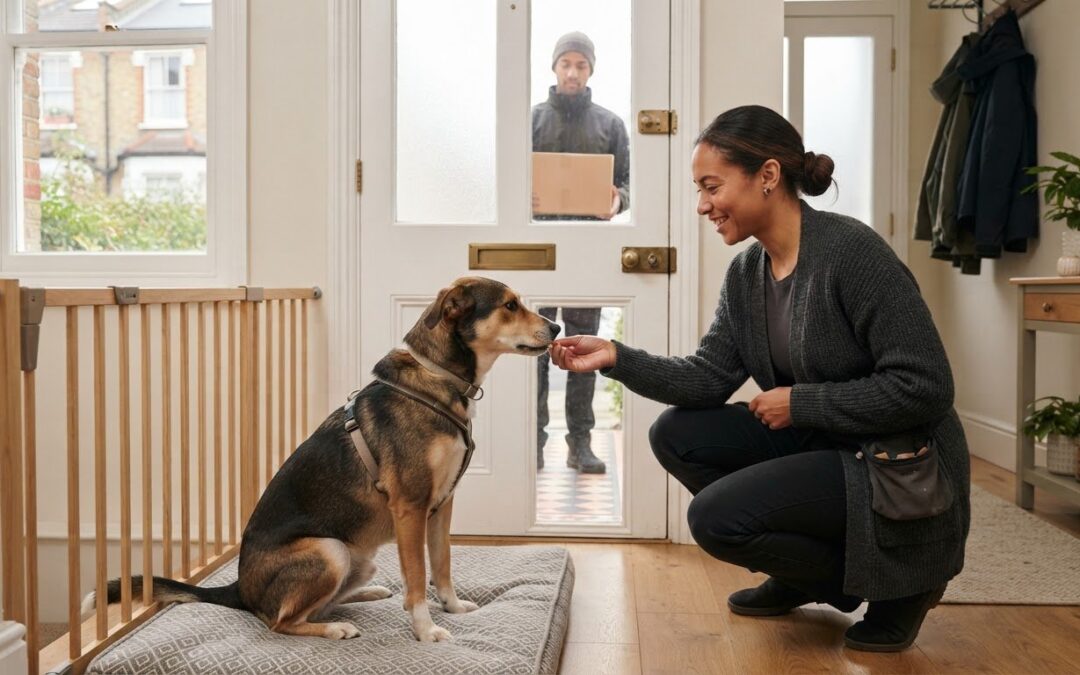
Every time a courier arrives, your dog genuinely believes their frantic barking successfully chased an intruder away. The postie drops the parcel, turns on their heel, and unwittingly reinforces the alarm, cementing an exhausting habit day after day. If you are searching for how to stop dog barking at delivery drivers London properties create unique pressure, especially when shared hallways, thin-walled conversion flats, and communal buzzers amplify every single arrival during your remote working day.
You shouldn’t have to live in dread of delivery vans, scramble to mute Zoom meetings, or worry about neighbour noise complaints through terraced party walls. Your dog isn’t trying to be difficult; they are simply reacting to a perceived intrusion into their sanctuary. By replacing stress with gentle stationing routines and positive communication, you can rebuild their confidence. We will walk you through humane desensitisation techniques to calm the letterbox chaos, alongside guidance on when bespoke behavioural support can help restore lasting peace to your home.
Key Takeaways
- Understand the alert cycle that convinces your dog their barking successfully drove the postal worker away from your door.
- Implement immediate management tools, such as frosted window film and baby gates, to stop unwanted behaviour rehearsal before training begins.
- Master a step-by-step positive counter-conditioning pathway on how to stop dog barking at delivery drivers London homes struggle to manage, replacing doorstep panic with settled stationing.
- Avoid common pitfalls like shouting or using punitive deterrents, which heighten stress rather than resolving the root emotional trigger.
- Recognise the key indicators that signal when to bring in bespoke 1-to-1 behavioural consultations tailored directly to your specific home layout.
Why London Dogs Bark at Delivery Drivers: Understanding the Urban Trigger Cycle
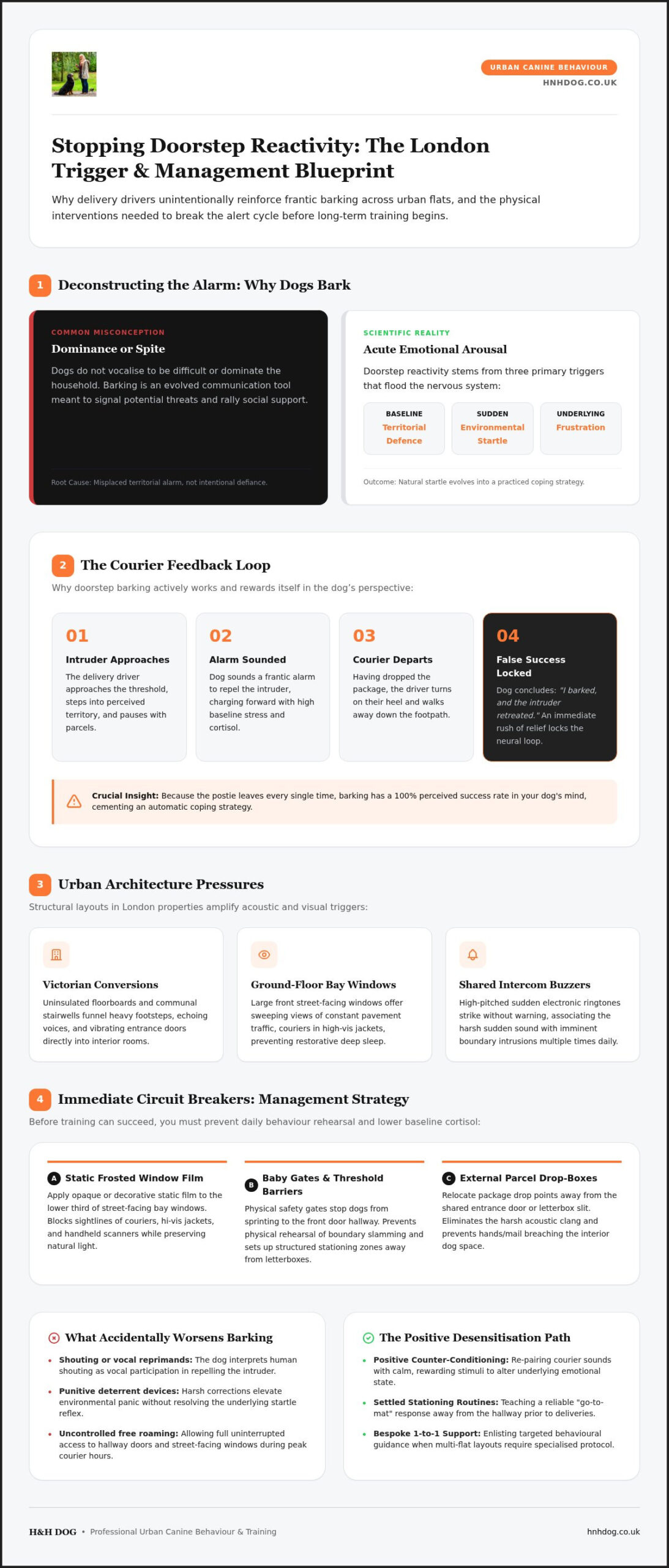
Doorstep reactivity is an innate, self-reinforcing alert behaviour triggered by environmental disruption. When exploring the science of dog barking, researchers categorise vocalisation as an evolved communication tool meant to signal potential threats and rally social support. Your companion does not vocalise out of spite or a desire to dominate the household. Instead, their barking stems from acute emotional arousal, typically a mixture of baseline territorial defence, sudden environmental startle, and underlying frustration.
Understanding these emotional drivers is crucial when learning how to stop dog barking at delivery drivers London homes often amplify. In a bustling urban setting, high acoustic density and close proximity to footpaths keep a dog’s sensory system on high alert. The constant arrival of couriers presents an intense challenge that rural or suburban dogs rarely face with the same unrelenting frequency.
The Courier Feedback Loop: Why Barking Works in Your Dog’s Mind
To understand why this habit persists, examine the interaction from your dog’s perspective. A courier approaches the threshold, steps into perceived territory, and pauses. Your dog sounds the alarm, barking frantically to repel the stranger. Moments later, having dropped the parcel, the postie turns and walks away down the path.
In your dog’s mind, the correlation is simple: I barked, and the intruder retreated. This immediate departure delivers a powerful rush of relief that actively rewards the behaviour. Each successful repetition floods the system with adrenaline and strengthens this neural circuit, turning a natural startle response into an automatic, highly practiced coping strategy.
London Living Challenges: Flats, Shared Hallways, and Street-Facing Windows
Urban architecture creates specific sensory pressures that fuel courier reactivity across the capital. London properties feature structural layouts that make relaxation difficult for sensitive dogs:
- Victorian conversions and party walls: Uninsulated floorboards and communal stairwells funnel heavy footsteps, echoing voices, and vibrating entrance doors directly into your living space.
- Ground-floor bay windows: Large Victorian and Edwardian front windows offer sweeping views of constant pavement traffic, keeping dogs visually stimulated and unable to settle into restorative sleep.
- Shared intercom buzzers: High-pitched electronic ringtones strike without warning, associating the sudden noise with imminent boundary breaches multiple times each afternoon.
When you recognise how urban architecture compounds this natural alert reflex, solving how to stop dog barking at delivery drivers London properties experience becomes far more manageable. The goal is not silencing an animal through fear, but changing their emotional response to the environment entirely.
Immediate Management Strategies to Reduce Doorstep Arousal Today
Before teaching your companion new habits, you must interrupt the cycle of daily panic. Behavioural learning happens through repetition; every instance of charging the front door cements the alarm response deeper into your dog’s nervous system. Immediate environmental management creates an essential circuit breaker. It prevents rehearsal of the unwanted behaviour while your longer-term desensitisation takes root, giving everyone in the home an instant reduction in stress.
When assessing the common reasons dogs bark, visual and auditory triggers serve as immediate igniters for protective arousal. Removing these sensory cues from your home does not mean ignoring the problem. Rather, thoughtful adaptations set your companion up to succeed by lowering their baseline cortisol levels. If you want practical progress on how to stop dog barking at delivery drivers London homes require physical adjustments that match our specific urban architecture.
Environmental Modifications for London Hallways and Letterboxes
Targeted adjustments to your front entrance can drastically diminish sensory spikes throughout the day:
- Static frosted window film: Apply opaque or decorative static film to the lower third of street-facing bay windows. This blocks the sightline to passing couriers, high-vis jackets, and hand-held scanners while keeping natural light in your living room.
- External parcel drop-boxes: Install a secure postal box outside your flat door or garden gate. Keeping the physical drop outside completely eliminates the startling metallic clatter of the internal letterbox flap.
- Acoustic masking: Place a simple white noise or brown noise machine in your hallway. Continuous, low-frequency sound softens the sudden auditory shock of street footsteps, slamming van doors, and shared intercom chimes.
Setting Up a Secure Boundary Behind Baby Gates
Physical distance builds emotional regulation. Positioning an extra-tall, pressure-mounted baby gate at the end of the hallway restricts direct access to the front entrance entirely. Preventing your dog from physically lunging or throwing their weight against the door removes the tactile rush of guarding the threshold.
Instead of leaving them to pace behind the gate, transform this separation into a dedicated decompression zone. Equip a quiet back room with a supportive bed and offer long-lasting enrichment items, such as stuffed rubber toys or natural chews. Licking and chewing release calming neurochemicals, actively shifting your dog from sympathetic fight-or-flight into a parasympathetic state. If you find your home layout particularly tricky to manage, scheduling professional 1-to-1 dog training can help you tailor an effective, calm layout tailored to your specific space.
How to Train Your Dog to Stay Calm During Deliveries
Remote work in London often means juggling conference calls while several parcels arrive throughout the afternoon. Standard obedience cues like “sit” fail when your dog experiences sudden panic or territorial arousal. Instead, counter-conditioning rewrites their emotional default, transforming the arrival from a perceived intrusion into a cue for an incompatible, calming task. As the American Kennel Club explains why dogs bark at mail carriers, giving your dog an active replacement job prevents adrenaline from hijacking their brain. Standard kibble won’t work here; prepare high-value reinforcers like diced roast chicken, warm sausage, or squeeze tubes of soft cheese.
Step 1: Desensitising the Knock, Buzzer, and Letterbox Sounds
Begin inside a calm environment without real couriers present. Record your specific intercom buzzer, front door knock, and letterbox rattle onto your smartphone. Play these audio clips at near-silent volume while immediately delivering tiny morsels of chicken. Repeat this sequence daily. Your dog will quickly learn to look to you for food rather than tensing up. Only increase playback volume once their body posture remains visibly loose and unbothered.
Step 2: Teaching the “Stationing” Alternative Behaviour
A dog cannot sprint to the letterbox while simultaneously lying quietly on a designated mat in your sitting room. Place a comfortable bed out of view of the entrance and reward your dog simply for stepping onto it. Mark the movement with a clear word like “settle” and feed repeatedly between their paws. Gradually build duration, requiring them to stay relaxed for thirty seconds before releasing them. Consistent stationing builds a predictable sanctuary during chaotic moments.
Step 3: Staging Controlled Mock Deliveries with a Partner
Real couriers move fast, making real-time training during busy work hours chaotic. Enlist a flatmate or neighbour to simulate realistic arrivals outside your flat door. Have your helper approach, tap the knocker once, drop an empty cardboard box, and walk away down the stairwell. Cue your dog to their station just before the sound occurs, keeping their focus locked on a lick mat or high-value treats while the interaction finishes.
Once mock trials achieve reliable success, transition to Step 4: live delivery proofing. Keep sealed containers of roast chicken near your workspace. The moment an unexpected postal van pulls up, send your dog to their bed before reactivity escalates. Practicing this four-step blueprint is how to stop dog barking at delivery drivers London households contend with, replacing chronic alarm with quiet, confident cooperation.
Common Mistakes That Accidentally Make Doorstep Barking Worse
When sudden barking shatters the quiet of your home, panic is an understandable human reflex. You drop everything, sprint to the hallway, and try to stop the noise before a flatmate wakes or a client on your conference call notices. Unfortunately, many intuitive reactions backfire entirely. Well-meaning owners often reinforce the exact alarm state they hope to quiet, sabotaging their efforts to master how to stop dog barking at delivery drivers London homes magnify.
Household inconsistency creates additional confusion. If family members allow door rushing on weekends but scold the dog for it on busy workdays, the animal never learns what safety looks like. Pushing an unready dog straight into live courier arrivals without foundational desensitisation causes severe flooding, leaving them overwhelmed and increasingly reactive.
Why Shouting and Panic Reinforce Your Dog’s Alarm
Raised voices sound remarkably like barking to a dog. When you yell “quiet” or rush to the front door with high energy, your companion does not hear a command to stop. Instead, they believe you are joining their vocal defence against the intruder outside.
Your agitation validates their perception of danger. Hallway tension escalates rapidly, sending their heart rate higher and convincing them that the postal worker poses a genuine threat to the flat. Calm, silent physical guidance; such as gently stepping between your dog and the door or guiding them back via a lead; communicates security far more effectively than shouting ever will.
The Hidden Risks of Aversive Collars and Startle Devices
Quick fixes like ultrasonic devices, citronella spray collars, or rattle cans may temporarily silence a dog, but they carry severe behavioural fallout:
- Escalating emotional panic: Shock and spray collars punish outward vocalisation while leaving underlying terror untouched, creating a ticking time bomb of unaddressed anxiety.
- Harmful accidental pairings: Your dog quickly associates the sudden pain or shock around their neck directly with the visual sight of the delivery driver, turning mild alarm into intense fear.
- Removal of early warning signs: Suppressing warning barks forces dogs to swallow their communication. When pushed past their limit later, a dog deprived of its voice may leap straight to defensive snaps or door aggression.
Ethical, evidence-based habituation solves the underlying emotional cause rather than suppressing vital communication. If doorstep turmoil has become unmanageable and you need experienced hands to evaluate your space, book tailored behavioural consultations to restore safety and quiet to your home without force.
When to Enlist Professional Dog Behaviour Support in London
While consistent counter-conditioning helps many households, doorstep reactivity sometimes runs deeper than basic habituation can resolve alone. When assessing how to stop dog barking at delivery drivers London owners often discover that general group obedience classes fail to address home-specific distress. Group classes teach basic commands in neutral settings, whereas chronic doorstep arousal involves complex emotional reactions within your personal living space. Bespoke behaviour modification focuses directly on what drives your dog’s distress where it actually occurs.
Recognising Deep-Seated Territorial Guarding and Separation Distress
Certain red flag indicators show that your dog’s reactions require professional intervention rather than everyday troubleshooting:
- Intense physical posturing: A rigid spine, raised hackles, fixed hard stares at the threshold, or snapping and lunging at mail entering the letterbox flap.
- Prolonged recovery times: Vocalising, trembling, or pacing for several minutes after the courier has departed, demonstrating that your dog cannot self-soothe or down-regulate from acute stress.
- Compounded distress: Outbursts that escalate whether you are standing beside them or when they are resting alone, suggesting unaddressed separation anxiety paired with territorial alarm.
The Value of Tailored In-Home Training Across North London
Overcoming entrenched reactivity requires a targeted evaluation of your specific domestic layout. An in-home assessment examines architectural nuances that generic advice easily overlooks, from echoing stairwell acoustics and vibrating entry doors to busy household routines that inadvertently spike adrenaline throughout the working day.
Personalised, ethical guidance ensures training protocols remain realistic for your schedule while respecting your dog’s emotional boundaries. With over 20 years of hands-on experience in canine behaviour modification, H&H Dog provides non-coercive 1-to-1 dog training and behavioural consultations across North London, North West London, and Watford. Seeking professional, welfare-focused support early prevents chronic panic from escalating into severe aggression, restoring quiet confidence to your shared urban home.
Transform Your Doorstep into a Place of Calm
Rebuilding your dog’s confidence around the front entrance takes patience, consistency, and the right environmental setup. By pairing practical management tools like frosted window film with rewarding stationing exercises, you effectively break the self-reinforcing alarm cycle. Mastering how to stop dog barking at delivery drivers London homes contend with doesn’t require harsh corrections; it simply asks that we meet canine needs with empathy and replace stress with clear, reliable routines.
If you feel overwhelmed by persistent hallway reactivity, you don’t have to navigate the journey alone. Bringing over 20 years of bespoke canine behaviour modification experience, H&H Dog provides compassionate, evidence-based methods tailored specifically to urban London lifestyles. Whether you occupy a lively conversion flat or a terraced property across North London, North West London, or Watford, dedicated local guidance makes all the difference. Book a 1-to-1 dog training consultation with H&H Dog today, and take the first gentle step toward quiet deliveries and lasting peace of mind.
Frequently Asked Questions
Why does my dog bark at the Amazon or Royal Mail driver but not guests?
Delivery drivers trigger an accidental reinforcement cycle because they leave immediately after placing packages on your doorstep. Your dog assumes their loud vocalisation repelled the stranger, giving them a fast rush of success. Invited guests, on the other hand, enter the flat, cross the threshold, and linger. That prolonged physical presence disproves the idea that barking drives the human away.
Can I stop my dog barking at the door if I live in a busy London flat?
Yes, you can manage this effectively by combining acoustic masking with physical barriers. Place an extra-tall safety gate across your main hallway to stop your dog charging the entrance, and run a continuous brown noise machine near the door to drown out communal foot traffic. When exploring how to stop dog barking at delivery drivers London flats require consistent management first so training can take hold without daily interruptions.
Will spraying water or using a rattle bottle stop my dog barking at the door?
Startle devices suppress outward barking through shock, but they leave internal panic untouched. Spraying water or shaking coins often causes accidental conditioning; your dog begins associating the postal worker directly with an unpleasant shock, dramatically worsening their anxiety over time. Modern welfare-led training focuses instead on changing your dog’s emotional state through positive reinforcement, producing lasting results without damaging your bond.
How long does it take to train a dog to stop reacting to the letterbox?
Most households notice measurable progress within three to four weeks of daily, low-volume desensitisation. Fully rewiring an entrenched reflex takes between eight and twelve weeks of consistent mock trials and high-value counter-conditioning. Progress depends on preventing daytime rehearsal; if your dog still rushes the door while you work from home, the habit takes longer to rewrite.
Should I let my dog greet the delivery driver to show they are friendly?
No, you shouldn’t encourage greetings at the threshold. Couriers work under tight schedules and cannot interact safely with every animal they meet on their route. Rushing forward also spikes arousal, blurring the boundary between excitement and frustration. Teaching your dog to retreat to a bed during arrivals builds predictable, calm self-control instead of chaotic doorstep encounters.
What is the best command to use when the doorbell rings?
The most effective cue is a directional stationing instruction, such as “on your bed” or “settle.” Shouting “quiet” simply adds your vocal noise to the chaos without showing your dog what physical action to take. A clear stationing cue tells them exactly where to go and rewards an incompatible posture, making rushing the front letterbox impossible.
When should I call a professional dog behaviourist for doorstep barking?
You should seek hands-on help if your dog displays rigid posturing, snaps at the letterbox, or takes longer than two minutes to settle after a delivery. When self-guided methods stall, understanding how to stop dog barking at delivery drivers London homes amplify often requires bespoke guidance. Professional behavioural consultations assess your exact floor plan, door mechanisms, and daily routine to create a safe, targeted modification plan.