
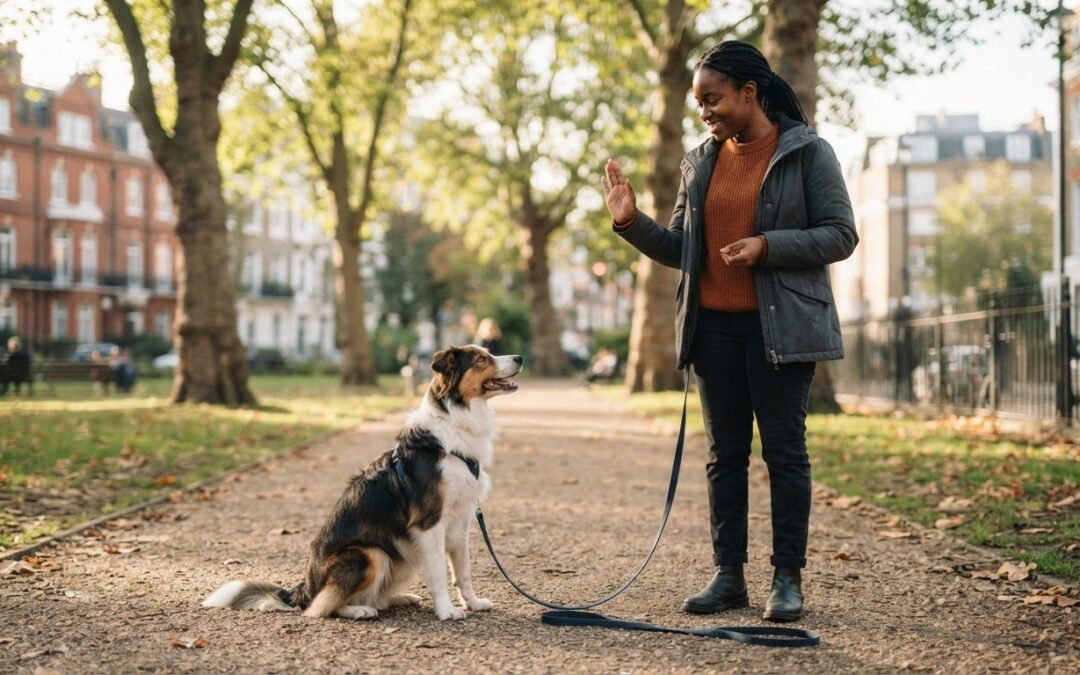
Stepping backwards is often the quickest way to break your dog’s focus before it even starts. If you feel a wave of familiar frustration whenever your companion pops up the second you take two paces away, you aren’t alone. Watching a dog bolt toward an open front door or tense up near a bustling road is deeply nerve-racking, especially when your reward timing feels like a guessing game. Learning how to teach a solid stay command isn’t about testing your dog’s patience with premature distance; it begins with building quiet, rewarding stillness right beside you.
When you replace pressure with clear communication, holding position becomes an enjoyable exercise in impulse control rather than a battle of wills. Master our step-by-step, reward-based protocol to build an unshakeable stay across any everyday distraction. Ahead, we’ll break down the exact mechanics to introduce a crystal-clear release marker, lengthen duration before adding distance, and foster dependable safety out on the street.
Key Takeaways
- A dependable stay begins with a clear release word, shifting your dog’s focus from physical restraint to calm, voluntary impulse control.
- Mastering how to teach a solid stay command requires reinforcing stillness directly beside your dog before introducing any steps away.
- Separating duration, distance, and distraction prevents the frustration and confusion that typically lead to broken stays.
- Treating breaks as helpful feedback rather than mistakes allows you to adjust criteria without damaging trust or clarity.
- Proofing holds gradually with a secure long line builds rock-solid reliability around demanding urban triggers, busy pavements, and open parks.
The Foundation: What Makes a True Stay Command Reliable?
True canine impulse control is never about physical restraint. While many generic tutorials rely on towering body language or raised palms like traffic signs, reliable stability comes from a dog’s voluntary choice to remain completely still. When discovering how to teach a solid stay command, you quickly realise that forcing an animal to freeze through physical pressure or intimidation creates underlying anxiety. That tension works against you; an uneasy dog simply waits for an opportunity to bolt. Instead, modern, evidence-based practices establish an unshakeable position by pairing stillness with calm clarity, transforming a basic behaviour into a rewarding mental exercise within basic obedience training.
Your dog needs to understand two fundamental truths: maintaining position earns valuable rewards, and the exercise only ends when you utter a specific release marker. Without this transparent framework, staying feels like an ambiguous guessing game. By cultivating calm, internal motivation rather than fearful hesitation, you provide your companion with the emotional security needed to hold position in any setting.
Stay Versus Wait: The Critical Difference Owners Overlook
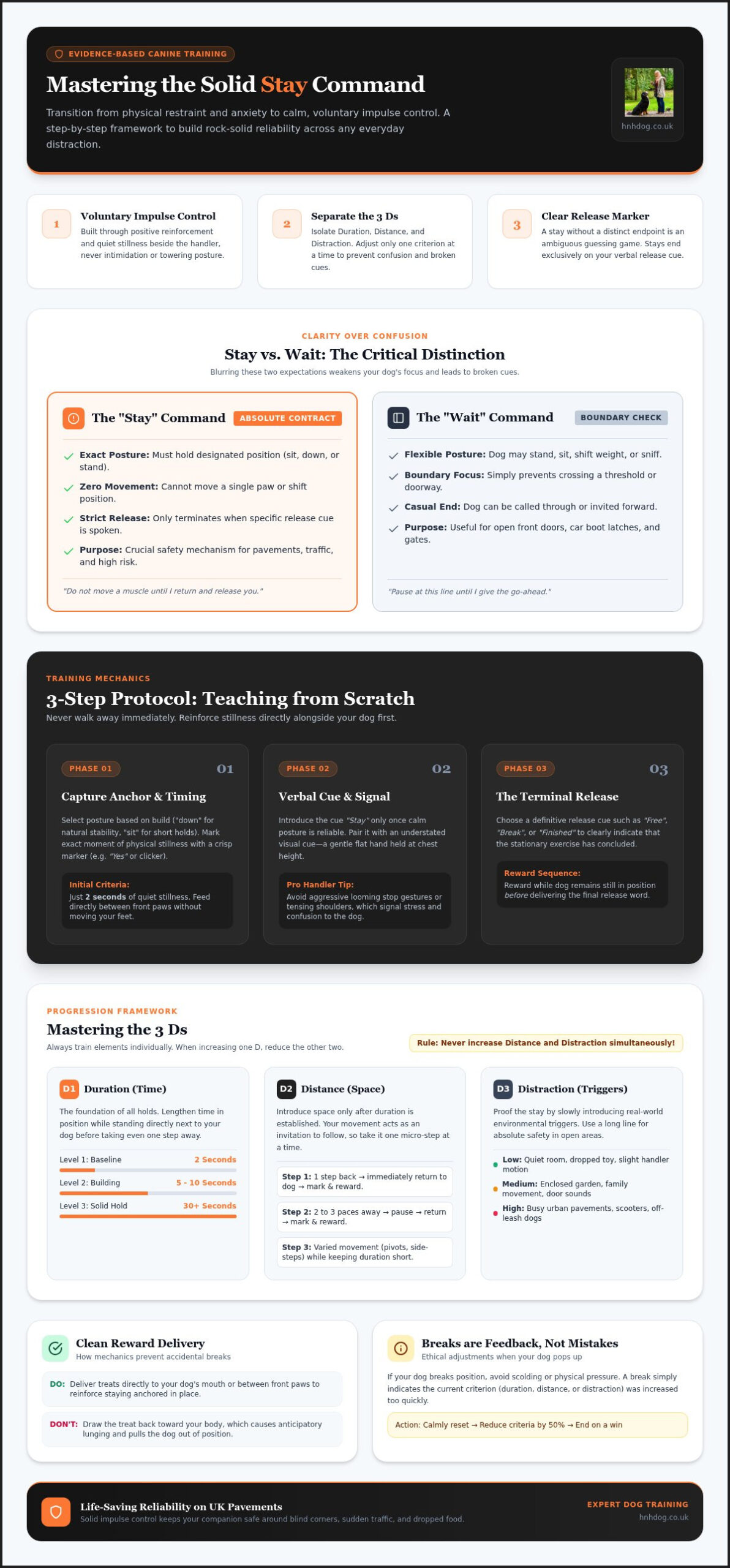
Many guides treat “stay” and “wait” as interchangeable, but blurring these boundaries creates confusion and broken cues. A stay is an absolute, non-negotiable contract: your dog holds their exact physical posture (sit, down, or stand) without moving a single paw until you deliver a release word. In contrast, a wait is a temporary boundary check; it simply prevents crossing a threshold, such as an open front door or boot latch, while allowing your dog to stand, shift weight, or sniff comfortably. Blending these two expectations weakens your dog’s focus. Precision requires distinct criteria.
Why Urban Environments Demand Flawless Impulse Control
Busy UK pavements offer zero margin for error. A sudden scooter, an off-leash dog rounding a blind corner, or a dropped sandwich can shatter an untested hold in seconds. In high-density settings, understanding how to teach a solid stay command functions as a life-saving safety mechanism, ensuring your companion stays glued to the pavement even if a lead slips. For young dogs encountering these bustling streetscapes for the first time, our bespoke advice on puppy training in London provides the structured socialisation necessary to navigate modern urban life with ease.
Step-by-Step: Teaching the Stay Command From Scratch
Most training tutorials tell you to cue a sit, say “stay”, and take three steps back immediately. That advice sets impulsive dogs up to fail. When you walk away right at the start, your movement acts like an accidental invitation to follow. Success starts by reinforcing stillness while you remain planted directly alongside your companion. Understanding how to teach a solid stay command means making stationary quietness predictable and richly rewarded before spatial freedom even enters the picture.
Your mechanics must be clean. Deliver treats directly to your dog’s mouth rather than drawing their nose forward, which prevents anticipatory lunging. Avoid pushing training sessions until your dog breaks. Always conclude on a successful, relaxed repetition so confidence stays high.
Step 1: Capturing the Anchor Position and Marker Timing
Choose an anchor posture that fits your dog’s build. A “down” provides natural muscular stability for energetic dogs, whereas an upright “sit” works well for shorter holds. Mark the exact moment of physical stillness using a crisp marker word like “yes” or a clicker. Keep the earliest repetitions to just two seconds of quiet stillness, feeding directly between their front paws without moving your feet. Mastering these subtle mechanics mirrors the progressive framework established in leading welfare guides on how to train the stay command.
Step 2: Introducing the Verbal Cue and Hand Signal
Only introduce the verbal cue “stay” once the calm posture happens reliably. Pair it with an understated visual cue, such as a gentle flat hand held briefly at chest height, rather than an aggressive, looming stop gesture. If you repeat the word multiple times or tense your shoulders, your dog will interpret that stress as confusion. Quiet consistency is your best tool.
Step 3: Implementing the Terminal Release Cue
A stay without an endpoint is incomplete. Choose a definitive release marker like “free”, “break”, or “finished” to tell your companion that the stationary exercise has concluded. To build absolute clarity, follow this simple sequence:
- Mark and deliver your high-value food reward while your dog remains entirely motionless in position.
- Pause briefly with empty hands so they digest the reinforcement without anticipating movement.
- Deliver your release word in a cheerful, conversational tone and toss a piece of kibble a few feet away to reset their posture.
Never let your companion decide when an exercise finishes. If you find your timing slips or your dog struggles to settle on their own, booking bespoke 1-to-1 dog training can give you hands-on feedback to refine these subtle mechanics into reliable habits.
Mastering the 3 Ds: Duration, Distance, and Distraction
Building true reliability requires balancing three distinct criteria: duration, distance, and distraction. The most frequent error handlers make is increasing these elements simultaneously. If you ask your dog to hold position for thirty seconds while walking five paces away in a busy garden, the cue will quickly collapse. Instead, isolate each variable. Whenever you increase one criterion, temporarily drop the other two to preserve clarity. Maintain an eighty percent success rate, meaning four out of five clean repetitions, before progressing any single metric. Crucially, always walk back to your companion to deliver their reward; calling them out of position teaches anticipation rather than stillness.
Building Duration: Reinforcing Calm, Motionless Focus
Duration always comes first. Stand quietly beside your companion and systematically stretch their stationary focus from five seconds up to a full minute. Feed at unpredictable intervals during the hold so your dog learns to settle rather than count the seconds. Watch for soft body language; reward loose muscles, slow breathing, and neutral ears rather than the vibrating, coiled posture of a dog waiting to spring.
Adding Distance: Walking Away Without Triggering Follow
Once duration feels effortless, isolate distance. The moment you introduce spatial separation, drop duration back to two seconds. Take a single step backward, pivot smoothly, and immediately return to your dog’s side to deliver the treat. Walking back proves that your movement isn’t an invitation to follow. Systematically expand your distance across the room only after single steps feel completely boring to your companion.
Layering Distractions: Preparing for Real-World Scenarios
Environmental interference is the final hurdle when mastering how to teach a solid stay command. Layer distractions in micro-steps:
- Handler movement: Raise an arm, clap lightly, or take a gentle hop while standing directly beside your dog.
- Novel objects: Drop a lead, bounce a tennis ball softly, or rustle a coat pocket a few feet away.
- Household activity: Practise while a family member walks across the room or prepares food on the counter.
Keep training sub-threshold so your dog easily succeeds. By systematically separating duration, distance, and distraction, you build unshakeable impulse control that holds up in any setting.
Troubleshooting Broken Stays: Common Pitfalls and Ethical Fixes
When a stay breaks, treat it as diagnostic feedback rather than disobedience. Dogs break position because the criteria escalated too quickly, environmental pressure exceeded their focus, or they anticipated the release. Scolding, collar jerks, or sharp reprimands only introduce anxiety into the behaviour. An anxious dog fidgets, breaks sooner, and loses trust in your cues. Refining how to teach a solid stay command means responding with quiet neutrality and resetting the exercise so success becomes immediate again.
Managing Premature Breaks Without Frustration or Conflict
If your dog gets up before your release word, utter a quiet non-reward marker like “oops” in an even tone. Guide them calmly back to their original starting spot without eye contact, treats, or physical irritation. Resetting shouldn’t feel like a punishment or a game. On the very next repetition, cut your duration or distance in half to guarantee a clean win. If urban distractions repeatedly derail your progress, our tailored programmes for dog training in North London can help you safely work through high-arousal triggers.
Eliminating Creeping and Position Shifts
Inching forward on elbows or shifting paws often stems from handler movement. If your hands hover near your treat pouch or your chest leans forward, your dog reads that body language as an invitation to advance. Use an elevated training cot or a distinct boundary mat to establish clear physical margins. When a dog feels the tactile edges of a mat, understanding where stillness ends becomes effortless. Only deliver food while all four paws stay firmly planted behind the threshold.
The Danger of Using Recall as the Stay Release
Never call your dog to come out of a stationary stay. Doing so creates mental conflict; your dog sits like a coiled spring, eagerly anticipating the recall cue rather than relaxing into stillness. This tension makes them break position the second you turn your back. Keep recall conditioning completely separate. Always walk all the way back to your companion’s side to mark, reward, and deliver your terminal release cue. If you want bespoke guidance to eliminate frustrating training plateaus, book a 1-to-1 dog training session to build calm, lasting reliability.
Proofing Your Stay in the Real World: Next Steps for Success
Transitioning from a quiet living room to dynamic outdoor spaces represents a massive leap in sensory load. Out on local pavements and parks, airborne scents, passing bicycles, and roaming dogs compete fiercely for your dog’s attention. A dependable hold acts as an essential safety net in these settings, whether pausing before a busy pelican crossing or preventing a dash out of an open car boot. Refining how to teach a solid stay command outdoors requires meeting your companion where they are, reducing expectations temporarily so their impulse control stretches without snapping.
Transitioning From the Living Room to Outdoor Spaces
Start outdoor generalisation in secure, low-arousal environments like an enclosed private garden or a quiet patio before visiting public parks. The moment you move onto grass or tarmac, treat your dog as if they are learning the behaviour from scratch. Drop your duration down to three seconds and remain planted right beside their shoulder. Always secure your companion with a five-metre or ten-metre long line attached to a back-clip harness. This simple safety measure prevents self-rewarding dashes toward dropped food or greeting dogs if a break occurs, keeping stress levels low and practice safe.
When to Seek Professional One-to-One Training Guidance
Sometimes, repeated breaks have very little to do with obedience. Physical stiffness, joint discomfort, environmental hyper-arousal, or subtle separation anxiety can make stationary postures emotionally or physically challenging for a dog. Ethical training always prioritises the animal’s underlying emotional welfare rather than merely suppressing unwanted movement. Consulting a certified London dog behaviourist allows you to uncover the root cause of chronic agitation and implement a tailored, non-coercive plan.
Backed by over twenty years of hands-on behavioural experience, H&H Dog delivers bespoke positive reinforcement programmes across London and Watford. If you want structured support navigating bustling high streets or proofing reliable manners, our tailored one-to-one training gives you the guidance needed for lasting, calm teamwork.
Transform Your Dog’s Focus Into Everyday Reliability
Mastering how to teach a solid stay command transforms your daily walks from a tense negotiation into a calm, cooperative partnership. By breaking exercises into manageable layers, prioritising duration before asking for distance, and honouring a clear terminal release cue, you give your dog the structural clarity they need to succeed. Stillness stops being a restrictive chore and becomes a voluntary, rewarding choice that keeps your companion safe in any environment.
Living alongside bustling roads and crowded parks brings unique challenges, but you don’t have to navigate them alone. Backed by over 20 years of hands-on canine care and training experience, we use non-coercive, modern behavioural techniques tailored specifically to urban London dogs. Whether you are troubleshooting persistent creeping or proofing impulse control around heavy traffic, book a bespoke 1-to-1 training session with H&H Dog today. With patient mechanics and consistent reinforcement, a steady, unshakeable stay is entirely within your companion’s reach.
Frequently Asked Questions
Can any breed of dog learn a solid stay command?
Yes, any breed can develop excellent impulse control with patience and clear communication. While high-drive working terriers or sight-focused sighthounds might find motionless focus more challenging than calmer companion breeds, the biological mechanics of learning remain identical. Learning how to teach a solid stay command simply requires tailoring reinforcement to what your individual dog finds most motivating, whether that means using high-value roast chicken, dried liver, or interactive toy play.
How long does it take to teach a reliable stay?
Most dogs understand the core mechanics within two to three weeks of short, positive sessions. However, proofing absolute reliability around high-arousal London distractions, such as passing scooters, squirrels in Regent’s Park, or lively off-leash dogs, usually takes three to six months. Progress depends entirely on your consistency, clear release timing, and taking small, incremental steps with duration, distance, and environmental distractions rather than rushing the process.
What should I do if my dog breaks their stay position?
Calmly guide your dog back to their original position without delivering a treat or using verbal frustration. Treat breaks as helpful information rather than naughty behaviour; your dog simply encountered criteria that were too difficult. Reset them gently, pause for a moment, and cut your duration or distance in half on the subsequent attempt. Ending the session on an easy, successful repetition keeps their confidence and enthusiasm intact.
Is it better to teach stay from a sit or a down position?
Teaching a stay from a “down” position is usually best for energetic dogs, as lying flat requires more conscious muscular effort to break. A settled down naturally encourages relaxation and lowers physiological arousal. An upright “sit” stay works brilliantly for brief, functional moments, such as kerbside stops before crossing a busy street, but a down remains the most stable anchor for building extended duration.
How much should I practice stay commands every day?
Keep training to two or three short sessions of three to five minutes every day. Canine impulse control functions like a muscle that fatigues quickly, especially in puppies or adolescent dogs. Ending sessions while your dog is still eager and engaged prevents mental burnout and sloppy breaks. Incorporating one or two quick stays into daily routines, like waiting for dinner bowls, reinforces habits effortlessly.
What happens if my dog gets distracted by other dogs while staying?
If your companion breaks position when seeing another dog, you are working too close to their emotional threshold. When discovering how to teach a solid stay command in public London green spaces, distance is your best safety net. Step back until your dog notices the other animal without lunging or freezing, reward calm focus, and gradually decrease the gap across several weeks of patient practice.
Can I use stay and wait interchangeably during training sessions?
No, mixing these cues creates mixed messages that undermine your training. A stay is an absolute freeze, meaning your dog cannot shift position or take a single step until hearing a formal release word. A wait is merely a boundary pause, preventing them from bolting through an open doorway while permitting small posture changes. Keeping these terms strictly distinct ensures clarity, confidence, and reliable response times.