
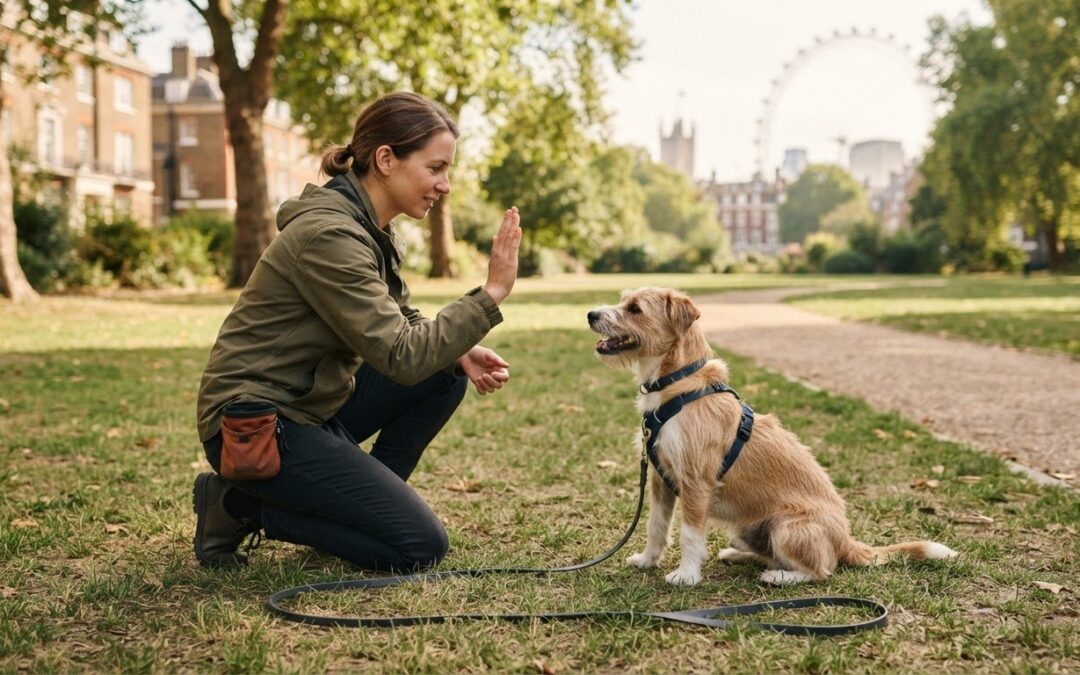
What if your deaf dog doesn’t need to hear you to understand what you’re asking? It’s natural to feel unsure about which hand signals to use, how to get their attention without startling them, or whether recall can be safe. Learning how to train a deaf dog is less about replacing every spoken word and more about building clear, consistent communication your dog can trust.
With patient, reward-based training, you can teach useful visual cues in small steps and help your dog feel secure as you practise together. Predictable signals and positive experiences make it easier for your dog to learn what each cue means.
This guide explains how to choose simple visual cues, introduce touch signals gently and practise everyday skills at a pace that suits your dog. You’ll also find practical ways to make walks, recall practice and unfamiliar places safer, so you can build a shared routine with greater confidence.
Key Takeaways
- Learn how to train a deaf dog by choosing one clear visual cue, pairing it with an action and rewarding your dog for responding.
- Compare hand signals, gentle touch cues and predictable routines to find communication methods that suit your dog and household.
- Build recall carefully in a secure practice area, using a long line while teaching your dog to check in visually.
- Notice when your dog seems worried or training feels stuck, and adapt your approach to support their comfort.
- Know when to seek tailored training guidance or speak to a vet about sudden hearing changes or other new health concerns.
Can you train a deaf dog? Start with communication, not hearing
Yes. Deafness changes how you deliver information, not your dog’s ability to learn. Training can use visual cues, gentle touch cues and predictable features of the environment instead of relying on sound. The right approach depends on your dog, including their vision, confidence and previous experiences. Begin with what helps them feel safe and able to engage.
Dogs already communicate through movement, posture and facial expression. Exploring Dog communication can help you notice these signals as well as your own. Your dog may turn towards you, soften their posture or move away. These responses offer useful feedback about whether they understand and feel comfortable.
How deafness changes communication with your dog
A spoken cue may not be accessible, so repeating it louder won’t necessarily help. Instead, make your signal visible and clear, and give your dog time to notice it. Approach from where they can see you when possible. Avoid sudden contact, especially while they’re asleep or focused elsewhere. A consistent, gentle way to get their attention can prevent surprises and support trust.
Set realistic goals and protect your dog’s trust
Start with behaviours that make daily life easier, such as checking in with you, settling in a familiar place or following your hand to a target. These skills can provide a foundation for more complex training. Keep sessions manageable and adjust the pace if your dog seems uncertain. Comfort and understanding matter more than quick progress.
Reward-based deaf-dog training recognises a desired behaviour with a consistent visual marker, then rewards your dog so they’re more likely to repeat it. This approach shows your dog what works, rather than treating missed cues as disobedience or using punishment. Deafness isn’t a reason to undermine their trust.
If you’re wondering how to train a deaf dog, think of it as building a shared vocabulary, one useful cue at a time. A dog who can’t hear may still learn everyday behaviours, but the plan should fit their abilities and history. If hearing loss appears sudden, or you notice pain or other new health changes, arrange a veterinary assessment before assuming the change is simply part of ageing.
How to teach a deaf dog visual cues step by step
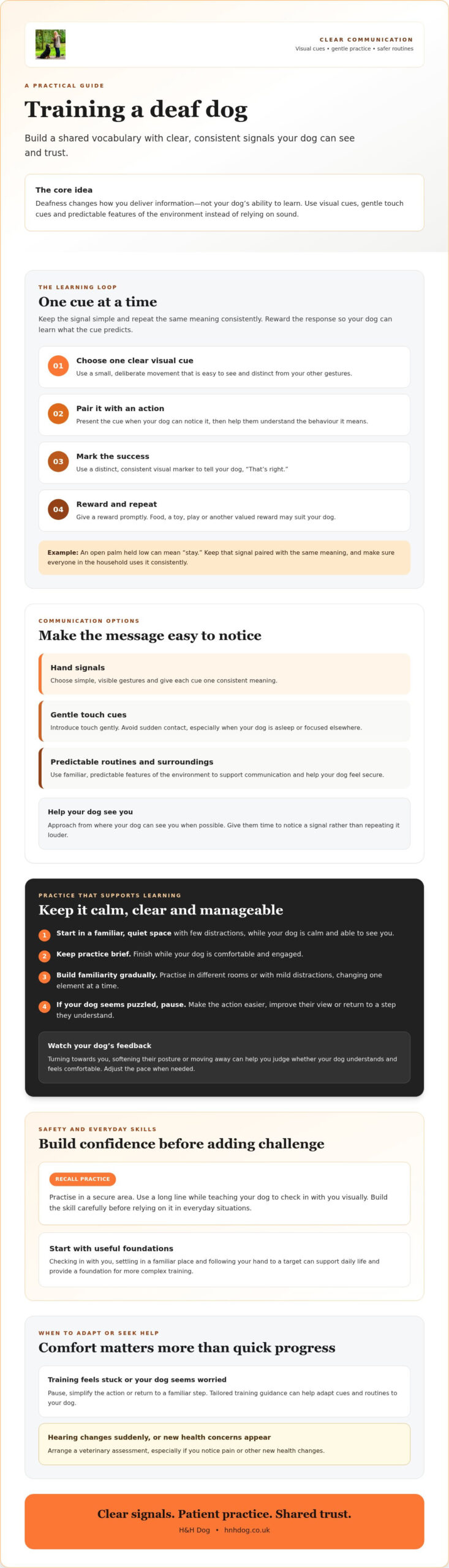
Keep the learning sequence simple: choose one cue, pair it with an action your dog can understand, reward the response, then practise in different situations as the meaning becomes familiar. Make the signal easy to see and distinct from your other gestures. A small, deliberate movement is often clearer than a complicated wave.
For example, you might choose an open palm held low as a cue for “stay”. Use that same signal for the same meaning each time, and make sure everyone in the household does too. The American Kennel Club’s guidance on teaching a dog to focus on you also highlights the value of first establishing visual attention.
Teach a marker and a simple hand signal
A visual marker is a consistent gesture that tells your dog, “That’s right,” and signals that a reward is coming. Choose a distinct hand movement, show it, then promptly offer a reward. Practise when your dog is calm and looking at you, so they can see the gesture. Once they recognise it, choose one everyday behaviour, such as touching your hand with their nose, and select a separate signal for that action.
Present the cue when your dog is in a position to notice it. As soon as they perform the desired action, show your marker and give the reward. Repetition builds the association: when the same visible cue is followed by immediate reinforcement, your dog can learn what the cue predicts.
Practise cues without rushing the dog
Begin in a familiar, quiet space with few distractions. Keep practice brief and finish while your dog is still comfortable and engaged, rather than waiting until they turn away or lose interest. Food may motivate one dog; another may prefer a toy, play or a different valued reward. Let your dog’s response guide your choice.
As the cue becomes familiar, practise in slightly different rooms or with mild distractions, changing one element at a time. If your dog looks puzzled, pause. Make the action easier, improve their view of the signal or return to a step they understand. Repeating a cue insistently can make it harder to follow, not clearer. This steady approach is a practical foundation for how to train a deaf dog.
If you’d like help adapting cues and routines to your dog, H&H Dog offers one-to-one dog training. Based in Watford, H&H Dog serves communities across North London and North West London. You can ask about the team’s experience with deaf dogs before deciding whether individual support is right for you.
Which cues and communication methods work best for deaf dogs?
There isn’t one universal sign system for deaf dogs. The best communication plan is one your dog can comfortably notice and your household can use consistently. Hand signals are often practical at close range, while gentle touch or familiar environmental patterns may help when your dog isn’t looking at you. Consider your dog’s vision, sensitivities and surroundings before choosing.
The American Kennel Club’s guide to how to train a deaf dog also discusses visual communication and reward-based learning. Treat any suggested cue as a starting point, not a guaranteed solution. Watch your dog’s response: turning towards you, relaxing or moving closer may indicate comfort, while flinching, moving away or appearing tense means you should pause and adjust.
Choosing visual signals the whole household can use
Choose gestures that are easy to see and clearly different from one another. For example, avoid using two signals that both involve a small movement near your waist if your dog may struggle to distinguish them. Agree on each cue’s meaning with everyone who regularly cares for your dog, including anyone who helps with daily routines. Introduce one new signal at a time and practise it in a familiar setting before relying on it elsewhere.
Using touch and routines without causing a startle
Touch can be useful when your dog is close but not looking at you, but it should feel predictable rather than surprising. First, pair a light touch in a place your dog is comfortable being handled with something they enjoy. Approach where they can see you whenever possible, and avoid touching them suddenly while they’re resting.
Some dogs may notice a consistent light change, your movement across their field of vision or a gentle vibration through the floor. These environmental cues won’t suit every dog, so introduce them carefully and observe their body language. A vibration device may startle or worry some dogs. If you’re considering one, ask a suitably experienced professional for individual guidance, introduce it gradually and positively, and use it only as an attention cue, never as punishment.
Keep the system manageable. A short household note listing each cue and its meaning can help everyone stay consistent. Change a signal if your dog doesn’t respond comfortably. The aim isn’t to make your dog adapt to a fixed method. It’s to find communication that makes sense from their perspective.
How to practise recall and keep a deaf dog safe
Recall is a safety skill to build carefully, not something to assume because your dog responds at home. A deaf dog may not notice you calling or dangers approaching, so use a securely fenced area for off-lead practice. In other settings, keep a long line attached while you teach your dog to check in visually and respond to a recall signal.
Practise recall before reducing physical restraint, because a visual cue can only help keep your dog safe if they notice it and have learned how to respond. Progress at your dog’s pace, and keep the long line in place if distractions make their response less reliable.
Build a visual check-in and recall gradually
Begin by rewarding your dog whenever they choose to look towards you in a quiet, secure space. This teaches them that checking in is worthwhile before you add a specific recall signal. Once they’re offering attention, introduce your chosen visible cue at a short distance, then reward them for turning and coming towards you.
Practise with the long line attached and gradually add distance or mild distractions, one at a time. If your dog doesn’t respond, avoid repeating the signal while they’re unable to see you or are absorbed elsewhere. Move closer, make it easier for them to succeed, and reward their next check-in. Reliability develops through well-managed practice, not by testing them where a mistake could put them at risk.
Make home routines and outdoor spaces more predictable
Use familiar visual cues for transitions, such as getting ready to go out or inviting your dog back inside. Before opening a door or gate, check where your dog is and make sure the boundary is secure. A consistent pause at access points can help you manage movement safely, but don’t rely on the routine instead of checking.
On walks, stay close enough to guide your dog and keep them within your view. They may not hear traffic, a cyclist, another dog or a person approaching from behind, so scan ahead and around you. Choose routes and spaces where you can stay aware, and shorten the long line when the surroundings call for closer control. Off-lead freedom belongs only in a securely fenced area.
If you’d like individual support adapting recall practice and routines, you can ask about one-to-one dog training with H&H Dog. Discuss your dog’s needs and ask about the trainer’s experience with deaf dogs before deciding whether the support is a good fit.
When to get tailored help training a deaf dog
Some uncertainty is normal while you and your dog learn a new way to communicate. Consider individual support if practice repeatedly stalls, your dog seems worried by cues or touch, or everyday handling has become difficult. A trainer can help you review the signals, setting and pace, then adapt the plan to your dog’s communication needs and temperament.
Choose someone who can explain their approach clearly. Ask how they adapt cues and rewards for a deaf dog, what they would do if the dog seemed uncomfortable, and whether they have relevant experience. Don’t assume every general trainer has worked with deaf dogs. Look for patient, reward-based methods that avoid force or punishment, and exercises that make sense to you as well as your dog.
Know when to speak to your vet
If your dog’s hearing seems to change suddenly, or you notice pain or other new health changes, contact your vet for an assessment. A veterinary check can help identify whether a health issue needs attention before you adjust training. Seek veterinary advice, too, if handling appears painful or your dog’s response changes in a way that concerns you.
Choose a supportive next step for your dog
A short training record can make it easier to spot patterns and explain what’s happening if you seek help. Note the cue you used, the reward, where you practised and how your dog responded. Include signs of comfort or worry, such as turning towards you, hesitating or moving away. These observations can help you and a trainer decide what to keep, change or practise more gradually.
For broader training principles, explore this North London dog training guide. If fear or handling concerns persist, the London dog behaviourist guide offers further context on seeking behaviour support.
Learning how to train a deaf dog is an individual process, and asking for guidance is a practical way to make your approach more manageable. H&H Dog provides one-to-one dog training and behavioural consultations tailored to each dog’s needs. You can discuss your dog’s individual training needs with H&H Dog and ask about the team’s experience before deciding whether support is right for you.
Build a clearer, safer way forward together
Learning how to train a deaf dog starts with seeing communication from your dog’s perspective. Choose clear visual cues, keep their meaning consistent and reward the responses you want to encourage. Practise recall carefully in secure settings, and use a long line while building reliable check-ins. Above all, let your dog’s comfort guide the pace.
If progress feels difficult or your dog seems worried, tailored guidance can help you adapt cues and routines to their individual needs. H&H Dog offers one-to-one dog training and behavioural consultations, with personalised care shaped around each dog’s needs and temperament. The team brings over 20 years of industry experience. You can discuss your dog’s individual training needs with H&H Dog and ask about relevant experience with deaf dogs.
Small, thoughtful steps can make everyday communication clearer and help you build confidence together. Keep observing, adjusting and celebrating the moments when you understand each other a little better.
Frequently Asked Questions
Can a deaf dog be trained?
Yes, deaf dogs can learn everyday behaviours using cues they can access, such as hand signals, gentle touch cues and consistent routines. The training process is similar in principle to training any dog: show the dog what you’re asking, reward the response and practise patiently. Adapt your approach to your dog’s vision, confidence and experience. If you’re learning how to train a deaf dog, prioritise communication and comfort over speed.
How do you get a deaf dog’s attention without startling them?
Whenever possible, move into your dog’s field of vision and give them a moment to notice you before offering a cue. If they’re close by, you can gradually teach them to associate a gentle touch in a comfortable spot with a positive reward. Avoid touching them suddenly, especially while they’re asleep. Watch their body language, and pause or change your approach if they flinch, tense up or move away.
What hand signals should I use to train a deaf dog?
Choose clear, distinct gestures that your dog can see easily, and use each signal consistently for the same behaviour. There’s no single universal sign system you need to follow. For example, you might use an open palm for one cue and a different, unmistakable movement for another. Introduce signals one at a time in a familiar setting, and make sure everyone who regularly handles your dog uses them consistently.
How do you teach a deaf dog to come when called?
Teach a visual recall cue in a secure, quiet space. First reward your dog for choosing to look towards you, then show your recall signal from a short distance and reward them for coming over. Practise with a long line attached as you gradually add distance or mild distractions. If your dog doesn’t respond, move closer or make the exercise easier rather than assuming they’ve understood or repeating the signal insistently.
Is it safe to let a deaf dog off the lead?
Only consider off-lead activity in a securely fenced area. A deaf dog may not hear traffic, people or other dogs approaching, and recall can’t be relied on until it’s been carefully practised. Use a long line in other spaces while your dog learns to respond to visual cues, and stay alert to what’s happening around you. Check gates and boundaries before letting your dog move freely, even at home.
Should I use a vibration collar to train a deaf dog?
A vibration collar may help some dogs notice an attention cue, but it can startle or worry others. It isn’t a tool for punishment or correction. If you’re considering one, seek individual guidance from a suitably experienced professional and introduce the sensation gradually, pairing it with positive experiences. Stop if your dog seems uncomfortable. A hand signal or another accessible cue may be a better fit for your dog.
What should I do if my dog suddenly seems unable to hear?
Contact your vet if your dog’s hearing seems to change suddenly. Don’t assume the cause or treat the change as a training issue, particularly if you also notice pain or other new health changes. A veterinary assessment can help check whether there’s an underlying concern that needs attention. Until you know more, keep your dog safely managed with familiar visual cues and avoid relying on spoken instructions or off-lead recall.