
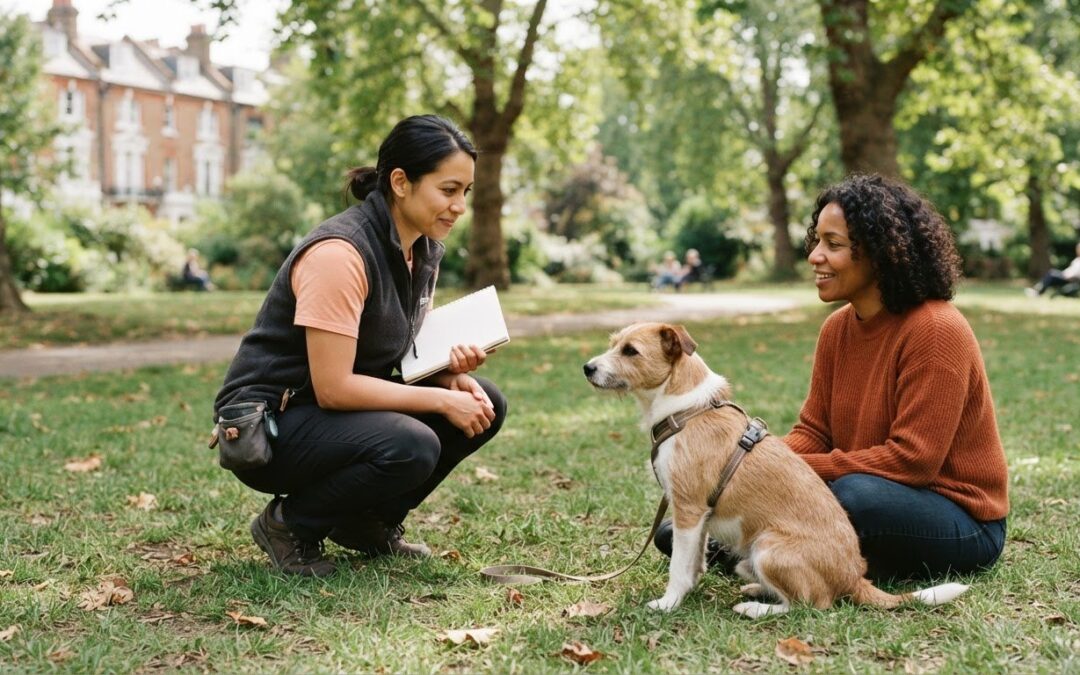
What if a behavioural consultation isn’t a test your dog has to pass, but a chance to understand what they’re communicating? If you’re wondering what does a dog behavioural consultation involve, it’s natural to feel unsure, especially if you’re worried your dog will be judged or asked to face something frightening. A thoughtful consultation should focus on your dog’s welfare, not blame or pressure.
A consultation can help you understand what is happening by looking beyond the behaviour itself: what tends to happen beforehand, how your dog responds and what in their surroundings may affect them. You’ll learn what information to prepare, what questions to ask and how to decide whether a behavioural consultation, one-to-one training or veterinary advice may be the right next step. If a health concern could be contributing, your vet can help assess it.
This step-by-step guide explains what may happen before, during and after a consultation, and how to prepare without staging a stressful situation. H&H Dog offers behavioural consultations and one-to-one training, with individualised support for dogs and their people in Watford, North London and North West London.
Key Takeaways
- Knowing what does a dog behavioural consultation involve can help you decide whether it fits your dog’s needs and what you want support with.
- A practitioner may discuss your dog’s history, ask questions and observe their behaviour, but the format can vary. Check what to expect before booking.
- Your dog’s behaviour is information, not a reason for blame. A suitable professional should notice your dog’s signals and adapt their approach.
- Guidance should reflect your dog’s circumstances and your practical goals. Next steps may include management changes, training or veterinary input.
- Prepare notes about behaviour, triggers and routine, then ask what information to send and who should attend.
What does a dog behavioural consultation involve, and who is it for?
Persistent or worrying behaviour can leave you unsure where to turn. Is your dog reacting to something around them, finding a situation difficult or showing signs they need a different kind of support? A behavioural consultation gives you time to explore those questions in context, rather than drawing conclusions from one moment.
A dog behavioural consultation is an individual assessment of a dog’s behaviour, circumstances and support needs, followed by guidance on suitable next steps. It isn’t a promise of a quick fix. The practitioner should consider possible influences such as routines, past experiences, the environment and your dog’s emotional state, rather than defining them by a single behaviour. Understanding dog behaviour and communication can help put what you see into context.
Owners may seek support for fear, reactivity, separation-related distress or difficulty settling. Knowing what does a dog behavioural consultation involve can be especially useful if you’re unsure whether you need a broader assessment or help practising particular skills.
When might a dog need a behavioural consultation?
Look at the pattern, not just an isolated incident. Your dog may have started reacting to visitors, become sensitive to being handled or seem unable to cope with situations they previously managed. Note what tends to happen before and after the behaviour, where it occurs and how it affects everyday life. If it is affecting your dog’s welfare, safety or household routines, professional guidance can help you consider suitable support.
How is a consultation different from a training session?
A consultation focuses first on understanding the behaviour and agreeing support that suits your dog and household. A training session is generally more focused on practising skills or working towards a specific goal. Training may become part of a plan after the assessment, but it isn’t automatically the answer to every concern.
If you’re exploring professional support, read our Dog Behaviourist London guide for broader guidance on finding help. H&H Dog offers behavioural consultations and one-to-one dog training for dogs in Watford, North London and North West London. The right starting point depends on what your dog is experiencing and what you want help to change.
What happens during a dog behavioural consultation, step by step?
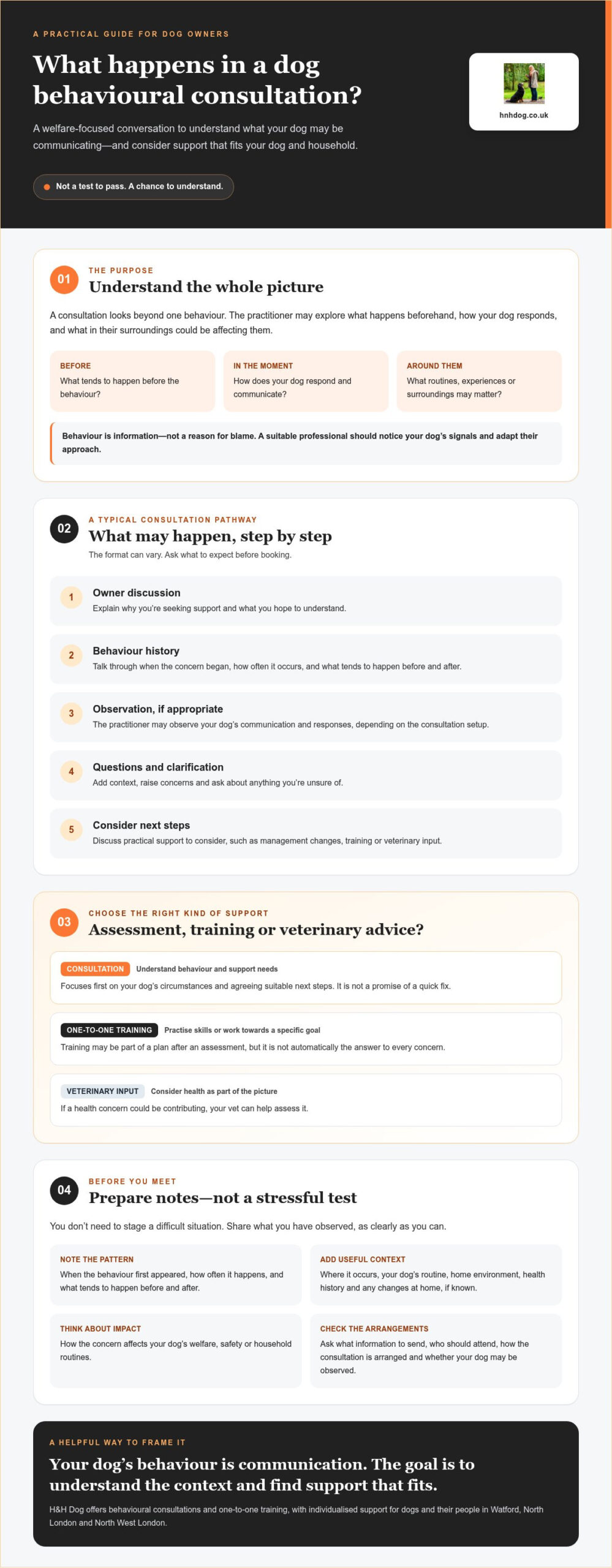
If you’re wondering what does a dog behavioural consultation involve, it often starts with a conversation rather than a test for your dog. The practitioner will want to hear what you’ve noticed and understand the circumstances around it. The format can vary, so ask in advance how the consultation is arranged, whether your dog may be observed and what information to prepare.
A consultation may include several stages:
- Owner discussion: You explain why you’re seeking support and what you hope to understand.
- Behaviour history: The practitioner asks when the concern began, how often it occurs and what tends to happen before and after.
- Observation: If appropriate, they may observe your dog’s communication and responses in a way that suits the consultation setup.
- Questions and clarification: You can add context, raise concerns and ask about anything you’re unsure of.
- Possible next steps: The discussion may help identify practical support to consider, such as management changes, training or veterinary input.
Behaviour makes more sense when considered alongside the setting, your dog’s history and what they’re communicating in that moment. That’s why a careful consultation explores more than a behaviour seen on its own.
What questions might the practitioner ask?
Before the appointment, think about when the behaviour first appeared, how often it happens and what is usually going on beforehand. The practitioner may also ask about your dog’s everyday routine, home environment, health history and any changes at home, if known. Share what you’ve observed as clearly as you can, including details that feel difficult. The purpose is to build understanding, not assign blame.
Will the practitioner observe my dog during the consultation?
Observation may help a practitioner understand your dog’s body language and responses, but whether it happens, and how, depends on your dog and the consultation arrangements. Ask how their comfort and safety will be considered. Your dog shouldn’t be deliberately put under pressure to provoke a reaction for demonstration. If observation could be stressful, ask what alternatives may be suitable.
Before choosing a practitioner, ask about their qualifications, experience and approach, including how they’ll adapt if your dog appears uncomfortable. Check what the consultation includes and what next steps may be available. If you’re considering individual support in Watford, North London or North West London, explore H&H Dog behavioural consultations and confirm the arrangements directly.
Will a behavioural consultation judge or overwhelm my dog?
It’s understandable to worry that a consultation might blame you or put your dog under pressure. A considerate assessment treats behaviour as information about how a dog is experiencing a situation, not as a moral failing. The aim is to understand what may influence their responses and identify support that takes their welfare into account.
Your dog shouldn’t need to perform a worrying behaviour to prove there’s a problem. If observation is being considered, ask how the practitioner will respond to your dog’s signals and what choices they’ll have. You can discuss breaks, keeping distance from anything that may cause discomfort and avoiding unnecessary exposure. No approach can guarantee your dog will feel relaxed, and what feels manageable differs between dogs.
How can you tell whether an approach respects your dog’s welfare?
Ask what the practitioner would do if your dog turns away, freezes, tries to move away or seems increasingly unsettled. A thoughtful answer should explain how they’ll adapt, pause or stop, rather than insist your dog continue. Look for explanations that connect behaviour with its context instead of relying on blame or fixed labels. You can agree boundaries beforehand and ask for adjustments at any point.
What if there may also be a health concern?
Pain or another change in health can affect behaviour, so discuss new or concerning symptoms with your vet rather than trying to diagnose the cause yourself. Tell the behaviour professional about relevant health history or changes, and clarify what information you’re comfortable sharing. If you’re unsure what does a dog behavioural consultation involve when health may be part of the picture, ask how the practitioner works alongside veterinary advice.
Before booking, ask about the practitioner’s training, experience and approach, including when they would recommend involving your vet. A good professional should be able to explain how their guidance fits alongside veterinary care and your dog’s individual needs.
What guidance should you expect after a behavioural consultation?
After an assessment, useful guidance should connect what the practitioner has learned about your dog with your priorities at home. That might mean making a particular situation easier to manage, practising a skill in manageable steps, gathering more information or speaking with your vet. The aim is a practical next step that respects your dog’s needs, not a generic checklist.
If you’re considering what does a dog behavioural consultation involve beyond the appointment itself, ask whether recommendations will be given verbally or in writing and whether follow-up support is available. Arrangements vary between practitioners, so confirm what’s included rather than assuming every consultation comes with a written plan or further sessions.
How do you know whether you need consultation, training, or veterinary advice?
Start with the question you most need answered. A consultation can help you understand behaviour and its context; training can help you practise skills towards a goal; veterinary advice is appropriate for health concerns or new symptoms. These options can complement one another, but they serve different purposes. Ask the professional to explain why they recommend a particular next step and how it relates to your dog’s situation.
| Type of support | Main purpose |
|---|---|
| Behavioural consultation | Explore behaviour, context and suitable support options. |
| One-to-one training | Practise skills or work towards agreed everyday goals. |
| Veterinary advice | Discuss health concerns that may need assessment by a vet. |
If an assessment suggests that practising skills could help, H&H Dog offers one-to-one dog training. For more on what that can involve, see the one-to-one dog training guide.
What should a useful behaviour plan make clear?
Whether guidance is written or discussed during the appointment, it should help you understand what to prioritise and what to observe over time. Ask for clear, manageable suggestions for everyday routines and how to apply them consistently without pushing your dog beyond what they can cope with. Check how you’ll know whether a recommendation is helping, and what to do if it isn’t practical for your household.
Progress and timescales differ from dog to dog, so be cautious of guaranteed results or fixed recovery claims. If you’re considering individualised support, explore H&H Dog behavioural consultations and confirm what recommendations and follow-up arrangements are available.
How to prepare for a dog behavioural consultation in London
You don’t need to arrive with a perfect explanation. A few clear notes can help the practitioner understand what your dog experiences and what support may be useful. If you’re still asking what does a dog behavioural consultation involve, use this opportunity to check the format and raise concerns before the appointment. For owners in London, including North London and North West London, confirming the arrangements in advance can also help you plan around your dog’s routine.
What should you write down before the appointment?
Use specific examples rather than trying to interpret your dog’s behaviour. Note what happened before, during and after, how often it occurs, where it happens and which people or animals were present. Include relevant details about your dog’s routine and any recent changes at home. Don’t stage a situation to capture it. Share a short video only if requested and you can record it safely.
- Behaviour notes: What you saw and what was happening around your dog.
- Patterns and triggers: When and where it tends to happen, and how often.
- Routine and changes: Relevant details about daily life and recent events at home.
- Your questions: What concerns you and what you’d like help understanding.
What should you ask a local behaviour professional?
Before arranging a consultation, ask about the practitioner’s experience and approach, how the appointment will be delivered, who should attend and whether anything should be sent beforehand. Check accessibility and ask what follow-up options may be available. These details vary, so confirm them directly instead of assuming a particular format or plan.
You can also ask how the practitioner will respond if your dog seems uncomfortable and whether any health information would be helpful. Be ready to explain the main concern and how it affects your household. That context can help the professional consider whether a behavioural consultation, one-to-one training or veterinary advice may be a suitable starting point.
H&H Dog offers behavioural consultations and one-to-one dog training for owners in Watford, North London and North West London. To ask about the available arrangements and share what you’re looking for, contact H&H Dog about behavioural support.
Take the next step towards understanding your dog
So, what does a dog behavioural consultation involve? It’s an individual assessment that explores behaviour in context, listens to your observations and helps identify suitable next steps. The appointment should be guided by your dog’s needs, not blame or pressure. Clear notes about patterns, triggers and daily routines can help you explain what’s happening.
Recommendations may include practical management changes, tailored training, further assessment or veterinary advice. The right option depends on your dog and your household, so ask what follow-up support is available.
H&H Dog offers behavioural consultations and one-to-one dog training, shaped around each dog’s needs and temperament. With over 20 years of industry experience, the team supports owners in Watford, North London and North West London. To discuss your concerns and explore individual support, talk to H&H Dog about individual behavioural support.
Understanding what your dog may be communicating is a meaningful first step. With patient, appropriate guidance, you can work towards a more comfortable life together.
Frequently Asked Questions
Is a dog behavioural consultation the same as a training session?
No, they usually have different primary purposes. A consultation explores the behaviour, its context and what support may suit your dog. Training focuses more directly on practising skills or adjusting routines. The two can complement one another, but the balance depends on your dog and the concern. Ask the practitioner what the consultation includes and whether training or follow-up support is offered separately, so you know what to expect.
What should I bring to a dog behavioural consultation?
Bring notes about the behaviour, including when it began, how often it happens and what tends to happen beforehand. Relevant information about your dog’s routine, environment, recent changes and health can also help build a fuller picture. Write down your questions too. Ask the practitioner in advance whether they need records or videos. Don’t recreate a difficult situation to film it; your dog’s welfare comes first.
Will my dog need to be present during a behavioural consultation?
Not necessarily. Whether your dog should attend depends on the concern, the consultation format and what the practitioner needs to understand. Some useful context can be gathered by speaking with you first. Check who should attend, how any observation will be managed and what options are available if your dog finds unfamiliar settings difficult. Confirm these arrangements beforehand rather than assuming your dog must be present throughout.
How long does a dog behavioural consultation take?
There isn’t one duration that applies to every consultation. The time needed can depend on the format, your dog’s history and how much discussion is useful. Ask the practitioner how long to set aside, whether you need to prepare anything in advance and whether follow-up is included. A careful assessment should make room to understand your dog’s circumstances rather than rushing towards a generic answer or fixed solution.
Can a behavioural consultation help with dog reactivity?
A consultation can help explore the situations around reactive behaviour, possible triggers and how your dog responds. This may inform practical management and suitable support tailored to your dog and daily life. It shouldn’t be presented as an instant fix. If the behaviour is new or you’re concerned that pain or illness may be involved, speak with your vet as well as sharing relevant information with the practitioner.
What happens after a dog behavioural consultation?
The practitioner may discuss next steps based on your dog’s situation. These could include management changes, training support, further assessment or veterinary input where appropriate. Recommendations, written notes and follow-up arrangements vary, so ask what’s included and how progress can be reviewed. If you’re in Watford, North London or North West London, H&H Dog offers behavioural consultations and one-to-one dog training, with support shaped around each dog’s needs.