
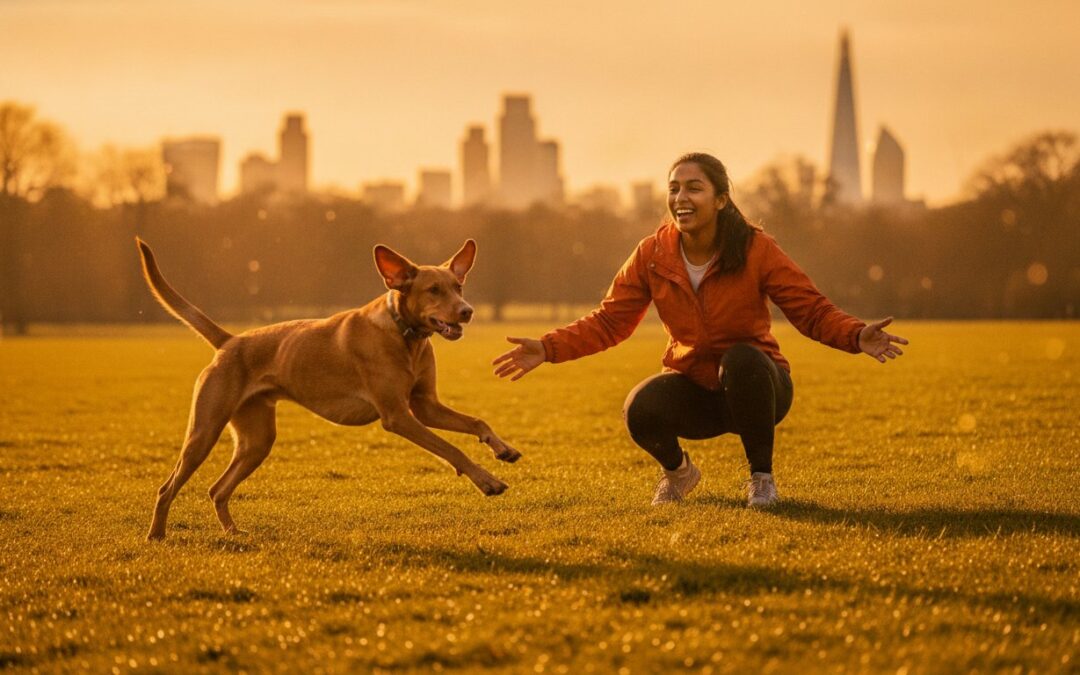
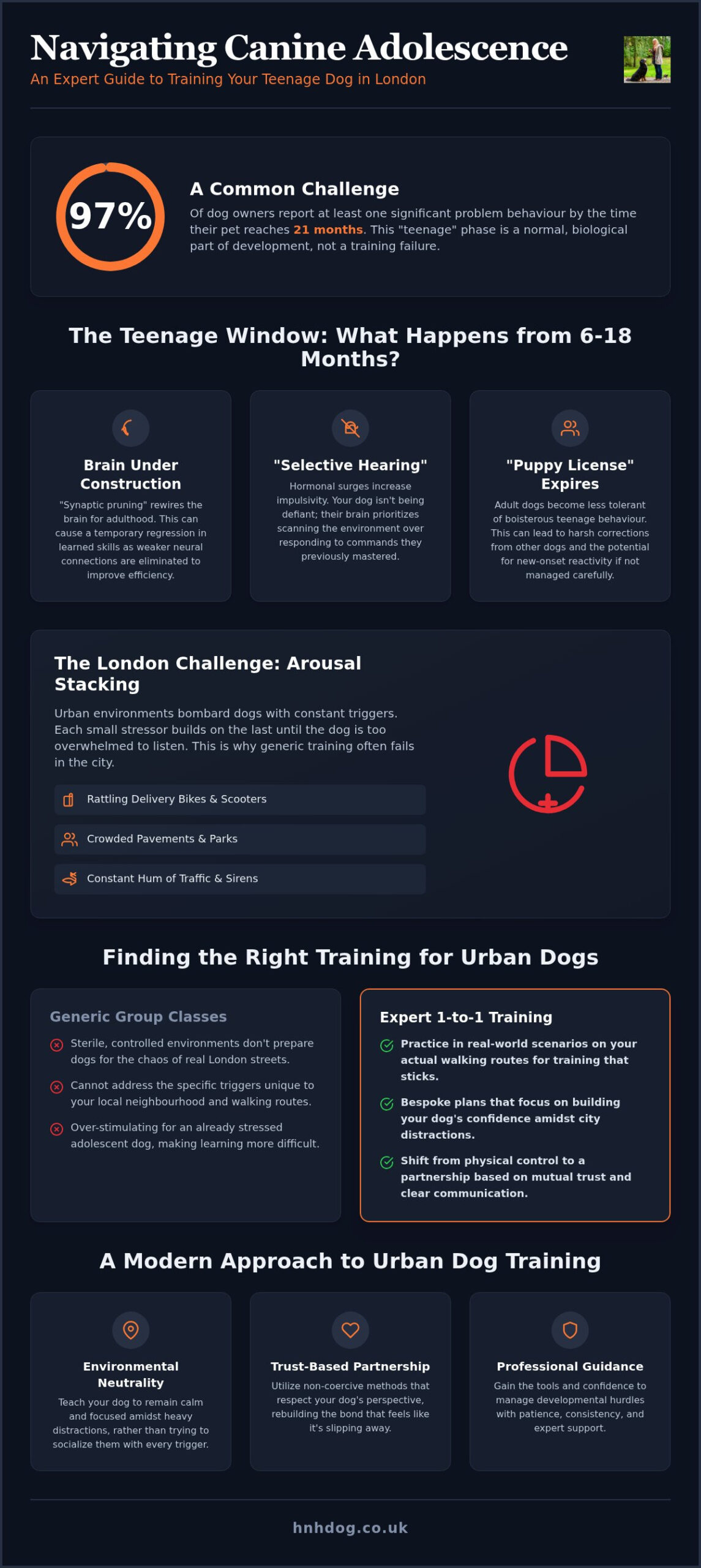
Did you know that 97% of dog owners report at least one significant problem behaviour by the time their pet reaches 21 months? It’s a staggering figure that highlights just how challenging the “teenage” phase can be. You might feel a sudden wave of embarrassment when your once-perfect puppy ignores a recall command in a crowded park, or perhaps you’re struggling with the physical strain of sudden lead pulling during your daily walk. It’s completely normal to feel like the bond you worked so hard to build is slipping away. Finding effective adolescent dog training London services is often the first step toward regaining control and confidence.
We understand that urban environments present unique pressures that generic group classes simply cannot address. This guide shows you how to transform your rebellious pup into a focused, well-behaved companion through expert-led, 1-to-1 training tailored to the nuances of city life. We’ll explore the biological reasons behind your dog’s changing behaviour and provide a clear, supportive path toward reliable recall and calm walks on busy streets. By focusing on mutual trust rather than conflict, you’ll discover how to manage these developmental hurdles with patience and professional guidance.
Key Takeaways
- Understand that adolescence is a period of biological change, where “synaptic pruning” often causes temporary regression in previously learned behaviours.
- Recognise why the high density of city environments increases stress, making bespoke adolescent dog training London essential for navigating local parks with confidence.
- Learn why prioritising environmental neutrality over constant socialisation is the key to maintaining focus amidst the heavy distractions of London life.
- Discover the benefits of 1-to-1 training over generic group classes, allowing you to practice real-world scenarios on your actual walking routes.
- Shift your training approach from physical control to a partnership based on mutual trust, using non-coercive methods that respect your dog’s perspective.
Understanding the “Teenage” Phase: Why Adolescent Dog Training in London Matters
Many owners feel a deep sense of accomplishment when their young puppy finally masters the basics of domestic life. Then, seemingly overnight, that reliable “sit” or “wait” is ignored in favour of a passing pigeon or a distant siren. This shift typically occurs between 6 and 18 months, marking the start of canine adolescence. It’s a period of profound biological change that can leave even the most dedicated owners feeling frustrated and embarrassed during walks. Seeking professional adolescent dog training London isn’t just about fixing “bad” behaviour; it’s about understanding the neurological reality of a developing brain.
The emotional toll on owners is significant. You might feel your dog is being spiteful or “testing” you, but science suggests otherwise. What looks like “selective hearing” is often a genuine inability to process cues while the brain is being flooded with new chemicals and restructuring itself. We’re here to help you move past the conflict and rebuild a bond based on empathy and clear communication.
The 6-18 Month Window: What is Happening?
During this developmental window, your dog’s brain undergoes a process similar to human puberty. Hormonal surges increase impulsivity, while the parts of the brain responsible for impulse control and rational decision-making are still maturing. This is a core concept in canine behavioral science, where we see a temporary regression in learned skills as the dog prioritises environmental exploration over obedience.
Social dynamics also shift during this time. Adult dogs in the park often lose their patience with teenagers. The “puppy licence” that once allowed your dog to jump or play roughly without consequence has expired. Other dogs may now correct your teenager more harshly, which can lead to new-onset reactivity if not managed carefully. Statistics suggest this is the most common age for dogs to be rehomed because owners feel they’ve “failed.” We aim to prevent that by giving you the tools to stay calm, consistent, and patient.
London-Specific Challenges for Teenage Pups
Living in a bustling city adds layers of complexity to this developmental stage. While a rural dog might encounter one cyclist a day, a London dog faces hundreds of triggers: rattling delivery bikes, crowded pavements, and the constant hum of traffic. These stressors don’t happen in isolation. They lead to “arousal stacking,” where each small trigger builds upon the last until your dog is too overwhelmed to listen to a simple command.
This is why bespoke dog training North London is so effective. We don’t train in a sterile vacuum. Instead, we address the specific challenges of your local environment, teaching your dog how to remain neutral amidst the chaos of urban life. By understanding these triggers, you can navigate your neighbourhood with a dog that feels safe, supported, and ready to listen despite the distractions.
The Science of Regression: Why Your Dog “Forgot” Their Training
It feels like a betrayal when a dog who once listened perfectly suddenly stares at you blankly while you give a simple command. You aren’t alone; this is a biological milestone rather than a personal slight. This regression is exactly why specialised adolescent dog training London programmes are so vital; they focus on the neurological “why” behind the “won’t.” Understanding that your dog’s brain is quite literally under construction helps replace frustration with the calm patience required to see them through to adulthood.
Synaptic Pruning and Selective Hearing
Synaptic pruning is the brain’s way of “rewiring” for adulthood by eliminating weaker neural connections to make room for more efficient, complex functions. During this process, your dog’s brain often prioritises environmental scanning over your cues. Their survival instinct tells them to monitor the surroundings for potential mates, rivals, or threats, which pushes your “sit” or “stay” command to the back of the queue. If you’re struggling with these basics, our 1-to-1 dog training can help you re-establish focus without resorting to outdated, forceful methods. This phase is temporary. With consistent, gentle guidance, those neural pathways will settle, and your reliable companion will return.
Navigating the Second Fear Period
Between 8 and 14 months, many dogs enter a “Second Fear Period.” This is a developmental stage where things they previously accepted without question suddenly become terrifying. In an urban setting, this might manifest as a sudden refusal to enter the London Underground, a suspicious barking fit at a newly placed rubbish bin on the pavement, or anxiety around cyclists. Their world has become larger and more threatening, and they’re looking to you for safety.
Forcing a dog through their fear can lead to long-term behavioural issues. If they feel trapped or pressured during a fearful moment, they may learn that lunging or aggression is the only way to make the “scary” thing go away. Instead, provide space and quiet support. Expert advice on handling adolescent dog behavior emphasises that staying calm and moving at the dog’s pace is crucial for their emotional health. Shifting your mindset from “commanding” to “supporting” changes the entire dynamic. You’re no longer an adversary fighting for dominance; you’re a mentor helping a confused teenager find their feet in a busy city.
1-To-1 Training vs. Group Classes: The Best Fit for London Teenagers
Deciding where to invest your time and energy during your dog’s teenage months is a pivotal choice. While group classes are often the default for early puppyhood, they can become counterproductive as your dog enters adolescence. The high-stimulus environment of a hall filled with other barking teenagers often creates a sensory overload that prevents any meaningful learning. This is why specialised adolescent dog training London programmes favour a 1-to-1 approach. By removing the chaotic distractions of a group setting, we allow your dog’s brain to settle and focus on you.
There is compelling scientific evidence for adolescent-phase behaviour indicating that dogs naturally become less responsive to their caregivers during this developmental window. In a crowded class, this reduced responsiveness is amplified. You might find yourself struggling to hold your dog’s attention while they are fixated on another pup across the room, leading to a cycle of frustration for both of you. Transitioning to bespoke, individual sessions ensures that every minute is spent building your specific relationship rather than managing the proximity of others.
The Limitations of Group Classes for Adolescents
Many teenage dogs develop into what we call “frustrated greeters.” They have an intense desire to interact with every dog they see but lack the impulse control to do so calmly. In a group class, being forced to stay near other dogs without being allowed to play can actually increase this frustration. This often leads to dogs “acting out” or completely “shutting down” emotionally. It’s incredibly difficult to receive personalised advice on these complex internal states when a trainer’s attention is split between ten different households. 1-to-1 adolescent dog training London solves this by providing a safe, controlled space where your dog’s individual temperament is the sole priority.
Benefits of Bespoke 1-to-1 Urban Coaching
Training should happen where your life happens. If your dog ignores you at a local North West London park or pulls toward joggers on your street, that is exactly where we should work. Bespoke coaching allows us to practice on your actual walking routes, addressing the specific triggers that cause you stress. This “real-world” practice is far more effective than learning commands in a sterile indoor environment that bears no resemblance to a busy London pavement.
If your dog’s behaviour has moved beyond typical teenage testing into more deep-seated reactivity, our behavioural consultations provide the clinical depth needed to address the root cause of their anxiety. These sessions reduce the public embarrassment many owners feel, replacing it with a structured plan and the calm confidence of a knowledgeable mentor. You’ll learn to read your dog’s subtle body language, allowing you to support them before they reach a point of overwhelm.
Mastering Urban Life: Key Training Focuses for London Dogs
Training a dog in a quiet rural village is vastly different from training one in the heart of the capital. For effective adolescent dog training London owners must shift their focus from simple obedience to environmental resilience. In a city where your dog encounters hundreds of people and other pets daily, the ability to remain calm and focused is far more valuable than a flashy trick. We prioritise building a toolkit that allows your dog to navigate high-pressure situations with a sense of safety and cooperation.
Neutrality: The Secret to Calm London Walks
Many owners confuse socialisation with constant interaction. In a busy area like Hampstead Heath, allowing your teenager to greet every dog they see actually creates a “frustrated greeter.” They begin to expect a play session with every passing animal, leading to lunging and barking when they are kept on a lead. Instead, we teach neutrality. This is the ability to see a distraction and remain emotionally level. You can practice “Look at That” (LAT) games, where your dog is rewarded for calmly noticing a trigger and then checking back in with you. This is particularly useful on narrow London pavements where “social distancing” from other dogs is often impossible.
Loose lead walking should also be viewed as a two-way communication tool. It’s not just about physical restraint; it’s about a shared rhythm. When the lead is loose, it signals that both you and your dog are in a state of calm. If you’re struggling to maintain this connection amidst the city chaos, our 1-to-1 dog training sessions provide the bespoke guidance needed to master these urban skills on your local streets.
Urban Recall Strategies
The “smellscape” of a London park is incredibly potent. From discarded food to the scent of foxes, the distractions are far more rewarding than a standard biscuit. To compete, you must use high-value rewards like dried liver or cheese and practice with a long-line training lead. This allows your dog the freedom to explore while ensuring they cannot “self-reward” by ignoring you. Never punish a slow recall. If your dog takes their time to return, they are likely struggling with a distraction. Punishing them only teaches them that returning to you is a negative experience, which will damage your bond in the long term.
Consistency is the foundation of success. If you’re a busy professional, ensuring these skills are reinforced daily can be a challenge. Enlisting a professional dog walking service that understands and supports your training goals can make a significant difference. A knowledgeable walker will use the same cues and rewards, helping your teenager generalise their good behaviour across different contexts.
Finally, don’t overlook the “settle” behaviour. With more dog-friendly offices and cafes opening across London, teaching your dog to relax on a mat while you work or drink coffee is a vital life skill. It encourages an “off switch” that is often missing in high-energy adolescent dogs, making them much more pleasant companions for your urban lifestyle.
The H&H Dog Approach: Ethical, Bespoke Support for Your Teenager
At H&H Dog, we believe that the adolescent phase is a bridge, not a barrier. With over 20 years of professional pet care experience, we have seen first-hand how the right support can prevent the breakdown of the human-animal bond during these challenging months. Our approach to adolescent dog training London is rooted firmly in empathy and non-coercive methodology. We avoid the outdated, adversarial tactics of the past; instead, we focus on understanding the internal emotional states that drive outward actions. This projects a calm confidence that every challenge has a manageable, ethical solution.
Success during the teenage months often starts with a solid foundation. Our puppy training programmes are designed to prepare young dogs for the specific pressures of city life from the very beginning. If you’ve already established these basics, we help you transition those skills into advanced urban reliability. For those starting fresh with a teenager, we serve as a knowledgeable mentor, helping you interpret your dog’s changing needs across North London, North West London, and Watford.
Individualised Training Plans
Every dog is an individual with a unique temperament and history. We begin our process by assessing your dog’s specific triggers and your own lifestyle goals. This is never a generic, mass-market programme. It’s a bespoke roadmap that moves your dog from basic obedience to a state of calm confidence on busy pavements. We provide the logic behind every exercise, ensuring you feel in control and capable of supporting your pet through every developmental hurdle. This personal mentorship ensures that the animal’s perspective is always represented with kindness and respect.
A Holistic Perspective on Adolescent Care
Training doesn’t happen in a vacuum. A dog’s ability to learn is deeply affected by their physical and emotional well-being. This is where our holistic model differs from generic services. We look at the whole picture. For example, regular physical exercise through group dog walking is essential for burning off the high energy levels typical of this age. A dog that has had an appropriate physical outlet is a more focused learner during your training sessions.
Similarly, we consider the impact of physical maintenance on mental health. A calm grooming experience, such as a professional bath and brush, is vital. High-stress handling during grooming can increase a dog’s general baseline anxiety, making them more reactive during their daily walks. By ensuring every touchpoint of their care is supportive and ethical, we create a dog that is emotionally ready to succeed. We value long-term emotional health over quick, forceful fixes.
Ready to transform your relationship and navigate the teenage phase with confidence? Book your 1-to-1 training session with H&H Dog today and start your journey toward a more harmonious urban life.
Building a Lifelong Partnership with Your Urban Dog
Navigating the teenage phase requires a shift from viewing your dog as a “finished product” to seeing them as a developing animal in need of supportive mentorship. By understanding the biological drivers behind their behaviour and prioritising neutrality in busy city settings, you can move past the frustration of regression. Choosing bespoke adolescent dog training London allows you to address these challenges in the real-world environments where you live and walk. This focused approach ensures that your training is relevant, effective, and tailored to your specific lifestyle.
With over 20 years of professional industry experience, H&H Dog provides expert 1-to-1 support across North London and Watford. We use evidence-based, non-coercive methods that respect your dog’s perspective while giving you the practical tools for success. Every session is designed to foster mutual trust and long-term emotional health. Book a Bespoke 1-to-1 Adolescent Training Session today to start rebuilding your bond. Remember that this phase is temporary. With patience and the right guidance, your rebellious teenager will emerge as the calm, focused companion you’ve always envisioned.
Frequently Asked Questions
Is it too late to start training my 1-year-old dog?
It’s never too late to start training your dog. At one year old, your pet is in the heart of adolescence, making it the perfect time to invest in adolescent dog training London. While puppies are blank slates, teenagers have more physical stamina and can engage in more complex tasks. We focus on re-establishing the bond that often feels strained during this developmental window, ensuring your dog becomes a reliable, well-behaved adult.
Why has my dog started barking at other dogs during walks in London?
This behaviour often stems from a mix of hormonal changes and the “Second Fear Period.” In a high-stimulus city environment, your dog may feel overwhelmed by the proximity of other pets on narrow pavements. Barking is often a distance-increasing signal or a manifestation of frustration because they cannot interact. We work on teaching neutrality, helping your dog feel safe and calm without needing to react to every passing distraction.
How many 1-to-1 sessions will my adolescent dog need?
The number of sessions depends entirely on your dog’s unique temperament and your specific goals. Typically, we begin with an initial 1.5-hour assessment to understand the underlying motivations for their behaviour. Most owners see significant progress within three to five 1-to-1 dog training sessions. We provide you with the skills to continue the work independently, acting as a mentor to ensure long-term success in your local urban environment.
My dog ignores me in the park but listens at home; what should I do?
This is a common challenge known as “lack of generalisation.” Your home has low distractions, but a London park is a sensory explosion of scents and sounds. To fix this, you must gradually increase the difficulty of your training environment. Use a long-line lead for safety and offer higher-value rewards that can compete with the environment. We help you bridge this gap by practicing in the actual parks where your dog currently struggles.
Can adolescent dog training help with separation anxiety?
Yes, training can certainly help, though we often approach this through a behavioural consultation. Separation anxiety is an emotional state rather than a simple lack of obedience. We look at your dog’s overall confidence and teach them that being alone is a safe, predictable experience. By addressing their internal anxiety rather than just the outward barking or destruction, we create a more resilient and relaxed pet who feels secure in your London home.
What is the difference between a dog trainer and a behaviourist for a teenager?
A dog trainer typically focuses on teaching specific skills like recall or loose lead walking. A behaviourist looks deeper into the “why” behind complex emotional issues such as aggression or severe anxiety. For many teenagers, adolescent dog training London is sufficient to manage boundary-pushing. However, if your dog shows signs of deep-seated distress or reactivity, a behavioural consultation provides a more clinical, holistic approach to their mental welfare and long-term stability.
Do you use treats or clickers in your London training sessions?
We use evidence-based, reward-focused methods, which often include high-value treats to motivate and reinforce positive choices. Clickers can be a fantastic tool for precision, but they aren’t mandatory if you prefer other markers. Our priority is using non-coercive techniques that respect your dog’s perspective. By making the right choice the most rewarding one, we build a partnership based on mutual trust rather than fear or physical force during our urban sessions.
How do I stop my teenage dog from pulling on the lead in busy streets?
Stopping lead pulling requires a shift from physical restraint to active communication. We teach your dog that walking by your side is the most rewarding place to be, even amidst the distractions of busy London streets. This involves using frequent “check-ins” and rewarding a loose lead before tension occurs. We avoid harsh corrections, focusing instead on building engagement so your dog chooses to stay with you because they want to, not because they have to.