
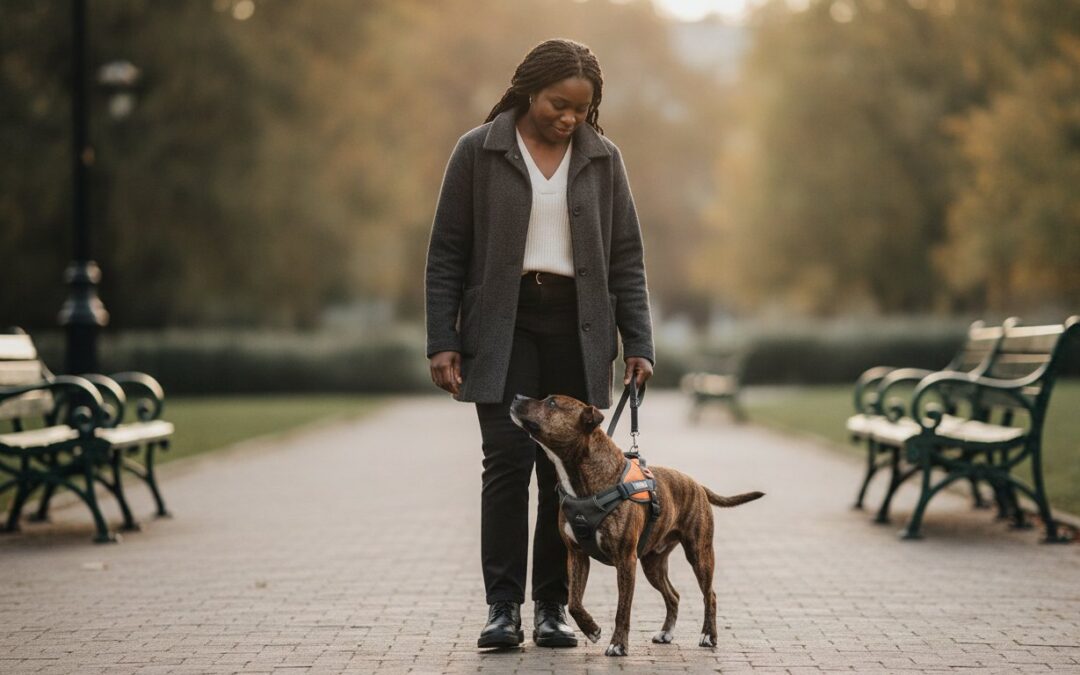
What if the daily walk through a busy London park felt like a moment of connection rather than a source of deep-seated dread? If you’ve ever felt your heart race at the sight of another dog on the horizon, or winced at the unsolicited advice of strangers, you know that managing canine aggression is as much about your own emotional resilience as it is about your dog’s behaviour. It’s exhausting to feel like you’re constantly on high alert, worrying about the next trigger or the judgment of other owners. You want a relationship built on trust, not one defined by the tension at the end of the lead.
We understand that every reactive response is actually a communication of internal distress. This article explores how bespoke dog reactivity training London can provide owners with a compassionate, evidence-based path to peace. You’ll discover how to decode your dog’s emotional state, implement ethical management strategies tailored for crowded city streets, and regain the confidence to handle any situation. By focusing on partnership rather than punishment, we’ll show you how to restore harmony to your walks and ensure both you and your dog feel safe in the urban landscape.
Key Takeaways
- Learn to view aggression as a vital communication tool rather than a character flaw by recognising early warning signs on the “Ladder of Aggression”.
- Discover how the specific pressures of city life contribute to fear, and why expert dog reactivity training London provides the necessary tools for navigating crowded parks safely.
- Understand the importance of rejecting outdated dominance myths in favour of evidence-based, non-coercive methods that prioritise your dog’s emotional welfare.
- Master tactical management techniques, such as using environmental barriers and ethical safety equipment, to keep every walk predictable and stress-free.
- Recognise why a bespoke behavioural consultation is the most effective way to transition from constant management to a restored bond of trust.
Understanding Dog Aggression as Communication
Aggression is often misunderstood as a sign of a “bad” dog. In reality, it is a distance-increasing signal designed to keep a perceived threat away. It is a cry for help, not a character flaw. Canine aggression is a functional response to perceived threat. When you begin searching for “aggressive dog training near me,” it is vital to find a professional who prioritises empathy over force. You aren’t managing a moral failing; you’re helping a dog who feels they have no other way to stay safe in a world that feels overwhelming.
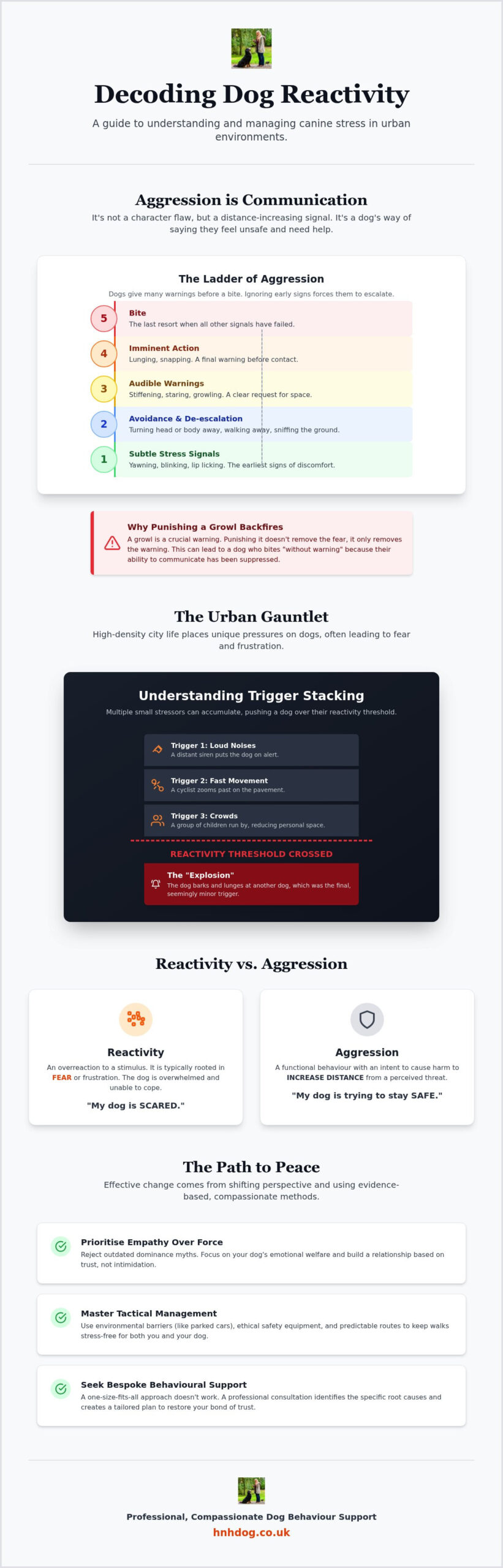
Understanding Dog Aggression as a form of communication allows us to look at the “Ladder of Aggression.” This is a sequence of signals dogs use to tell us they are uncomfortable. It starts subtly and escalates only when the dog feels their earlier attempts to communicate have failed. These signals often include:
- Lip licking or yawning: Early signs of physiological stress.
- Turning the head away: An attempt to avoid conflict or “de-escalate” the situation.
- Walking away or tucking the tail: Clear signs of fear and a desire to escape.
- Growling, snapping, or biting: The final stages when the dog feels they must defend themselves.
If these lower-level signals are ignored or misunderstood, the dog feels forced to escalate to ensure their voice is heard. This is why a bespoke approach is so important.
Reactivity vs. Aggression: Decoding the Signals
People often use these terms interchangeably, but they describe different internal states. Reactivity is an overreaction to a stimulus, such as barking and lunging on a London lead because the dog is over-threshold and unable to cope. Aggression implies an intent to cause harm. Many dogs exhibiting “aggressive” displays in busy parks are actually reactive; they are terrified and trying to create space. Shifting your perspective from “my dog is bad” to “my dog is scared” is the first step in effective dog reactivity training London owners can trust. It changes how you respond to their distress.
Why Punishing a Growl Backfires
A growl is a dog’s early warning system. It’s their way of saying, “I’m not coping.” If you punish the growl, you don’t fix the underlying fear; you only remove the warning. This suppression is dangerous because it leads to what owners describe as “unpredictable” bites. Without the ability to growl, the dog may go straight to a bite when they reach their limit. Our goal is to foster a relationship where your dog feels safe enough to communicate. We want to address the root cause of the anxiety rather than just masking the symptoms through force.
The Root Causes of Reactivity in Urban Environments
Living in a high-density area like North London or Watford places unique psychological demands on our dogs. While we might view a walk as a leisure activity, for a reactive dog, it can feel like running a gauntlet. Fear is the primary driver for most aggressive displays in these settings. When a dog feels trapped by buildings or crowds, their natural “flight” instinct is restricted, leaving “fight” as the only perceived option for safety.
Frustration also plays a significant role. This is often seen as “barrier aggression,” where the restriction of a lead prevents a dog from greeting others or moving away from a trigger. On narrow North London pavements, dogs may also engage in resource guarding, where they feel the need to protect their owner or their immediate personal space because they cannot maintain a comfortable distance from passers-by. We must never overlook the role of physical pain. A dog dealing with undiagnosed joint discomfort or dental issues will have a much lower threshold for stress, making outbursts more likely.
Trigger Stacking on London Streets
Success in dog reactivity training London depends on understanding trigger stacking. This is the process where multiple stressors accumulate over a short period. A morning walk might start with a distant siren, followed by a cyclist zooming past on the pavement, and then a group of school children running nearby. Individually, your dog might cope with these. Together, they spike baseline cortisol levels until the dog finally “explodes” at a minor trigger. This explains why your dog might be perfectly calm in your living room but appear “aggressive” the moment you enter Watford town centre.
The Hidden Link: Physical Comfort and Grooming
There is a direct correlation between a dog’s physical state and their emotional reactivity. Matted coats or overgrown nails cause constant, low-level discomfort that makes a dog more irritable and sensitive to touch. For a dog already anxious about their environment, this extra physical burden can be the tipping point. Utilising mobile dog grooming can significantly reduce this baseline stress by providing care in a familiar, low-trigger environment.
If your dog’s behaviour has changed suddenly, it is essential to involve a vet to rule out medical causes. Combining clinical health checks with the guidance of a dog behaviourist London ensures a holistic approach to their welfare. Identifying these root causes is the first step toward a more predictable life together. If you’re struggling to identify why your dog is reacting, a professional behavioural consultation can provide the clarity you need to move forward.
Selecting an Ethical Behaviourist in London and Watford
Choosing the right support is a pivotal decision for your dog’s future. In the field of dog reactivity training London owners often encounter conflicting advice that can do more harm than good. It is essential to reject “dominance” or “alpha” theories. These concepts are scientifically debunked and dangerous when applied to a dog already experiencing fear or anxiety. Punishment-based methods don’t solve the underlying emotional state; they merely suppress the symptoms, which often leads to more significant behavioural outbursts later on.
When you interview a professional, ask one crucial question: “What happens when my dog makes a mistake?” An ethical behaviourist will explain how to manage the environment and redirect the dog without using fear, startle, or pain. You need a bespoke plan that accounts for the specific triggers your dog faces in your local area, rather than a generic “one size fits all” approach. Finding someone with extensive experience in dog training in North London ensures they understand the unique pressures of our urban environment.
Why 1-to-1 Training Trumps Group Classes
For a reactive dog, a group class is often an environment where they are constantly over-threshold. This means they are too stressed to process new information or learn. 1-to-1 sessions allow us to work in a controlled setting where your dog feels safe enough to focus. This format provides the opportunity for real-world practice on your specific walk route, whether that’s a busy high street or a local park. It also offers you, the owner, personal mentorship to build your own handling skills and confidence.
Accreditations and Standards to Look For
Understanding the difference between a trainer and a qualified behaviourist is key. While a trainer might focus on teaching specific cues, a behaviourist looks at the psychological “why” behind the action. Look for professionals who demonstrate a commitment to contemporary, evidence-based methodology. Having 20+ years of professional experience matters when navigating the complex social dynamics of London’s dog parks. Identify red flags in local advertisements, such as “guaranteed fixes” or terminology associated with hierarchy and punishment. These are often indicators of outdated, coercive techniques that prioritise quick results over long-term emotional welfare.
Tactical Management for Busy London Parks and Pavements
Managing a reactive dog in the capital requires more than just patience; it demands a tactical mindset focused on environmental control. While we work on the underlying emotional response through dog reactivity training London, management acts as our safety net. It prevents your dog from practising the very behaviours we want to resolve. One of the most responsible tools at your disposal is the muzzle. Think of it as a safety belt. It doesn’t mean your dog is “bad”; it provides you with the peace of mind to train effectively without the fear of a physical incident.
Environmental management also involves using London’s unique landscape to your advantage. Visual eye contact is often the catalyst for a reaction. By using parked cars, large trees, or even post boxes as visual barriers, you can break that stare and keep your dog below their stress threshold. If a situation feels too intense, employ the “Emergency U-Turn.” This is a graceful, practised 180-degree turn that allows you to exit a high-pressure encounter before an outburst occurs. Crucially, keep your lead handling light. A tight lead transmits your own tension directly to your dog, signalling that there is something to fear.
Creating a “Safety Bubble” in Crowded Spaces
Success in Watford or North West London often depends on timing. Choosing low-trigger periods, such as early mornings or later evenings, reduces the number of unpredictable encounters. You must also become your dog’s advocate. When “he just wants to say hello” owners approach, be firm and clear about your dog’s need for space. London’s narrow residential streets can create a “corridor effect” where a dog feels trapped. In these moments, it’s better to step into a driveway or cross the road early rather than hoping for the best.
In-Home Management for Visitors
Reactivity doesn’t stop at the front door. To reduce territorial anxiety, use baby gates to manage access to the hallway. Implementing “place” training gives your dog a specific, rewarding job to do when the doorbell rings. For guests, use the “Three-Second Rule” during meet-and-greets. Allow a brief, three-second interaction before calmly redirecting your dog to their safe zone. This area should be strictly off-limits to guests, ensuring your dog has a predictable retreat when they feel overwhelmed. If you need a personalised safety plan for your specific route, our 1-to-1 dog training provides the expert guidance you need to navigate these challenges with confidence.
Bespoke Behavioural Support with H&H Dog
At H&H Dog, our philosophy is rooted in the belief that every dog deserves to be understood. We don’t see reactivity as a problem to be “fixed” with force, but as an emotional state that requires a compassionate, evidence-led partnership. By prioritising the dog’s internal welfare, we create a foundation of trust that allows for genuine progress. This holistic approach is why our dog reactivity training London services are sought after by owners who value ethical care over quick, coercive results. We believe that when you change how a dog feels, the behaviour naturally follows.
Your journey starts with a detailed behavioural consultation. This essential first step allows us to peel back the layers of your dog’s history and environment. We look beyond the barking and lunging to identify the specific stressors at play in your daily life. From there, we transition into bespoke 1-to-1 dog training sessions. These are designed to build your confidence as a handler, giving you the practical skills to manage triggers in real-time. We support the “whole dog,” which means we consider how professional walking and stress-free grooming contribute to their overall emotional baseline.
Why 20 Years of Local Experience Matters
Our deep understanding of North London and Watford’s unique canine community is built on over two decades of professional experience. We know the specific dynamics of local parks and the challenges of navigating busy high streets. Unlike generic global brands, we offer a personal, local touch that accounts for the reality of London living. We’ve seen countless success stories where dogs once deemed “difficult” have learned to find relaxation in the city. Our commitment to non-coercive, welfare-first methodologies ensures that your dog’s spirit is never broken, only supported through kindness and logic.
Your Path to Calm: Booking an Assessment
Preparing for your first session is straightforward. We’ll ask you to provide a history of your dog’s behaviour and any specific incidents that have caused concern. This information helps us tailor the initial assessment to your precise needs. The journey from that first meeting to a managed, happy life together is a structured process of education and gradual progress. You won’t be left to figure it out alone; we act as your steady hand throughout the transition. Book a Behavioural Consultation with H&H Dog today to begin restoring the relationship you and your dog deserve.
Restoring Harmony to Your London Walks
Transforming your relationship with a reactive dog begins with a fundamental shift in perspective. By viewing outbursts as a functional response to stress rather than a character flaw, you can replace frustration with focused, ethical management. We’ve explored how understanding the “Ladder of Aggression” and implementing tactical environmental controls can make busy parks feel manageable again. Effective dog reactivity training London owners can trust relies on this blend of empathy and evidence-based strategy. It’s about building a partnership where your dog feels heard and you feel entirely in control of the situation.
With over 20 years of experience as specialists in London dog behaviour, we’re here to guide you through every challenge. Our positive, non-coercive methods ensure that your dog’s emotional health remains the priority while you regain your confidence on the lead. You don’t have to navigate these stressful situations alone. A predictable, peaceful life with your companion is achievable with the right professional mentorship. Book an Expert Behavioural Consultation with H&H Dog today to take the first step toward a calmer future together. Your dog is communicating; it’s finally time to start listening.
Frequently Asked Questions
Is it ever too late to train an aggressive dog?
It’s never too late to begin the dog reactivity training London owners might have delayed. While older dogs often have more practised habits, their brains remain capable of learning new emotional responses at any age. We focus on gradual, non-coercive methods that respect your dog’s individual pace. Significant improvements in quality of life and safety are always achievable with a bespoke, patient approach tailored to their senior years.
Will my dog ever be able to go off-lead in London parks again?
Off-lead freedom depends entirely on your dog’s individual progress and the specific social dynamics of your local environment. In busy London parks, the priority is always safety and legal compliance. Many owners find that using a long line provides a secure middle ground, allowing the dog space while maintaining control. Our goal is to build a reliable “check-in” habit, ensuring you feel confident even in high-trigger urban settings.
What is the difference between a dog trainer and a dog behaviourist?
A trainer typically focuses on teaching specific cues like “sit” or “stay” through repetition. A behaviourist looks at the psychological motivations behind actions, such as fear or frustration. At H&H Dog, we bridge this gap by addressing the emotional root cause through a behavioural consultation before applying practical training skills. This ensures we aren’t just masking symptoms but are actually changing how your dog feels about their environment.
Can I use a muzzle during training sessions?
We actively encourage the ethical use of muzzles as a vital safety tool during our sessions. A well-fitted basket muzzle acts like a safety belt; it doesn’t mean your dog is “bad,” but it allows you to train with reduced anxiety. When you feel calm, your dog is less likely to pick up on your tension. We can guide you through a positive introduction to ensure your dog is comfortable.
How many sessions will it take to see an improvement in my dog’s aggression?
Every dog is unique, so there is no fixed number of sessions for guaranteed improvement. Some owners notice a shift in their dog’s baseline stress after just two or three 1-to-1 sessions, while complex cases require longer-term support. We use the initial assessment to create a realistic roadmap. Success depends on consistent practice between our meetings and effectively managing your dog’s environment to prevent further trigger stacking.
What should I do if my dog bites another dog or person?
If a bite occurs, your immediate priority is to secure your dog and ensure the safety of everyone involved. Once the situation is stable, you should seek professional help immediately. In the UK, owners are legally responsible for keeping their dogs under proper control at all times. We recommend a comprehensive behavioural consultation to assess the risk and implement an urgent management plan, which often includes mandatory muzzle use.
Does neutering help with aggressive behaviour?
Neutering is not a “silver bullet” for aggression and can sometimes worsen fear-based reactivity by reducing confidence. While it may reduce behaviours driven by sex hormones, it doesn’t address fear or frustration. It’s essential to discuss this with both your vet and a behaviourist. We look at the whole dog to determine if hormonal changes will truly support their emotional welfare or if other interventions are more appropriate.
Can my dog’s diet affect their aggression levels?
Diet can significantly influence a dog’s arousal levels and overall mood. Some high-protein diets or those with specific artificial additives can contribute to increased excitability or irritability in sensitive individuals. The gut-brain axis plays a significant role in how dogs process stress. During our sessions, we may discuss nutritional adjustments as part of a holistic plan to lower your dog’s baseline anxiety and improve their focus during training.