
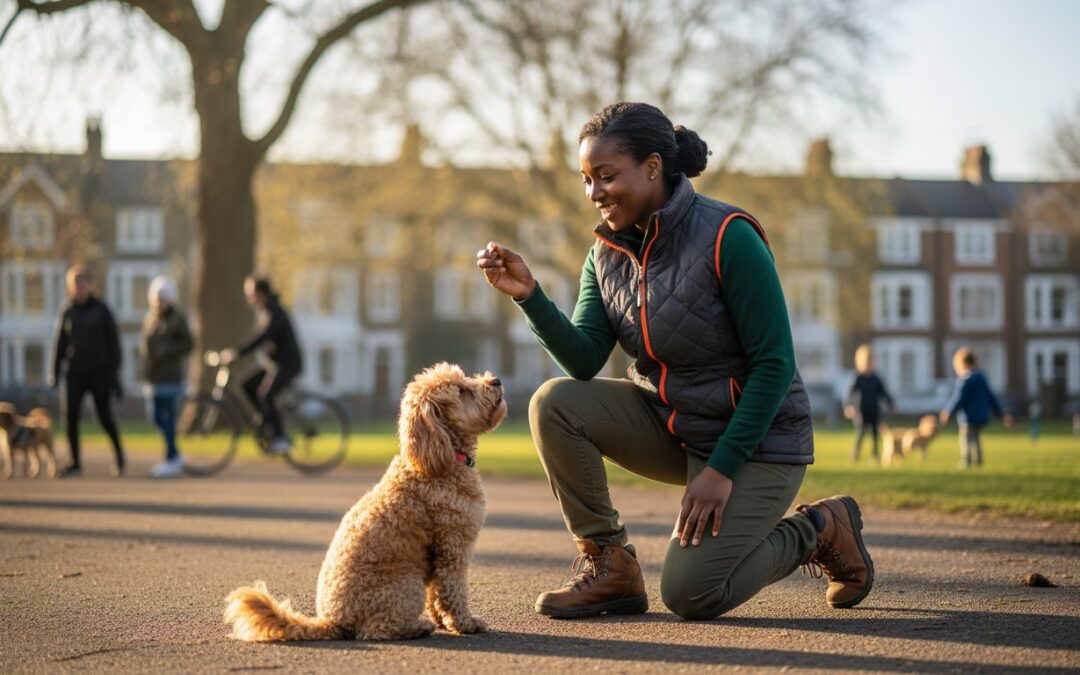
Imagine standing in a crowded Victoria Park on a Tuesday morning, watching your dog lunging at a passing cyclist while you juggle a lead and a sense of growing embarrassment. You’ve likely spent hours searching for dog training close to me, only to be met with a wall of conflicting online advice or classes located three postcodes away. It’s exhausting to feel that every walk is a tactical mission rather than a moment of connection. Recent 2024 data indicates that urban dogs encounter up to 50 distinct stressors in a typical thirty-minute walk, which explains why your current routine often feels so overwhelming.
We agree that the sensory overload of London life requires more than just basic obedience; it requires a deep understanding of your dog’s internal emotional state. This guide will show you how to find expert, local support that addresses the specific pressures of urban living in 2026. We will examine the essential criteria for choosing a force-free professional and provide a clear path toward a calm, focused companion who can handle the capital’s distractions with ease.
Key Takeaways
- Learn why finding dog training close to me is essential for reducing travel stress and ensuring your dog learns effectively in their own London neighbourhood.
- Understand how to identify ethical professionals by looking for ABTC or APDT accreditation and a commitment to force-free, positive reinforcement.
- Discover why bespoke 1-to-1 sessions are often more effective than group classes for navigating the unique sensory challenges of urban life.
- Identify the essential equipment and mindset shifts required to set your dog up for success during training sessions in busy city parks.
- Explore how an “Expert Advocate” approach helps you see the world through your dog’s eyes to address the emotional roots of their behaviour.
Why Finding ‘Dog Training Close to Me’ Matters for London Pups
Searching for dog training close to me isn’t just a matter of convenience; it’s a vital strategic choice for your dog’s emotional health. London is a high-arousal environment that presents unique challenges for urban pets. When you choose a local expert, you eliminate the logistical hurdles that often sabotage a training plan before it even begins. Proximity allows for a more integrated approach where the trainer supports you in the exact streets and squares where your daily life unfolds.
The Hidden Stress of the London Commute
The journey to a training centre can be more taxing than the session itself. Whether it’s the high-pitched screech of Tube brakes at Camden Town or the unpredictable crowds on a red bus, a long commute creates a state of physiological arousal. Research into canine behaviour suggests that elevated cortisol levels can linger in a dog’s system for up to 72 hours, significantly hindering their ability to focus and learn. By opting for local sessions, you ensure your dog starts their lesson in a calm, receptive state of mind.
Trigger stacking in a busy London street occurs when a sequence of minor stressors, like a passing cyclist followed by a loud siren, accumulates until a dog reaches a breaking point and reacts. Training in your immediate neighbourhood avoids this “stacking” effect. We focus on keeping your dog below their threshold, which leads to a more confident animal and a more relaxed owner. Short, local sessions are often more productive than a marathon session involving a stressful cross-city trek.
Training in Your Dog’s Natural Urban Habitat
A dog might master a perfect “stay” in a quiet suburban hall, but those skills often evaporate on a bustling Hampstead Heath afternoon. Real-world success requires practicing in the environments where your dog actually struggles. A trainer who knows North West London understands the specific distractions of your local high street, from the scent of a specific bakery to the heavy foot traffic near a certain primary school. This local expertise allows us to apply the principles of dog training to the exact scenarios you face every morning.
Local knowledge also ensures your training aligns with the specific bylaws of your borough. For instance, the lead-only requirements in parts of Islington differ significantly from the seasonal restrictions in the Royal Parks. An expert familiar with your area can help you navigate these rules while ensuring a smooth transition to professional dog walking London services later on. This tailored approach respects the dog’s perspective, focusing on building a life together that feels manageable and harmonious within your specific community.
- Environmental Specificity: Practice occurs where the behaviour actually happens.
- Reduced Travel Fatigue: Your dog arrives fresh and ready to engage.
- Borough Expertise: Guidance on local lead laws and dog-friendly zones.
- Realistic Socialisation: Exposure to the specific “dog-traffic” patterns of your neighbourhood.
Essential Criteria for Choosing a London Dog Trainer
Selecting the right support for your dog involves more than just convenience. When searching for dog training close to me, your primary focus should be on finding a professional who understands the sensory overload of the capital. London dogs face unique pressures, from the constant hum of the Tube to the bustling crowds of weekend markets. You need a trainer who prioritises force-free, positive reinforcement methods that foster a genuine connection rather than relying on fear or suppression.
Avoid any practitioner who still references “alpha” or “dominance” terminology. These concepts were scientifically debunked decades ago and can cause significant psychological harm to your pet. Instead, look for specialists who view themselves as a mentor for both you and your dog. This ethical approach ensures that your dog feels safe and supported, even in high-stakes urban environments.
Understanding Modern, Science-Based Methods
Effective training focuses on why a dog acts, not just what they do. We adopt an “Expert Advocate” philosophy, which means we prioritise your dog’s internal emotional state over their outward obedience. In high-arousal settings like Hackney or Marylebone, traditional “corrections” often backfire. They increase a dog’s cortisol levels and can lead to redirected aggression. Choosing positive reinforcement dog training ensures long-term results by rewarding desired behaviours and building confidence. This methodology aligns with official UK dog welfare standards, which highlight the legal and ethical necessity of protecting dogs from pain and distress during handling.
Verifying Credentials and Insurance
The UK dog training industry is currently unregulated, meaning anyone can market themselves as an expert. Finding reliable dog training close to me requires you to be diligent with your background checks. Always verify accreditation with reputable bodies like the Animal Behaviour and Training Council (ABTC) or the Association of Pet Dog Trainers (APDT). These organisations require members to undergo rigorous assessments and commit to continuing professional development.
During your initial consultation, ask these specific questions:
- Can you provide proof of professional indemnity and public liability insurance? This is non-negotiable for sessions held in public London parks.
- What is your specific experience with urban-dwelling dogs and leash reactivity?
- How do you handle a dog that is too overwhelmed to take treats?
Be wary of “red flag” marketing. If a trainer guarantees results in a single hour or uses equipment designed to cause discomfort, walk away. Real behavioural change is a journey that requires patience and a tailored training plan designed for your dog’s specific personality. Professional insurance and ethical accreditation are the hallmarks of a trainer who respects the complex nature of the human-canine bond.
1-to-1 Personalised Training vs. Group Classes in London
Finding effective dog training close to me in London often involves a choice between the communal energy of a group class and the focused precision of 1-to-1 sessions. For many urban dogs, this decision isn’t just about convenience; it’s about emotional safety. While group settings are a traditional staple, the high-density environment of a London community hall can be counterproductive for a dog already struggling with the city’s sensory demands. Personalised training shifts the focus from performing cues to genuine learning, ensuring your dog remains below their stress threshold throughout the process. This tailored approach respects your dog’s specific temperament and the realities of your home life, creating a foundation that generic classes often fail to reach.
When to Choose 1-to-1 Support
Private support is vital when addressing complex challenges like lead reactivity or separation anxiety. These issues often require the intervention of a dog behaviourist London residents can trust to look beneath the surface of the action. A bespoke plan respects your dog’s unique temperament and fits the 60-hour work weeks common among city professionals. You receive a mentor’s undivided attention, allowing for real-time adjustments based on subtle shifts in your dog’s body language. In-home consultations are particularly effective because they reveal domestic triggers, such as the sound of a communal lift or specific hallway echoes, which contribute to 85 percent of household behavioural issues in urban flats. This level of detail is impossible to achieve in a park or hall with other participants present.
The Limitations of Urban Group Classes
Group classes in London often face the hurdle of distraction overload. Attempting to teach a new cue while ten other dogs are barking in a confined space creates a cortisol spike that hinders long-term retention. True socialisation is about the quality of the interaction, not just being in the presence of other animals. It’s the ability to remain calm and neutral, rather than the frantic play often seen in generic class blocks. When you evaluate the cost-to-value ratio, a £300 block of six classes might seem economical. However, if the environment is too stressful for your dog to actually process information, that investment yields very little progress. 1-to-1 training ensures every minute is productive, making it a more efficient path to a peaceful life together. Choosing
dog training close to me
that prioritises your dog’s emotional state over a rigid curriculum is the most ethical way to support your companion’s development.
Preparing Your Dog for Local Training in Busy London Parks
Searching for dog training close to me often leads owners to the vibrant, yet unpredictable, green spaces of London. Success in these environments requires a shift in perspective. Training isn’t a one-off fix or a series of commands; it’s a continuous journey of communication between you and your dog. You aren’t just teaching a sit; you’re building a reliable partnership amidst the distractions of a city that never truly sleeps.
Preparation begins with the right kit. For London training, we recommend a well-fitted, Y-shaped harness that allows for natural shoulder movement and a 5-metre long-line lead. This equipment ensures safety while providing your dog the freedom to sniff and process their surroundings. Avoid extendable leads; they lack the tactile feedback necessary for nuanced communication. You’ll also need high-value rewards that can compete with the intense sensory input of a park like Victoria Park or Battersea. Think beyond standard kibble. Use small pieces of boiled chicken, liver cake, or dried sprats to maintain your dog’s motivation when a cyclist or a group of runners passes by.
Understanding your dog’s working distance is the most effective way to prevent frustration. This is the specific space your dog needs to feel safe and remain capable of learning. If your dog freezes or barks at a squirrel 10 metres away, their working distance is 15 metres. By respecting this boundary, you prevent them from reaching their threshold. Threshold is the emotional and physiological boundary where a dog shifts from a calm, learning state into a reactive or shut-down state.
Urban Proofing: Building Focus Amidst Chaos
Capturing attention in a local park requires a structured approach. Start in a quiet corner before moving toward busier paths. The “watch me” cue is your most vital tool for navigating crowded London pavements. It asks for a brief moment of eye contact, allowing you to check in with your dog before they fixate on a potential trigger. Practice this 10 times in a low-distraction environment before testing it near other dogs. When you’re looking for dog training close to me, ensure your trainer prioritises these focus-based foundations over simple obedience.
The Importance of Enrichment
A dog’s ability to focus outdoors is directly linked to their mental welfare at home. Dogs living in London flats often face higher baseline stress due to noise pollution and limited space. You can lower this stress by implementing simple indoor enrichment:
- Scent work: Hide high-value treats around your living room to encourage natural foraging behaviour.
- Lick mats: Using a silicone mat with wet food can reduce cortisol levels by up to 20% through the soothing action of licking.
- Puzzle toys: These provide the cognitive challenge your dog craves, making them less likely to seek out their own “jobs” in the park.
Mental stimulation prepares the brain for the rigours of outdoor learning. It’s about more than just “tiring them out”; it’s about fostering an emotionally resilient dog who is ready to take on the world with you.
Ready to transform your park walks into a stress-free experience? Book a tailored consultation with H&H Dog today to start your journey.
Bespoke 1-to-1 Dog Training with H&H Dog in London
H&H Dog has spent more than 20 years refining a supportive, science-led approach for London’s canine community. We operate as your “Expert Advocate,” a role that requires us to look past outward symptoms like barking or pulling. We focus on the internal emotional state instead. By understanding why a dog feels the need to react, we can implement lasting changes that improve their quality of life. This philosophy is central to our 1-to-1 sessions, which we deliver directly to your door in North London and North West London.
Our service is designed for the busy urban owner who values a holistic perspective. We know that a dog’s behaviour is influenced by their entire day, not just a single hour of training. That’s why we connect our training protocols with our professional walking and grooming services. It creates a consistent environment where your dog feels safe and understood. When you search for dog training close to me, you deserve a partner who sees the full picture of your dog’s lifestyle.
Personalised Care for Every Temperament
Every dog possesses a distinct personality shaped by genetics and their environment. Our support is entirely bespoke, whether you’re managing a rescue dog with a complex history or a bold puppy finding their feet. We handle a wide spectrum of needs, ranging from basic obedience to deep-seated anxiety and reactivity. Our mobile expertise is a significant advantage for Londoners. We visit your home or local park, which eliminates the stress of travelling to a busy class environment. This setting allows us to address real-world challenges where they actually happen. If you’ve just welcomed a younger dog, our puppy training program is the perfect starting point to ensure they grow into a well-adjusted urban companion.
Start Your Journey with H&H Dog
Every successful transformation starts with a thorough behavioural assessment. This initial meeting allows us to observe your dog’s body language and discuss your concerns without judgment. We’re committed to force-free, compassionate methods that foster trust rather than fear. You won’t find any outdated “alpha” theories here. Instead, we use positive reinforcement to encourage better choices and clearer communication.
Our goal is to give you the tools to feel in control and confident. If you’ve been searching for dog training close to me that prioritises your dog’s emotional health and long-term development, H&H Dog offers the professional guidance you need. Book your consultation today to build a stronger, more confident connection with your dog.
Transform Your Urban Dog’s Potential Today
Navigating the unique pressures of London’s busy streets and parks requires more than just basic obedience. It demands a deep understanding of canine communication and the specific triggers found in our capital’s urban landscape. By choosing 1-to-1 support over generic group classes, you ensure your dog receives a tailored plan that respects their individual emotional state. Finding effective dog training close to me shouldn’t be a source of stress; it’s the foundation of a lifelong partnership built on trust.
At H&H Dog, we bring over 20 years of professional experience directly to your local park or doorstep. Our force-free and positive reinforcement certified methods are specifically designed for the complexities of London life. We specialise in urban canine behaviour, helping you decode your dog’s body language so you can navigate the city with confidence. You don’t have to face behavioural challenges alone when expert, ethical guidance is within reach.
Book Your Personalised 1-to-1 Training Session with H&H Dog
Your journey toward a more harmonious life together starts with a single, supportive step. We’re here to help you and your dog thrive in the city you both call home.
Frequently Asked Questions
How much does dog training cost in London on average?
Professional dog training in London typically costs between £60 and £120 per hour for individual sessions according to 2024 industry averages. These rates reflect the high level of expertise required to navigate complex urban environments and the bespoke nature of modern, force-free coaching. Investing in a qualified specialist ensures you’re receiving science-based guidance that prioritises your dog’s long-term emotional health over temporary fixes.
How many sessions will my dog need to see improvement?
Most owners observe a significant shift in their dog’s communication and focus within 3 to 6 targeted sessions. Every dog is a unique individual, so the timeline depends on their specific history and the complexity of the behaviour we’re addressing. While we often see immediate changes in engagement, modifying deep-seated emotional responses requires patience and consistent practice to ensure the new habits become permanent.
Is my dog too old to start professional training?
Your dog is never too old to learn new skills or benefit from cognitive enrichment. Senior dogs often find great joy in training sessions that are adapted to their physical pace and energy levels. We focus on enhancing their mental well-being and strengthening your bond, proving that older dogs can absolutely adapt their behaviour when supported with kindness and clear communication.
Can you help with aggressive behaviour towards other dogs in parks?
We specialise in supporting reactive dogs by identifying the underlying fear or frustration that drives their outward actions. When you search for dog training close to me, it’s essential to choose a mentor who understands that reactivity is a form of communication. We’ll work together to change your dog’s internal emotional state, giving you the tools to navigate London’s busy green spaces with confidence and peace of mind.
Do you offer puppy training classes or just 1-to-1 sessions?
We provide both tailored 1-to-1 support and small, curated puppy socialisation sessions to ensure a well-rounded education. Our 1-to-1 sessions are ideal for addressing specific household challenges, while our small groups offer a controlled environment for your puppy to learn vital social skills. This flexible approach allows us to create a bespoke plan that fits your lifestyle and your puppy’s developing personality.
What should I bring to my first training session?
You’ll need a standard flat collar or Y-shaped harness, a fixed 1.5-metre lead, and a generous supply of high-value treats like small pieces of chicken or cheese. It’s also helpful to bring your dog’s favourite toy to use as a reward. Having these items ready ensures we can focus entirely on your dog’s needs from the moment the session begins, making the experience rewarding for everyone involved.
What happens if it rains during our outdoor park session?
We usually proceed with sessions in light rain, but we’ll reschedule or find a sheltered spot if the weather becomes a barrier to your dog’s learning. If a heavy downpour or extreme heat is forecast, we’ll contact you at least 2 hours before our scheduled time to make alternative arrangements. Our priority is always your dog’s comfort, as they can’t learn effectively if they’re feeling stressed or physically uncomfortable.
Do you cover my specific area in North West London?
Our team provides expert support across North West London, specifically serving clients in Hampstead, Highgate, Queen’s Park, and surrounding NW postcodes. Finding effective dog training close to me is about more than just proximity; it’s about having a specialist who understands the local environment. We come directly to your home or local park to ensure our training solutions are practical for your daily life.