
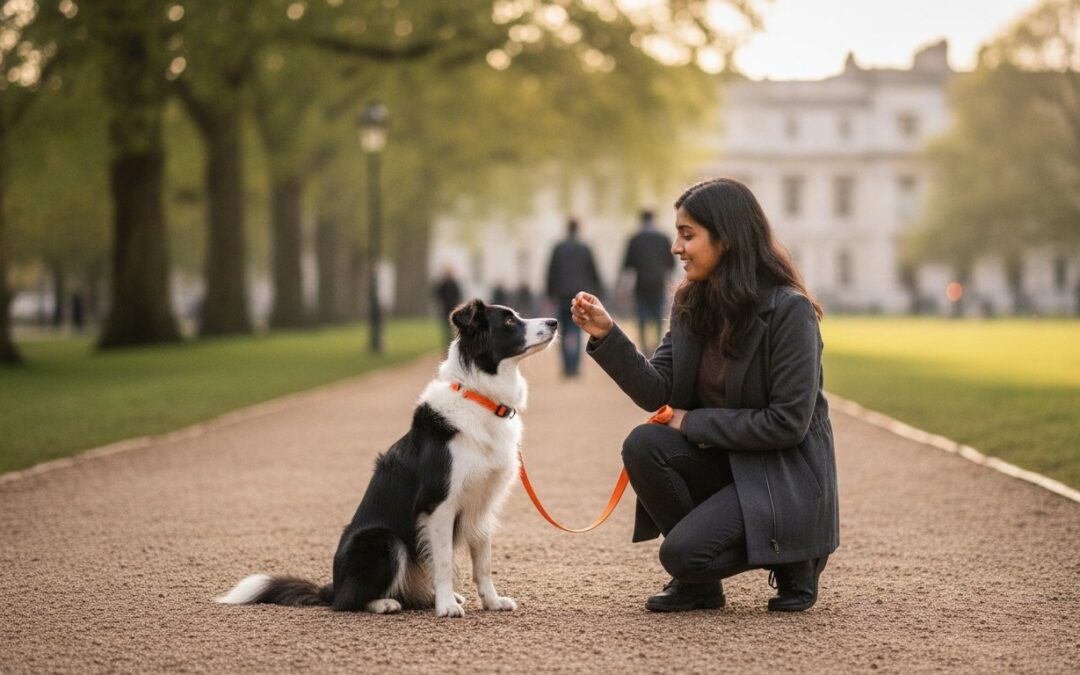
Imagine standing on a bustling Watford High Street, your arm aching as your dog lunges toward every passing scent while you feel a flush of embarrassment rising. You’ve likely been told that you need to be the “alpha” or assert more dominance to gain control, but this outdated advice often creates more anxiety than it solves. It’s frustrating to feel like your dog is ignoring you, especially when you’re worried about their safety during an off-lead walk in Cassiobury Park. You deserve a relationship built on mutual respect rather than fear or confusion.
This guide will show you how to transform those stressful outings into moments of calm connection through ethical, evidence-based dog training Watford residents can use to see real results. We’ll explore how shifting from coercive force to a partnership-based approach ensures a reliable recall and a peaceful, cooperative lifestyle at home. By understanding the science of how dogs actually learn, you’ll discover a clear, manageable path toward a well-adjusted companion who can navigate any local environment with confidence. It’s time to move past the noise of conflicting theories and focus on what truly works for your dog’s emotional health.
Key Takeaways
- Understand why moving beyond “dominance” theories to science-based partnership creates a deeper, more reliable bond with your dog.
- Master the art of dog training Watford owners need to navigate high-distraction environments like bustling parks and busy roads with confidence.
- Demystify the principles of positive reinforcement to understand the underlying motivations behind your dog’s choices and actions.
- Identify the safety-critical skills every urban dog needs and why starting in a low-distraction environment is the key to long-term success.
- Explore why bespoke 1-to-1 sessions offer a more effective, tailored alternative to generic group classes for addressing specific behavioural challenges.
Modern Dog Training in Watford: Moving Beyond Dominance
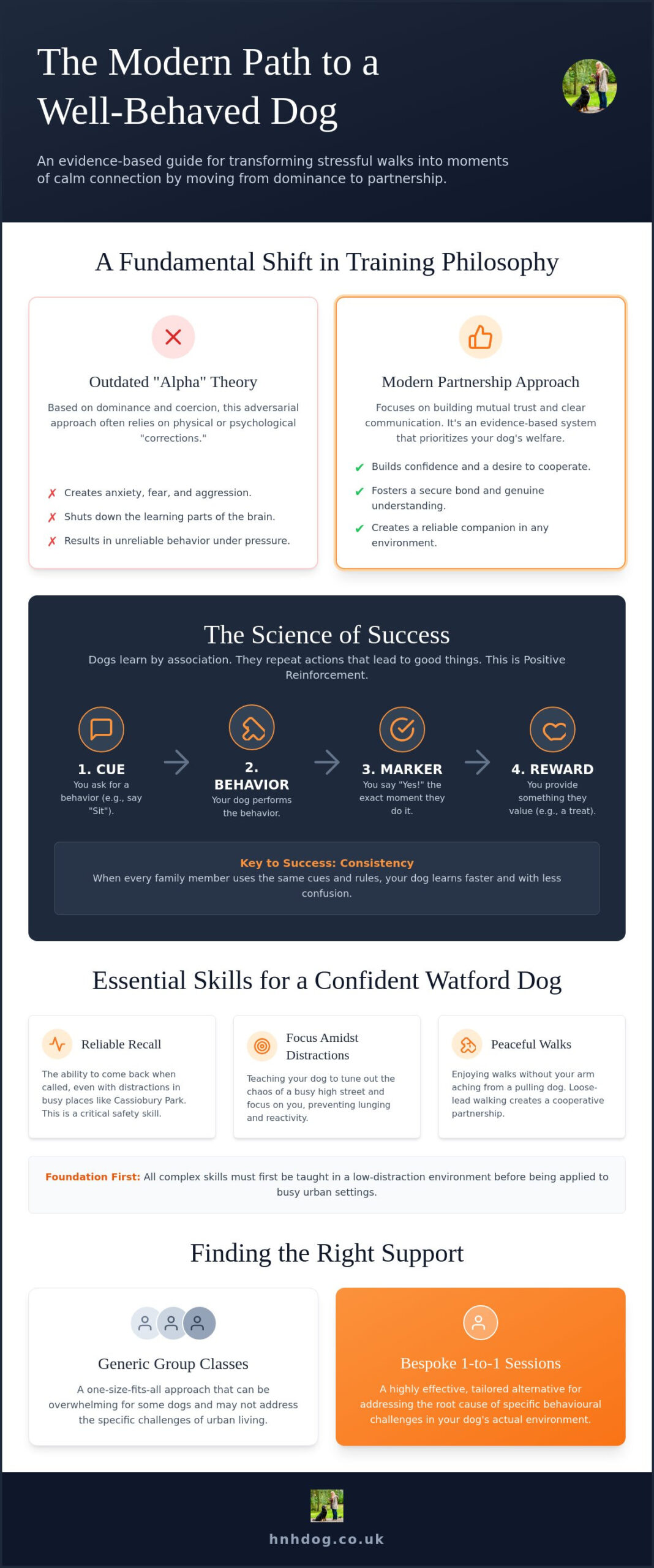
Modern dog training isn’t about imposing your will; it’s about establishing a clear, functional dialogue with your companion. For decades, the industry was clouded by the idea that owners needed to be “alpha” or “pack leaders” to see results. This adversarial approach is now being replaced by evidence-based systems that prioritise your dog’s welfare and cognitive abilities. When you look for dog training Watford, you’re likely seeking more than just a dog that sits on command. You’re looking for a partner that can navigate a busy town centre or a crowded park without losing their focus or their cool. Dog training is the process of building mutual understanding through reinforcement.
Transitioning from “pack leader” myths to partnership-based learning is a significant shift that benefits both ends of the lead. Understanding How Dogs Learn allows us to move away from outdated guesswork and toward methods that actually work. When you choose a partnership-based approach, you aren’t just teaching a command; you’re fostering a genuine willingness to cooperate. Ethical methods are inherently more reliable for long-term behaviour because they don’t rely on the presence of a threat. A dog that performs because they find the interaction rewarding is far more consistent in high-pressure situations than one that performs simply because they are afraid not to.
The Problem with Outdated “Alpha” Theories
Dominance-based training often relies on physical or psychological “corrections” that can inadvertently increase a dog’s anxiety and aggression. If a dog is constantly scanning their environment for signs of conflict, they can’t focus on the task at hand. Fear triggers the “fight or flight” response, which effectively shuts down the parts of the brain responsible for processing new information. Under modern animal welfare standards in the UK, we recognise that psychological well-being is as vital as physical health. Using methods that cause distress isn’t just outdated; it’s counterproductive to creating a calm, urban-ready companion.
Building Trust as the Foundation of Learning
A secure bond is the most powerful tool in your training kit. When your dog trusts you, their response times to cues naturally improve because they aren’t second-guessing your intentions or reacting out of self-preservation. It’s helpful to remember that your dog’s internal emotional state matters far more than their outward physical action. If they sit while trembling with stress, the “sit” hasn’t truly been mastered. For those dealing with more complex emotional challenges, seeking a Dog Behaviourist London can provide the deep-level support needed to repair trust and build a dog training Watford plan that truly lasts.
The Science of Success: How Your Dog Actually Learns
Effective dog training Watford owners can rely on is rooted in a branch of science called operant conditioning. While that sounds academic, the concept is simple: dogs repeat behaviours that produce a favourable outcome. When your dog sits and receives a piece of chicken, they learn that sitting is a “winning” move. This isn’t magic; it’s a logical communication system that allows your dog to make better choices. By focusing on how your dog’s brain actually processes information, we move away from the guesswork of old-fashioned methods and toward a reliable, predictable partnership.
In the world of behavioural science, there are technically four “quadrants” of learning. However, modern ethical training focuses heavily on positive reinforcement. This involves adding something your dog values to increase the likelihood of a behaviour happening again. It is the gold standard for animal welfare because it builds confidence rather than suppressing personality through fear. To make this communication precise, we use “markers” such as a clicker or a specific verbal cue like “Yes!” These markers act as a bridge, telling your dog exactly which millisecond of behaviour earned the reward. This level of clarity is particularly useful in busy urban settings where distractions are constant and timing is everything.
Success also depends on household consistency. If one person says “sit” while another says “sit down,” your dog is essentially trying to learn two different languages at once. When every family member uses the same cues and follows the same rules, your dog’s progress in dog training Watford sessions will accelerate. If you’re finding it difficult to get everyone on the same page, a 1-to-1 training session can help establish a unified plan that works for the whole family.
Positive Reinforcement: Reward vs. Bribery
A common concern is that using treats is simply “bribery.” There is, however, a vital distinction: a bribe is shown to the dog before the behaviour to coax them into doing it, whereas a reward follows the behaviour as a paycheck. To build reliability, we use Positive Reinforcement Techniques to reinforce the action after it occurs. In challenging environments like a busy high street, you might use high-value rewards like roast beef or a favourite toy. As the behaviour becomes a habit, we gradually fade out the food rewards, moving to an intermittent schedule that keeps the dog’s focus sharp.
Understanding Motivation and Drive
Every dog is an individual with unique preferences. While many are food-motivated, others might find a game of tug or the chance to sniff a specific tree more rewarding. Understanding these nuances allows us to use the Premack Principle, which suggests that a high-probability behaviour (like sniffing) can reinforce a low-probability behaviour (like walking on a loose lead). Motivation is the “engine” of any successful training programme. By identifying what truly drives your dog, you can turn the environment from a series of distractions into a powerful set of rewards.
Navigating Training Challenges in Busy Urban Environments
Living in Watford presents a unique set of challenges for any dog. From the darting squirrels in local woods to the heavy traffic and high footfall of the High Street, the environment is a constant source of sensory input. Many owners find themselves frustrated because their dog is a “star pupil” in the quiet of a living room but becomes unreachable the moment they step outside. This isn’t a lack of intelligence or “dominance” on the dog’s part. It’s simply a lack of “proofing,” where the dog hasn’t yet learned that a cue like “sit” means the same thing in a busy town centre as it does in a silent garden. Effective dog training Watford sessions must bridge this gap by gradually introducing distractions at a pace the dog can handle.
It’s helpful to understand a concept called “Trigger Stacking.” This occurs when several small stressors pile up until the dog’s emotional bucket overflows. A loud bus, a passing cyclist, and then a barking dog might be too much to handle, even if the dog is usually fine with each event individually. When a dog is “stacked,” their ability to process new information effectively shuts down. Aligning with AVSAB’s humane training guidelines, we manage these urban stressors by keeping the dog under their threshold. This ensures they feel safe enough to remain in a learning state rather than a reactive one. Managing your own expectations is also vital; a dog that is stressed by the crowds on Watford High Street isn’t being “naughty,” they are simply overwhelmed.
Training for the “Real World” of North London
Training for the real world means moving beyond the basics. On the narrow pavements of North London, lead reactivity can become a major hurdle when you cannot easily move away from other dogs. We focus on creating a “bubble” of safety for your dog through careful management and redirection. It’s also vital to distinguish between socialisation and exposure. Simply taking a dog to a busy park and letting them be overwhelmed by other dogs isn’t training. True socialisation involves creating positive, calm associations at a distance the dog can comfortably manage. This prevents the development of fear-based behaviours that often lead to more significant issues later.
Overcoming Age Myths: Training Senior Dogs
Don’t let age be a barrier to progress. The idea that you can’t teach an old dog new tricks is a harmful misconception that limits a pet’s potential. Senior dogs benefit immensely from the mental stimulation provided by dog training Watford programmes, which can actually help stave off cognitive decline. We adapt the physical requirements for dogs with reduced mobility or sensory decline, focusing on scent work or gentle trick training that doesn’t strain their joints. Lifelong learning is a core component of maintaining a high quality of life and a strong emotional bond for any dog, regardless of their age.
Essential Skills for Every Watford Dog: A Step-by-Step Guide
To succeed in dog training Watford, we must prioritise the skills that keep your dog safe and composed in a high-density environment. It is often tempting to head straight to the busiest park to test your progress, but any new behaviour must first be “whisper-quiet” at home before it can be “shout-loud” in public. By starting in a low-distraction environment, you allow your dog to master the mechanics of a cue without the emotional pressure of external triggers. This layered approach ensures that when you do eventually face the bustle of the town centre, the foundation is already solid.
A helpful way to manage this progression is by understanding the “3 Ds” of training: Distance, Duration, and Distraction. Distance refers to how far you are from your dog; Duration is how long they can hold a behaviour; and Distraction is the complexity of the environment. The golden rule is to only increase one of these at a time. If you are moving from your hallway to a local green space, you have significantly increased the Distraction. To compensate, you should decrease the Distance and Duration required for a successful “win.” For those starting with a younger pet, our guide to Puppy Training in London offers a deeper dive into these foundational habits.
The Reliable Recall: Safety in Cassiobury Park
A dependable recall is the ultimate safety net for any dog owner. In a space as large and varied as Cassiobury Park, you need to know your dog will return regardless of what is happening around them. We follow a three-step process to build this reliability:
- Step 1: Build a “super-cue” using a unique word or whistle that is never used for anything else. This cue must always result in the highest-value reward your dog can imagine, such as fresh chicken or a favourite game of tug.
- Step 2: Use a long-line lead to bridge the gap between “on-lead” and “off-lead.” This allows your dog to feel a sense of freedom while ensuring you can still prevent them from practising the “ignore” response.
- Step 3: Gradually introduce environmental distractions, such as distant dogs or moving water, only once the response is 100% reliable in a quiet field.
Loose-Lead Walking on Watford Pavements
Dogs don’t pull because they want to be “alpha” or dominate the walk. They pull because they move faster than we do and the world is full of interesting scents. To change this, we teach the dog that a tight lead is a red light that stops all progress. When the lead goes slack, the “engine” starts again. Choosing the right equipment is also vital. A well-fitted Y-shaped harness is often far more effective than a collar for dog training Watford walks. It removes pressure from the sensitive neck area and allows the dog to move naturally, which significantly reduces frustration and lead-related tension.
For personalised support in mastering these urban essentials, our 1-to-1 dog training provides a bespoke environment for your dog to learn without the pressure of a group class.
Bespoke Support: 1-to-1 Dog Training with H&H Dog
At H&H Dog, our philosophy is rooted in the belief that every dog is an individual with a unique emotional landscape. Led by Roland, an IMDT-certified trainer with over 20 years of professional experience, we move away from generic, mass-market models. Our approach prioritises a sophisticated blend of professional authority and warm encouragement, ensuring that your dog’s perspective is always respected. When you choose dog training Watford services with us, you aren’t just hiring a trainer; you’re gaining a knowledgeable mentor invested in your peace of mind and your dog’s long-term welfare.
While group classes have their place, 1-to-1 training often yields significantly faster results for urban dogs. In a group setting, the presence of other dogs can act as a constant distraction, making it difficult for your pet to focus on new concepts. Private sessions allow us to tailor the pace and environment to your dog’s specific needs, addressing challenges exactly where they occur. We understand the local geography of Watford and North London intimately. Whether you’re struggling with lead tension on the way to the shops or a lack of focus in the local park, we provide practical solutions that work in the real world.
Why a Personalised Plan is Essential
A bespoke plan is vital because it accounts for your dog’s specific temperament and your personal lifestyle. We don’t expect you to fit into a rigid curriculum. Instead, we offer flexible scheduling designed to accommodate the busy lives of London and Watford professionals. Our process typically begins with an in-home assessment. Seeing your dog in their natural environment allows us to identify the underlying motivations behind their actions without the added stress of a strange location. This logical, step-by-step progression ensures that improvement feels inevitable rather than a struggle of wills.
A Holistic Approach to Canine Wellbeing
We believe that training is just one pillar of a happy, well-adjusted life. Our services are designed to integrate seamlessly, creating a holistic support system for your pet. For instance, the confidence built during our sessions can lead to much more positive experiences with Mobile Dog Grooming in Watford, where a calm dog is a safer dog. Similarly, mastering urban focus ensures your pet is fully prepared for the social dynamics of Professional Dog Walking in London. By looking at the “whole dog,” we ensure that the progress you make in dog training Watford sessions carries over into every aspect of their daily routine.
Ready to build a deeper bond of trust with your companion? Enquire about a bespoke training session today and take the first step toward a more harmonious life together.
Transforming Your Relationship Through Modern Partnership
Building a life of mutual understanding with your dog doesn’t have to be a battle of wills. We’ve explored how moving beyond outdated dominance myths and embracing positive reinforcement creates a dog that listens because they want to, not because they’re afraid. By focusing on essential urban skills and managing the unique stressors of our local environment, you can enjoy stress-free walks from the High Street to the quietest corners of Cassiobury Park.
Achieving this level of calm requires a tailored approach that respects your dog’s individual temperament. As a local expert serving the North London community, Roland brings IMDT-certified expertise and over 20 years of professional experience to every session. Whether you’re working with a spirited puppy or a senior companion, our personalised 1-to-1 plans provide the steady hand you need to navigate the challenges of dog training Watford residents face daily. Every challenge has a manageable, ethical solution when you have the right guidance.
You deserve a relationship built on trust and clear communication. Enquire about 1-to-1 Dog Training in Watford today to begin your journey toward a more harmonious life together. Your dog is ready to learn; it’s time to show them the way with kindness and confidence.
Frequently Asked Questions
How long does it typically take to see results from dog training?
You’ll often see initial progress within the very first session, but establishing long-term, reliable habits typically takes several weeks of consistent practice. Every dog is an individual; factors like age, previous history, and the complexity of the behaviour all play a role. Short, daily sessions of 15 minutes are far more effective for cementing new skills than one long weekly session.
Is my dog too old to start an obedience training programme?
No dog is ever too old to benefit from a structured learning programme. While physical exercises may need to be adapted for mobility or sensory decline, mental stimulation is vital for cognitive health in older pets. Training provides a sense of purpose and can significantly improve the quality of life for senior dogs by keeping their minds active and engaged.
What is the best age to start puppy training in Watford?
You can begin dog training Watford sessions as soon as your puppy arrives home, typically around eight weeks of age. This early window is critical for positive exposure and building foundational communication before they reach adolescence. Focusing on gentle, reward-based habits during this formative period helps prevent common behavioural issues from developing as they mature.
Do I need to use treats for the rest of my dog’s life?
You won’t need to carry a pocket full of treats forever, but you should always be prepared to reinforce your dog’s good choices. Once a behaviour is reliably mastered, we move to an intermittent reinforcement schedule. This means you reward randomly, which actually makes the behaviour stronger, though high-distraction environments will always require a higher “paycheck” to ensure success.
How much does professional dog training cost in the Watford area?
In the Watford area, professional training costs vary depending on the format and expertise required. Industry data from 2025 suggests that private 1-to-1 sessions typically range from £50 to £120 per hour, while group puppy courses often cost between £100 and £200 for a multi-week programme. Some local providers may offer specific assessment sessions at different rates to establish a bespoke plan.
What should I do if my dog is aggressive towards other dogs on walks?
The first step is to increase the distance between your dog and the trigger to keep them under their emotional threshold. Management is key to preventing the behaviour from being practised and reinforced. Seeking professional support is essential for identifying the underlying motivation, whether it’s fear or frustration, and developing a safe, ethical desensitisation plan.
Can 1-to-1 training help with separation anxiety?
Yes, 1-to-1 training is highly effective for separation anxiety because it allows for a detailed assessment of your dog’s specific triggers within their home environment. Unlike a group class, private sessions focus on a bespoke desensitisation and counter-conditioning protocol. This gradual process helps your dog feel safe when left alone, building their confidence through manageable, incremental steps.
What equipment do I need to bring to a dog training session?
For a productive dog training Watford session, you should bring a well-fitted Y-shaped harness, a standard lead, and a variety of high-value rewards. Using a mix of treats, such as small pieces of cheese or boiled chicken, helps maintain high motivation. If you’re working on recall in public spaces, a 5-metre or 10-metre long-line is also a valuable tool for ensuring safety.