
What if the secret to a reliable dog isn’t the total hours spent drilling commands, but the quality of the communication you build in the quiet moments? It’s frustrating to feel you’re falling behind, especially when your dog ignores you in a busy park. You might feel a sense of embarrassment or wonder why progress feels so slow. You’re likely asking, how long does it take to train a dog, while searching for a clear path through the confusion. With 33% of owners struggling to complete their recommended training programmes, having a realistic schedule is vital for your success.
We understand that every dog is an individual with a unique temperament. This guide offers a realistic roadmap, stripping away the myths to reveal the honest timelines you can expect when using supportive, non-coercive methods. We’ll explore the factors that influence learning speed, from urban distractions to emotional well-being. By the end, you’ll have a predictable timeline for specific behaviours and the confidence to foster a partnership based on mutual respect. We’ll look at how consistent, bite-sized sessions lead to lasting results in as little as four to six months.
Key Takeaways
- Shift your perspective from teaching isolated tricks to building a shared language, which is the first step in answering how long does it take to train a dog.
- Identify the core factors, such as consistency and breed-specific motivations, that either accelerate or hinder your progress.
- Master the art of generalisation to ensure your dog listens as reliably in a crowded park as they do in your own kitchen.
- Navigate a realistic roadmap that transitions from foundational engagement in the first four weeks to intermediate skills by month three.
- Explore how bespoke 1-to-1 guidance can fast-track your success by addressing individual temperaments and subtle body language cues.
The “How Long” Question: Why Dog Training Timelines Vary
Training is far more than stopping unwanted behaviours; it’s the sophisticated process of building a shared language between you and your dog. When you ask, how long does it take to train a dog, you’re really asking how long it takes to establish clear, reliable communication through reinforcement. This journey involves more than just physical actions. It’s about emotional connection and mutual respect. Understanding fundamental Dog training principles helps you see that training is an ongoing dialogue rather than a one-off task.
There’s a significant difference between a dog “knowing” a trick and exhibiting reliable obedience. Your dog might sit for a treat in your kitchen in seconds, but performing that same action while a squirrel runs past in a North London park requires a different level of psychological commitment. Reliability is earned through repetition in various environments. The answer to how long does it take to train a dog often depends on this transition from simple understanding to automaticity.
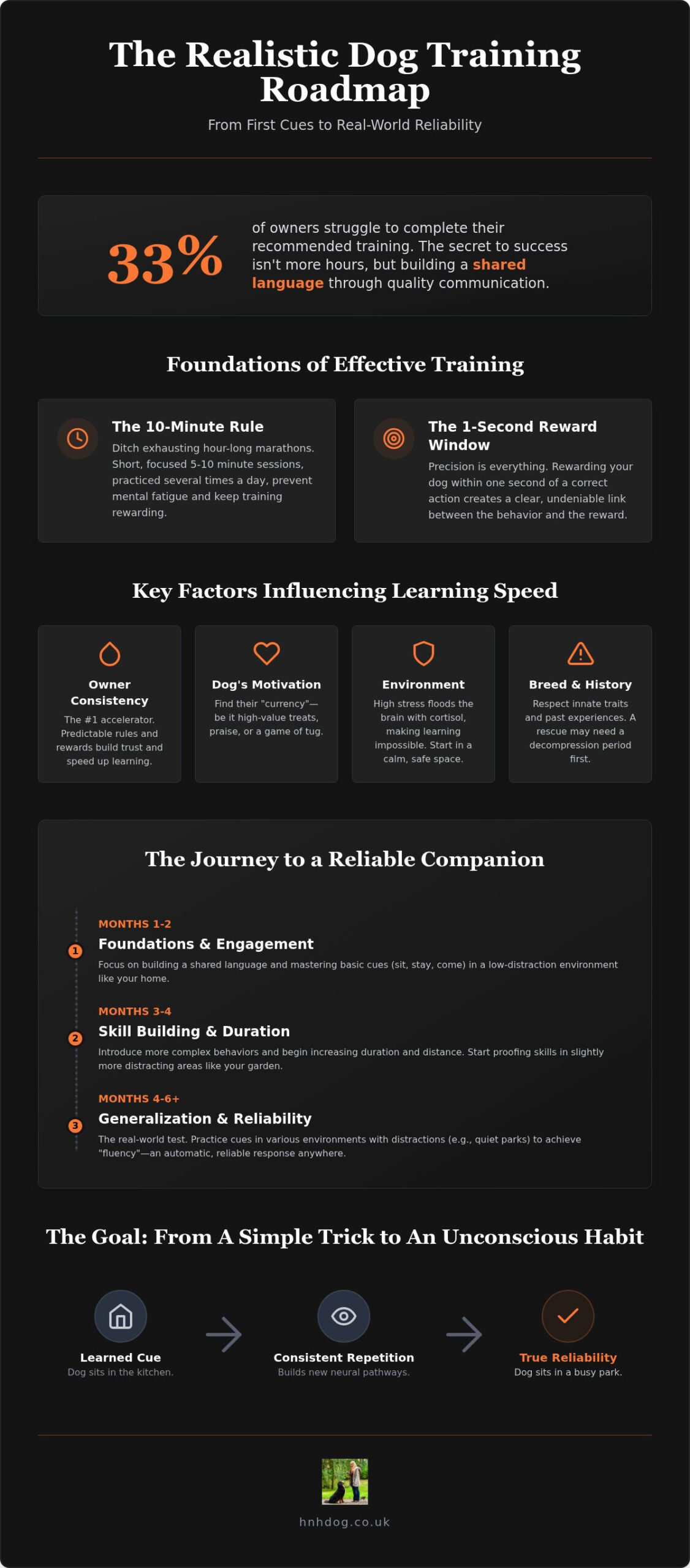
Progress often accelerates when you ditch hour-long marathons for the “10-minute rule”. Dogs have limited attention spans, especially when learning complex new concepts. Short, focused sessions of five to ten minutes, practised several times a day, prevent mental fatigue. This approach keeps the experience rewarding for both of you. It’s the consistency of these small moments that builds a solid foundation.
Manage your expectations by looking at your dog’s heritage. A Labrador, bred for cooperative work, might seem to learn faster than a Terrier, whose independent nature was prized for solo hunting. Neither dog is “smarter” than the other. They simply have different internal motivations that dictate their learning pace. Respecting these innate traits allows for a more empathetic training experience.
The Distinction Between Cues and Habits
Learning a new physical movement, like a “down” or “sit”, can happen in minutes. However, turning that specific cue into an automatic habit takes weeks of consistent repetition. We define “fluency” in dog training as the stage where a dog responds to a cue immediately and correctly without hesitation, regardless of the surrounding distractions. It’s the transition from conscious thinking to unconscious doing. This stage requires patience as the brain builds new neural pathways through positive reinforcement.
The Role of Age and History
Puppies are often described as “clean slates”, but adult dogs bring their own advantages, such as longer focus periods and a calmer baseline. If you’ve adopted a rescue, it’s vital to allow for a “decompression” period. This is a quiet time for the dog to feel safe in their new environment before formal training starts. The idea that you can’t teach an old dog new tricks is a persistent myth. Older dogs can learn beautifully; they may just need to unlearn old habits first, which requires a little extra time and customised care.
Core Factors Influencing Your Dog’s Learning Speed
While the question of how long does it take to train a dog is common, the answer depends heavily on the environment and the human at the other end of the lead. Learning speed is rarely a straight line. It is influenced by a combination of your consistency, your dog’s genetics, and their emotional state. If any of these pillars are unstable, progress will inevitably stall. It is vital to distinguish between simply learning a cue and the deeper work of behavioural modification; the former is a cognitive task, while the latter involves changing an underlying emotional response.
Consistency acts as the primary accelerator. If you reward a behaviour one day but ignore it the next, your dog receives conflicting data. This confusion creates hesitation. Motivation is equally vital. You must find your dog’s unique “currency”. For some, it is a piece of high-value chicken; for others, it is a brief game of tug or a calm word of praise. Without a meaningful reward, the dog has no logical reason to repeat the action.
Environmental stress is a frequently overlooked decelerator. When a dog is over-threshold or anxious, their brain is flooded with cortisol. This physiological state makes it physically impossible for them to process new information or “learn” in the traditional sense. Creating a safe, low-stress space is the prerequisite for any successful session. If your dog is struggling to focus, it is often a sign that the environment is too demanding for their current emotional state.
Owner Consistency and Timing
Precision is everything in communication. The “1-second reward window” is the gold standard for reinforcement. If the reward arrives too late, the dog may associate it with a different action entirely. Progress often falters when different family members use varying cues or reward different standards. This is why professional one-to-one puppy training is so effective. It ensures everyone in the household is following the same ethical, clear-cut protocol, preventing the mixed signals that stall development.
Biological and Breed Predispositions
Every dog is “built” for a specific purpose. High-drive breeds like Border Collies or German Shepherds often grasp new cues rapidly because they are genetically predisposed to cooperate with humans. Independent breeds, such as Akitas or Hounds, may require more patience and creative motivation. Following a Realistic Training Roadmap helps you align your expectations with these biological realities rather than fighting against them.
Health and nutrition also play a quiet but significant role in cognitive function. A dog that is uncomfortable or lacking essential nutrients will struggle to maintain focus. Tailoring your session length to your dog’s natural attention span ensures you always end on a successful note. If you’re feeling overwhelmed by slow progress, a behavioural consultation can help identify these hidden roadblocks and provide a bespoke path forward.
Command vs. Reliability: Training for the Real World
Many owners experience the “Kitchen Phenomenon”: the baffling moment your dog performs a perfect “stay” in your quiet home but seems to have forgotten their own name at the local park. This isn’t a sign of stubbornness or a lack of intelligence. Instead, it’s a natural result of how dogs learn. They are context-specific learners, meaning a cue learned in the living room doesn’t automatically translate to a busy street. Generalisation is the process of teaching your dog that “Stay” means the same thing regardless of whether you’re in the hallway or outside a bustling café.
When asking how long does it take to train a dog, you must factor in the time required for “proofing”. This is the stage where you move from teaching the movement to ensuring reliability in the real world. According to realistic dog training timelines, while a basic cue can be understood in a few days, achieving true reliability amidst distractions often takes several months of consistent practice. This phase is about building a dog’s confidence and focus, ensuring they feel safe enough to listen when the world gets loud.
Mastering the Three Ds
To bridge the gap between the kitchen and the park, we use the Three Ds: Distance, Duration, and Distraction. The secret is to increase only one of these variables at a time. If you’re working on a “down,” start by asking for a few seconds of duration in your hallway. Once that’s solid, move to the garden, but reduce the duration to make it easier. If a dog fails, the distraction level was too high for their current skill level. By gradually layering these challenges, you prevent frustration and ensure your dog always feels successful and supported in their learning journey.
Urban Proofing in London and Watford
Training in high-density areas like North London or Watford requires a specific level of proofing that rural training rarely demands. On narrow pavements, your dog needs the emotional resilience to ignore passing lorries, cyclists, and other pedestrians. We focus on building “neutrality,” where your dog can observe the world without feeling the need to react or investigate every stimulus. Achieving a reliable recall in open spaces like Cassiobury Park or Hampstead Heath is the ultimate goal. This level of reliability ensures your dog’s safety and your peace of mind, allowing you both to enjoy the vibrancy of city life without stress or embarrassment.
The Realistic Training Roadmap: From Foundations to Mastery
Training your dog is a structured progression rather than a single event. When considering how long does it take to train a dog, it helps to view the journey in distinct phases that respect the animal’s developmental needs. This roadmap provides a realistic timeline for most dogs, though individual temperaments will always dictate the final pace. Progress isn’t always linear; you may find some weeks feel like a leap forward, while others require a step back to reinforce the basics.
The First 30 Days: Building the Bond
The initial month is dedicated to building a foundation of trust and engagement. We recommend using hand-feeding during your daily interactions to create a powerful association between your presence and positive outcomes. This teaches your dog that you’re the most interesting and rewarding part of their world. During this period, focus on setting up the environment for success by using crates, baby gates, or tethers to prevent unwanted habits. Your primary goals for these first 30 days are the “Big Three”:
- Engagement: Building a strong desire to focus on you.
- Name Recognition: Ensuring an immediate head-turn when called.
- Basic House Rules: Establishing clear boundaries for a harmonious home life.
During the second and third months, you move into the intermediate phase. This is where you layer in duration and mild distractions. You aren’t just asking for a “sit” in a quiet room anymore. Instead, you’re asking for a “sit” while you open the front door or while a family member walks past. By month four to six, your dog should be ready for advanced work in public spaces, eventually moving toward reliable off-lead work in secure environments. This is the stage where the “proofing” discussed earlier becomes the central focus of your sessions.
6 Months and Beyond: The “Polished” Dog
By the six-month mark, your dog may appear “polished,” but they are also entering the complex adolescent phase, which typically lasts from 6 to 18 months. During this time, hormonal changes can cause a temporary regression in focus and obedience. It’s vital to transition from constant rewards to intermittent reinforcement to keep behaviours sharp. If you find that progress has plateaued or old issues are resurfacing, behavioural consultations offer the professional “eye” needed to navigate these developmental shifts and provide a bespoke path forward.
Training is a lifelong subscription rather than a one-time purchase. Even once your dog listens reliably in busy North London parks, regular “top-up” sessions prevent skills from fading. This ongoing engagement keeps your bond strong and ensures your dog remains a confident, well-adjusted companion throughout their life. To ensure you’re using the most effective, ethical methods for your dog’s unique personality, consider professional expert support to guide your long-term success.
Accelerating Progress through Personalised Professional Guidance
Choosing the right professional support can dramatically alter the answer to how long does it take to train a dog. While group environments offer basic social exposure, 1-to-1 sessions often fast-track progress by up to three times compared to traditional classes. This efficiency stems from a completely bespoke approach that avoids generic templates in favour of your dog’s specific emotional state and learning pace. A professional “eye” identifies subtle micro-expressions and body language cues that most owners miss, ensuring you never push your dog beyond their threshold or cause unnecessary frustration.
A mentor provides a steady hand in what can often feel like a chaotic situation. By focusing on your specific London lifestyle, professional guidance ensures that the skills you practice are the ones you actually need. Whether it’s navigating the narrow pavements of North West London or achieving a calm “settle” in a local café, personalised training targets your real-world challenges. This focused attention prevents the common owner mistakes that often lead to stalled progress or confusion for the animal.
The H&H Dog Approach: Bespoke 1-to-1 Training
Our methodology prioritises identifying the root cause of behaviours rather than just suppressing outward symptoms. By conducting assessments in your real-world environment, such as your home or local parks in Watford and North London, we ensure the training is practical and relevant. This mentorship builds your confidence as much as your dog’s, giving you the skills to handle any situation with calm authority. We believe in advocacy for the animal, ensuring their perspective is always respected throughout the learning process.
Integrating Training into Daily Life
Training thrives when it becomes a seamless part of every mealtime and walk, rather than a chore you tick off once a week. Consistency is easier to maintain when you have a support system in place. Services like group dog walking can play a vital role here, reinforcing social manners and providing consistent reinforcement even when you aren’t present. This holistic approach ensures that the shared language you’ve built becomes a permanent habit.
Your journey toward a reliable, happy companion doesn’t have to be a stressful one. With the right ethical, evidence-based guidance, you can move from frustration to confidence in a matter of months. If you’re ready to see real progress and foster a deeper bond with your dog, we are here to provide the steady hand you need. Book a personalised training session in London or Watford today.
Your Path to a Confident Urban Companion
Achieving a dog that listens reliably in the bustling streets of London or the parks of Watford is a journey of mutual understanding. We’ve explored how training is less about drilling commands and more about building a shared language through consistent, positive reinforcement. While a solid foundation typically takes four to six months, the bond you cultivate during this time is what ensures long-term success. Understanding the Three Ds and respecting your dog’s individual temperament allows you to move at a pace that prioritises their emotional well-being.
When you ask, how long does it take to train a dog, remember that the most reliable results are built on trust rather than force. With over 20 years of experience in canine behaviour, we specialise in creating personalised plans tailored to the unique challenges of urban life. Our ethical, evidence-based methods are designed to fast-track your progress while keeping the animal’s perspective at the heart of every session. You don’t have to navigate this process alone. A steady, professional hand can turn frustration into a harmonious shared life. Book an Expert 1-to-1 Dog Training Session in London or Watford and start your journey today. Your dog is ready to learn; it’s simply a matter of starting the conversation.
Frequently Asked Questions
How many hours a day should I train my dog?
You should aim for short, frequent sessions of five to ten minutes rather than hour-long marathons. Dogs process information best in bite-sized chunks that prevent mental fatigue. Practising three to four times a day keeps the learning fresh without causing frustration. This approach respects your dog’s attention span and ensures training remains a positive, rewarding part of your daily routine. Consistency in these small moments builds lasting habits far more effectively than occasional long drills.
Is it too late to train a 5-year-old dog?
It’s never too late to start training; dogs are capable of learning at any age. While a five-year-old dog may have established habits, they also possess a longer attention span and more emotional stability than a puppy. The key is using ethical, positive methods that motivate them to change their focus. Whether you are addressing a specific issue or teaching new skills, adult dogs often thrive with the mental stimulation that comes from professional 1-to-1 training.
How long does it take to potty train a puppy in a London flat?
Potty training in a London flat typically takes between four and six months to achieve full reliability. The physical distance to a suitable outdoor spot, such as using a lift or stairs, adds a layer of complexity that requires extra vigilance. You must establish a strict routine and reward every success immediately. Using a consistent schedule helps your puppy understand the expected shared language, even in a high-density urban environment where outdoor access isn’t immediate.
Why does my dog listen at home but not in the park?
This common challenge occurs because dogs are context-specific learners who struggle with generalisation. Your home is a low-distraction environment where your dog feels safe and focused. The park, however, is filled with competing motivations like squirrels, other dogs, and novel scents. To bridge this gap, you must gradually increase the distraction level. This process is a key part of answering how long does it take to train a dog, as “proofing” behaviours in public takes time and patience.
How long does it take to fix leash reactivity?
Fixing leash reactivity is a gradual process that typically requires several months of consistent behavioural modification. Since reactivity is often rooted in fear or over-arousal, you aren’t just teaching a command; you’re changing an underlying emotional state. Progress depends on your dog’s history and your ability to manage their environment. Specialist behavioural consultations provide the bespoke strategies needed to help your dog feel safe and neutral when encountering triggers on busy London pavements.
Can I train my dog myself or do I need a professional?
You can certainly teach basic house rules yourself, but a professional offers a steady hand for complex challenges. An expert “eye” spots subtle body language cues that indicate stress or confusion, preventing common owner mistakes. Professional 1-to-1 training fast-tracks your progress by providing a bespoke roadmap tailored to your specific lifestyle. This mentorship builds your confidence, ensuring you have the right tools to foster a lifelong partnership based on mutual respect and ethical communication.
How long does it take to teach a dog reliable recall?
Teaching a reliable recall usually takes four to six months of dedicated practice in various environments. It begins with simple engagement in your garden before moving to high-distraction areas like North London parks. True reliability means your dog chooses to return to you even when something exciting is happening. This skill requires a high-value “currency” and a relationship built on trust. Consistent reinforcement ensures the response becomes an automatic habit rather than a conscious choice for the dog.
What happens if my dog regresses in their training?
Regression is a normal part of the learning process, particularly during the adolescent phase between six and eighteen months. If your dog suddenly “forgets” their training, it is often a sign of developmental shifts or environmental stress. The best approach is to pause, lower your expectations, and return to foundational exercises. This isn’t a failure; it’s an opportunity to reinforce the basics. A professional behavioural consultation can help you identify the root cause and adjust your roadmap accordingly.