
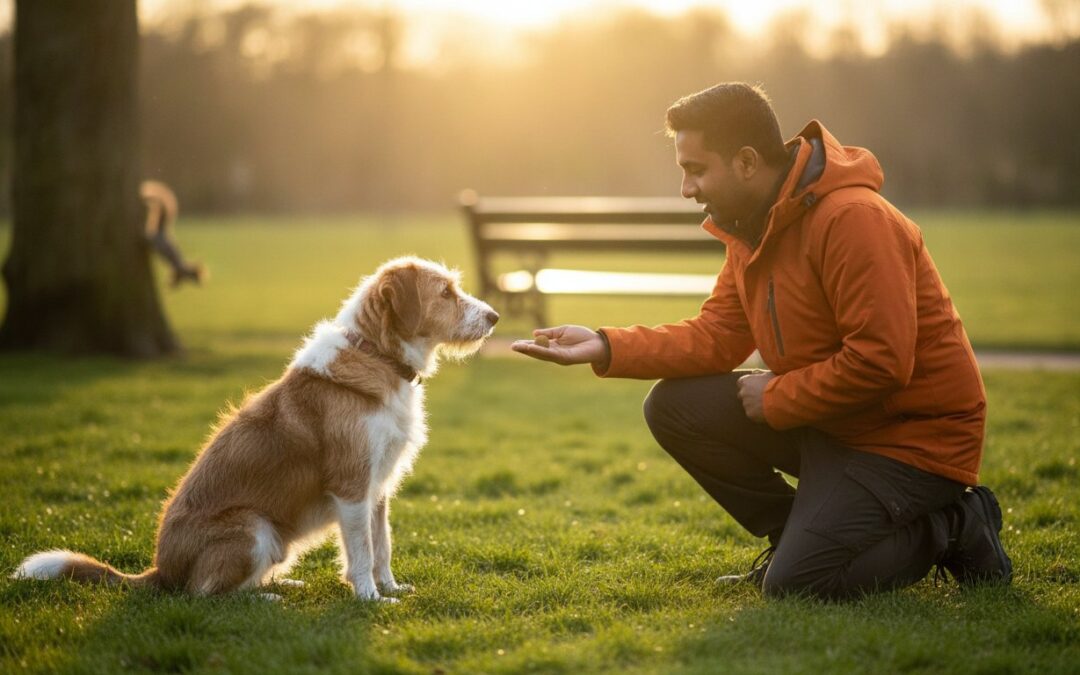
Imagine you’re enjoying a crisp morning walk through Gladstone Park when your dog spots a squirrel and suddenly lunges, nearly pulling you off your feet. You feel the sting of embarrassment as other walkers skirt around you, and that familiar wave of frustration rises because your dog simply cannot “switch off” in the face of excitement. It’s a common struggle for many owners in North West London, where the density of distractions makes impulse control games for dogs a vital part of everyday training. You aren’t alone in feeling that your dog’s ears stop working the moment their paws hit the grass.
The solution isn’t about more force or tighter leads; it’s about teaching your dog how to manage their own internal dial. This guide will walk you through ethical, evidence-based activities designed to build your dog’s mental “brakes” and transform reactive moments into opportunities for focus. We’ll explore how to move from simple kitchen-floor exercises to achieving real-world reliability in busy urban environments, ensuring your walks become the peaceful, shared experiences you both deserve.
Key Takeaways
- Understand that inhibitory control is a cognitive skill that allows your dog to resist distractions in favour of calmer, more deliberate outcomes.
- Master structured impulse control games for dogs that build a reliable “mental brake” system, starting in the home and progressing to the park.
- Discover how the “Look at That” technique can help you manage high-arousal triggers like squirrels or cyclists with calm confidence.
- Learn to identify the most effective rewards for your individual dog, ensuring that training remains a positive, ethical, and supportive partnership.
- Recognise when to seek professional 1-to-1 training to bridge the gap between simple games and consistent real-world reliability in busy environments.
Understanding Canine Impulse Control: Why Your Dog Struggles to ‘Stop and Think’
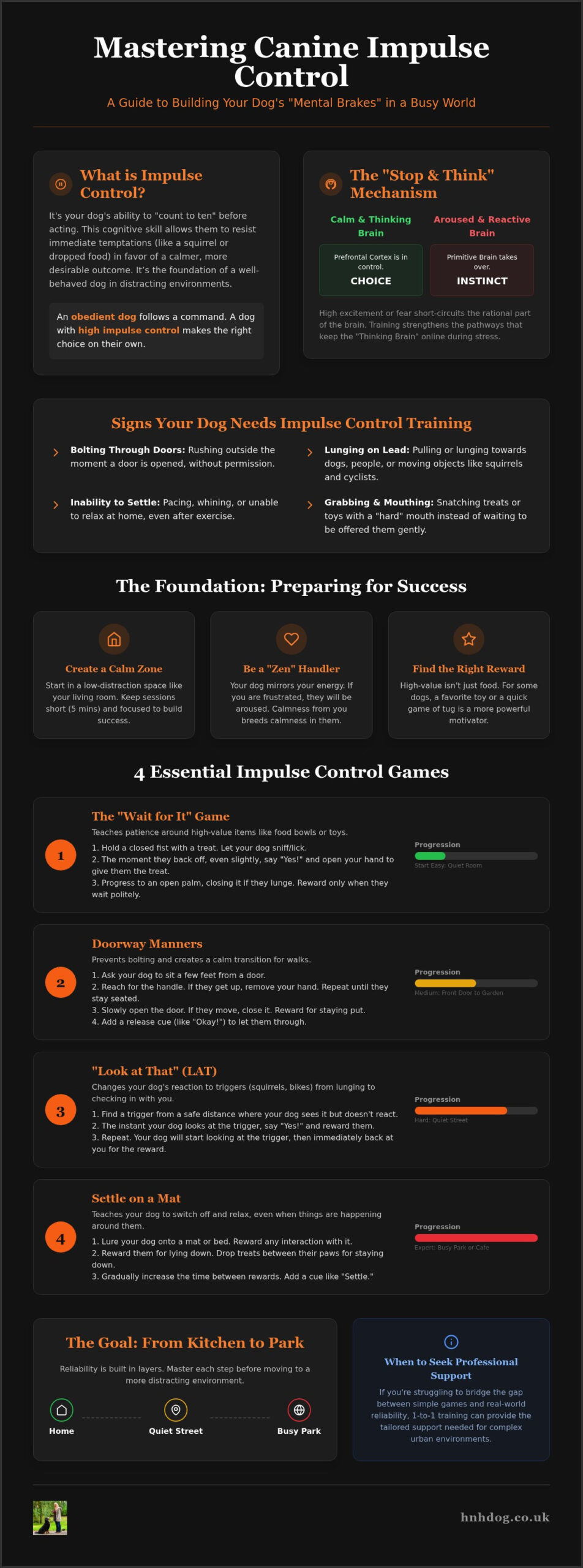
Inhibitory control is essentially the canine version of “counting to ten.” It is the cognitive ability to resist an immediate, tempting distraction, such as a discarded chicken bone on a North West London pavement or a sprinting squirrel in Queen’s Park, in favour of a more desirable long-term outcome. When we talk about impulse control games for dogs, we are actually discussing the process of strengthening the neural pathways that allow a dog to pause before they act. This internal regulation is the foundation of a calm life, yet it is a skill that must be carefully nurtured rather than expected as a default setting.
Living in high-density areas like North West London places immense pressure on a dog’s self-control. Unlike a rural setting where distractions are sparse, urban environments offer a constant stream of high-arousal triggers. Every cyclist, delivery van, and passing pedestrian requires a micro-decision from your dog. Without a robust “stop and think” mechanism, the dog’s nervous system remains in a state of hyper-vigilance. There is also a vital distinction between an obedient dog and one with high impulse control. An obedient dog follows a command because you are there to give it; a dog with high impulse control makes the right choice even when you haven’t said a word. This level of autonomy is often achieved through Operant conditioning, where the dog learns that their own calm choices are the key to accessing the things they value most.
The Science of the “Stop and Think” Mechanism
Decision-making happens in the prefrontal cortex, the part of the brain responsible for executive function and moderation. When a dog becomes overly excited or fearful, their arousal levels spike, effectively “short-circuiting” this rational centre and handing control over to the more primitive, reactive parts of the brain. This is why a dog who is perfect in the kitchen might seem to “forget” everything the moment they step onto a busy street. In an urban setting, a threshold is the precise point where environmental stimuli become so overwhelming that a dog loses the ability to think and begins to react purely on instinct.
Signs Your Dog Needs Impulse Control Training
Lack of self-regulation often manifests in ways that owners find deeply stressful. Common indicators include:
- Bolting through open doors before you’ve given the okay.
- Lunging at the end of the lead to greet other dogs or chase moving objects.
- An inability to settle at home, even after physical exercise.
- Grabbing treats or toys with a “hard” mouth before they are offered.
These behaviours are frequently mislabelled as stubbornness or even aggression. In reality, the dog is simply overwhelmed by their own impulses. By using impulse control games for dogs to build these cognitive “brakes,” you reduce the dog’s chronic stress levels. Developing this skill leads to better emotional health, as the dog no longer feels like a passenger to their own frantic reactions.
The Foundation: Preparing Your Dog for Success
Success in training is rarely about the intensity of the effort. Instead, it’s about the quality of the environment and the clarity of your communication. Before you introduce impulse control games for dogs, you must adopt a “Zen” philosophy: your internal state directly influences your dog’s ability to learn. If you are rushed or frustrated, your dog will mirror that arousal, making it impossible for them to access their rational decision-making centres. Calmness breeds calmness. This starts with setting realistic expectations. A six-month-old Labrador will naturally struggle more with stillness than a mature Greyhound. Recognise your dog’s age and breed traits as you begin this journey.
Rewards are the currency of this partnership. While many assume “high value” always equals a piece of cheese, for some dogs, a brief game of tug or the chance to sniff a specific patch of grass is far more motivating. Understanding what truly drives your dog allows you to customise the games to their specific needs. By using rewards that your dog genuinely craves, you make the choice to “wait” feel like a winning strategy rather than a chore.
Creating a Low-Distraction Training Zone
Your living room is the ideal laboratory. Clear the space of loose toys or half-chewed bones that might pull focus. The goal is to make yourself the most interesting thing in the room. Keep these initial sessions brief. Five minutes of focused, high-quality engagement is infinitely more effective than a thirty-minute marathon that leaves both of you exhausted. This approach mirrors how professional puppy training establishes basic foundations before moving into the chaos of the outdoors.
Mastering “The Wait” vs. “The Stay”
Clarifying your terminology prevents confusion for your dog. Think of “Wait” as a temporary pause; it’s a “don’t go yet” before they are given permission to eat or exit a door. “Stay” is a commitment to a position and duration. Introducing the concept of “permission” is a cornerstone of impulse control games for dogs. It teaches them that they don’t simply take what they want. Instead, they look to you for access to the reward. Build duration slowly. If your dog breaks their position, it’s a sign the challenge was too great. Reset, simplify, and try again. For those struggling to bridge the gap between home success and park reliability, a bespoke 1-to-1 dog training session can provide the personalised guidance needed to progress safely.
4 Essential Impulse Control Games to Play at Home
Building a reliable “stop” button starts in the comfort of your living room. These impulse control games for dogs provide a safe space to fail and learn without the pressure of North London traffic or the chaos of a busy park. By practicing in a low-stakes environment, you help your dog master the mechanics of self-regulation before you ask them to perform under pressure. Each game is designed to shift your dog’s mindset from “I want it now” to “How do I earn this?”
The “Magic Hand” exercise is a perfect starting point for dogs that tend to grab or nudge for attention. Hold a piece of kibble in a closed fist and present it to your dog. They will likely sniff, paw, or lick your hand. Remain still and silent. The moment they pull back and stop trying to force the hand open, mark the behaviour and offer the treat. This teaches them that stillness, not persistence, is the key to the reward. Similarly, the Boundary Game involves rewarding your dog for choosing to stay on a specific mat or bed. By making the boundary the most rewarding place in the house, you provide them with a default “safe harbour” when the household environment becomes too stimulating.
The ‘Leave It’ Evolution
The “Leave It” cue is often misunderstood as a correction. In reality, it’s a request for your dog to disengage from one thing to access something better. We build this in three distinct stages:
- Step 1: Place a treat on the floor and cover it with your hand. When your dog stops investigating your hand, reward them with a high-value treat from your other hand.
- Step 2: Once they’re consistent, drop the treat from a small height while they’re in a sit. This adds the element of movement, which naturally triggers their impulse to lunge.
- Step 3: Place several tempting items on the floor and walk your dog past them on a loose lead. Reward them every time they choose to look at you instead of the “forbidden” items.
Arousal Regulation with Tug and Fetch
Many owners avoid high-energy play because they fear their dog will lose control. However, games like tug and fetch are actually brilliant tools for simulating real-world excitement in a controlled way. The secret lies in the “off switch.” Start a game of tug, let the energy rise for a few seconds, and then ask for a “drop” or “thank you.” If your dog releases the toy, immediately reward them by restarting the game. Allowing your dog to “win” the game by following a calm cue is a powerful reward that reinforces their focus during high-energy moments. This cycle of “arouse and settle” is exactly what they’ll need when they encounter a squirrel on a Watford walk.
Managing High-Arousal Situations in Busy London Parks
Transitioning impulse control games for dogs from your living room to the real world is the most challenging phase of training. A quiet kitchen in Watford is a world away from the sensory overload of Hampstead Heath or Gladstone Park. You must bridge this gap by gradually increasing the environmental pressure. Distance is your most valuable asset here. If your dog cannot focus on you, it’s a clear signal that you’re too close to the trigger. Move away until their thinking brain comes back online. Then begin your exercises from that safer vantage point.
The “Look at That” (LAT) technique is a cornerstone of urban distraction management. Instead of trying to distract your dog from a squirrel or a cyclist, you acknowledge the trigger together. When your dog notices the distraction but remains calm, you mark the moment and reward them for looking back at you. This shifts their emotional response from a reactive “I must chase” to a proactive “I see it, and I’m choosing to check in with my owner.” Over time, the sight of a trigger becomes a cue for them to offer you their focus automatically.
Integrating impulse control games for dogs into your walk allows you to use the environment itself as the ultimate prize. If your dog displays excellent self-control by walking past a tempting group of pigeons on a loose lead, reward them by giving permission to go and sniff a nearby tree. These environmental rewards reinforce that calm behaviour is the most efficient way for them to access the activities they find naturally fulfilling.
Navigating Urban Triggers Safely
London’s narrow pavements and shared paths often force you into close proximity with joggers and bikes. When your dog’s prey drive is activated, their focus narrows and their arousal spikes. You can use the foundations described in our guide to dog training North London to create a bubble of focus. Use high-value rewards to maintain a steady connection until the trigger has passed, ensuring your dog feels supported rather than overwhelmed by the city’s pace.
The Role of Socialisation in Self-Control
Authentic socialisation isn’t about every dog meeting every other dog. It’s about teaching your dog to be neutral and calm in the presence of others. Frustrated greeters, which are dogs that bark or lunge because they are desperate to play, benefit immensely from structured, neutral environments. This is where professional dog walking can be a powerful tool. Group walks with an experienced professional help your dog learn to remain focused while moving with a pack, rather than seeing every canine encounter as a high-octane play session.
If you’re finding the transition from home to the park overwhelming, our behavioural consultations provide a bespoke roadmap to help you navigate these high-arousal environments with confidence and care.
When to Seek Professional Support for Behavioural Challenges
While most owners find great success using impulse control games for dogs, there are moments when a dog’s reactions feel beyond the reach of standard home training. It’s vital to recognise the line between an excitable dog and one who is struggling with clinical impulsivity. If your dog seems to exist in a constant state of high arousal, or if their reactions are so instantaneous that you cannot find a “learning window,” it may be time to transition from games to a professional behavioural assessment. These complex cases often require a deeper look at the dog’s internal emotional state rather than just their outward actions.
A professional assessment can uncover underlying factors that are often invisible to the untrained eye. Chronic anxiety, environmental phobias, or even undiagnosed physical pain can all manifest as a lack of self-control. With over 20 years of industry experience, H&H Dog specialises in identifying these root causes. We provide the bridge between “playing games” and achieving real-world reliability. Our evidence-based, non-adversarial methodology ensures that your dog feels supported throughout the process, rather than pressured to perform.
The Value of a Behavioural Consultation
A professional consultation in Watford or North West London is far more than a standard obedience class. It is a deep dive into your dog’s history, environment, and specific triggers. During an assessment, we observe how your dog processes information and where their cognitive “brakes” are failing. This allows us to create a bespoke 1-to-1 training plan that addresses your dog’s unique personality. For those navigating the specific pressures of city life, consulting a dog behaviourist London provides the specialised expertise needed to manage complex reactivity and urban stress safely.
Building a Long-Term Partnership with Your Dog
The ultimate goal of training isn’t simply to “fix” a problem. It’s about fostering a shared life based on mutual understanding and respect. Consistent, ethical guidance helps your dog feel safe, which naturally leads to a calmer, more focused household environment. By choosing a path that values long-term emotional health over quick, forceful fixes, you are investing in a happier future for both you and your companion. If you’re ready to transform your walks and deepen your bond, contact H&H Dog for expert 1-to-1 training and bespoke behavioural support.
Empowering Your Dog to Make Better Choices
Mastering self-regulation is a journey that begins with patience in your own living room. By establishing a solid foundation of impulse control games for dogs, you provide your companion with the mental tools needed to navigate the sensory intensity of North West London and Watford. You’ve learned that calmness isn’t just about obedience. It’s about fostering a dog’s internal ability to pause and check in with you before they react. This shift in perspective transforms your walks from a struggle for control into a collaborative partnership.
While these exercises are powerful, some behavioural challenges require a more nuanced, professional touch. H&H Dog brings over 20 years of expert experience to help you bridge the gap between simple games and real-world reliability. We specialise in bespoke plans tailored to your dog’s unique temperament, ensuring every step is ethical and supportive. If you’re ready to move beyond the frustration of lunging and distraction, book a bespoke 1-to-1 training session with H&H Dog. With the right guidance and a steady hand, a peaceful, focused walk is well within your reach.
Frequently Asked Questions
What are the best impulse control games for high-energy puppies?
High-energy puppies benefit most from impulse control games for dogs that focus on stillness, such as the “Magic Hand” or simple boundary training. These activities teach them that calm behaviour is the most effective way to access rewards. Because puppies have shorter attention spans, keep sessions under five minutes. This prevents mental fatigue and ensures that training remains a positive, engaging experience for their developing minds and bodies.
How long does it take to see results from impulse control training?
You will often see minor shifts in focus within the first few sessions, but consistent real-world reliability typically takes several weeks of daily practice. Every dog is an individual with a unique learning pace. Factors like age, breed, and previous history influence how quickly they internalise these new skills. Regular, short bursts of training are far more effective for long-term retention than infrequent, lengthy sessions that might overwhelm your dog’s progress.
Can older dogs still learn impulse control through games?
Older dogs are absolutely capable of learning new self-regulation skills through structured play. While they may have more deeply ingrained habits, their mature focus can actually make the learning process smoother than with a frantic puppy. Training provides vital mental stimulation for senior dogs, which supports their cognitive health and overall well-being. It’s a wonderful way to strengthen your bond while teaching them that it’s never too late to adopt a calmer lifestyle.
My dog ignores me when they see a squirrel; what should I do?
If your dog becomes fixated on a squirrel, it’s a sign they’ve reached their emotional threshold and can no longer process your instructions. You should immediately increase the distance between your dog and the trigger until they can check back in with you. At this safer distance, you can use the “Look at That” technique to reward them for choosing to look at you instead of the distraction, gradually building their focus.
Is impulse control the same as basic obedience training?
Impulse control is distinct from basic obedience because it focuses on a dog’s internal emotional regulation rather than just following external cues. While obedience training teaches a dog to “sit” when told, impulse control games for dogs empower them to choose a calm action without being prompted. This cognitive shift is what creates a dog that can think before they react, leading to much more reliable behaviour in high-pressure urban environments.
What should I do if my dog gets too frustrated during a game?
When a dog shows signs of frustration, such as barking or mouthing, it usually means the challenge is currently too difficult for them. You should immediately simplify the game to a level where they can succeed, ensuring they receive a reward for their effort. Ending a session on a positive “win” prevents negative associations with training. If frustration persists, it may be beneficial to seek a professional behavioural consultation to identify any underlying stress.
How can I practice impulse control on a lead during walks?
Practicing on a lead is an excellent way to bridge the gap between home and the park. You can play “Red Light, Green Light,” where you stop moving the moment the lead becomes taut and only proceed once your dog offers a loose lead or looks back at you. Rewarding this self-correction with the chance to sniff a nearby tree or patch of grass reinforces that staying calm is the best way to move forward.
Do I need special toys or equipment for these games?
You don’t need any specialised or expensive equipment to begin these exercises. Most games can be played using your dog’s daily kibble, a favourite toy, or high-value treats like small pieces of cooked chicken. A standard lead and a comfortable harness are sufficient for outdoor practice. The most important “equipment” is actually your own patience and a quiet environment where your dog can focus on the learning process without unnecessary distractions.