
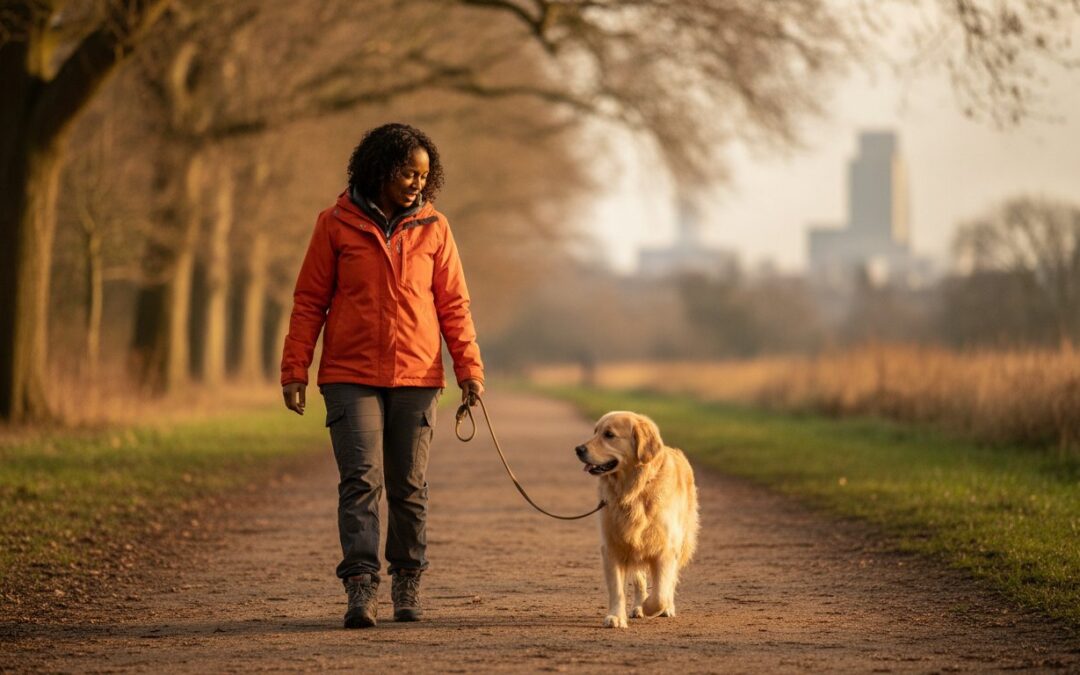
What if your dog’s lead wasn’t a restraint you had to white-knuckle through every morning, but a quiet connection between two partners? For many dog owners in North London, a stroll through Hampstead Heath or Highgate Wood feels more like a physical power struggle than a relaxing break. You likely know the dull ache in your shoulder or the sharp sting of embarrassment when your dog lunges toward a passing neighbour. It’s truly exhausting to feel that every outing is a battle of wills rather than a shared joy.
This loose lead walking masterclass North London guide is designed to change that narrative for good. You’ll discover the professional, evidence-based techniques required to stop the pulling and transform your daily walks into a stress-free partnership. We’ll explore the underlying motivations behind your dog’s behaviour and provide a structured, ethical path to achieving a calm, focused companion by your side. By refocusing on your dog’s internal emotional state and building mutual understanding, you can finally enjoy the peaceful, weekend strolls you’ve always envisioned. This journey isn’t about force; it’s about fostering a deeper bond through clear communication and bespoke care.
Key Takeaways
- Understand why the “opposition reflex” causes your dog to pull harder when you tension the lead and how to break this cycle through better communication.
- Discover the “300-degree awareness” technique to monitor your dog’s focus and intervene before they reach the end of the lead.
- Learn how this loose lead walking masterclass North London focuses on building value by your side, making walking together more rewarding than pulling away.
- Identify the ethical equipment choices that support a partnership and why avoiding aversive tools is crucial for your dog’s emotional well-being.
- Prepare for real-world challenges by mastering the transition from narrow North London pavements to high-distraction green spaces like the park gate.
Why Your Dog Pulls: Understanding the Psychology of the Lead
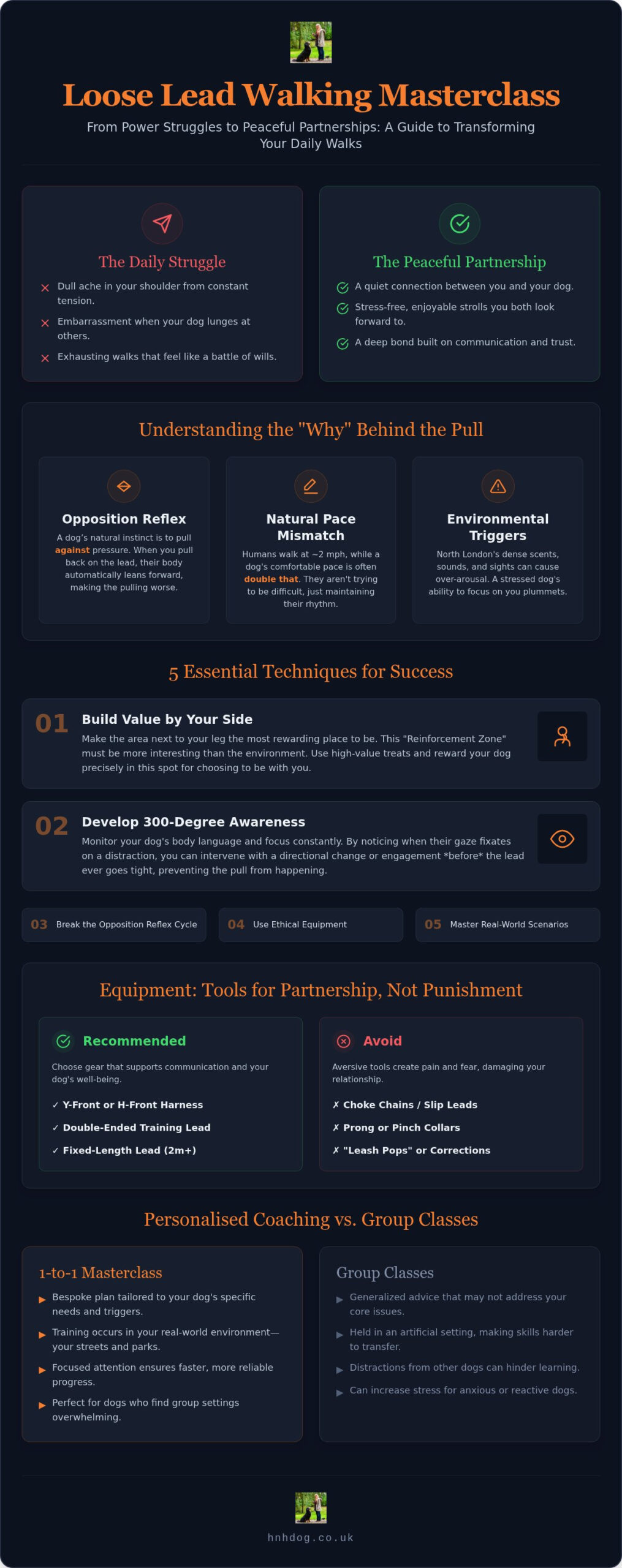
It’s helpful to remember that your dog isn’t trying to dominate you or be difficult. Most pulling occurs because of a fundamental mismatch between canine biology and the constraints of a lead. Dogs naturally move at a much faster pace than humans. While we plod along at a steady two miles per hour, your dog’s comfortable walking speed is often double that. When they reach the end of the lead, they aren’t necessarily “pulling”; they’re simply trying to maintain their natural rhythm. This physical gap is the first hurdle we must bridge to create a harmonious walk.
The Opposition Reflex Explained
One of the most common reasons walks become a tug-of-war is a biological phenomenon known as the opposition reflex. This is an instinctive reaction where a dog pulls in the opposite direction of any pressure they feel on their collar or harness. The opposition reflex is a thigmotaxis-related survival instinct where an animal instinctively pushes against the direction of physical pressure.
Traditional training methods often rely on “leash pops” or sharp corrections to stop pulling. However, these actions usually backfire because they trigger this exact reflex. When you pull back, your dog’s body automatically leans forward to find balance. Understanding these principles of animal training allows us to move away from conflict and toward cooperation. Instead of fighting their biology, we learn to work with it.
Environmental Triggers in North London
Our local environment adds another layer of complexity. North London is a sensory-rich landscape. From the dense scents of the high street to the unpredictable sounds of sirens and construction, your dog’s nervous system is constantly processing data. In high-density areas like Muswell Hill or Highgate, the sheer volume of stimuli can lead to over-arousal. This isn’t just about excitement; it’s a physiological response that changes how your dog interacts with the world.
This state of high arousal causes a spike in cortisol, the stress hormone. When a dog is “stressed up,” their ability to focus on you diminishes significantly. They might become a “frustrated greeter,” pulling frantically to reach another dog, or they might pull simply to escape a situation that feels overwhelming. A bespoke 1-to-1 loose lead walking masterclass North London helps you identify whether your dog is sniffing for enrichment or pulling out of a need for safety. Using “corrections” in these moments only adds to their frustration, turning a sensory experience into a negative emotional event. By viewing the lead as a communication tool rather than a control device, we can begin to lower those arousal levels and build a calmer, more connected partnership.
The Loose Lead Masterclass: 5 Essential Techniques for Success
Transitioning from a stressful tug-of-war to a relaxed stroll requires a shift in how you communicate with your dog. This loose lead walking masterclass North London focuses on five core pillars designed to rebuild your partnership from the ground up. We move away from physical restraint and toward a shared understanding of movement and focus. The goal is a dog that chooses to stay with you because it’s the most rewarding place to be.
Building Value by Your Side
The first step is establishing the “Reinforcement Zone,” which is the area right next to your leg where you want your dog to walk. To make this zone high-value, you must deliver rewards frequently and precisely in this spot. Understanding the psychology of leash pulling reveals that dogs often pull because the environment is more reinforcing than the owner. To compete with the scents of a North London park, use high-value rewards like small pieces of cooked chicken or cheese.
Utilise the “Catch and Release” method for treat delivery. This involves marking the correct position with a bridge word like “Yes,” delivering the treat at your seam line, and then releasing the dog to sniff or continue walking. This creates a clear cycle of engagement. If you find these initial steps challenging to implement amidst local distractions, our 1-to-1 Dog Training offers the personalised support needed to refine these mechanics in your own neighbourhood.
The second pillar is “300-Degree Awareness.” This involves monitoring your dog’s body language and focus before the lead even goes taut. If you see their ears prick or their gaze fixate on a distant squirrel, you can intervene with a directional change or a “follow the leader” game. By changing direction frequently, you teach your dog that they need to pay attention to your movement to know where the walk is going.
Managing the Taut Lead
When the lead does go taut, you must have a consistent plan. The “Penalty Box” method is a simple but effective rule: tension equals a total stop. You can choose the “Be a Tree” technique, where you stand still until the dog creates slack, or the “Reverse Direction” technique, where you calmly walk the other way. The choice often depends on your dog’s specific temperament and the level of environmental arousal.
- Consistency is key: How you handle the first five minutes of a walk dictates the dog’s expectations for the rest of the journey.
- The Bridge Word: Use a clicker or a specific word to mark the exact moment the lead slackens, followed immediately by a reward in the Reinforcement Zone.
- Generalisation: Once your dog is successful in a quiet hallway or garden, gradually move to the pavement outside your house before attempting the local high street.
Mastering these techniques takes patience and a commitment to non-coercive methods. By focusing on internal emotional states and rewarding the choice to remain close, you’ll find that the lead becomes a light, almost invisible connection rather than a source of constant tension.
Equipment & Gear: Choosing Tools That Support Partnership
Selecting the right equipment is a vital step in your journey, but it’s essential to view these tools as safety features rather than training shortcuts. At H&H Dog, we draw on 20 years of experience to ensure that every recommendation we make prioritises your dog’s emotional and physical welfare. A comfortable dog is a focused dog. When your dog is free from the restrictive or painful pressure of certain tools, their baseline stress levels drop. This makes the techniques shared in our loose lead walking masterclass North London much more effective, as your pet isn’t distracted by physical discomfort.
We strictly advocate for non-coercive methods and strongly advise against aversive equipment like prong collars or choke chains. These tools rely on fear and physical pain to achieve “compliance,” which ultimately damages the bond of trust between you and your pet. Instead, we prioritise gear that facilitates a calm, stress-free partnership. By choosing ethical tools, you’re signaling to your dog that the walk is a shared, safe experience rather than a series of corrections.
Harness vs. Collar: The Health Perspective
From a physiological standpoint, the choice of equipment has significant implications for your dog’s long-term health. Constant pressure on the throat from a collar can lead to serious issues, including thyroid damage and increased intraocular pressure. This is particularly dangerous for breeds prone to eye issues. A well-fitted, Y-front, non-restrictive harness is the gold standard for urban walking. This design ensures that pressure is distributed across the chest and shoulders, leaving the neck free and allowing for a natural range of motion. For a deeper dive into selecting ethical gear for your pet, consult The Ultimate Guide to Dog Training in North London.
The Myth of the Retractable Lead
While retractable leads are popular for their perceived freedom, they often hinder the progress of loose lead learning. These devices work on a mechanism of “constant tension,” which inadvertently teaches your dog that they must pull against the lead to move forward. This constant feedback loop makes it difficult for them to distinguish between a loose lead and a taut one. It essentially trains them that pulling is a requirement for exploration.
If you want to give your dog more space during “sniffari” walks in North West London, a fixed-length long line is a far safer and more effective alternative. Unlike retractable leads, a long line allows for genuine slack, helping your dog understand when they have reached the end of their tether without confusing mechanical resistance. This clarity is a cornerstone of our loose lead walking masterclass North London, ensuring your dog learns to manage their own proximity to you with confidence and ease.
Navigating North London: Real-World Training Scenarios
Training in a quiet garden provides the necessary foundation, but the true test of your partnership happens on the bustling streets of North London. Whether you’re navigating the narrow, winding pavements of Highgate or the crowded high streets of Muswell Hill, the urban environment presents constant challenges. This loose lead walking masterclass North London approach focuses on applying your skills in these high-pressure moments. One of the most significant hurdles owners face is the “Park Gate Challenge.” This is the specific moment your dog transitions from the structured pavement walk to the exciting green space. By pausing and requesting focus before you enter the park, you set a calm, intentional tone for the rest of your session.
We also must address the “London Greeting.” In a city this dense, strangers or other dogs will inevitably approach you. Instead of allowing a frantic on-lead interaction, which often reinforces pulling and high arousal, we teach you to maintain a bubble of focus. You can use the “Premack Principle” here; this psychological concept suggests that a high-probability behaviour, like sniffing a tree, can be used as a reward for a low-probability behaviour, such as walking on a loose lead. Essentially, if your dog walks calmly for ten paces, you cue them to go and sniff that lamp post as a functional reward. This turns the environment into your training ally rather than your enemy.
Training in High-Distraction Zones
Busy areas like the cafes of Crouch End require a specific set of skills. While you enjoy a coffee, your dog needs to understand how to settle despite the proximity of other diners and passing traffic. For dogs distracted by the famous squirrels of Alexandra Palace, we utilise “Look at That” (LAT) training. This non-coercive method teaches your dog to look at a distraction and then immediately check back in with you for a reward. It transforms a potential pulling trigger into a cue for engagement. If you’re struggling to manage these specific local triggers, our 1-to-1 Dog Training provides bespoke coaching in the exact locations where you walk every day.
The “Sniffari” Walk
It’s vital to distinguish between “working time” and “free time.” A dog cannot be expected to walk in a perfect heel for an entire trek across North West London. We suggest using clear verbal cues to signal a change in expectations. A cue like “With me” can mean structured walking, while “Go sniff” gives them permission to explore on a loose lead. These “sniffari” sessions are essential decompression walks. They allow your dog to process the urban environment at their own pace, reducing overall cortisol levels and making your structured training sessions much more productive. True partnership is about balance; giving your dog time to be a dog makes them a more attentive partner when you need their focus.
Personalised Coaching: Why a 1-to-1 Masterclass Beats a Group Class
Choosing a 1-to-1 environment allows us to strip away the chaos of a group class, where many dogs are simply too overwhelmed to absorb new information. While a group setting might seem social, the high arousal levels often prevent the deep, cognitive shifts required for true lead mastery. This loose lead walking masterclass North London is designed to meet your dog exactly where they are, physically and emotionally. We focus on the individual nuances of your pet’s personality, ensuring that the training remains ethical, supportive, and highly effective. For dogs that struggle with reactivity or anxiety, the quiet focus of a private session is not just a preference; it’s a prerequisite for success.
Training in your own neighbourhood provides a significant advantage that a community hall cannot replicate. We work on the very pavements where your dog usually pulls, allowing us to address real-world triggers in real-time. Whether it’s the specific scent of a local park gate or the distraction of a neighbour’s cat, we provide immediate, manageable solutions. Backed by 20 years of experience, our approach provides you with the calm confidence needed to lead your dog through any situation. You’ll learn to read your dog’s subtle cues, turning what was once a stressful struggle into a predictable, manageable conversation.
The H&H Dog 1-to-1 Experience
Our process begins with a comprehensive initial assessment that looks far beyond the physical act of pulling. We examine the emotional root of the behaviour, identifying whether the tension is driven by over-excitement, frustration, or fear. By understanding the “why” behind the action, we can create a customised training plan that fits seamlessly into your busy London lifestyle. In cases where pulling is a symptom of deep-seated anxiety, we may recommend a more intensive approach through our Dog Behaviourist London services. This ensures that we aren’t just masking a problem but fostering long-term emotional health.
Ongoing Support and Maintenance
Progress doesn’t end when the session concludes. We provide clear, actionable steps for you to follow between meetings, ensuring that your dog’s new skills become permanent habits. For many clients, our group walking services offer an excellent way to reinforce these lead skills in a controlled, professional environment. This allows your dog to practice their “loose lead” mindset while socialising with a stable, well-managed pack. Transitioning from 1-to-1 coaching to confident solo walks is a steady progression, and we remain a steady hand throughout the journey.
Ready for a stress-free stroll? Book your 1-to-1 Lead Walking session today. By investing in bespoke, individual care, you’re choosing a path that values your dog’s welfare and your own peace of mind. Let’s transform your daily walks into the rewarding partnership you both deserve.
Reclaiming the Joy of Your Daily Strolls
Reclaiming your daily walks starts with a fundamental shift in perspective. You’ve discovered that pulling isn’t a battle for dominance but a biological response you can manage through empathy and evidence-based techniques. By choosing a Y-front harness and focusing on the “Reinforcement Zone,” you’re already laying the groundwork for a stress-free partnership. Whether you’re navigating the narrow paths of Highgate or the busy streets of Muswell Hill, remember that every step is an opportunity to communicate rather than correct.
This loose lead walking masterclass North London guide provides the necessary framework, but the most significant progress often happens through consistent, bespoke practice. At H&H Dog, we bring over 20 years of expert training experience to every session, offering personalised, ethical methods tailored to your dog’s unique emotional needs. We understand the specific urban challenges across North London and Watford. It’s time to replace the tension with trust. Transform your walks with a bespoke North London training session and discover the joy of a dog that chooses to walk calmly by your side. You both deserve a life of shared, peaceful exploration.
Frequently Asked Questions
How long does it take to train a dog to walk on a loose lead?
Progress depends on your consistency and your dog’s previous history, but you’ll often see initial shifts in focus within two to four weeks. It’s helpful to view this as a marathon rather than a sprint. By committing to daily ten-minute sessions and never allowing your dog to move forward while the lead is taut, you’ll find that the new habit begins to solidify within the first month of dedicated practice.
Should I use a harness or a collar for loose lead walking?
A Y-front, non-restrictive harness is the safest and most effective choice for your pet’s physical health. Collars can place dangerous pressure on the thyroid and neck, whereas a harness distributes force across the chest. This physical comfort is a cornerstone of any loose lead walking masterclass North London, as it prevents pain-related frustration and allows your dog to move naturally while learning to stay by your side.
My dog only pulls when they see another dog, what should I do?
This behaviour usually stems from over-arousal or “frustrated greeting” rather than a simple lack of lead skills. You should increase the distance between your dog and the other animal until your pet can remain calm. Use rewards to reinforce the moment they choose to look at you instead of the distraction. If this reactivity feels unmanageable, a professional behavioural consultation can help address the underlying emotional response.
Are retractable leads okay for training loose lead walking?
Retractable leads are generally counterproductive for learning because they apply constant tension to the harness or collar. This mechanical feedback inadvertently teaches your dog that pulling is a requirement to move forward. To provide clear communication, it’s better to use a fixed-length lead for training. If you want to offer more freedom in open spaces, a long line is a much clearer tool for your dog to understand.
Is it too late to train an older dog to stop pulling?
It’s never too late to help an older dog adopt new habits. While senior dogs may have years of “muscle memory” regarding pulling, they’re often more focused and less flighty than puppies. The core principles of building value by your side remain exactly the same regardless of age. With patience and a gentle, consistent approach, even a lifelong puller can learn to enjoy a relaxed, loose lead walk.
What is the best high-value treat for training in busy London parks?
The ideal reward is whatever your dog finds most motivating amidst the intense scents of a London park. Small pieces of plain cooked chicken, cheese, or even dried sprats often work well because they’re high-value and aromatic. Since the “distraction tax” is high in urban green spaces, your treats must be potent enough to keep your dog’s focus. Always keep pieces small to ensure your dog stays motivated without becoming full.
Why does my dog walk perfectly at home but pulls like a train outside?
This happens because dogs don’t generalise skills easily; a “heel” in a quiet kitchen feels very different from a “heel” on a busy high street. Your home has a low distraction level, making focus easy. To bridge this gap, you must gradually increase the difficulty of your training environment. Start in your hallway, move to the garden, and then practice on your quiet doorstep before attempting a full walk around the block.
Can a professional dog walker help with my dog’s lead training?
A professional walker can be an excellent partner in reinforcing your dog’s training. If they use the same consistent cues and ethical methods you’ve established, they help solidify the habit during their daily outings. Our group dog walking services are designed to complement your training by maintaining these standards. When every person at the end of the lead follows the same rules, your dog’s progress accelerates significantly.