
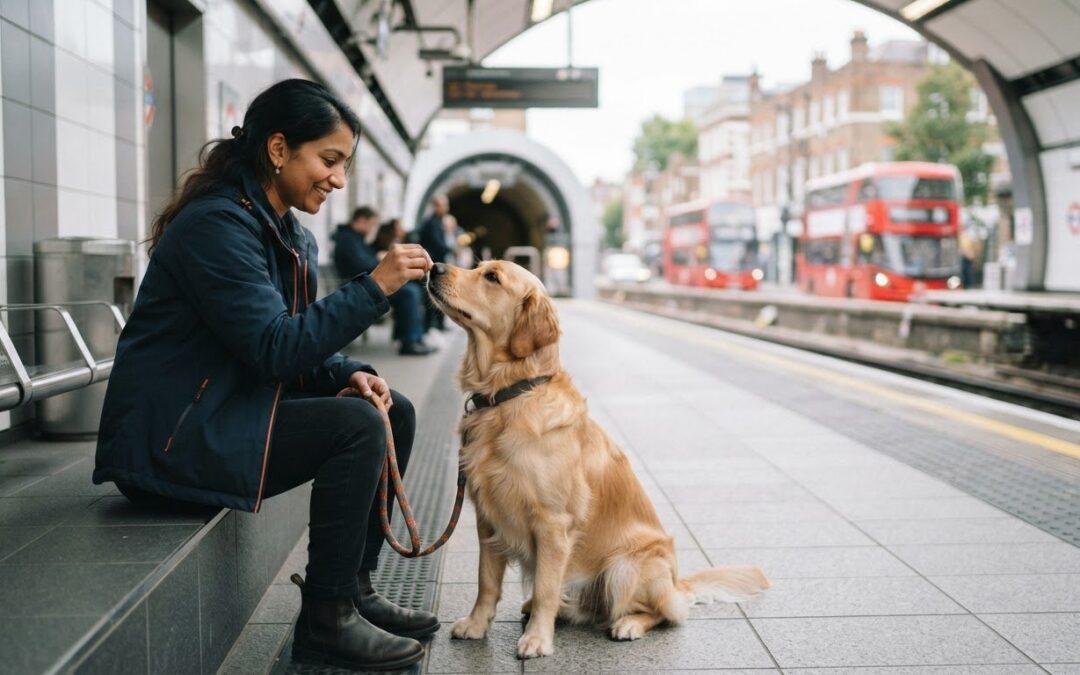
What if a calmer London journey starts before you choose your route? Managing dog behaviour on London public transport begins with considering how your dog responds to noise, crowds, movement and close contact.
If you’re worried about barking, pulling, freezing or reacting near passengers, you’re not alone. These behaviours can signal that a journey feels difficult, rather than a reason to push your dog through it. Preparation, manageable practice and a willingness to change plans can help you make safer, more positive choices.
This guide explains how to spot early signs of stress, plan practice journeys and respond if your dog becomes overwhelmed. You’ll also find tips for comparing routes and travel times, and a reminder to check current TfL rules before setting out. The aim isn’t to make every dog love public transport. It’s to understand what your dog can manage and build confidence at a pace that suits them.
Key Takeaways
- Judge travel readiness by how well your dog copes, recovers and stays safe, not simply by whether they can board.
- Barking, pulling or avoiding a busy area can signal that the sights, sounds or close contact feel difficult for your dog.
- Compare crowd levels, journey length, transfers and places to pause when choosing a route. No single transport option suits every dog.
- Build confidence with flexible, gradual practice. Reward voluntary engagement rather than forcing your dog closer to a trigger.
- Managing dog behaviour on London public transport may call for individual guidance if distress persists, safety is a concern or your dog struggles to recover.
Managing dog behaviour on London public transport starts with understanding your dog
A journey that looks straightforward to you can be challenging for a dog. Noise, movement and unfamiliar people may arrive all at once. Your dog’s behaviour offers clues about how they’re experiencing it. Barking or pulling isn’t simply a behaviour to stop; it may be information that your dog needs more space or a quieter moment.
Readiness isn’t about perfect obedience or looking completely relaxed. It means your dog can cope with the journey, recover after something unsettling and remain safe. A dog may be still and quiet while feeling uncomfortable, so consider their whole body: posture, facial expression, breathing, movement and ability to respond to you.
Manageable alertness means your dog can notice what’s happening and still recover. Escalating distress means they’re struggling to settle, move away or reconnect with you. This distinction can help you decide whether to continue, pause or create more distance.
What might make a London journey difficult for a dog?
A station can combine announcements, footsteps, crowds, trains arriving and unfamiliar surfaces. On a bus, vehicle movement, engine noise and close contact with passengers may be the harder parts. The broader topic of animals using public transport spans different settings, but each dog experiences a particular journey in their own way.
Journey length, time of day and previous experiences can all affect what your dog can manage. One dog may find a brief bus ride easier than a busy station. Another may cope with a train but struggle on a crowded platform. Avoid assuming that one mode of transport will suit every dog.
Which early signs of stress should you notice?
Look for changes from your dog’s usual behaviour. Turning away, lip licking, yawning or seeking distance can be subtle signs that they need more space. Barking, pulling, trembling or freezing are more obvious responses, but no single signal tells the whole story.
Notice what happens before and after a behaviour. Does your dog turn away as people approach? Can they recover when the crowd thins? Patterns across a journey help you understand their experience without jumping to conclusions. If signs are building, increase distance or pause where it’s safe. Your dog’s ability to recover is useful information, not a test they need to pass.
Why dogs react to London buses, the Underground and busy stations
Public transport can ask a lot of a dog’s senses at once. There may be sudden announcements, braking, footsteps, doors opening and people moving close by, alongside unfamiliar smells and surfaces. Each element might be manageable on its own, but together they can make it harder for a dog to settle or work out where to go.
Space matters, too. On a crowded platform or bus, your dog may have fewer chances to move away from something worrying or find a comfortable place to pause. A quiet journey on a familiar route may go well, while a busy interchange with rushing passengers feels much harder. That doesn’t mean your dog is being unpredictable or difficult. The conditions have changed.
How crowds, noise and movement can affect behaviour
Notice what happens around your dog. A train braking nearby, a sudden announcement or a passenger stepping close may prompt barking, pulling or avoidance. These actions can communicate that the environment feels intense or that your dog needs more distance. They aren’t deliberate attempts to spoil the journey.
A dog’s ability to cope depends on how intense a trigger feels, how close it is and how long the dog has to experience it. No single London transport mode is easier for every dog. The same dog may manage a bus at a quieter time but struggle on a packed train, or find a station’s echo harder than the ride itself.
How to read body language before behaviour escalates
Look for changes from your dog’s usual posture, movement and engagement. They might become more rigid, keep looking towards a sound, stop responding as they normally would or repeatedly try to move away. Consider these signs in context rather than treating one behaviour as a definitive explanation.
If signals are increasing, create distance or leave the environment when it’s safe and practical. You don’t need to wait for barking or freezing before changing your plan. A brief pause in a less busy area may give your dog a chance to recover. If they can’t settle, ending the practice and trying a gentler situation another time may be the kinder choice.
Afterwards, make a brief note of the setting, time, crowd level, likely trigger and how long recovery took. Over several outings, these details can reveal patterns, such as a particular interchange being harder than a direct journey. This makes managing dog behaviour on London public transport more thoughtful and individual. If you’d value help interpreting those patterns, one-to-one dog training may be worth exploring.
Choosing a manageable London route, time and transport option
The most suitable journey is the one your dog can manage today, not necessarily the quickest route or your preferred mode of transport. Before setting out, compare likely crowd levels, journey length, changes between services and places where you can pause or leave. A direct journey with a straightforward exit may be a better first step than a shorter route through a crowded interchange.
There’s no universally easiest option. A bus may avoid a station change but involve close passenger movement. A train may offer a direct trip but require your dog to manage a busy platform or an unfamiliar station. Use the table as a starting point, then adapt your plan to your dog’s comfort and the conditions on the day.
| Environment | Possible challenge | Planning adjustment |
|---|---|---|
| Bus | Close contact with passengers, engine sounds or vehicle movement | Consider a quieter period and a short ride with a simple exit point |
| Underground station | Crowds, announcements, echoes or several transitions before boarding | Choose a station and route with fewer changes, and identify a place to pause |
| Overground or Elizabeth line journey | Busy platforms, waiting time or a longer journey | Check conditions and journey details in advance, and plan where you can end the practice |
How to choose a first practice journey
Start with a short, low-pressure outing that matches what your dog already finds comfortable. That might mean visiting a station without boarding, or trying a brief ride at a quieter time. Check travel conditions before leaving and have an alternative route or a simple way to stop the practice if your dog finds it difficult. Keep the goal modest: a manageable experience is more useful than completing a particular journey.
What to check before travelling on TfL services
Rules and arrangements can vary by service, so check current official TfL guidance for the specific journey you’re planning. Confirm what applies to buses, the Underground, London Overground and the Elizabeth line, including any requirements for travelling with your dog. If your route uses another operator, check its guidance too. Don’t rely on an old account of the rules; verify them before you set out.
Thoughtful route planning supports managing dog behaviour on London public transport by reducing avoidable pressure while letting your dog’s responses guide the pace. For individual help shaping practice around your dog, you could explore one-to-one dog training.
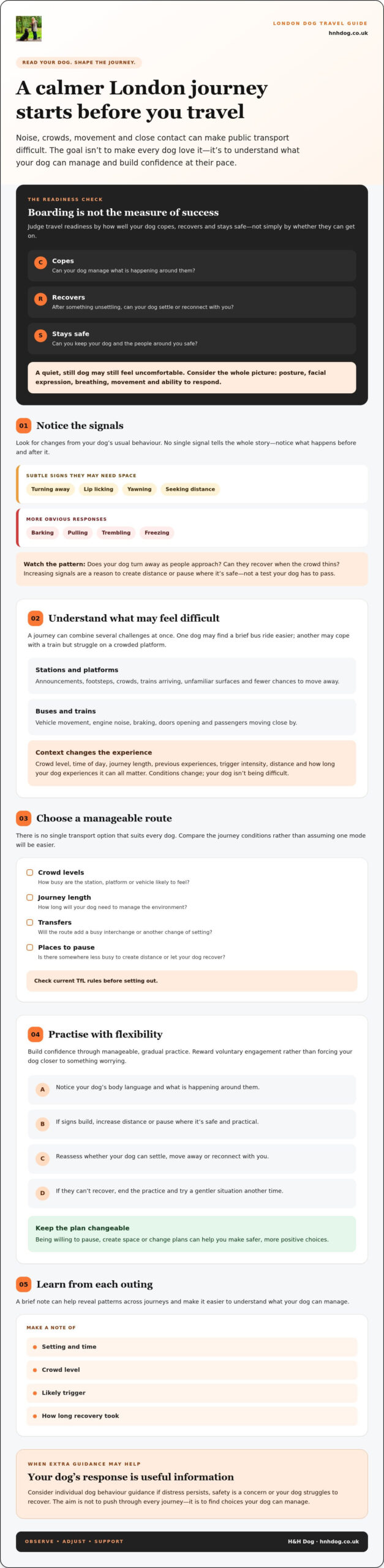
A step-by-step plan for practising public transport with your dog
Build familiarity in small, flexible steps. There’s no fixed timetable: one dog may be ready to move closer after a few visits, while another benefits from repeating the same easy stage. Let your dog’s ability to stay engaged and recover guide the pace, rather than aiming to board by a particular date.
Build confidence before boarding
Start near a station or route at a distance where your dog can notice what’s happening without becoming overwhelmed. Reward voluntary engagement, such as calmly looking towards the entrance and then turning back to you. Keep the exposure brief and leave while your dog is still coping, rather than waiting for stress to build.
As your dog becomes comfortable, you might gradually approach the entrance, spend time in a quieter part of the station or observe from a suitable spot. Move on only if your dog can still engage with you and recover between moments of activity. If they begin turning away, become tense or stop taking rewards they usually enjoy, increase distance or return to an easier step. Don’t lure or pull them closer to a trigger.
Respond calmly if your dog becomes overwhelmed
If your dog’s stress increases, prioritise space and a safe way out over completing the planned journey. Move away from the crowd or leave the station if you can do so safely. Familiar cues and rewards may help, but only if your dog is comfortable enough to respond. Avoid insisting on a cue or using food to draw them closer to something they’re trying to avoid.
After the session, consider what changed: the crowd, noise, closeness to a train or time spent in the environment. Next time, make the practice shorter or begin farther away. That isn’t failure; it’s useful information about what your dog can manage right now.
Observe, create space, reward recovery and reassess before continuing. This gives you a calm sequence to follow instead of pushing on simply because a journey has started. With managing dog behaviour on London public transport, progress means building experiences your dog can cope with, not reaching a platform as quickly as possible.
If you’d like a practice plan tailored to your dog’s needs, ask about one-to-one dog training.
When tailored dog behaviour support can make London journeys easier
Sometimes a quieter route and gradual practice aren’t enough. If your dog remains distressed, struggles to recover after a journey or their reactions raise safety concerns, individual guidance can help you understand what may be contributing to the difficulty and decide on a suitable next step. You don’t need to wait until travel feels impossible before asking for support.
One-to-one training can help you work on practical skills and confidence for travel. A behavioural consultation can focus more closely on persistent or complex responses, considering what your dog may be experiencing and the factors contributing to their distress. Neither option can promise a particular outcome, but tailored guidance can help shape a plan around your dog rather than asking them to fit a standard approach.
For broader information, explore this London dog behaviourist guide or the North London dog training guide.
How individual support can adapt the plan to your dog
A professional can consider your dog’s triggers, history, temperament and your goals for travel. For one dog, that may mean first working on feeling comfortable near a station. For another, it may involve understanding why a particular crowd, sound or journey is difficult. Practice may begin away from transport, then move towards real journeys as your dog is ready.
If you’re also looking for foundations for a young dog, the London puppy training guide offers a useful starting point.
Choose a welfare-led next step
When you enquire, describe what you’ve observed and the conditions that make journeys difficult. Include what happens before your dog reacts, how they behave and how long they take to recover. These details can help clarify whether one-to-one dog training or a behavioural consultation is the more relevant option.
H&H Dog offers both, drawing on over 20 years of industry experience and an approach tailored to each dog’s temperament. The business serves Watford, North London and North West London; check current availability for your area. Thoughtful support can make managing dog behaviour on London public transport feel more considered, with your dog’s welfare at the centre. Ask H&H Dog about tailored behaviour support.
Take the next step at your dog’s pace
Managing dog behaviour on London public transport starts with noticing what your dog can cope with, not expecting them to tolerate every journey. Noise, crowds and close contact can affect dogs differently, so choose a route and practice step that fit your dog’s needs. Reward voluntary engagement, watch for signs of stress and be ready to pause or leave if they’re struggling.
Progress doesn’t have to mean boarding straight away. Small, manageable experiences can help you understand what feels difficult and where your dog may need more support. If distress persists, safety is a concern or recovery remains hard, one-to-one dog training or a behavioural consultation may offer a more individual way forward.
H&H Dog has over 20 years of industry experience and provides both options across North London, North West London and Watford. Check availability for your area, then talk to H&H Dog about tailored support for your dog.
With patience and a plan shaped around your dog, each next step can feel more manageable.
Frequently Asked Questions
Can I take my dog on London public transport?
Yes, dogs can travel on TfL services, including the Tube, buses, London Overground and trams, without a separate fare. Keep your dog on a lead or in a suitable carrier, and don’t let them on seats or roam freely. Staff may refuse entry if they believe a dog is dangerous, uncontrolled or causing a nuisance. Check current TfL guidance, and any other operator’s rules, before travelling.
How do I calm my dog on the London Underground?
Start by choosing a quieter time and a short journey your dog is ready to manage. Keep enough space from passengers and activity where possible, and reward calm, voluntary engagement. Watch for changes such as turning away, becoming tense or struggling to respond. If your dog’s distress is increasing, move to a quieter place or leave safely rather than asking them to endure the journey.
What should I do if my dog barks or reacts on a bus?
If your dog barks or reacts, focus first on safety and reducing pressure, not on correcting them. Create space from the trigger if you can do so safely, and use a familiar cue or reward only if your dog can respond comfortably. If distress continues, consider leaving at a suitable stop and ending the practice. Afterwards, note what happened so you can plan an easier journey next time.
Is the London Underground too stressful for anxious dogs?
Not necessarily, but the Underground may be too much for some dogs, particularly if noise, crowds, movement or limited space are difficult for them. There’s no single answer for every dog. Notice whether yours can remain engaged, recover after a startling moment and travel safely. If they become increasingly distressed or struggle to recover, don’t force the journey. Practise in a less demanding setting or consider another travel option.
How can I prepare my dog for their first train journey in London?
Prepare with small steps that suit your dog, rather than making the first experience a full journey. You could begin by spending a short time near a station at a comfortable distance, then gradually approach if your dog stays relaxed and engaged. Choose a quieter time where practical, check travel conditions and current operator rules, and plan how to leave early if your dog finds it difficult.
When should I get professional help for my dog’s behaviour on public transport?
Consider individual support if your dog’s distress persists, raises safety concerns or makes it difficult for them to recover after travel. One-to-one dog training may help with practical skills, while a behavioural consultation can explore the behaviour and your dog’s individual needs. H&H Dog offers both, with over 20 years of industry experience in Watford, North London and North West London. Check availability in your area.