

You’re standing on the crest of Parliament Hill, watching your dog disappear toward a group of picnickers while your calls go completely ignored. It’s a familiar, sinking feeling for many North London owners who find that the vast, 800-acre expanse of the Heath quickly turns a relaxing walk into a high-stakes game of chase. We understand that the fear of your dog getting lost or the anxiety of them bothering cyclists can make you reach for the lead far sooner than you’d like. Achieving off-leash reliability training Hampstead Heath requires more than just a loud whistle; it demands a partnership built on mutual focus and trust.
In this guide, we’ll show you how to transform your dog’s recall so they check in naturally, even when faced with the irresistible distractions of the swimming ponds or crowded trails. You’ll learn the ethical, evidence-based techniques we’ve refined over 20 years to ensure your dog chooses you over every squirrel and cyclist. We’ll explore the specific environmental triggers of the Heath and provide a clear, actionable path toward stress-free walks where the lead becomes an optional safety net rather than a constant necessity.
Key Takeaways
- Understand why off-leash success on the Heath depends on fostering your dog’s internal choice to focus on you rather than relying on mechanical control.
- Master the art of “Value Transfer” to ensure you remain more interesting to your dog than the kites on Parliament Hill or the wildlife near the ponds.
- Implement a structured roadmap for off-leash reliability training Hampstead Heath, beginning in tranquil spots like Kenwood before moving to high-traffic areas.
- Explore how bespoke, 1-to-1 coaching addresses your dog’s unique emotional triggers, from passing cyclists to the sensory overload of the Vale of Health.
- Transition from a reliance on the lead to cultivating a relationship rooted in mutual trust, ensuring your walks become a source of shared joy rather than anxiety.
The Hampstead Heath Challenge: Why Recall Fails in NW3
Many owners believe they’ve mastered recall in their back garden, only to find those skills evaporate the moment they unclip the lead at Parliament Hill. True off-leash reliability is not a mechanical response to a command; it is a conscious choice by the dog to maintain focus amidst a sea of competing interests. In the 800-acre sensory landscape of the Heath, your dog is bombarded by the scents of ancient woodland, the movement of hundreds of other dogs, and the tempting calls of wildlife. This scale triggers a “Hampstead Effect” where a dog’s natural roaming instinct expands proportionally to the open space available. Effective off-leash reliability training Hampstead Heath starts by acknowledging that the environment is your biggest competitor.
The Heath isn’t just a park; it’s a complex ecosystem of competing priorities. A dog’s nose is processing layers of history in the soil near Kenwood, while their eyes may be locked onto the erratic movement of a kite or a distant runner. This sensory overload explains why a dog who is “perfect” at home suddenly develops selective hearing in North London. We aren’t just fighting for obedience. We’re competing with the most exciting playground in the city.
The Psychology of High-Distraction Environments
Chasing a squirrel across the East Heath isn’t just “naughty” behaviour; it’s a deeply ingrained predatory motor pattern. These actions are self-rewarding, releasing dopamine that makes your whistle sound like a distant, irrelevant hum. When a dog is over-stimulated, adrenaline and cortisol flood their system, leading to a physiological state where they physically cannot “hear” you. Understanding the foundations of dog training helps us see that this isn’t defiance. Instead, the dog has reached their environmental threshold. We define an environmental threshold as the specific limit where a dog’s nervous system becomes so saturated by external stimuli that they can no longer process cues or make calm decisions.
Local Hazards and Bylaws to Note
Success with off-leash reliability training Hampstead Heath also requires navigating specific local risks and legalities. The famous swimming ponds present a unique challenge for dogs with high water drive, as an unexpected plunge can disrupt bathers and create safety concerns. Beyond the ponds, the Heath is a vital sanctuary for wildlife. Between 1st March and 31st July, City of London bylaws require dogs to be kept on a lead of no more than two metres on “Open Access” land to protect ground-nesting birds. Staying aware of these “on-lead” zones and the high density of cyclists near the Vale of Health ensures your walk remains ethical, safe, and compliant with local regulations.
The Foundations of Impulse Control and Focus
Building a reliable dog in a high-stakes area like North London starts long before you reach the park gates. We focus on creating a “checking-in” habit, where your dog voluntarily offers eye contact in low-stakes environments. This habit is the bedrock of off-leash reliability training Hampstead Heath. By rewarding these moments of focus, you’re teaching your dog that you are the most valuable resource in their world. This concept, known as “Value Transfer,” ensures you remain more engaging than a Parliament Hill kite or a scurrying squirrel.
Unlike coercive methods that rely on hardware like e-collars, our approach fosters a “thinking” dog. A thinking dog evaluates their environment and chooses to listen because they understand the partnership, not because they fear a correction. This creates a deep bond based on mutual respect. If you’re struggling to bridge this gap, our 1-to-1 dog training provides the personalised guidance needed to master these focus-based foundations.
Mastering the Long-Line Transition
Think of the long-line as a safety net rather than a tether. It allows your dog to experience freedom while ensuring they remain within your sphere of influence. Proper handling is vital; never let the line go taut, as this creates tension that can lead to frustration. As your dog’s reliability improves, you can gradually increase the line length. This structured progression is a core component of off-leash reliability training Hampstead Heath, helping you stay compliant with UK dog control laws, which mandate that dogs must be kept under control in public spaces. By using a long-line correctly, you avoid the common pitfall of a “lead-wise” dog who only listens when they feel the physical connection of a short lead.
Engagement Drills for the Urban Explorer
The “Name Game” is a powerful tool for maintaining focus when joggers or other dogs pass by. The goal is a snap-head turn toward you the moment they hear their name. We use bio-appropriate rewards, such as scent-based games or high-energy play, to keep the training sessions dynamic. Premack’s Principle allows you to use the environment as a reward by making access to a desired activity, like sniffing a specific patch of grass, contingent on a less-preferred behaviour, such as making eye contact first. This turns the distractions of the Heath into your greatest training assets.
1-To-1 Bespoke Coaching vs. Residential Training
Choosing the right path for off-leash reliability training Hampstead Heath often leads owners to a crossroads: the convenience of residential “boot camps” versus the commitment of 1-to-1 coaching. While the idea of sending a dog away to return “fixed” is tempting, it overlooks a fundamental biological truth. Dogs are context-specific learners. They may perform perfectly for a trainer in a controlled facility, but those skills rarely translate to the chaotic reality of the Heath. True reliability is built on the relationship between you and your dog, not between your dog and a stranger.
The “Owner-Centric” advantage ensures that you are the one your dog looks to for guidance when a cyclist zooms past or a group of swimmers enters the ponds. By being part of the process, you learn to read the subtle shifts in your dog’s emotional state before they lead to a lost focus. This professional mentorship builds your confidence, ensuring that your dog’s responsiveness is sustainable for a lifetime rather than just the duration of a boarding stay. Adhering to Hampstead Heath’s Code of Conduct requires this level of personal control and mutual understanding.
Why Residential Training Often Fails the Transition
Residential training often struggles because dogs don’t generalise well across different environments and handlers. A dog might learn to “sit” or “stay” in a quiet kennel, but they haven’t learned to do so while smelling the ancient woodlands of NW3. There is also a significant risk when fast results are promised. Often, these quick fixes rely on aversive tools that suppress behaviour through fear rather than teaching the dog how to process distractions. When the dog returns home, the underlying anxiety remains, often resurfacing the moment they feel the freedom of an open field. We believe in bridging the gap by ensuring the dog respects and trusts you, the owner, in the specific places you walk every day.
The H&H Bespoke Approach to North London Training
Our approach utilises over 20 years of professional experience to help you navigate the unique challenges of urban dog ownership. We focus on reading subtle body language cues that indicate your dog is about to reach their threshold. During our 1-to-1 sessions, we provide immediate, actionable feedback in the very environment where you need it most. Whether you are near the Vale of Health ponds or the Parliament Hill crowds, we help you master the nuances of communication. For those looking for a comprehensive strategy, our guide to Dog Training North London offers deeper insights into the specific needs of city-dwelling pets. This bespoke coaching ensures that every session is tailored to your dog’s specific triggers and your individual lifestyle.
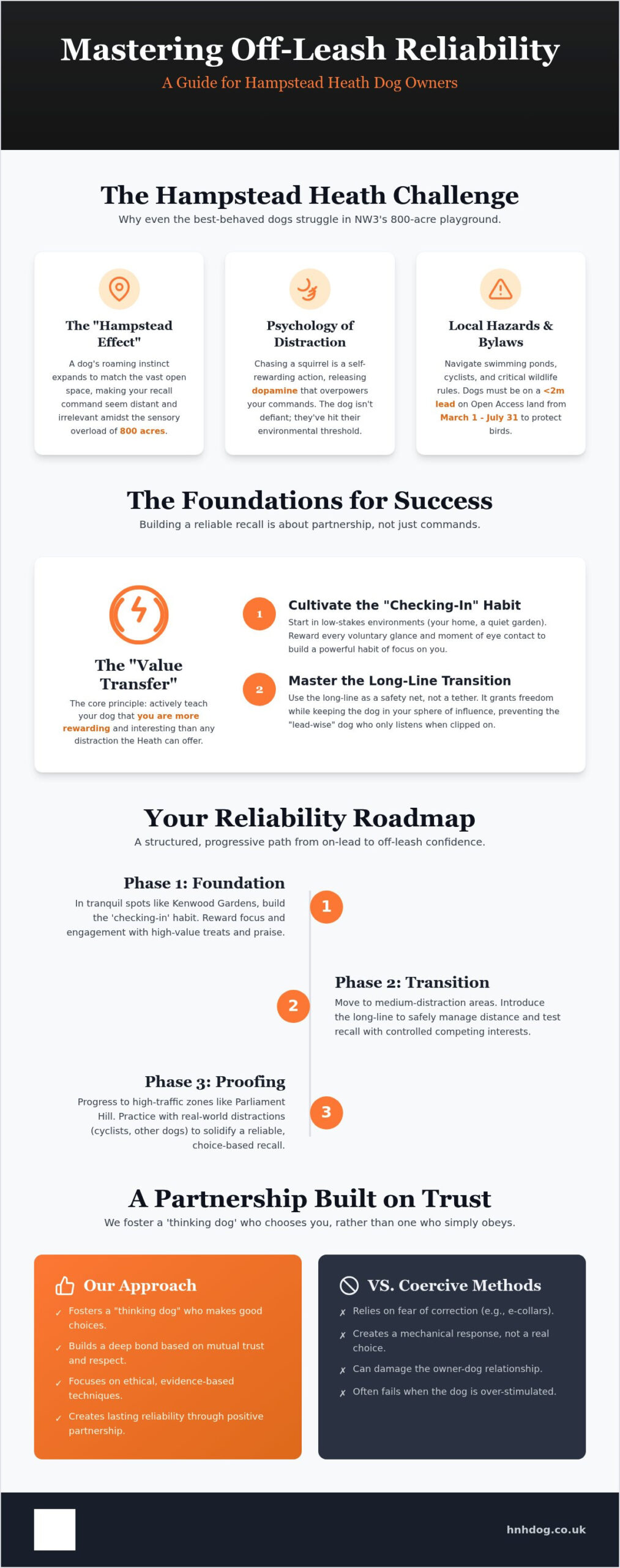
Step-by-Step: The Reliability Roadmap for the Heath
Progressing toward off-leash freedom requires a structured approach that respects your dog’s current abilities while gradually testing their focus. We view this as a roadmap, moving from controlled environments to the open expanses of North London. Successful off-leash reliability training Hampstead Heath is never about rushing to unclip the lead; it’s about ensuring your dog is emotionally prepared for the next level of distraction.
- Phase 1: Foundation. Begin in the quieter, enclosed corners of Golders Hill Park or the manicured lawns near Kenwood House. These areas provide a lower sensory load, making it easier for your dog to choose you over the environment.
- Phase 2: Distance and Duration. Move toward the open spaces near the athletics track. Use a 10-metre long-line to practice recalls while your dog is exploring. This builds the “muscle memory” of returning to you from a distance without the risk of them wandering off.
- Phase 3: Controlled Socialisation. Practice your engagement drills on the high-traffic paths leading to the Parliament Hill café. Here, the challenge is maintaining focus as other dogs and families pass by in close proximity.
- Phase 4: Off-Leash Trials. Conduct your first short trials in low-wildlife zones during quieter hours. Always follow a “safety first” protocol, only unclipping when you’ve had five successful “check-ins” in a row.
If you’re ready to start this journey with professional support, our 1-to-1 dog training sessions are designed to guide you through each phase with confidence.
The Emergency Recall: Your Safety “Panic Button”
Every dog walking on the Heath needs a “panic button” cue. This is a unique whistle or high-pitched verbal sound used only for life-or-death situations, such as your dog heading toward a busy road or a deep pond. To make this cue infallible, you must use a “Jackpot Reward” system, providing a high-value treat or a favourite game that they never receive at any other time. You must never use this specific cue for casual, everyday recalls. If you use it to bring your dog back for a routine lead-clip, the cue loses its urgency and power, potentially failing you when you need it most.
Proofing Against the “Heath Trio”: Dogs, Ponds, and Picnics
The final stage of reliability is proofing against the three biggest temptations NW3 offers. Practice calling your dog away from a play session with another dog by rewarding them and then immediately sending them back to play; this teaches them that coming to you doesn’t always mean the fun ends. For water-loving breeds, work on your recall before they reach the water’s edge, rewarding the choice to turn back. Finally, a robust “Leave It” command is essential for protecting your dog from discarded picnic scraps and ensuring you don’t become the local nuisance near the Parliament Hill benches.
Investing in a Shared Life: The H&H Dog Difference
Investing in your dog’s education is ultimately an investment in your shared freedom. While many owners struggle for years with inconsistent recall, expert guidance provides a steady hand and a logical shortcut to a stress-free life. Our approach to off-leash reliability training Hampstead Heath values long-term emotional health over quick, forceful fixes. With over 20 years of professional industry experience, we understand that the goal isn’t just a dog that obeys commands. It’s a dog that chooses to stay connected with you because they trust your partnership. Trust is earned through patience and ethical methodology, not enforced through fear.
Transitioning away from a reliance on the lead enriches your dog’s mental and physical health in ways that a pavement walk never can. The ability to explore the diverse textures and scents of the Heath provides essential sensory enrichment, reducing boredom and the behavioural issues that often follow it. This freedom is a privilege that relies on a foundation of mutual respect. We help you move beyond the clinical coldness of basic obedience to foster a relationship where your dog checks in naturally, ensuring every outing is a source of joy rather than anxiety.
Bespoke Support for Every Temperament
Every dog brings a unique history to the trails of North London. Whether you’re supporting a nervous rescue through their first urban walks or managing the exuberant energy of a high-drive adolescent, we tailor every session to the individual. Generic, mass-market training models often fail because they ignore the nuances of a dog’s internal emotional state. For complex challenges that require a deeper look at underlying motivations, our Dog Behaviourist London services provide the specialised, ethical care needed to rebuild confidence. We act as your lifelong canine mentor, offering supportive guidance as your dog matures and their needs evolve.
Take the First Step Toward Off-Leash Freedom
Your journey toward a more relaxed walk begins with a comprehensive 1-to-1 consultation. We assess your dog’s current focus, identify specific environmental triggers, and establish clear, manageable goals. We use the Heath as our primary classroom, ensuring that the skills you learn are effective in the presence of real-world distractions like the Parliament Hill crowds or the wildlife near the ponds. This practical approach demystifies complex psychological concepts and gives you immediate control over your dog’s progress. Improvement is inevitable when you have the right tools and a customized plan. Book your bespoke off-leash training session today to begin your transition toward a life of shared trust and freedom.
Your Path to Stress-Free Freedom on the Heath
Mastering off-leash reliability training Hampstead Heath is a transformative journey that shifts your relationship from one of physical control to one of mutual trust. By understanding your dog’s internal emotional state and following a structured, step-by-step roadmap, you can learn to navigate high-distraction environments like Parliament Hill with calm confidence. We’ve seen that building a “checking-in” habit and utilizing ethical, non-coercive methods ensures your dog chooses you over the park’s many sensory temptations. This foundation allows you to enjoy the vast landscape of NW3 without the constant anxiety of a lost focus.
With over 20 years of professional expertise, we provide the gold standard in personalised care tailored to your dog’s unique temperament. Our deep familiarity with North London’s urban challenges allows us to use the Heath as a practical classroom for real-world success. You don’t have to face the anxiety of poor recall or the fear of your dog wandering toward the ponds alone. Book Your Bespoke 1-to-1 Training Session at Hampstead Heath today to start building a bond that lasts a lifetime. We are here to act as your steady hand, ensuring every walk becomes a source of shared joy and freedom.
Frequently Asked Questions
Is my dog too old to learn off-leash reliability for the Heath?
No dog is too old to improve their focus. While puppies are often seen as blank slates, senior dogs possess a level of maturity that can actually aid the learning process. We focus on building new neural pathways through consistent, positive reinforcement. Whether your dog is two or ten, the goal is to enhance their internal desire to check in with you during off-leash reliability training Hampstead Heath.
How many sessions will it take for my dog to be reliable off-leash?
The number of sessions varies significantly based on your dog’s history and your own consistency between meetings. Most owners begin to see a noticeable shift in focus after three to four sessions, but true reliability in high-distraction environments like the Heath is a gradual process. We provide bespoke plans that adapt to your progress, ensuring we move at a pace that respects your dog’s emotional capacity and learning speed.
What should I do if my dog ignores me and runs toward the ponds?
Avoid chasing your dog, as this often triggers a secondary game of “catch me if you can.” Instead, try moving rapidly in the opposite direction or dropping to the ground to pique their curiosity. These actions utilize your dog’s natural interest in novel movements. Once you’ve regained their attention, reward them heavily for the return. This reinforces that coming back to you is always the most rewarding choice they can make.
Can high-prey drive breeds like Sighthounds ever be trusted off-leash?
High-prey drive breeds can certainly enjoy off-leash freedom, but it requires a deeper understanding of their biological motivations. We use specific engagement drills that channel these instincts into productive focus on the owner. While some individuals may always require the safety net of a long-line in high-wildlife zones, many Sighthounds and Terriers achieve excellent recall through our evidence-based, non-coercive methods that prioritize the bond over forceful control.
Are there specific areas of Hampstead Heath where dogs must be on a lead?
Yes, certain areas of the Heath require dogs to be on a lead for safety and conservation. You must use a lead in the formal gardens at Golders Hill Park, around Kenwood House, and near all children’s play areas. Additionally, between 1st March and 31st July, dogs must be on a lead of no more than two metres on “Open Access” land to protect ground-nesting birds. Always check local signage to stay compliant.
What training equipment do I need for our first session at the Heath?
For your first session, we recommend a well-fitted harness and a 5 to 10-metre long-line rather than an extendable lead. You’ll also need a variety of high-value rewards that your dog doesn’t receive at home. If you’re using a whistle for your emergency recall, bring that along too. This equipment allows us to practice off-leash reliability training Hampstead Heath safely while maintaining a supportive connection with your dog during the learning process.
How do I handle other off-leash dogs approaching mine during training?
Managing unexpected interactions is a key part of training in a public park. If an off-leash dog approaches, try to remain calm to avoid telegraphing anxiety to your own pet. You can use body blocking to create a physical barrier or toss a handful of treats toward the approaching dog to distract them. Clear communication with the other owner is also helpful. We teach you these management skills to protect your dog’s focus.
What is the difference between a dog trainer and a behaviourist for recall issues?
A dog trainer generally focuses on teaching specific skills and mechanics, such as a reliable “sit” or “come.” A behaviourist looks at the underlying emotional state driving the actions, such as fear or predatory drive. If your dog’s recall issues are rooted in anxiety or over-arousal, a behavioural consultation may be necessary. At H&H Dog, we combine both perspectives to offer a holistic, ethical approach to your dog’s welfare and training.