
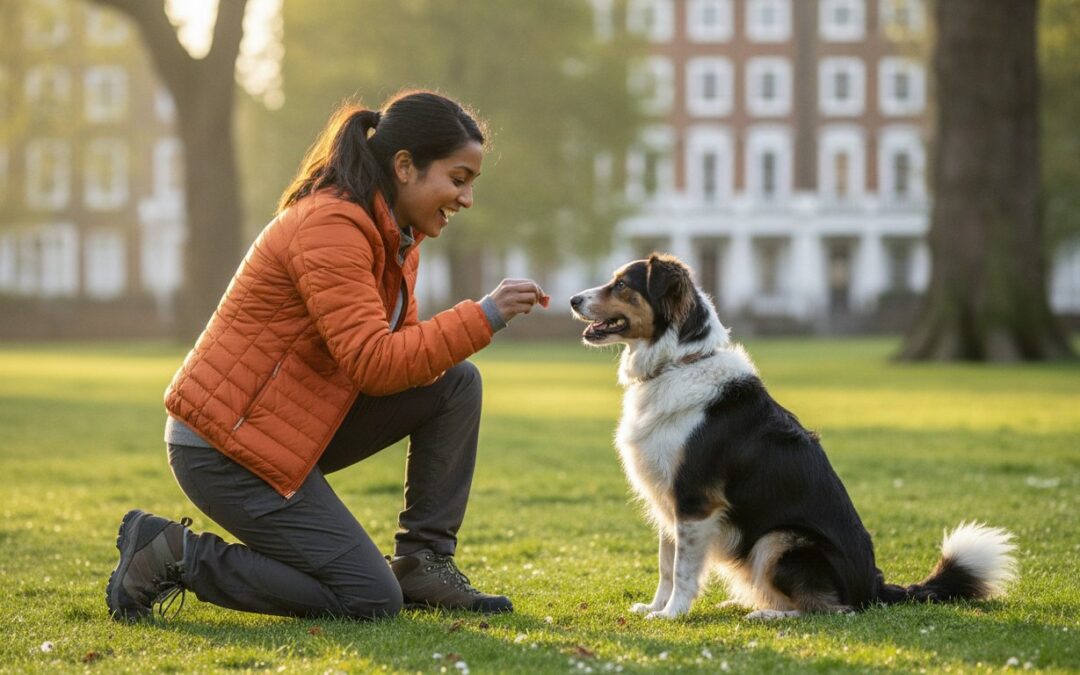
What if your dog’s frantic reaction to a passing cyclist or a crowded North London park wasn’t a sign of defiance, but a request for a clearer communication system? It is incredibly draining to feel a flash of embarrassment when your pet lunges on the lead, especially when you are already anxious about their safety in such a high-stimulus environment. You likely feel the weight of conflicting advice from every corner of the internet, leaving you unsure which path is truly ethical and effective. We understand that you want a peaceful life together, free from the stress of unpredictable behaviour.
By partnering with a skilled positive reinforcement dog trainer London, you can move past outdated dominance theories and embrace a science-based approach tailored to urban life. This guide will show you how reward-focused techniques transform your dog’s internal emotional state rather than just suppressing outward actions. You will learn to navigate the unique challenges of the city with confidence, fostering a deep bond built on trust and mutual respect. We will explore the essential tools needed for real-world scenarios, ensuring your dog becomes a calm, well-adjusted companion in any setting from busy high streets to quiet residential roads.
Key Takeaways
- Understand how science-based rewards facilitate lasting behavioural change by working with your dog’s natural biology rather than through suppression.
- Explore the ‘Stress Bucket’ concept to understand why your dog may struggle with focus in busy urban settings and how to lower their anxiety levels.
- Learn how to select a qualified positive reinforcement dog trainer London by looking for accredited certifications that guarantee ethical, force-free methods.
- Master actionable strategies for real-world London scenarios, including lead reactivity on narrow pavements and high-distraction recall in busy parks.
- Transition from a hierarchy-based approach to a trust-based partnership that values your dog’s emotional well-being and long-term adjustment.
What is Positive Reinforcement Dog Training in London?
At its heart, positive reinforcement training is a sophisticated communication system. It shifts the focus from stopping “bad” behaviours to actively rewarding the ones we want to see more often. In the UK, we’ve seen a significant transition away from correction-based methods. We now prioritise understanding over obedience. When you work with a positive reinforcement dog trainer London, you aren’t just teaching a “sit”; you’re building a shared language that survives the chaos of city life.
London is a high-pressure environment for a dog. The constant hum of traffic and the proximity of strangers on narrow pavements can be overwhelming. This is why a trust-based foundation is non-negotiable. You aren’t a “pack leader” or an “alpha” figure demanding submission. Instead, you’re a supportive mentor. Your job is to guide your dog through these stimuli with a steady hand and a clear plan. By adopting your dog’s perspective, you can help them feel safe in situations that might otherwise trigger fear or reactivity.
The Core Principles of Reward-Based Learning
To understand this method, we look at operant conditioning. While science identifies four quadrants of learning, we focus on the most ethical one: adding something the dog loves to reinforce a choice they made. Timing is everything here. If you’re walking through Primrose Hill and your dog chooses to look at you instead of a passing squirrel, that reward needs to arrive instantly. This clear feedback loop tells the dog exactly what they did right, making the learning process logical and stress-free.
Many owners worry they’re “bribing” their pet. There’s a vital difference. A bribe is shown before the behaviour to lure them; a reinforcement is the “paycheck” delivered after the desired action. By using high-value rewards, you’re building a history of success. This makes your dog want to listen, even when the city is at its loudest. When you consult a positive reinforcement dog trainer London, we use these tools to build focus and engagement in real-world scenarios.
Why ‘Force-Free’ is the Gold Standard for Urban Pups
Aversive tools like prong collars or heavy slip leads might seem like a quick fix for a dog that pulls, but they carry a heavy psychological cost. In a busy city, these tools often increase anxiety. A dog that is corrected for reacting to a bus may eventually associate the bus itself with pain. This leads to a “shut down” effect where the dog stops reacting because they’re terrified, not because they’re calm. It’s a dangerous state that masks underlying distress and can lead to unpredictable outbursts later.
Choosing force-free methods ensures your pet remains an active participant in their education. We want a dog that cooperates because they trust the outcome, not one that is simply avoiding failure. This approach preserves their emotional health, which is the most important factor for a long, happy life together in North London. It builds a resilient, confident pet that can handle the complexities of the capital with ease.
The Science of Learning: Why Rewards Beat Punishment
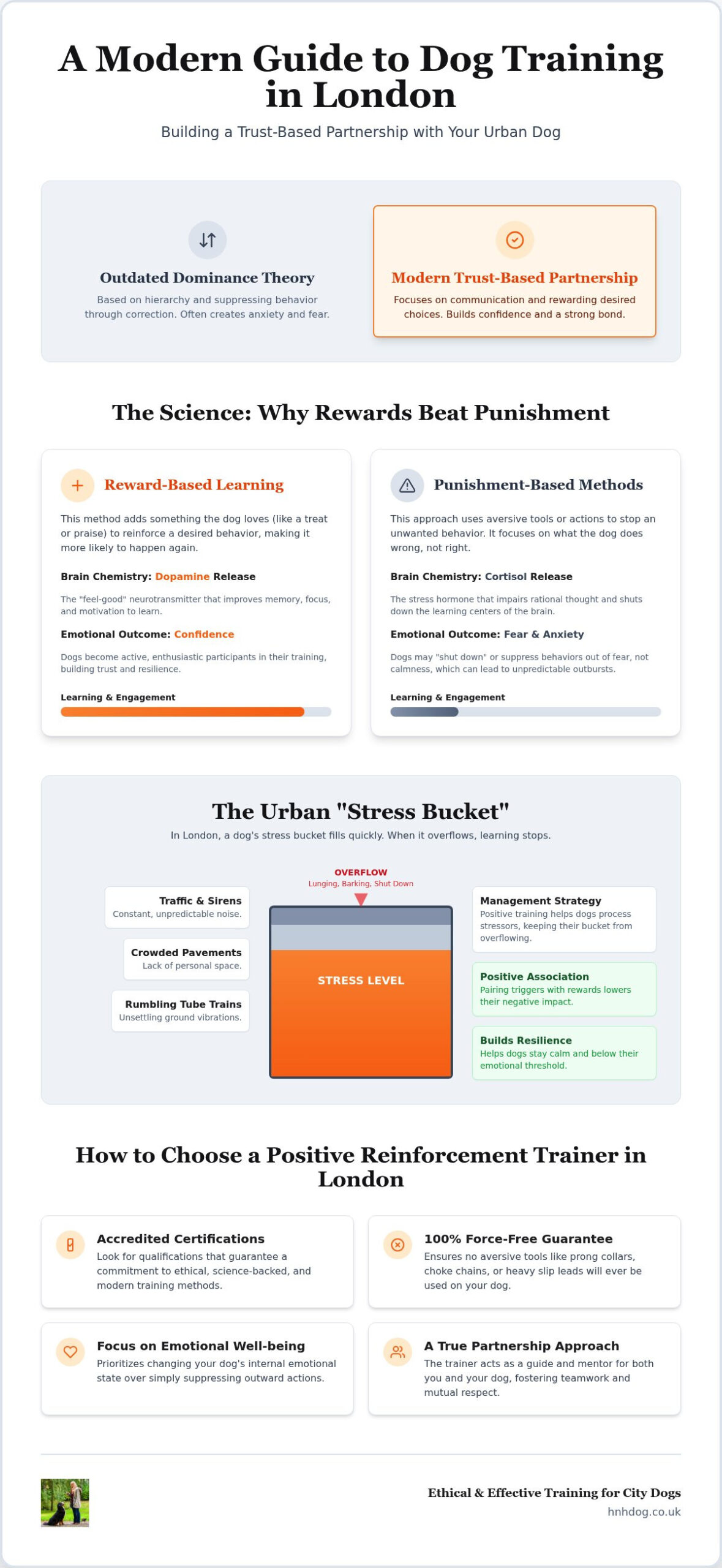
To understand why modern methods succeed, we must look at the canine brain’s chemical response to stimuli. When your dog earns a reward, their system is flooded with dopamine, a neurotransmitter that facilitates memory and focus. Conversely, punishment or fear triggers the release of cortisol, the stress hormone. High levels of cortisol effectively shut down the parts of the brain responsible for rational thought and learning. This is a core reason why the veterinary position on humane training strongly favours reward-based methods. By prioritising emotional regulation, a positive reinforcement dog trainer London ensures your pet remains in a state of mind where they can actually process new information.
Think of your dog’s emotional capacity as a “stress bucket.” In a city like London, that bucket fills quickly with every siren, crowded pavement, or rumbling tube train. When the bucket overflows, your dog enters a state of “flooding” where they can no longer listen or learn. Positive reinforcement creates long-term neural pathways by building positive associations with these triggers. Over time, this process helps your dog stay below their threshold, allowing them to remain calm even in a high-pressure urban environment.
Demystifying Canine Learning Theory
Classical conditioning is the process where your dog learns to associate a neutral stimulus, such as a London doorbell or a passing siren, with an inevitable emotional outcome. Desensitisation and counter-conditioning work in tandem to change these associations. We gradually expose the dog to a trigger at a level they can handle while providing high-value rewards. This is enhanced by choice-based training, which gives the dog a sense of agency. When a pet feels they have a choice in how to respond, their confidence grows, replacing reactive impulses with thoughtful cooperation.
Why Punishment Often Backfires in the City
Punishment-based methods carry a significant risk of “fallout,” where a dog incorrectly associates a correction with something in their environment. For instance, if a dog is jerked on the lead for lunging at a cyclist, they may learn that the presence of cyclists causes pain. This increases their anxiety rather than solving it. Similarly, suppressing a growl through intimidation is a dangerous tactic. A growl is a vital communication tool; removing it doesn’t fix the underlying fear, it simply creates a dog that may bite without warning because their “early warning system” has been silenced.
We believe in moving beyond the “quick fix” to solve the underlying emotional root of the behaviour. If you’re feeling overwhelmed by your pet’s reactions, our behavioural consultations offer a steady, ethical path toward a calmer, more predictable life together. By focusing on partnership rather than punishment, we help you build a relationship that’s resilient enough for the busiest London streets.
Solving Common London Dog Behavioural Issues Positively
Living in London presents a unique set of hurdles that suburban training guides often ignore. Narrow North London pavements and crowded tube carriages require a level of impulse control that doesn’t come naturally to most dogs. When you work with a positive reinforcement dog trainer London, we focus on practical, real-world applications. We don’t just train in quiet halls; we train for the reality of a morning walk near a busy bus route or a weekend trip to a dog-friendly cafe. Your dog isn’t being “naughty” when they bark at a cyclist. They’re likely just overwhelmed by the proximity of the stimulus.
Lead reactivity is often rooted in a feeling of being trapped. On a tight pavement, your dog cannot move away from a perceived threat, so they resort to lunging or barking to create space. We address this by teaching your dog that they can look at a trigger without needing to react. Similarly, mastering recall in high-distraction areas like Hampstead Heath isn’t just about a whistle. It’s about being more interesting than a squirrel or a group of playing dogs. We build this through high-value engagement games that make returning to you the most rewarding choice your dog can make, even when distractions are at their peak.
For many Londoners, the shift to hybrid working has created a new challenge: separation anxiety. Dogs that became accustomed to constant company now struggle with the sudden silence of an empty flat. We solve this through gradual, low-stress departures that build your dog’s confidence in being alone. We also work on “City Anxiety,” helping your pet learn to settle calmly under a table while you enjoy a coffee. This holistic approach ensures your dog is a welcome guest in all aspects of your London lifestyle, rather than a source of stress.
Urban Neutrality: The Secret to a Calm London Dog
Urban neutrality is the ability to dismiss distractions rather than fixating on them. We use “Look at That” (LAT) games to help your dog acknowledge a siren or a cyclist and then immediately check back in with you for guidance. This changes their emotional response from alert to relaxed. A reliable “settle” command is equally vital. It provides your dog with a clear job to do in a busy environment, which lowers their overall arousal levels and prevents them from becoming overwhelmed by the city’s constant motion. It’s about building a dog that can thrive amidst the noise.
Stress-Free Socialisation in Busy London Parks
Many owners feel pressured to let their dogs greet every pet they meet. However, forced socialisation in busy parks can lead to fear and trauma. It’s your role to advocate for your dog’s space, ensuring they never feel cornered by an over-enthusiastic stranger. If your dog needs more social development, we recommend controlled group dog walking. This provides a structured environment where your pet can learn to be around others without the pressure of direct, high-energy interactions. It’s a safer, more ethical way to build their social confidence.
How to Choose a Positive Reinforcement Trainer in London
Selecting a positive reinforcement dog trainer London is one of the most significant decisions you’ll make for your pet’s welfare. Since the UK dog training industry is currently unregulated, the burden of vetting falls on the owner. You should prioritise professionals accredited by reputable bodies such as the ABTC, APDT, or PACT. These credentials ensure the trainer uses evidence-based, non-coercive methods. A mentor with 20+ years of professional experience understands that every dog is an individual. They will avoid generic, mass-market models in favour of a bespoke approach that respects your pet’s unique personality.
Adversarial terminology is a major red flag. If a trainer mentions “alpha” status, “dominance,” or “balanced” training, they’re likely using outdated concepts that rely on suppression rather than communication. These methods can be particularly damaging in high-stimulus urban areas, where a dog’s anxiety is already heightened. Instead, look for a partner who prioritises emotional health and uses logic-based phrasing to explain your dog’s motivations. This calm, ethical approach ensures that every challenge has a manageable solution.
Questions to Ask Your Potential Trainer
A vital question to ask is: “What happens when my dog gets it wrong?” An ethical trainer will never use a physical correction. They will instead focus on managing the environment to set the dog up for success or using redirection to a desired behaviour. You deserve a clear explanation of their methodology without confusing jargon. Ensure they provide a structured path forward with manageable homework and ongoing support. This personal mentorship is what makes the difference between a temporary fix and a lifelong bond.
1-To-1 Training vs. Group Classes in the City
Group classes often take place in echoey community halls or busy parks, which can be far too intense for a nervous London pup. When a dog is overwhelmed, their ability to learn disappears. Opting for 1-to-1 dog training allows us to work in the specific locations where you face challenges. Whether it’s your local high street or the stairs in your flat, training in the actual environment is far more effective. This allows for a customised plan that fits your schedule and focuses on the real-world scenarios you encounter daily.
If you’re looking for a steady, ethical solution to your dog’s behavioural challenges, reach out for a behavioural consultation to begin your journey toward a calmer life together.
The H&H Dog Approach: Holistic Care for North London Dogs
Our methodology is built upon over 20 years of professional experience, a legacy that translates into a sense of calm confidence for the owners we mentor. We understand that the city can be a chaotic environment, which is why our approach is rooted in steady, ethical solutions rather than quick, forceful fixes. As a dedicated positive reinforcement dog trainer London, we don’t view training as a siloed activity that only happens during a scheduled session. Instead, we see it as a fundamental part of your dog’s lifestyle. We proudly serve the diverse communities of North London, North West London, and Watford, providing a local expertise that understands the specific pressures of urban pet ownership.
The H&H difference lies in our commitment to the dog’s internal emotional state. While many trainers focus solely on outward obedience, we prioritise how your dog feels. A dog that sits because they’re terrified is not a well-adjusted pet; they’re a suppressed one. By focusing on partnership and mutual understanding, we help you foster a shared life where your dog feels safe to make the right choices. This holistic perspective ensures that every interaction, from a walk in the park to a quiet evening at home, strengthens your trust-based relationship.
Positive Reinforcement in Mobile Grooming
We believe that training principles should extend to every aspect of canine care, including hygiene. Traditional grooming environments can be incredibly stressful for sensitive pets, which is why we utilise mobile dog grooming to provide a one-to-one, low-stimulus experience. During a Full Groom or a Bath & Brush, we employ “Cooperative Care” techniques. This means we listen to the dog’s signals and allow them to have a say in the process. By using patience and high-value treats, we build a positive association with the grooming van, ensuring the experience is supportive rather than frightening.
Behavioural Consultations and Personalised Support
For more complex challenges such as aggression, extreme fear, or deep-seated reactivity, a standard training class is rarely enough. These issues require the deep-dive assessments offered in our behavioural consultations. We take the time to unpick the underlying motivations behind the behaviour, looking at the environment, health, and history of the individual dog. This allows us to create a sustainable, bespoke path forward that respects the animal’s welfare at every step. If you’re ready to move beyond conflicting online advice and embrace a professional, empathetic approach, you can contact H&H Dog to begin a customised journey of care and transformation.
Building a Resilient Future for Your London Dog
Thriving in the capital requires more than just basic obedience; it demands a deep, trust-based partnership that can withstand the unique pressures of urban life. We’ve explored how science-based communication replaces the need for force, allowing your dog to navigate high-stimulus environments with genuine calm. By focusing on emotional regulation and understanding the “stress bucket,” you move away from suppression and toward a relationship built on mutual respect. Every challenge you face on a busy North London pavement is an opportunity to strengthen this bond through ethical, reward-focused guidance.
Selecting a qualified positive reinforcement dog trainer London is the first step toward a more peaceful life together. At H&H Dog, we bring over 20 years of professional experience to every consultation, specialising in the needs of nervous and urban dogs. We don’t believe in generic solutions. Instead, we provide bespoke plans tailored to your specific London lifestyle and your pet’s individual personality. If you’re ready to see a transformation in your dog’s confidence and your own peace of mind, book a bespoke 1-to-1 training session with H&H Dog today. You have the tools to create a shared life filled with trust and joy.
Frequently Asked Questions
Is positive reinforcement training effective for aggressive dogs in London?
Yes, positive reinforcement is highly effective for aggression because it addresses the underlying emotional state rather than just the outward action. In a busy city, aggressive outbursts are often rooted in fear or overstimulation. By changing how your dog feels about their triggers, we create a safer, more predictable pet. A positive reinforcement dog trainer London focuses on building trust and providing your dog with alternative, non-confrontational coping strategies for urban encounters.
How long does it take to see results with reward-based training?
The timeline for results varies based on the individual dog’s history and the consistency of the training. You will often see small, encouraging changes in focus and engagement within the first few sessions. However, modifying deep-seated habits or emotional responses in a complex city environment requires patience and repetition. We focus on sustainable, long-term progress rather than temporary quick fixes, ensuring your dog develops the resilience needed for London life.
Do I always have to carry treats for the rest of my dog’s life?
You won’t necessarily need a pocket full of treats forever. Once a behaviour is reliably learned, we transition to an intermittent reinforcement schedule, meaning rewards are given less frequently to maintain the habit. However, living in a high-stimulus environment is hard work for a dog. Continuing to acknowledge and reward good choices in challenging situations ensures those behaviours remain strong. Think of it as a periodic “thank you” for their cooperation.
Can an older rescue dog learn through positive reinforcement?
Absolutely, older rescue dogs are perfectly capable of learning through reward-based methods. While the “you can’t teach an old dog new tricks” myth persists, canine brains remain plastic throughout their lives. Positive reinforcement is particularly beneficial for rescues as it builds the trust and security they may have lacked in the past. It offers a gentle, non-threatening way to help them adapt to the sights and sounds of a new London home.
What should I do if my dog is too distracted by London traffic to take a treat?
If your dog refuses a treat, they are likely “over threshold,” meaning their stress levels are too high to process food. In these moments, the most effective tool is distance. Move away from the traffic or noise until your dog’s heart rate slows and they can focus again. We teach you how to read these early signs of overstimulation, allowing you to advocate for your dog’s space before they become overwhelmed.
How much does a professional dog trainer cost in London?
Professional training rates in London vary significantly based on the trainer’s level of expertise, their certifications, and the complexity of the issues being addressed. Bespoke 1-to-1 sessions typically represent a higher investment than group classes because they offer a customised plan and the trainer’s undivided attention in your dog’s actual environment. When considering the cost, it is helpful to view it as an investment in your pet’s long-term emotional health and your shared peace of mind.
What is the difference between a dog trainer and a behaviourist?
A dog trainer typically focuses on teaching specific skills like recall or lead walking. A behaviourist specialises in unpicking complex emotional issues such as aggression or severe anxiety. Our behavioural consultations allow us to conduct a deep-dive assessment into your dog’s internal state, while our 1-to-1 training provides the practical skills needed to navigate the city safely. This holistic approach ensures every challenge has a manageable, ethical solution that respects your dog’s welfare.
Is positive reinforcement the same as ‘purely positive’ training?
Positive reinforcement is a science-based methodology that focuses on rewarding desired actions, but it doesn’t mean a lack of boundaries. We use management and redirection to prevent unwanted behaviours without resorting to fear or pain. A positive reinforcement dog trainer London avoids the “purely positive” label if it implies ignoring safety. Instead, we use ethical, non-coercive tools to guide your dog, ensuring they understand what is expected while keeping their emotional health as our top priority.