
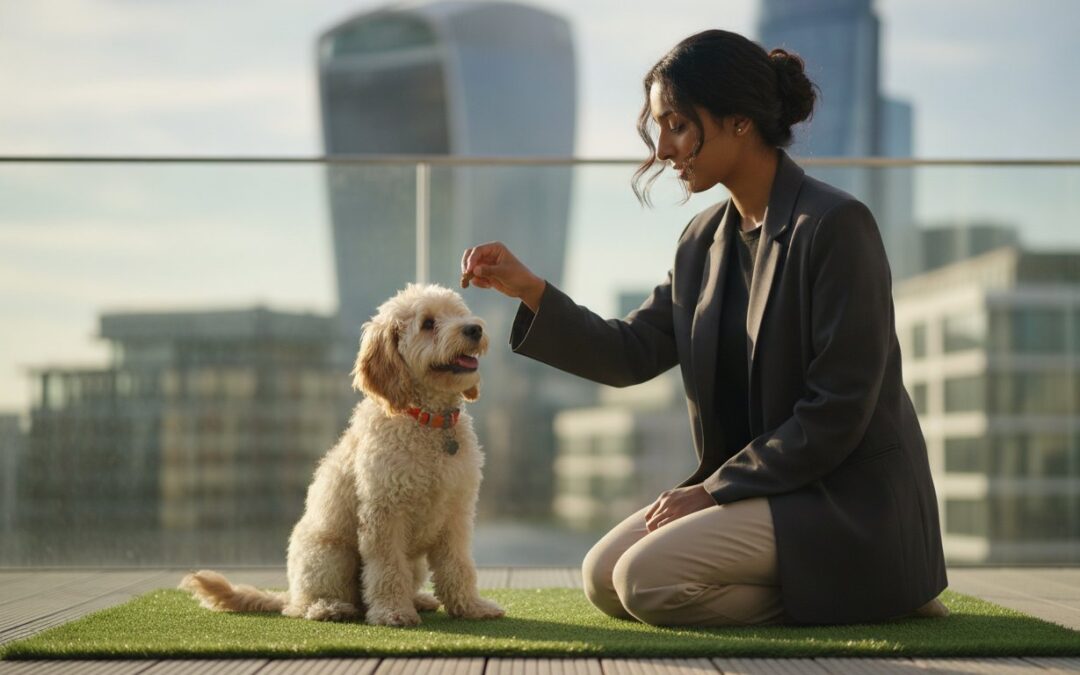
Mastering puppy toilet training in London often feels like a high-stakes race against the clock and your own exhaustion levels. You might believe that living in a third-floor flat or balancing a demanding career makes a clean home an impossible dream, but the secret isn’t just more frequent walks; it’s about refined communication. It is completely natural to feel overwhelmed by conflicting advice regarding puppy pads or the constant anxiety of a ruined rug. We understand that the unique pressures of urban living can quickly turn the joy of a new companion into a cycle of hyper-vigilance and owner burnout.
You deserve a living space that feels like a sanctuary rather than a minefield of potential accidents. This guide provides a sophisticated, evidence-based approach to house training designed specifically for the London lifestyle. We will move beyond outdated, coercive methods to establish a reliable routine rooted in mutual trust and clear environmental management. You are about to learn how to master a clean, accident-free home while fostering a deeper emotional connection with your puppy through patience and professional mentorship.
Key Takeaways
- Understand how to navigate the specific logistical hurdles of high-rise living, ensuring your puppy remains focused despite the distractions of communal hallways and lifts.
- Learn the biological “month plus one” rule to set realistic expectations for your puppy’s bladder capacity and physical development.
- Master a bespoke routine for puppy toilet training London that integrates seamlessly with a busy urban schedule and various flat layouts.
- Explore the benefits of creating a dedicated “scent post” or using effective balcony solutions to provide your puppy with a clear, consistent toileting location.
- Discover how 1-to-1 professional mentorship and mobile grooming services can help you manage hygiene and resolve complex house-training challenges.
Why London Life Makes Puppy Toilet Training a Unique Challenge
Living in a city like London changes the fundamental nature of house training. While standard advice often suggests taking a puppy out every hour, this rarely accounts for the reality of navigating a ten-storey apartment block or waiting for a lift during the morning rush. For residents in North London and Watford, the architecture of your home dictates your training strategy. A Victorian conversion with a shared garden requires a different protocol than a modern high-rise. Successful puppy toilet training London relies on acknowledging these environmental pressures rather than fighting them. It’s about adapting the principles of The Science of House Training to fit a vertical landscape.
The puppy pad debate is particularly relevant for urban owners. While these pads offer a temporary solution for those without immediate garden access, they can sometimes hinder long-term progress by confusing the puppy about which textures are appropriate for toileting. If a puppy learns that soft, absorbent surfaces inside the home are acceptable, your expensive rugs may become unintended targets. A bespoke strategy often involves moving away from these pads as quickly as possible, or replacing them with synthetic or real grass patches that mimic the outdoor environment.
The Logistics of High-Rise Puppy Parenting
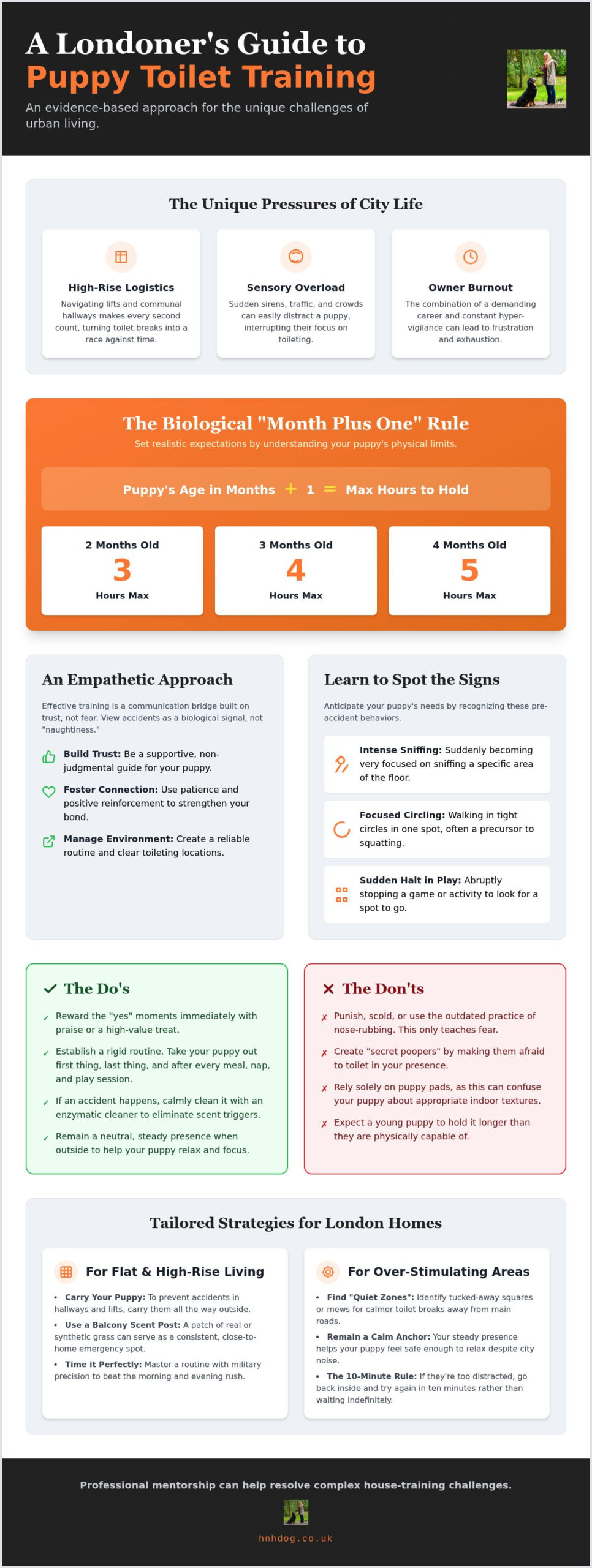
When you live several floors up, the “every second counts” rule becomes literal. Carrying your puppy through communal hallways and down lifts is often necessary to prevent accidents before you reach the pavement. You must manage the transition from your front door to the street with military precision. Timing is everything. Setting up a designated indoor “emergency” spot on a balcony can bridge the gap during the early weeks, but it shouldn’t replace outdoor excursions. A rigid routine is the only real antidote to the “London rush” that often disrupts a puppy’s internal clock. Consistency creates a sense of safety for your pup.
Sensory Overload and Toilet Breaks
The urban environment is a symphony of distractions. A sudden siren or a passing bus can easily interrupt a puppy’s focus, causing them to “forget” why they are outside. This sensory overload is why many London pups struggle to go while on a lead. Identifying “quiet zones” in North West London, such as tucked-away mews or smaller residential squares, provides the calm necessary for them to relax. Your goal is to remain a neutral, steady presence. If your pup is too distracted by the city noise, head back inside and try again in ten minutes. Patience in these high-stimulation environments is essential for building long-term reliability.
The Science of House Training: An Empathetic Approach
Effective puppy toilet training London requires you to look beyond the puddle on the floor and understand the internal emotional state of your companion. Toilet training is not merely a physical habit; it is a communication bridge built on trust. When we view a puppy’s accidents through the lens of biological limits rather than “naughtiness”, we can remain calm and supportive mentors. To build a solid foundation, many owners find it helpful to follow A Step-by-Step Routine for Toileting Success, which aligns with modern, evidence-based welfare standards.
A puppy’s bladder capacity is governed by a simple biological guideline known as the “month plus one” rule. This suggests that the number of months your puppy has been alive, plus one, equals the maximum number of hours they can physically hold their bladder. For a two-month-old pup, this means a three-hour limit is their absolute maximum. Expecting more from them is not just unrealistic; it is physically impossible for their developing muscles. By using pattern recognition, you can learn to anticipate their needs before they become urgent. Watch for the sudden halt in play, the intense sniffing of a specific floor area, or the focused circling that precedes an accident.
It is vital to avoid any form of punishment, such as scolding or the outdated practice of nose-rubbing. These adversarial methods do not teach the puppy where to go; they only teach the puppy to fear you. This fear often creates “secret poopers” who learn to hide their business behind the sofa or in another room to avoid your presence. This destroys the bond of partnership you are trying to build. Instead, focus on being a steady, non-judgmental guide who rewards the “yes” moments.
The Biological Clock: When Puppies Need to Go
Your puppy’s internal clock is remarkably predictable. There are three non-negotiable windows when a toilet break is essential: immediately after waking from a nap, within fifteen minutes of eating a meal, and directly following a session of high-energy play. Because puppies require up to 20 hours of sleep a day to support their rapid growth, their digestive systems are constantly resetting during these rest periods. Positive reinforcement is the practice of rewarding desired behaviours with something the puppy values, such as food or praise, to ensure those actions are repeated. If you find these patterns difficult to manage alone, our 1-to-1 puppy training sessions offer bespoke guidance tailored to your specific home environment.
Building a “Yes” Culture at Home
Creating a “yes” culture means setting your puppy up for success by managing their environment. If you cannot give them your full attention, use a crate or a puppy-safe pen to prevent unsupervised wandering. This isn’t about restriction; it’s about helping them make the right choice. When you catch them doing the right thing, reward them with genuine warmth and high-value treats. A calm, empathetic owner who focuses on what the puppy does right will always see faster progress than one who focuses on mistakes. Your patience is the most powerful tool in your training kit.
Garden vs. Flat: Tailored Strategies for London Homes
While many generic guides assume you have a sprawling back garden, we know that puppy toilet training London often takes place in much more confined spaces. Whether you have a small patio in North London or a balcony in a Watford high-rise, your strategy must be bespoke to your property type. Success isn’t about the size of the outdoor space. It’s about the consistency of the signals you provide. By adapting your approach to your specific architectural layout, you can eliminate confusion and build a reliable routine that respects both your home and your neighbours.
The Private Garden Advantage
If you are fortunate enough to have a private garden, the key is to establish a “toilet-only” zone immediately. This prevents the puppy from confusing the entire lawn with a playground. By creating a specific “scent post”, such as a small patch of mulch or a specific tree, you use their natural instincts to your advantage. This method is explored in depth within our comprehensive guide to puppy training in London, which focuses on raising well-adjusted urban dogs. Using a consistent scent marker helps trigger the puppy’s elimination reflex, making outdoor trips more efficient and less about exploration.
Survival Guide for London Flats
For flat dwellers, the balcony becomes a vital training tool. Real grass patches are often superior to artificial turf because they provide the correct tactile and olfactory feedback. This makes the eventual transition to park grass much smoother. If you are following the RSPCA’s puppy toilet training guide, you’ll know that hygiene is paramount. Use enzymatic cleaners to remove pheromones from carpets or floorboards. Standard household disinfectants often contain ammonia, which actually smells like urine to a dog and may encourage them to revisit the same spot. This simple change in cleaning products can drastically reduce repeat accidents.
The “Leash Method” is a powerful tool for puppy toilet training London residents who live in open-plan apartments. By keeping your puppy on a lead while you’re relaxing together, you ensure they stay within your immediate line of sight. This allows you to catch the subtle circling or sniffing cues that precede an accident. When navigating communal hallways or lifts, etiquette is crucial. Always carry your pup or keep them on a very short lead to avoid accidents on shared carpets. This proactive approach maintains positive relationships with your neighbours and keeps the building environment clean for everyone.
A Step-by-Step Routine for Toileting Success
Consistency is the secret weapon of any successful urban dog owner. By setting a 24-hour clock, you transform a potentially chaotic living situation into a predictable environment where your puppy feels secure. This structure helps your pup understand exactly when and where they are expected to relieve themselves, reducing the anxiety that often leads to indoor accidents. While puppy toilet training London presents unique logistical hurdles, a disciplined routine ensures that these challenges become manageable daily habits rather than sources of stress.
The Hourly Commitment
For the first 14 days of your puppy’s arrival, a 60-minute timer is your most valuable tool. Taking your puppy to their designated spot every hour, regardless of whether they show signs of needing to go, builds a powerful history of success. We recommend using a “Success Journal” to track meal times, water intake, and successful outdoor breaks. This data-driven approach allows you to identify your puppy’s unique patterns. If you take them out and they don’t go within ten minutes, bring them back inside but keep them under close supervision or on a lead. Try again in ten minutes. This “10-minute rule” prevents the frustration of waiting aimlessly on a busy street while ensuring you don’t miss the next window of opportunity.
Night-time Management
Managing the overnight hours requires a balance of empathy and pragmatism. Crate training is often the most effective method for night-time bladder control, as puppies instinctively avoid soiling the area where they sleep. However, if a crate feels too restrictive for your pup, a small, confined area with easy-to-clean flooring can work equally well. Expect to provide at least one middle-of-the-night break for the first few weeks. These trips should be strictly “business only.” Keep the lights low, avoid eye contact, and do not engage in play. This teaches your puppy that night-time is for resting, not for socialising. Most puppies can begin sleeping through the night consistently between 14 and 16 weeks of age, provided their daytime routine is solid.
Your reaction to accidents is just as important as your celebration of successes. If you discover a mess, simply clean it up using an enzymatic neutraliser without comment. If you catch your puppy in the act, a gentle interruption is enough to redirect them to their correct spot. Scolding only teaches them that toileting in your presence is dangerous, which can lead to the “secret pooper” behaviour mentioned earlier. For those struggling to find a rhythm that fits a demanding city schedule, our 1-to-1 puppy training provides a customised roadmap to help you achieve a clean home faster.
The “First Light” break is the most critical trip of the day. As soon as your puppy wakes up, carry them directly to their toileting area. This prevents them from stopping in the hallway or lift on the way out. Similarly, an evening wind-down routine that involves reducing water intake approximately one hour before bed can significantly improve night-time success. By starting and ending the day on a successful note, you reinforce the “yes” culture that makes house training a bonding experience rather than a battle of wills.
Professional Support: Integrating Training, Grooming, and Walking
Success in puppy toilet training London isn’t a solo journey. While the steps outlined in previous sections provide a solid foundation, the complexities of urban architecture and demanding professional schedules often require a more integrated approach. Building a network of trusted professionals ensures that your puppy’s education continues even when you aren’t physically present. This holistic support system transforms house training from a stressful chore into a manageable, predictable part of your shared life. It’s about creating a circle of care that understands both the biological needs of the dog and the logistical realities of the city.
The Power of 1-to-1 Bespoke Training
Every London home has its own unique “blind spots”-those specific floor transitions or hidden corners that might confuse a young pup. Generic online advice cannot see your specific hallway layout or account for the exact timing of your building’s lift. This is where one-to-one dog training becomes the gold standard for urban owners. An expert eye identifies environmental triggers and customises a routine that fits your precise work-life balance. Whether you’re working from a home office in North West London or commuting from Watford, bespoke mentorship ensures your training plan is as individual as your puppy. It replaces guesswork with logic-based strategies that respect the animal’s perspective.
Holistic Care: Grooming and Socialisation
Hygiene is a frequently overlooked component of the house-training process. Accidents are inevitable in the early stages, and maintaining your puppy’s coat is essential for their comfort and your home’s cleanliness. Our mobile dog grooming Watford service provides a convenient, stress-free solution for post-accident deep cleans without the need for a stressful trip to a salon. Beyond simple hygiene, preparing for a “Puppy First Groom” ensures your pup becomes comfortable with handling from an early age. This reduces the overall anxiety that can sometimes manifest as regressive toileting behaviour.
Consistency must extend beyond your front door to be truly effective. Engaging a professional dog walking service ensures that your pup’s outdoor toileting habits are reinforced by an expert who understands the “yes” culture we’ve established. Group walking also promotes “dog-neutral” behaviour, helping your puppy remain calm and focused on their business even in high-stimulation environments. At H&H Dog, we bring 20 years of professional pet care experience to every interaction. We are committed to non-coercive, supportive methods that prioritise your puppy’s long-term emotional health. By building this long-term care network in North West London and Watford, you aren’t just solving a temporary training hurdle; you are investing in a lifetime of mutual respect and partnership.
Embarking on a Clean and Confident Journey Together
Mastering puppy toilet training London is less about rigid control and more about understanding your dog’s internal world within the context of our unique city landscape. By embracing a “yes” culture and adapting your routine to the specific logistics of your flat or garden, you’ve already taken the most important steps toward a harmonious home. Every accident is simply a data point, helping you refine your pattern recognition and timing. With a steady hand and a calm perspective, you’ll soon find that the hyper-vigilance of the early weeks gives way to a reliable, trusting partnership built on mutual respect.
If you feel that your specific home layout or busy schedule requires a more tailored approach, we are here to offer professional mentorship. With over 20 years of professional experience, we specialise in bespoke training that addresses the nuances of urban life and behaviour. From 1-to-1 sessions to mobile grooming support for post-accident care, our holistic methodology ensures you don’t have to navigate this phase alone. We focus on long-term emotional health, helping you build a bond that lasts a lifetime.
Book a bespoke 1-to-1 puppy training session with H&H Dog to fast-track your progress and secure your peace of mind. Your journey toward an accident-free home is well within reach, and we look forward to supporting you and your puppy every step of the way.
Frequently Asked Questions
How long does it take to toilet train a puppy in a London flat?
Most puppies achieve full reliability within four to six months, though you will see significant progress within the first few weeks of a consistent routine. The specific timeline for puppy toilet training London often depends on your floor level and how quickly you can reach a suitable outdoor spot. Consistency in the early stages is the most influential factor in how fast your pup learns to communicate their needs.
Should I use puppy pads if I live on the 5th floor?
While puppy pads offer immediate convenience in high-rise buildings, they can sometimes confuse a puppy by teaching them that toileting on soft, indoor surfaces is acceptable. We often recommend using real grass patches on a balcony as a more effective bridge to the outside world. This provides the correct tactile feedback, making the eventual transition to park grass much smoother for your urban pup.
What is the best way to clean up puppy accidents to stop them from happening again?
You must use a high-quality enzymatic cleaner that specifically breaks down the proteins in pet waste. Avoid using any household cleaners that contain ammonia; because urine contains ammonia, these products actually leave a scent that encourages your puppy to return to the same spot. A thorough, scent-neutralising clean is essential for breaking the cycle of repeat accidents on your carpets or floorboards.
My puppy goes as soon as we come back inside, what am I doing wrong?
This common issue usually occurs because the puppy is too overstimulated by London’s street noises to focus on their business. When they return to the quiet safety of your flat, they finally feel relaxed enough to go. To solve this, try staying in a “quiet zone” for longer or utilise the 10-minute rule: if they don’t go outside, bring them in under close supervision and try again very shortly after.
How do I toilet train my puppy while I am at work?
Successful training while you are away requires a dedicated support network to maintain the hourly schedule your puppy needs. You should arrange for a professional dog walker or a trusted friend to visit every two to three hours to provide necessary relief breaks. Leaving a puppy alone for a full workday without these breaks will lead to accidents and significantly delay their learning progress.
Is it ever too late to toilet train a rescue dog in London?
It is never too late to establish new habits with a rescue dog, regardless of their age. While adult dogs have better physical bladder control than puppies, they may have established different associations with indoor spaces. The process remains the same: use a structured routine, reward successful outdoor trips, and remain patient as they learn to navigate their new urban environment with you.
Why is my puppy suddenly having accidents after being clean for weeks?
Toileting regression is a normal part of development and is often triggered by a change in routine, a growth spurt, or environmental stress. It can also be a sign of a medical issue like a urinary tract infection, so a vet check is always a wise first step. If health issues are ruled out, simply return to the basic hourly routine for a few days to rebuild their confidence.
How much does professional 1-to-1 puppy training cost in North London?
Costs for professional support vary based on the trainer’s level of expertise and the specific requirements of your home environment. While national averages for one-to-one sessions were approximately £73.60 in early 2026, you should expect to pay more for premium, bespoke services within the capital. We recommend contacting us directly to discuss a customised plan that addresses your puppy’s unique needs and your specific London lifestyle.