
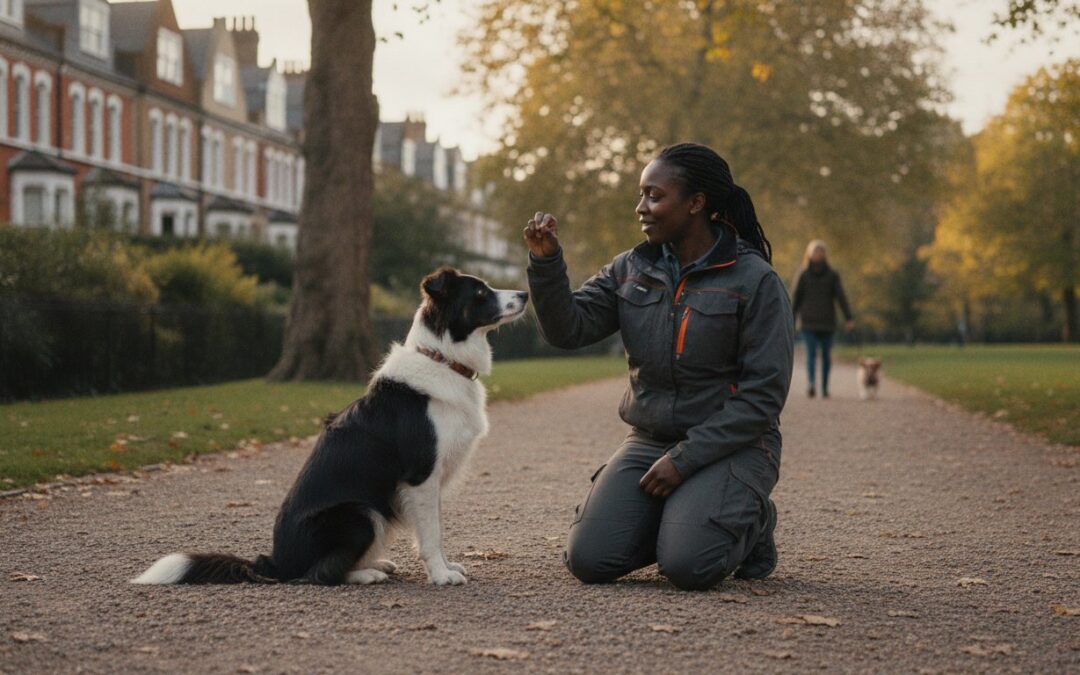
You’re walking through Gladstone Park, but your eyes aren’t on the greenery; they’re scanning every corner for an approaching lead or a dog appearing from behind a tree. This constant state of high alert is exhausting, yet for many owners seeking reactive dog training London services, it’s a daily reality. You likely feel a pang of social isolation when you have to turn back to avoid a confrontation, or perhaps you’re quietly worried about the legal implications of the Dangerous Dogs Act if a situation escalates. It’s a heavy burden to carry alone, and the emotional burnout is real.
We understand that your dog’s lunging and barking isn’t a character flaw, but a survival communication born from fear or frustration. You deserve to feel confident and calm on the streets of North West London again. This guide offers a compassionate, evidence-based approach to managing canine reactivity and restoring peace to your home. We will explore how bespoke 1-to-1 behavioural support can deconstruct these complex responses, moving away from stressful, forceful methods toward a partnership built on mutual trust and clear, non-coercive communication.
Key Takeaways
- Understand that reactivity is a spectrum of communication, and acknowledging your dog’s struggle is the first brave step toward a calmer life together.
- Learn to distinguish between fear-based and frustration-based reactivity to ensure your training plan addresses the specific emotional root of the behaviour.
- Discover why bespoke 1-to-1 reactive dog training London sessions are more effective than residential bootcamps by working in the real-world environments where triggers occur.
- Master immediate tactical walking techniques, such as using visual barriers, to safely navigate busy urban spaces like Gladstone or Cassiobury Park.
- Benefit from over 20 years of expertise to build a relationship based on mutual trust, moving away from quick fixes toward long-term emotional health.
Why searching for ‘reactive dog training London’ is a brave first step
Admitting that your dog is struggling in a city as fast-paced as London takes immense courage. Many owners carry a heavy weight of silent embarrassment when their dog lunges at a cyclist or barks at a neighbour in the lift. You might feel like you’ve failed, but the reality is that searching for reactive dog training London is a profound act of advocacy for your pet. This search marks the moment you stop simply managing the chaos and start seeking a solution that respects your dog’s emotional welfare. It is the first step toward reclaiming your peace of mind and your dog’s happiness in the capital.
Reactivity isn’t a single, defiant action; it is a spectrum of distance-increasing signals. It often begins with subtle signs like a fixed stare, a tensed jaw, or a low growl, eventually escalating to the vocal outbursts that make urban walks so stressful. By the time a dog is lunging on the lead, they are already past their emotional threshold. While these behaviours look intimidating, Understanding Dog Aggression provides essential context for why these defensive mechanisms exist. Most urban reactivity is a plea for space in a city that rarely offers it. Professional support helps you decode these signals before they reach a breaking point.
The myth of the “bad dog” in the city
High-density living in boroughs like Brent or Camden places unique pressures on our canine companions. Narrow Victorian pavements, crowded tube stations, and the constant hum of traffic can keep a dog in a state of hyper-arousal. It is easy to label a dog as “bad,” but this is a damaging myth. These behaviours are often natural instincts amplified by an environment they weren’t evolutionary designed for. Modern behavioural modification isn’t about suppression; it’s about teaching your dog that the world isn’t as threatening as it seems. Even if you didn’t have the chance to implement puppy training in London during those early months, it is never too late to reshape their emotional responses through patient, ethical guidance.
Reactivity as communication
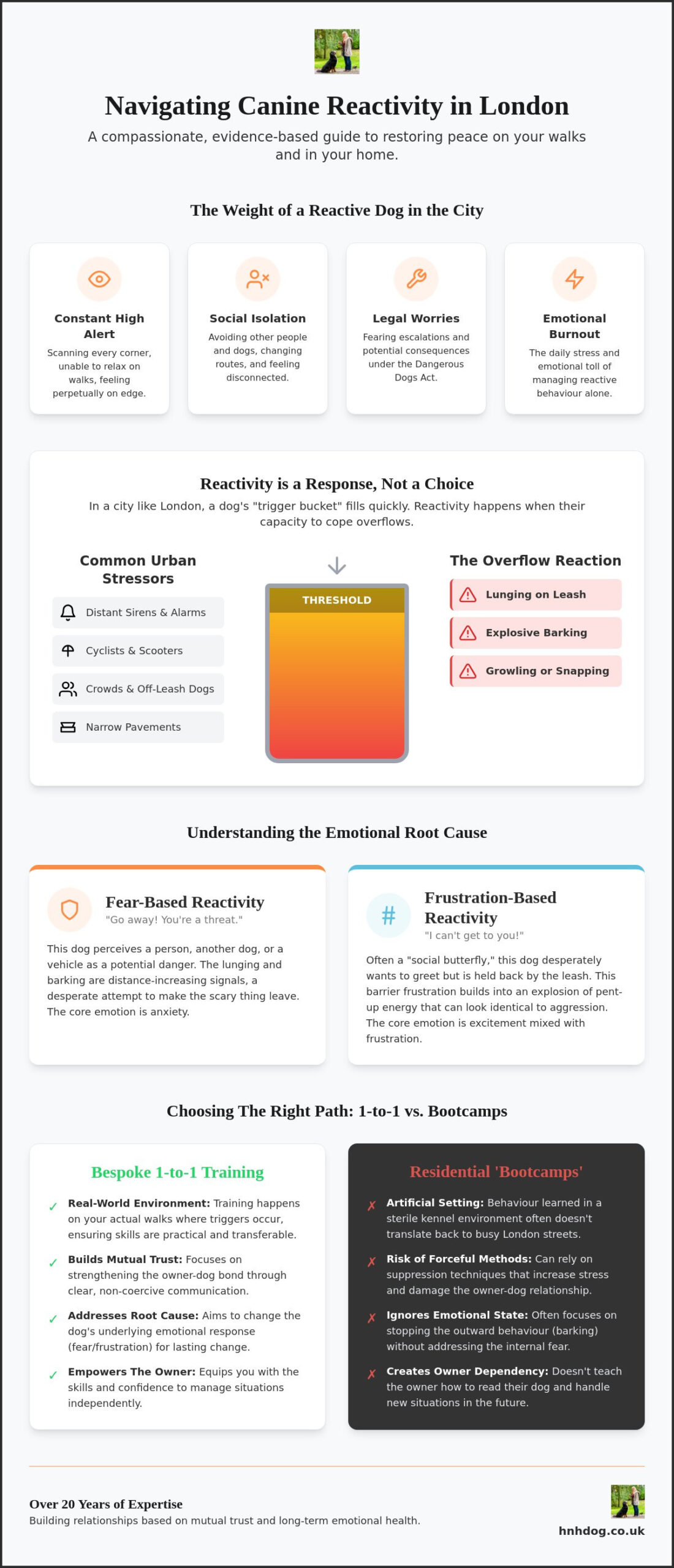
Think of your dog’s tolerance as a “trigger bucket.” Every distant siren, every fox scent, and every boisterous off-lead dog in Gladstone Park adds a drop to that bucket. In a city like London, that bucket fills incredibly quickly. Reactivity is an involuntary emotional response to perceived threats, where the dog’s nervous system takes over. They aren’t “acting out” to be difficult; they are crying for help because they no longer feel safe in their surroundings. Effective reactive dog training London focuses on emptying that bucket and building the resilience your dog needs to navigate urban life with calm confidence. By addressing the internal emotional state rather than just the outward action, we create lasting change that survives the bustle of the city.
Understanding the roots of canine reactivity in London
To effectively address canine reactivity, we must first understand that it is rarely a choice made by the dog. Instead, it is an physiological response to an environment that feels overwhelming. In busy London boroughs, the most common root is fear-based reactivity. This occurs when a dog perceives a person, another dog, or a vehicle as a threat and uses distance-increasing signals, like barking or lunging, to drive that threat away. For these dogs, the urban landscape is a series of obstacles they must survive rather than enjoy.
Conversely, some dogs experience frustration-based reactivity. These are often the “social butterflies” who desperately want to greet every passerby but are restricted by the lead. This barrier prevents natural movement and communication, leading to an explosion of pent-up energy that looks identical to aggression. Whether driven by fear or frustration, reactive dog training London owners must navigate the unique challenges of our city, such as narrow North London pavements that offer no “buffer zone” between dogs. While genetics play a role in a dog’s baseline temperament, the relentless stimulus of urban noise pollution, from sirens to delivery bikes, significantly lowers a dog’s threshold for tolerance.
The science of the stress response
When your dog sees a trigger, their brain enters a “Fight, Flight, or Freeze” state. In a city context, the “Flight” option is removed by the lead, leaving “Fight” as the only perceived way to stay safe. This surge of adrenaline and cortisol doesn’t vanish the moment the trigger passes. Cortisol can remain in a dog’s system for days, making them more likely to react to minor incidents later in the week. Using punishment-based methods in these moments is counterproductive. These tactics might suppress the outward barking, but they worsen the internal fear, essentially creating a “pressure cooker” effect. Our behavioural consultations focus on changing this internal emotional state rather than just masking the symptoms.
Common urban triggers
London’s infrastructure often works against a reactive dog’s needs. High-density dog populations in areas like Watford and North West London mean that a simple walk to the park can involve dozens of high-stakes encounters. Specific urban challenges include:
- Crowded Pavements: The lack of space makes it impossible for dogs to use natural “curving” body language to show they are non-threatening.
- On-Lead Restrictions: Leads can transmit owner tension and prevent dogs from communicating effectively, often leading to misunderstood intentions.
- Sensory Overload: Constant auditory and visual stimuli from the city can lead to “trigger stacking,” where a dog finally snaps after a series of small, stressful events.
Implementing practical management for leash-reactive dogs is essential in these high-pressure environments. By understanding the “why” behind the bark, we can begin to build a bespoke plan that respects your dog’s limits while gradually expanding their comfort zone in the heart of the city.
One-to-one training vs. residential ‘bootcamps’: Choosing the right path
When your dog lunges at a cyclist in Brent or barks at a delivery van in Watford, it’s tempting to look for a quick fix. Residential “bootcamps” often promise a transformed dog in two weeks by taking them away to a remote facility. However, reactivity is deeply contextual. A dog might behave perfectly in a quiet rural kennel with a professional handler, but those results often vanish the moment they return to the high-pressure environment of the city. Effective reactive dog training London requires working in the exact locations where the stress occurs. If the problem happens on the narrow pavements of North West London, that’s exactly where the training should take place.
Success in behavioural modification relies on the bond between you and your dog. Reactivity is fundamentally an issue of safety and trust. If a stranger “fixes” the dog, the dog hasn’t learned to trust you as their guardian and guide. For long-term success, you must be the one who understands how to read their body language and de-escalate a situation before it peaks. Relying on a residential stay often bypasses this vital connection, leading to a difficult “handover” where the owner feels ill-equipped to maintain the new behaviours. Consulting the RSPCA’s guide to dog behaviour can help you understand these underlying emotional states before you commit to a training path.
The H&H Dog ethical framework
Our approach is built on partnership rather than dominance. We reject the outdated idea that you must “show the dog who’s boss.” Instead, we use evidence-based methodology that prioritises your dog’s emotional health. This involves teaching you to become a knowledgeable mentor for your pet. By focusing on mutual understanding, we ensure that the progress you make is sustainable. For those dealing with complex cases, our guide on working with a dog behaviourist in London offers deeper insight into how we support urban pups through bespoke care.
What to look for in a London trainer
Choosing a professional to handle your reactive dog is a significant decision. You need someone who understands the specific dynamics of local spaces like Gladstone or Cassiobury Park. Always verify that a trainer is fully insured and adheres to a modern, non-coercive ethical stance. A crucial question to ask is: “What happens when the dog gets it wrong?” If the answer involves physical correction or intimidation, it will likely damage your dog’s trust and worsen their reactivity. With over 20 years of industry experience, we provide the steady hand and bespoke 1-to-1 plans necessary to navigate reactive dog training London safely and effectively.
Practical management for reactive dogs on busy London streets
Living in London requires a set of “street smarts” that differ from rural dog ownership. While we work on the underlying emotional roots during our reactive dog training London sessions, your immediate priority is keeping your dog below their threshold. This starts with tactical environmental management. Use the city’s geography to your advantage. Large plane trees, red post boxes, and even parked vans serve as excellent visual barriers. If you see a trigger approaching on a narrow North London pavement, don’t wait for a reaction; step behind a car or into a shop doorway to break the line of sight.
Timing is also a powerful management tool. Many owners find success by identifying “quiet windows” for exercise. This might mean visiting Gladstone Park at dawn or taking a late-evening stroll through the residential streets of Watford when the density of other dogs is at its lowest. After these walks, your dog needs a dedicated “safe zone” at home. London is a sensory assault of sirens and delivery bikes, so providing a quiet, darkened space with a long-lasting chew helps their nervous system decompress and lowers their overall cortisol levels.
Tactical lead handling
Mastering a few specific cues can save a walk from spiralling into a stressful event. The “emergency U-turn” should be a fluid, rehearsed movement that allows you to change direction the moment you spot a potential conflict. Similarly, a “Find it” cue, where you scatter high-value treats on the ground, keeps your dog’s nose down and their focus away from a passing trigger. These techniques are especially vital in London flat blocks, where narrow hallways and lifts can feel like traps. If you’re faced with an off-lead dog approaching your on-lead pet, don’t be afraid to advocate loudly for your dog’s space; a firm “please keep your dog back, mine needs space” is often necessary for safety.
Muzzle training without the stigma
In a crowded city, a muzzle shouldn’t be viewed as a sign of a “dangerous” dog. Instead, it’s a tool of freedom and safety. It allows you to breathe more easily, knowing that an unexpected interaction won’t lead to a legal or physical crisis. Introduce the muzzle slowly at home using plenty of positive reinforcement so your dog associates it with treats and praise. A muzzled dog is a responsibly managed dog. By removing the fear of a bite, you can focus entirely on the training and communication that builds a better life for your urban pup.
If you’re feeling overwhelmed by the logistics of city walks, we can help you design a management plan that fits your specific neighbourhood. Book one of our 1-to-1 dog training sessions to start your journey toward calmer, more confident outings.
Bespoke 1-to-1 training with H&H Dog
With over 20 years of industry experience, H&H Dog has supported some of London’s most challenging and misunderstood dogs. We understand that every household is different, and a generic, one-size-fits-all approach simply cannot address the nuances of urban reactivity. Our specialised reactive dog training London services are designed to meet you exactly where you are. Whether you’re navigating the busy streets of Brent or the quieter residential corners of Watford, our team provides the professional authority and empathetic encouragement needed to navigate this journey safely.
Our role is to act as your knowledgeable mentor. We are as invested in your peace of mind as we are in your dog’s welfare. Reactivity often leaves owners feeling isolated, but you don’t have to manage this alone. We provide a steady hand and a clear, actionable path forward, ensuring that every challenge has a manageable, ethical solution. By focusing on long-term emotional health rather than quick, forceful fixes, we help you build a relationship based on mutual respect and trust.
The H&H 1-to-1 process
Every successful behavioural modification begins with a deep understanding of the individual dog. Our process starts with in-depth history taking and trigger mapping within your home. This allows us to observe your dog in their most comfortable environment before we slowly transition to real-world settings. We conduct practical sessions in the local parks and pavements where you walk every day, ensuring the skills you learn are directly applicable to your North West London lifestyle. For those who wish to build a broader foundation of urban skills, our guide to dog training in North London offers expert tips for raising a confident city dog.
Integrated care for the urban dog
We believe in a holistic perspective that values the entire life of the dog. The work we do in our 1-to-1 sessions often serves as a gateway to other essential services. By reducing your dog’s stress and improving their communication, we can help prepare them for future needs such as a Full Groom or Group Dog Walking. This integrated approach ensures that your pet care team is aligned on your dog’s specific emotional requirements. We aren’t just trainers; we are your local pet care experts, dedicated to fostering a shared, peaceful life between you and your canine companion.
You deserve to enjoy your walks again without the constant scanning and stress. Taking the first step toward professional support is an act of kindness for both you and your dog. Book a behavioural consultation today and discover how our bespoke, evidence-based methods can restore harmony to your London home.
Reclaim your peace on the streets of London
Reclaiming your peace of mind and your dog’s confidence is a journey that starts with understanding, not force. We’ve explored how reactivity is a vital form of communication and why working in the real-world environments of North West London is far more effective than distant residential programmes. By mastering tactical management and addressing the underlying emotional states, you can move away from the stress of constant scanning. You deserve a partnership built on mutual trust rather than fear.
With over 20 years of professional experience, H&H Dog provides the steady mentorship you need to navigate these urban challenges. Our bespoke plans are specifically tailored to the unique pressures of city life, ensuring your dog receives compassionate, non-coercive support. If you are ready to transform your walks, your search for reactive dog training London has led you to a manageable, ethical solution. Book a 1-to-1 Behavioural Consultation in London or Watford today. Improvement is a steady process, and we’re here to guide you every step of the way.
Frequently Asked Questions
Is my dog too old for reactive dog training?
No, dogs are capable of learning at any age. Neuroplasticity allows them to form new emotional associations throughout their lives. Senior dogs may take a little longer to process new information, but they can certainly benefit from a bespoke 1-to-1 plan. We adapt our pace to their physical comfort and cognitive needs, ensuring they feel safe and supported during every session.
Will my dog ever be able to go off-lead in a London park again?
While the ultimate goal is freedom, the answer depends on your dog’s individual progress and the specific environment. In high-density areas like North West London, safety must remain the priority. We focus on building a reliable “recall” and solid focus first. Many owners find that using a long-line lead provides the perfect balance of freedom and security while navigating busy urban spaces.
What is the difference between reactivity and aggression?
Reactivity is an overreaction to a stimulus. It’s often driven by fear or frustration. Aggression, however, is an intent to cause harm. A reactive dog may bark or lunge because they don’t know how else to handle big emotions. By identifying these triggers through reactive dog training London, we can address the underlying stress before it ever escalates into a truly aggressive encounter.
How much does reactive dog training cost in London?
Costs for professional behavioural support vary based on the complexity of the case and the level of expert guidance required. Investing in reactive dog training London ensures you receive a customised plan that addresses your specific urban challenges. We recommend checking our current service listings for the most accurate information regarding our behavioural consultations and training packages tailored to your needs.
Do you use shock collars or prong collars?
We never use shock, prong, or choke collars. These coercive tools rely on pain and fear to suppress behaviour. Our evidence-based methodology prioritises your dog’s emotional health and long-term welfare. We use supportive, non-aversive methods that build a partnership between you and your dog. This ethical approach ensures that your dog learns to trust you rather than simply fearing a punishment.
Can you help with reactivity towards bikes and delivery riders?
Yes, we specialise in de-sensitising dogs to common city triggers. These fast-moving objects often spark a dog’s predatory chase drive or a fear response. We work in real-world settings to help your dog remain calm as these stimuli pass. This practical training is essential for anyone living near busy London thoroughfares or high-traffic delivery zones.
How many sessions will my dog need to see progress?
Every dog is an individual, so the timeline depends on the severity of the reactivity and how long the behaviour has been practised. You’ll often see a shift in your own confidence after the first session. Lasting emotional change takes time and consistency. We provide ongoing mentorship to ensure you feel supported as your dog gradually builds their resilience.