
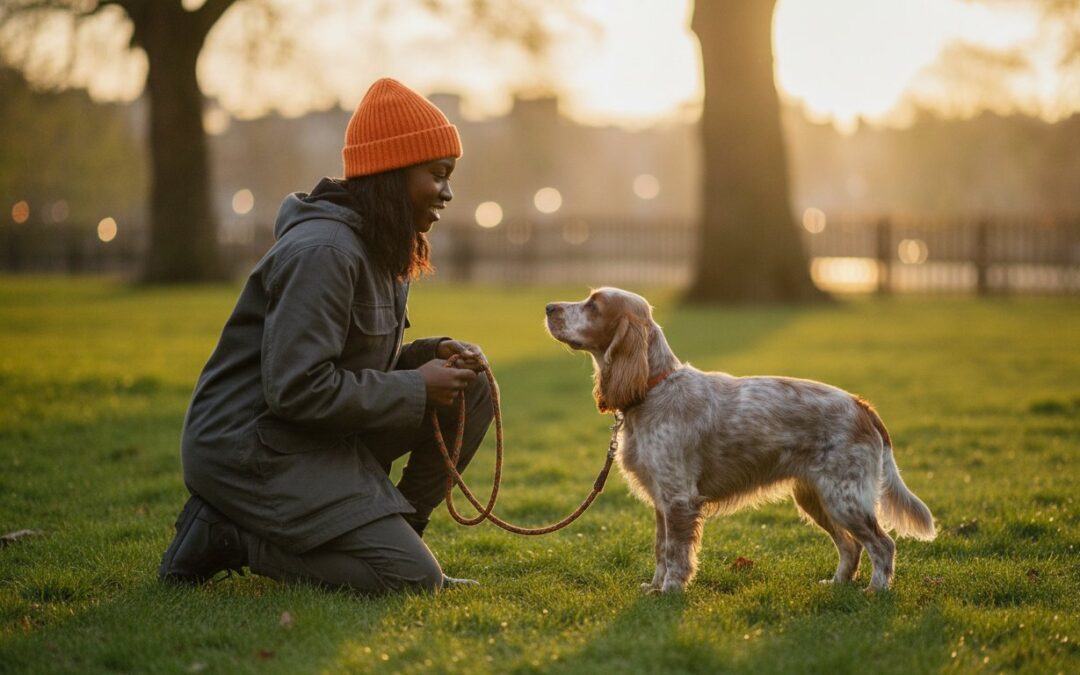
Imagine standing in a bustling North London park, calling your dog’s name with increasing desperation as they completely ignore you for a passing cyclist. It’s a sharp contrast to the “perfect puppy” you had just weeks ago. You aren’t alone in this frustration; research shows that by 21 months of age, 97% of dogs display at least one problem behaviour, with poor recall affecting over half of them. It’s natural to feel a sense of embarrassment or anxiety when your once-attentive companion suddenly seems reactive or distracted on crowded streets.
This shift isn’t a sign of a “bad dog” or a training failure, but a biological milestone. Through our specialised teenage dog regression training London owners trust, you’ll discover why your well-trained puppy is regressing and how our expert, evidence-based methods restore focus. Drawing on over 20 years of experience, we provide a clear, non-coercive path to reliable recall and calm walking. This article explains the science of the adolescent brain and previews the bespoke strategies we use to rebuild your bond and ensure your dog remains a confident city companion.
Key Takeaways
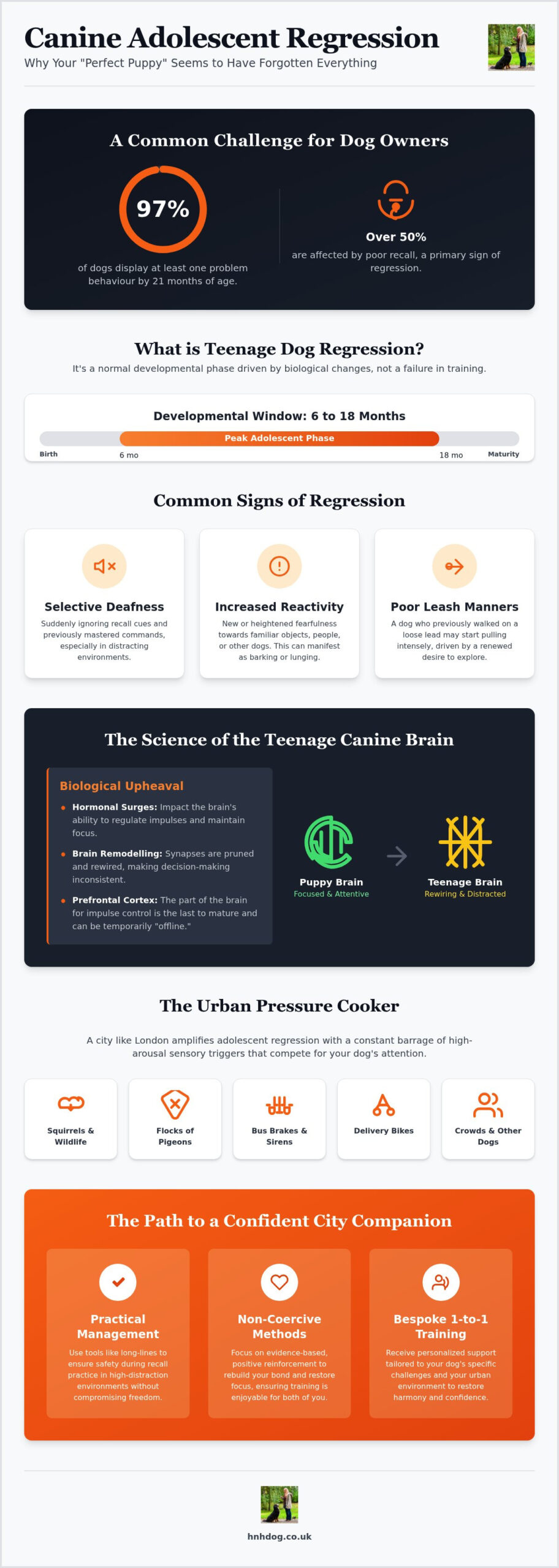
- Understand that adolescent regression is a normal developmental phase between 6 and 18 months, driven by significant biological rewiring rather than a loss of training.
- Discover how the unique sensory overload of the London urban environment can trigger impulsive behaviours and temporary lapses in focus.
- Learn about the late development of the canine prefrontal cortex and how this biological shift impacts your dog’s decision-making and impulse control.
- Master practical management strategies, such as using long-lines for recall, to navigate high-distraction environments without compromising your dog’s safety.
- Explore why bespoke 1-to-1 teenage dog regression training London provides the personalised, non-coercive support needed to restore harmony and strengthen your bond.
What is Teenage Dog Regression and Why Does it Happen?
If your once-attentive puppy has suddenly started ignoring your cues, you’re likely experiencing the onset of adolescent regression. This phase is characterized by a temporary decline in previously mastered behaviours, appearing as if your dog has simply “forgotten” everything you’ve taught them. This developmental window typically opens between 6 and 18 months of age. While it’s often a source of deep frustration for owners, it’s actually a vital sign of healthy neurological progress. For those seeking teenage dog regression training London, the first step is recognising that this isn’t a training failure, but a biological shift that requires a refined approach.
It’s easy to label this behaviour as “stubbornness” or “dominance,” but these outdated terms ignore the complex reality of the teenage canine. Your dog isn’t trying to challenge your authority; they’re simply struggling to process a world that has suddenly become much more stimulating. This period is entirely manageable with the right local support and a commitment to understanding your dog’s changing needs. We focus on providing a steady hand through this transition, ensuring you don’t feel like a failure as a dog owner while your pet navigates their path to maturity.
Common Signs of Adolescent Regression
The most frequent complaint we hear involves sudden “selective deafness” during walks in North London’s busy parks. You call, but your dog is far too occupied with a scent or another dog to acknowledge you. This regression often extends to their social interactions. You might notice increased reactivity or a new-found fearfulness toward familiar objects, like a parked scooter or a neighbour’s bin. Additionally, lead walking manners often deteriorate. A dog who previously walked on a loose lead may start pulling with renewed intensity, driven by a heightened desire to explore their environment at their own pace.
Why Puppies “Forget” Their Training
The shift from a dependent puppy to an independent adolescent is driven by significant hormonal changes. These surges directly impact the brain’s ability to regulate impulses and maintain focus. It’s during this time that dog behavior undergoes a profound “remodelling” process. Synapses are being pruned and rewired, often leaving the parts of the brain responsible for decision-making temporarily offline.
This biological upheaval coincides with the return of “fear periods.” An adolescent dog may suddenly find the world overwhelming again, causing them to retreat into defensive or avoidant behaviours. The drive to seek safety from you is replaced by a biological urge to explore and establish independence. Understanding this motivation helps you stay patient. They aren’t choosing to ignore you; they’re simply prioritising the massive influx of sensory information their changing brain is now receiving.
Navigating Adolescence in the London Urban Environment
London presents a unique set of challenges that can amplify the effects of adolescent regression. While a dog in a rural setting might simply ignore a recall cue in an empty field, a London dog faces a constant barrage of sensory input that competes for their attention. This environment acts as a pressure cooker for the hormonal and brain changes occurring during this phase. Suddenly, the skills you built in a quiet living room or a fenced garden seem to evaporate the moment you step onto a busy high street. It’s a common experience, but one that requires a specific urban strategy.
Many owners encounter what we call the “Hampstead Heath Effect.” You arrive at one of London’s vast green spaces expecting a relaxing walk, only to find your dog’s ears have stopped working the moment they’re off-lead. The sheer scale of these parks, combined with the presence of hundreds of other dogs and people, is often too much for a regressing brain to handle. This is why specialized dog training in North London is essential. It focuses on building reliability where it matters most: in the heart of the city.
London Distractions: More Than Just Other Dogs
The city is a theatre of high-arousal triggers. For a teenage dog, a squirrel darting across a path in Highgate Woods or a flock of pigeons in a local square can trigger an intense prey drive that overrides any previous training. Beyond wildlife, the urban soundscape is relentless. The hiss of bus brakes, the wail of sirens, and the erratic movement of delivery bikes all demand a dog’s attention. There’s also the social pressure of navigating narrow North West London pavements. Passing another dog or a group of commuters within inches requires a level of impulse control that many adolescents haven’t yet solidified.
The Importance of Urban Proofing
Training “proofing” is the process of practicing behaviours in increasingly distracting environments. A common mistake is assuming that a “sit” in the kitchen translates to a “sit” at a busy cafe in Camden. It rarely does. Effective teenage dog regression training London requires gradual, structured exposure to the city’s infrastructure. This includes controlled visits to the London Underground or overground stations during quieter periods to build confidence without overwhelm.
We recommend using local green spaces for focused, long-line training sessions. This allows your dog a sense of freedom while ensuring they cannot self-reward by ignoring your recall. Consistency in these environments is the only way to bridge the gap between “puppy school” and real-world reliability. If you’re finding these urban challenges overwhelming, a 1-to-1 training session can provide the bespoke roadmap you need to regain control and safety on London’s busy streets.
The Science of the Teenage Canine Brain
To effectively manage this phase, you must first understand the biological upheaval occurring within your dog’s head. The adolescent period is marked by a significant “remodelling” of the brain. During this time, the brain undergoes synaptic pruning, where unused connections are cleared away to make room for more efficient pathways. However, the prefrontal cortex, the area responsible for impulse control and complex decision-making, is the last part to fully develop. This means that while your dog’s body is maturing, their internal “brakes” aren’t yet fully functional. For owners navigating teenage dog regression training London, this explains why a dog might suddenly act before thinking, especially in high-arousal city environments.
This neurological transition is backed by rigorous evidence. A landmark Newcastle University study on adolescent dogs confirmed that dogs exhibit a distinct “difficult” phase during puberty, showing reduced obedience to their primary caregivers. This shift is driven by fluctuating dopamine levels that make your dog far more impulsive and reward-seeking than they were as a puppy. While a young puppy is safety-oriented and stays close for protection, the teenage brain is biologically wired for exploration and novelty. They aren’t being difficult; they’re following a primitive urge to test their environment and establish independence.
Hormones and Emotional Regulation
The surge of testosterone and oestrogen does more than just change social interests; it fundamentally alters emotional regulation. You might notice your dog becomes “over-threshold” much faster than before. This is partly because cortisol, the stress hormone, often takes longer to clear from an adolescent dog’s system. In a high-stimulus setting like a North West London high street, these stressors can “stack,” leaving your dog in a state of constant physiological arousal. When their system is flooded with these chemicals, their ability to listen to a “sit” or “stay” cue is severely compromised by their internal state.
Removing the “Stubborn” Label
It’s vital to move away from adversarial language. Terms like “dominant” or “stubborn” are scientifically inaccurate and unhelpful for building a partnership. Instead of viewing your dog as working against you, try to see them as struggling with themselves. Their brain is essentially under construction, and the wiring required for consistent responses is currently being re-routed. Brain rewiring makes consistent responses physically harder for the dog. By adopting this perspective, you can replace frustration with the patient, structured guidance they need to navigate this temporary biological chaos.
Proven Training Strategies for Regressive Behaviour
Once you understand the biological drivers behind your dog’s sudden change in behaviour, the focus must shift toward practical management. It’s vital to prioritise management over “testing” your dog in high-stress situations. If you repeatedly call your dog in a busy park when you know they’re unlikely to respond, you’re inadvertently teaching them that your cues are optional. To break this cycle, re-introduce a long-line for recall. This simple tool prevents your dog from being “rewarded” by the act of ignoring you, ensuring you maintain a safety net while their brain continues to develop. This structured approach is a cornerstone of effective teenage dog regression training London owners use to regain control.
Instead of drilling static obedience commands like “stay” or “heel,” which can be physically taxing for an impulsive adolescent brain, focus on engagement games. These activities build a desire to check in with you rather than just reacting to the environment. It’s often necessary for puppy training foundations to be revisited with fresh eyes. By returning to these core principles, you aren’t admitting defeat; you’re providing the scaffolding your dog needs to navigate their temporary neurological chaos.
Back to Basics: Re-Teaching the Foundation
Success in a high-distraction city environment requires you to lower your criteria. If your dog cannot focus in a local park, move your training back to the living room or a quiet garden. You must ensure the behaviour is solid in a low-distraction setting before adding the complexity of London’s streets. Use high-value rewards, such as real meat or cheese, to compete with the intense sensory input of the city. Keep your training sessions short and frequent. Five minutes of focused engagement is far more productive than a thirty-minute session that exhausts your dog’s limited attention span.
Building Focus Amidst London Chaos
Building eye contact is a vital safety skill, especially near busy roads. Implementing a “Watch Me” command helps your dog learn to look to you for guidance when they feel overwhelmed by traffic or crowds. In London’s green spaces, try scatter feeding. By dropping treats into the grass for your dog to find, you encourage sniffing, which is a natural way to lower their arousal levels and heart rate. We also recommend the “10-foot rule” for passing other dogs. Maintaining this distance on North West London pavements prevents your adolescent from reaching their emotional threshold, making calm greetings much more achievable. If you’re finding it difficult to manage these urban triggers, our 1-to-1 training sessions provide the bespoke, hands-on support needed to restore your dog’s focus.
Bespoke Adolescent Training with H&H Dog
While group classes are an excellent starting point for young puppies, they often prove overwhelming for a dog navigating the height of adolescent regression. In a room full of other high-energy teenagers, your dog’s ability to focus is compromised by a surge of social pressure and sensory input. This is why 1-to-1 teenage dog regression training London is the most effective way to address these specific challenges. By working in your dog’s actual environment, whether that’s the streets of North West London or your local park, we can address behaviours exactly where they occur. This personalised approach ensures that training is tailored to your dog’s unique temperament rather than a generic curriculum.
At H&H Dog, we bring over 20 years of industry experience to every session. We understand that adolescence isn’t just about “bad manners”; it’s often a period of significant emotional shifting. For dogs experiencing deeper levels of fear or reactivity during this phase, our dog behaviourist services provide the specialist support needed to manage urban anxieties. We don’t believe in forceful corrections. Instead, we use evidence-based, non-coercive methods that respect your dog’s emotional state while providing you with the steady hand needed to navigate this often stressful transition.
Personalised Training Plans
Every London neighbourhood has its own set of triggers. A dog living near the constant buzz of Camden requires a different strategy than one frequenting the quieter residential streets of Watford. We begin by assessing these specific environmental factors to create a plan that fits your urban lifestyle. These customised schedules are designed to be manageable for busy owners, focusing on quality of engagement over hours of repetitive drills. Our priority is restoring the bond between you and your dog, ensuring that communication remains clear even when the environment is chaotic.
Why Choose H&H Dog in London?
Our local expertise in North London park dynamics and street etiquette allows us to provide practical, real-world advice. We know the specific challenges of keeping a teenage dog focused near Highgate Woods or navigating the narrow pavements of Belsize Park. Beyond 1-to-1 sessions, we offer group dog walking as a structured way to maintain your dog’s social skills. These walks are conducted in a controlled environment, ensuring your teenager learns to be around other dogs without the high-arousal “free-for-all” found in many public spaces.
Choosing H&H Dog means opting for a modern, holistic perspective that values long-term emotional health. We provide the ongoing support necessary to ensure you move through the adolescent phase with a confident, well-adjusted adult dog. Improvement is inevitable with the right guidance. By adopting your dog’s perspective and fostering a shared life based on mutual respect, you can turn these challenging months into a foundation for a lifetime of harmony.
Reclaim Harmony with Your Adolescent Dog
The adolescent phase represents a temporary but significant shift in your dog’s neurological development. By understanding that regression is a biological necessity rather than a sign of stubbornness, you can replace frustration with a structured, empathetic approach. Success in the city depends on moving from simple obedience to emotional regulation, ensuring your dog can process the unique sensory demands of the London environment without becoming overwhelmed.
Our teenage dog regression training London provides the bespoke intervention needed to restore focus and safety. With over 20 years of experience serving North and North West London communities, we use evidence-based, non-coercive methods to help you and your dog thrive. Every challenge has a manageable solution when you have the right mentorship and a commitment to your dog’s long-term welfare.
Book a Bespoke 1-to-1 Training Session for Your Teenage Dog
You aren’t alone in this journey. This phase is a bridge to a lifetime of partnership, and with patient, expert guidance, you’ll emerge with a resilient and well-adjusted companion by your side.
Frequently Asked Questions
Is teenage dog regression permanent or just a phase?
Adolescent regression is a temporary biological phase, not a permanent change in your dog’s personality. While it feels like they’ve forgotten their manners, the neural pathways for those behaviours are simply being remodelled. With patience and consistent management, your dog will emerge from this period as a reliable adult. It’s a developmental milestone that requires a steady hand rather than frustration.
Why does my dog listen at home but ignore me in the park?
Dogs struggle to generalise behaviours across different environments, especially during adolescence. Your home is a low-stimulus space where focus is easy to maintain. A London park is a theatre of competing scents, sounds, and social triggers. Your teenager’s brain is currently wired to prioritise this novelty, making the “cost” of listening to you feel much higher than the reward of exploring.
Should I stop taking my teenage dog to busy London parks if they are acting out?
You don’t need to avoid parks entirely, but you should manage the level of stimulation to match your dog’s current threshold. If a busy park causes your dog to go over-threshold, try visiting during quieter hours or staying in less crowded corners. Using a long-line ensures safety while allowing them to exist in these spaces without rehearsing unwanted behaviours like bolting or ignoring recall.
Can a dog behaviourist help with adolescent regression in London?
A professional behaviourist is invaluable for differentiating between normal teenage antics and developing anxiety or reactivity. Expert teenage dog regression training London services provide bespoke strategies that address the root cause of these shifts. If your dog’s behaviour feels driven by fear rather than just distraction, a one-to-one consultation offers the targeted support needed to prevent long-term issues.
How long does the teenage regression phase usually last?
The most intense period of regression typically occurs between 6 and 18 months of age. However, some larger breeds may continue to show adolescent traits until they reach 24 months. The duration of this phase depends on your dog’s individual development and the consistency of your teenage dog regression training London. Staying patient and maintaining clear boundaries helps this transition pass more smoothly.
Is it too late to start training if my dog is already 12 months old?
It’s never too late to begin or revisit training with your dog. At 12 months, your dog’s brain is still highly plastic and receptive to positive reinforcement. In many ways, this is a critical time to solidify boundaries and re-teach foundation skills. Starting now ensures that temporary regressive behaviours don’t turn into permanent adult habits as your dog matures.
How does group dog walking help an adolescent dog going through regression?
Structured group dog walking teaches your adolescent dog the vital skill of being neutral around others. Unlike the chaotic play often found in public parks, professional walking provides a calm, managed social experience. This helps lower their arousal levels and prevents them from becoming over-excited or reactive when they see other dogs on busy city pavements or narrow North West London streets.
What are the best high-value treats for training a teenage dog in London?
High-value rewards must be moist, smelly, and rare to compete with intense city distractions. Boiled chicken, small cubes of cheddar, or dried sprats are excellent choices for urban training sessions. These “premium” rewards provide the necessary motivation for your dog to choose you over a darting squirrel or a passing cyclist during your walks in the park.